Source: reinsurancene.ws
Why it matters: Duck Creek’s appointments follow its acquisition of Send Technology Solutions and bring underwriting and EMEA leadership changes relevant to insurance technology providers and users.
- Andy Moss, Send’s co-founder and former CEO, was named GM of Underwriting and will continue to oversee Send product, technology and customer operations.
- Moss will report to Duck Creek CEO Hardeep Gulati and help develop the company’s underwriting strategy.
- Lloyd Peters was appointed Vice President and GM for EMEA; the excerpt does not provide further detail on his remit.
Source: reinsurancene.ws
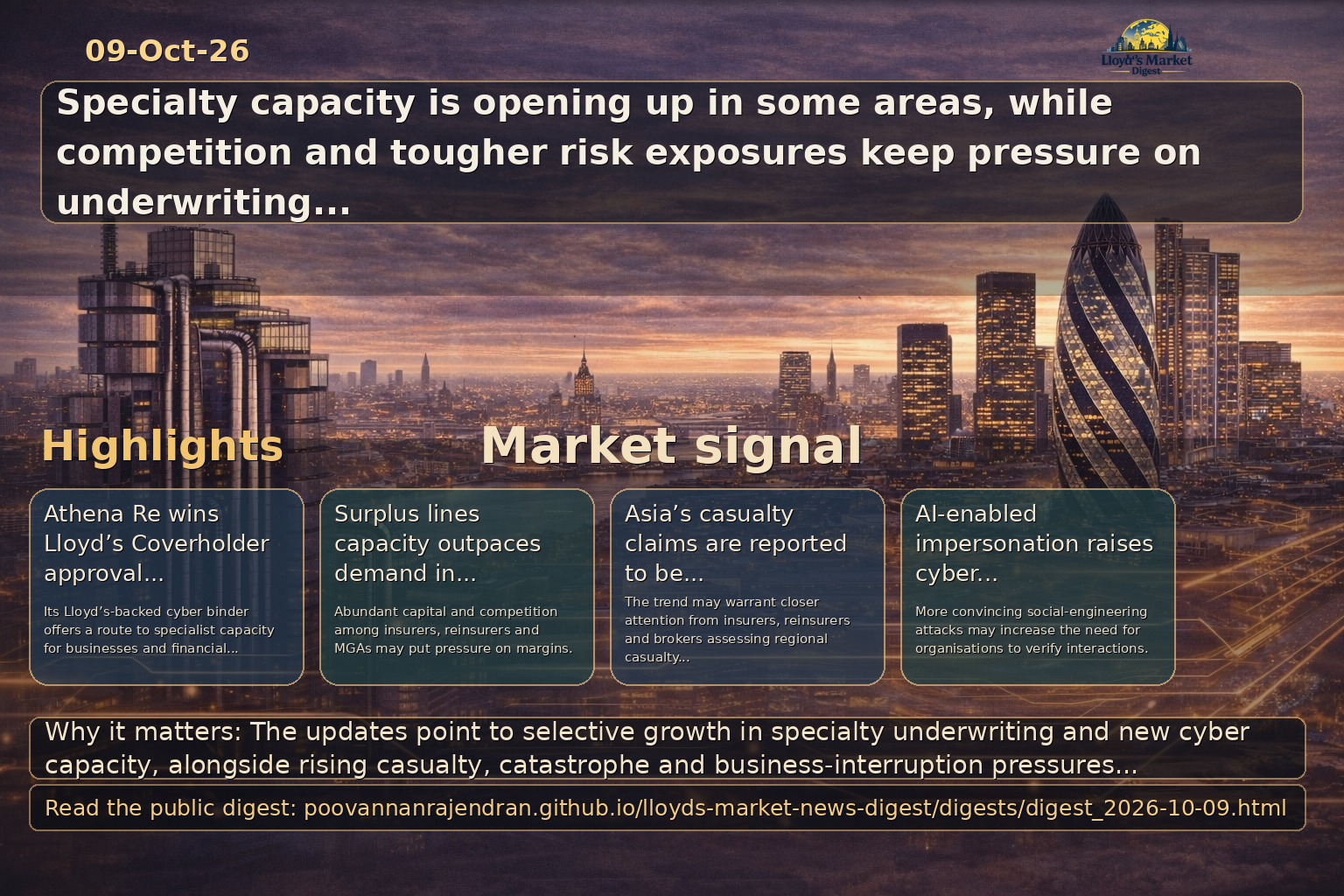
Why it matters: Athena Re’s Lloyd’s Coverholder approval creates a stated route for Lloyd’s-backed cyber capacity to reach businesses and financial institutions in emerging markets.
- The London-domiciled MGA will operate a flagship cyber insurance binder backed by A+ rated Lloyd’s capacity.
- Athena Re says the offering targets specialist cyber risks and the evolving needs of businesses and financial institutions across emerging markets.
- The MGA expects to expand into additional product lines, but no timing or further lines are specified in the excerpt.
Source: fca.org.uk
Why it matters: The FCA’s changes to long-term investment fund withdrawal terms are a relevant asset-management development for executives monitoring private-market investment structures, although the excerpt does not indicate direct insurance-sector effects.
- Investors in the funds covered by the new rules will have to give 90 days’ notice to access their money.
- The FCA says the rules are intended to clarify withdrawal timing and improve certainty for investors.
- The excerpt refers to investments such as property and does not specify the full scope or implementation date.
Source: fca.org.uk
Why it matters: The FCA’s review of compliance functions in corporate finance firms is relevant to wholesale-market governance, though the supplied detail does not connect the findings to insurance firms.
- The FCA surveyed 411 corporate finance firms and received 382 responses.
- Most firms reported carrying out key compliance activities, while the FCA also identified areas needing improvement.
- The FCA emphasises that there is no single blueprint for effective compliance and highlights firms’ ability to challenge the business.
Source: fca.org.uk
Why it matters: The FCA warning is relevant to UK market due diligence, but the excerpt provides no evidence linking the firm to insurance or the Lloyd’s market.
- The FCA says Shellnovatrade is not authorised by it and may be targeting people in the UK.
- The FCA advises the public to avoid dealing with the firm and beware of scams.
- The excerpt says customers would not have access to the Financial Ombudsman Service or FSCS protection if they dealt with the firm.
Source: fca.org.uk
Why it matters: The FCA warning may be relevant to counterparty and conduct screening, but no insurance-sector connection is stated in the supplied excerpt.
- The FCA says Huron Financial Group LLC is not authorised by it and may be targeting people in the UK.
- The FCA advises people to avoid dealing with the firm and be alert to scams.
- The excerpt says dealings with the firm would not be covered by the Financial Ombudsman Service or FSCS protections.
Source: fca.org.uk
Why it matters: The FCA warning is a UK financial-services due-diligence signal; the supplied information does not identify any relationship to insurance.
- The FCA says Motion Capital Ltd is not authorised by it and may be targeting people in the UK.
- The FCA advises the public to avoid dealing with the firm and beware of scams.
- The excerpt says customers would not have access to the Financial Ombudsman Service or FSCS protection if they dealt with the firm.
Source: artemis.bm
Why it matters: The report highlights a possible squeeze in catastrophe-bond and ILS economics as the global reinsurance market softens, relevant to capital providers and specialty market participants.
- Moody’s says changing reinsurance-cycle conditions affect catastrophe-bond and ILS economics and investor appetite.
- The excerpt describes more risk being assumed for less return as the market softens.
- Moody’s sees no cause for concern at this stage if ILS managers maintain discipline; further report detail is not provided.
Source: businessinsurance.com
Why it matters: Awbury’s reported move into Japan’s credit insurance market is a relevant specialty-market development. The available excerpt contains only the headline, limiting assessment of its scale and execution.
- The title reports that Awbury is entering Japan’s credit insurance market.
- The excerpt does not specify products, underwriting capacity, partners or launch timing.
- The move could indicate an opportunity for additional specialty credit insurance capacity, but the source detail is insufficient to assess market impact.
Source: businessinsurance.com
Why it matters: The reported rise in the frequency and cost of casualty claims in Asia is relevant to insurers, reinsurers and brokers assessing regional casualty exposure. The excerpt provides no supporting figures or analysis.
- The title attributes the observation to Marsh Re.
- It reports that casualty claims in Asia are now more frequent and costly.
- The excerpt does not identify affected markets, claim drivers, lines of business or quantified changes.
Source: businessinsurance.com
Why it matters: Markel has introduced property cover for chemical, oil and gas risks, a relevant specialty-market product development.
- The title identifies chemical, oil and gas property cover.
- The excerpt does not specify coverage terms, capacity or target clients.
- The product may be relevant to brokers assessing options for industrial property risks; further details are unavailable.
Source: businessinsurance.com
Why it matters: An Allianz report is described as showing a rise in business interruption claims, a potentially material concern for commercial insurers and insureds.
- The title reports that business interruption claims have soared, citing an Allianz report.
- The excerpt provides no figures, period, causes or geographic scope.
- The headline may warrant attention from property and specialty market participants, but the underlying evidence is not supplied.
Source: businessinsurance.com
Why it matters: Multinationals are reported to be considering increased risk spending to address multiple threats, which may affect demand for risk advice and insurance.
- The title describes multinationals eyeing higher risk spending.
- The threats, intended spending and insurance implications are not detailed in the excerpt.
- Any effect on placement demand or coverage remains uncertain.
Source: destination.insurancetimes.co.uk
Why it matters: The event’s agenda addresses workforce issues that may be relevant to insurers, brokers and other market participants; the excerpt does not identify specific Lloyd’s initiatives or outcomes.
- Destination Insurance is scheduled for 28 January 2027 at The Minster Building, London.
- The programme will explore pathways into insurance for career changers, veterans, public service professionals, apprentices and future industry leaders.
- Listed topics include AI, skills gaps, workplace expectations, first-time management, diversity, retention and data-led talent strategy.
Source: globalreinsurance.com
Why it matters: The report highlights a regional capacity shortfall alongside strong underwriting performance, relevant to insurers and reinsurers assessing specialty capacity and market conditions in sub-Saharan Africa.
- AM Best said sub-Saharan African reinsurers maintained robust underwriting results in 2025, supported by stricter risk selection and pricing action on loss-affected accounts.
- Capital buffers have strengthened in recent years, and the sector recorded a third consecutive year of double-digit return on equity, helped by favourable interest rates.
- Africa-domiciled reinsurance capacity remains insufficient to meet regional demand; the excerpt does not quantify the gap or detail specific lines of business.
Source: insurancejournal.com
Why it matters: Potential hurricane exposure to offshore energy assets is relevant to energy underwriters and specialty-market risk monitoring, although the excerpt reports preparations and forecasts, not insured losses.
- Producers had shut in roughly 25% of crude output and 16% of natural-gas production by Wednesday afternoon.
- Wells were being shut in and personnel evacuated from rigs and platforms ahead of the storm.
- Forecasters expected the storm to track east of major Louisiana and Texas energy assets, but a westward shift could bring more infrastructure into its path.
Source: insurancejournal.com
Why it matters: The reported rise in AI-enabled impersonation and social engineering is relevant to cyber insurers and organizations assessing evolving exposure; the excerpt does not quantify insured losses.
- Experian's 2027 breach forecast calls for greater verification as AI blurs the distinction between authentic and synthetic interactions.
- The report says cybercriminals are using AI to improve social-engineering attacks.
- Organizations are also deploying AI across customer service, operations and business processes, widening the range of interactions requiring verification.
Source: insurancejournal.com
Why it matters: A reported attack that disrupted a major data-centre site highlights a potential accumulation and business-interruption consideration for cyber and property markets, but the excerpt gives no loss estimate.
- Yandex said a drone attack caused a fire and forced it to suspend operations at its Sasovo data-centre site.
- The site is one of the company's five large data centres and hosts tens of thousands of servers.
- The excerpt describes the event as the first major attack on a Russian data hub since the start of the war with Ukraine.
Source: insurancejournal.com
Why it matters: The viewpoint's account of an increasingly fragmented insurance supply chain is relevant to carriers, brokers, underwriters and capital providers evaluating operating models; it is an argument rather than a report of a confirmed market outcome.
- The article describes a chain linking retail agents, wholesale brokers, underwriters, carriers, reinsurers and, increasingly, pension funds or credit managers.
- It contrasts this with the historical model in which one carrier underwrote, issued policies, paid claims, held data and supplied capital.
- The title frames AI as a factor in the emergence of an unbundled insurer, but the excerpt provides limited detail on specific platforms or business changes.
Source: insurancejournal.com
Why it matters: This is directly relevant to specialty and surplus-lines market conditions, including capacity, delegated underwriting and competitive pressure on margins.
- AM Best reported abundant capital and heightened competition among insurers, reinsurers and managing general agents.
- The excerpt says capacity from insurers, reinsurers and delegated underwriting enterprises is outpacing demand in some areas and pressuring margins.
- Supply-demand differences across lines and risk classes are creating micro-market conditions; the article title says market leaders remain bullish, but the excerpt provides limited detail on their outlook.
Source: insurancetimes.co.uk
Why it matters: A new global bloodstock portfolio represents a specific specialty-capacity development, led by an underwriter with prior Lloyd’s committee and portfolio experience.
- The MGA, part of MNK Group, appointed David Higgins to establish and lead the portfolio.
- The cover targets high-value horses and ownership risks including injury, theft and death, rather than standard veterinary care.
- The excerpt does not specify launch timing, capacity, distribution arrangements or underwriting appetite.
Source: insurancetimes.co.uk
Why it matters: The reported Asos breach underscores cyber exposure beyond customer-data access and keeps prevention and resilience in focus for cyber insurers and brokers.
- The excerpt says attackers appeared to access systems beyond customer databases and send ransom-demand notifications to thousands of customers.
- Experts cited in the article warn of potentially lasting financial and reputational consequences; the full impact is not provided.
- Tokio Marine Kiln’s cyber analyst comments on the incident, but the excerpt does not report a confirmed cause or insurance outcome.
Source: insurancetimes.co.uk
Why it matters: The discussion points to a possible role for insurers’ data in supporting risk-management decisions beyond risk transfer.
- Sompo Group international markets chief executive Alessa Quane described insurers’ client data as a significant opportunity for risk managers.
- The excerpt identifies unstructured claims data as a potential source of foresight and frames partnership as important in an interconnected risk landscape.
- The comments were made at FERMA Forum 2026; the excerpt does not detail specific tools, deployments or measurable results.
Source: insurancetimes.co.uk
Why it matters: Broker talent pipelines are a material distribution issue, particularly for regional firms with limited training resources.
- The excerpt cites 2024 research in which 50% of 250 UK brokers said they struggled to recruit people aged 30 and under.
- It also says 55% of those brokers had training programmes to support young brokers.
- Aviva says it is seeking to re-seed talent and experience through its broker programmes; the excerpt cuts off before giving further survey findings or programme detail.
Source: insurancetimes.co.uk
Why it matters: The webinar describes placement practices aimed at reducing friction and improving access to underwriting decisions for brokers.
- Zurich’s session covered trading propositions, responsive support and underwriting relationships.
- Topics included reducing referral friction, improving submission quality and accessing support to help secure quicker decisions.
- The excerpt references Zurich Online, Club Blue and Sapphire, but provides no performance data or independent assessment.
Source: reinsurancene.ws
Why it matters: Moody’s outlook highlights the tension between resilient UK insurance revenues and pressure on underwriting profitability, relevant to pricing and portfolio planning.
- Moody’s expects the UK life and P&C sectors to remain stable, supported by investment yields, pension savings and demand for compulsory insurance.
- Economic uncertainty, weaker pricing and rising claims costs are identified as profitability pressures.
- The excerpt says recent reserve releases, favourable weather and lower reinsurance costs supported P&C earnings, while price declines may weigh more heavily on margins during 2027.
Source: reinsurancene.ws
Why it matters: The reported Canadian catastrophe estimates illustrate substantial net losses for P&C insurers and renewed severe-weather exposure.
- Intact estimated Q3 2026 catastrophe losses of approximately $660 million, pre-tax and net of reinsurance.
- Its estimate includes $390 million in Personal Property losses and $173 million in Commercial lines.
- Intact attributed losses in the most impacted lines to severe weather, including flooding, water and wind damage, and wildfires in British Columbia.
Source: reinsurancene.ws
Why it matters: The initial insured-loss estimate adds evidence of material catastrophe activity in Canada; the excerpt does not provide exposure or reinsurance details.
- CatIQ estimated insured losses of CAD 563 million from a severe storm outbreak in southern Ontario on 2 and 3 September 2026.
- The reported hazards included large hail, damaging winds, torrential rain, confirmed tornadoes and downbursts.
- Toronto was among the hardest-hit locations; the estimate is described as initial.
Source: artemis.bm
Why it matters: The forecast and broker estimate offer a developing view of potential insured-loss severity, but the possible landfall and loss range are not confirmed outcomes.
- The excerpt identifies Isaias as the first hurricane of the 2026 Atlantic season and reports sustained winds of 80 mph in an update.
- A Category 2 Gulf Coast landfall is described as a possible outcome, not a confirmed forecast result.
- Gallagher Re says such a landfall would typically produce insured losses in the low-to-mid single-digit billions; actual losses are uncertain.
Source: risk.net
Why it matters: The article discusses technology pressures and modernisation approaches in securities processing; it does not report a specific Lloyd’s or insurance-market development.
- The excerpt cites 23/5 markets, faster settlement, retailisation, crypto, tokenisation and AI as pressures on post-trade infrastructure.
- FIS’s global head of securities processing discusses cloud-native, API-first and AI-enabled technology.
- The excerpt identifies potential improvements in resilience, agility, control, scalability and operational friction; it provides no specific implementation results.