Source: fca.org.uk
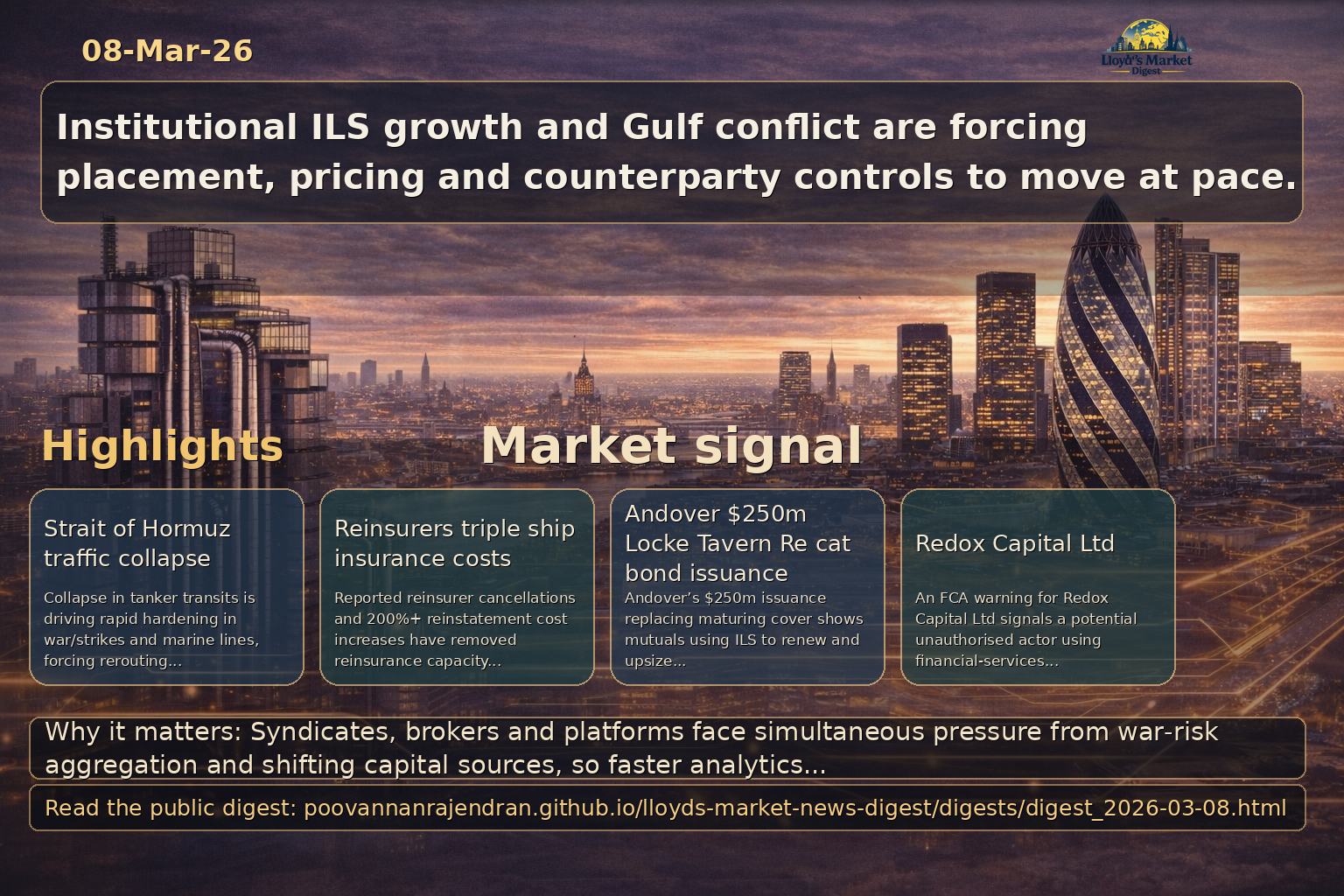
Why it matters: An FCA warning for Redox Capital Ltd signals a potential unauthorised actor using financial-services branding that could mislead corporate clients and retail intermediaries; such actors can introduce uninsured placements, claims dispute exposure and reputational contagion for brokers and syndicates active in specialty lines.
- Operational impact: Unauthorised intermediaries can cause placement leakage and create uninsured contracts or letters of credit that expose syndicates to non-standard claim vectors.
- Broker risk management: Brokers should suspend engagement with the named entity, validate counterparties through FCA registers and platform KYC, and document source-of-referral for any leads tied to the name.
- Market action: Syndicates and MGAs should notify their appointed representatives and placement platforms, circulate a client advisory emphasizing lack of FSCS/FOS protection, and escalate to market-wide distribution controls where necessary.
Source: fca.org.uk
Why it matters: The SecuroomAI warning highlights a growing vector where technology-branded services are used to approach insureds and brokers; for Lloyd’s market participants that rely on cyber and tech specialty placements, this increases the chance of fraudulent premium flows, misdirected cyber cover and supplier impersonation.
- Exposure to cyber lines: False tech or cyber advisory fronts can misrepresent coverage terms, causing gaps in cyber risk transfer and post-incident liability misallocation between brokers and insurers.
- Due diligence requirement: Placement platforms and brokers must verify vendor and referral identities, demand direct FCA registration proof, and apply enhanced scrutiny to tech-branded intermediaries before onboarding.
- Preventive measures: Implement mandatory sanctions-and-warning-list screening in CRM and platform APIs, issue targeted communications to wholesale clients, and update cyber-security underwriting questionnaires to capture vendor provenance.
Source: fca.org.uk
Why it matters: SELFTRADEINV appearing on the FCA warning list demonstrates the persistence of investment-style or trading-branded frauds that can intersect with specialty lines via premium financing, collateral arrangements or capital-market linked products — creating settlement and solvency complexity for syndicates and brokers.
- Financial exposure: Use of unauthorised investment intermediaries in premium finance or collateral arrangements can leave syndicates with non-recoverable funds and contested claim recoveries absent FSCS/FOS coverage.
- Controls and contract hygiene: Brokers should enforce counterparty approval clauses, require verified banking details, and avoid third-party payment routes that are not pre-approved by underwriters and compliance teams.
- Market governance: Placement platforms, managing agents and broker compliance functions should share intelligence on such warnings, maintain a live blocklist for onboarding, and coordinate with market associations to issue joint advisories where patterns emerge.
Source: artemis.bm
Why it matters: Elementum Advisors promoting a Chief Compliance Officer signals maturation and governance strengthening among ILS managers, improving institutional credibility for investors and cedants.
- Internal governance upgrades increase investor confidence and support growth of managed catastrophe portfolios
- Stronger compliance frameworks help ILS managers navigate regulatory scrutiny and institutional due diligence
- Syndicates and brokers can leverage reputable ILS managers for fund-based or private placement capacity solutions
Source: artemis.bm
Why it matters: Liberty Mutual’s decision to lift aggregate reinsurance attachment higher to protect the tail highlights strategic capital optimisation and shifting tower design post-major loss events.
- Repositioning of aggregate layers signals greater focus on tail protection versus occurrence limits to manage retained volatility
- Opens opportunities for structured aggregate solutions via reinsurers or ILS to provide diversified capacity
- Brokers and analytics teams must reassess aggregate vs occurrence placement economics and capital impacts for clients and syndicates
Source: artemis.bm
Why it matters: Aon’s expansion of George Attard’s role to lead global reinsurance analytics reflects an industry-wide shift: brokers are aligning data, technology and analytics to influence placement strategy and capital optimisation.
- Integrated analytics capability enables more sophisticated pricing, capital modelling and alternative-capital structuring for cedants
- Enhances brokers’ ability to originate and execute ILS and bespoke reinsurance solutions with data-driven differentiation
- Syndicates and carriers should prioritise data transparency and counterparty analytics when engaging with large global brokers
Source: artemis.bm
Why it matters: Andover’s $250m Locke Tavern Re issuance replacing maturing cover highlights how mutuals and established carriers use ILS to maintain and increase collateralised catastrophe protection.
- ILS used as a renewal and upsizing tool to replace maturing protection and ensure continuity of cover
- Repeat sponsor transactions indicate streamlined processes and investor familiarity, lowering execution friction
- Placement platforms should focus on efficient documentation and investor communications for repeat issuers
Source: businessinsurance.com
Why it matters: A major carrier suspending Gulf services directly affects marine hull, cargo and P&I placement dynamics — increasing broker workload and war-risk demand for Lloyd's and specialty capacity.
- Immediate spike in demand for alternative routing and additional war/terrorism covers increases placement complexity and broker negotiation time.
- Heightened cargo and contingent BI exposures may push clients toward higher deductibles or bespoke wording sold via Lloyd's syndicates and specialty MGAs.
- Insurers should reassess voyage exclusions, policy triggers and reinsurance retro limits for Gulf transits to avoid aggregation surprise.
Source: businessinsurance.com
Why it matters: Lancashire's profit decline is a signal on specialty carrier earnings and pricing adequacy, relevant to syndicate capital allocation and broker strategy in hard/soft market cycles.
- A 9% profit drop suggests underwriting or reserving pressure in specialty classes, prompting syndicates to tighten capacity or reprice casualty and marine accounts.
- Brokers should expect increased scrutiny on terms and renewal pricing as carriers protect margins and reassess deployment across lines.
- Capital providers and reinsurers may demand clearer catastrophe and attritional loss analytics, affecting retro purchase strategies.
Source: businessinsurance.com
Why it matters: Widening conflict in Iran elevates global supply-chain risk, increasing exposures for cargo, logistics providers, and contingent business interruption — core concerns for specialty underwriters and placement platforms.
- Increased frequency of routed delays and supply shortages will raise claims under cargo and contingent BI programmes placed by global brokers.
- Underwriters and placement platforms must refine embargo and war risk clauses, and reassess accumulation models for exposed insureds.
- Trade credit and political risk capacity may be strained; syndicates should coordinate with reinsurers to manage correlated supply-chain losses.
Source: businessinsurance.com
Why it matters: Pool Re securing $3.7B of retrocession cover highlights the role of government-backed or supported pools in stabilising terrorism/attack risk — a template relevant to Lloyd's exposure management.
- Demonstrates how sovereign or quasi-sovereign backstops can be structured to restore market capacity and confidence for terrorism and war-type perils.
- Syndicates underwriting property and specialty lines should reassess their reliance on public-private mechanisms when evaluating tail risk.
- Brokers can leverage such programmes in client conversations to manage pricing volatility and limits for high-exposure accounts.
Source: businessinsurance.com
Why it matters: Profile of an industry executive can indicate talent bench strength and influence at brokers, MGAs or syndicates; relevant for relationship-led placement strategies.
- Senior profiles are used by brokers and clients to assess technical leadership and distribution strength at placement platforms.
- Talent retention and visible leadership profiles affect client confidence when shifting complex specialty risk placements.
- Syndicates and reinsurers monitor such appointments for potential shifts in referral flows and strategic partnerships.
Source: globalreinsurance.com
Why it matters: The article highlights a collapse in Strait of Hormuz tanker transits driven by war-risk cancellations, spikes in pricing and reinsurer withdrawals — dynamics that directly affect Lloyd's market capacity, syndicate exposures and broker placement options for marine and energy risks. For C-suite and brokers this is a timely signal to reassess underwriting appetite, placement channels and client routing and contingency advice.
- Capacity and pricing: Expect rapid hardening in war-risk and related marine lines — syndicates must reprice, refine limits, and coordinate on aggregate exposure modelling to manage concentration and peak per-risk losses.
- Broker placement and product evolution: Brokers should mobilise multi-source sourcing (Lloyd’s, market utilities, ILS and regional carriers), use electronic placement platforms to surface capacity quickly, and negotiate disciplined wordings/clauses (clear exclusions, warranties, conditional coverage).
- Operational and strategic client actions: Advise clients on pragmatic routing and cargo strategies, update contingency plans, stress-test portfolio accumulation against prolonged chokepoint disruption, and engage reinsurers early to rebuild retrocessional arrangements.
Source: insurancejournal.com
Why it matters: Direct attacks on tankers materially increase hull, cargo and war‑risk exposure in a concentrated maritime corridor, prompting immediate underwriting action across specialty syndicates and brokers.
- Underwriters and Lloyd’s syndicates will restrict appetite for voyages through the Strait of Hormuz and apply higher war‑risk premiums or explicit exclusions to limit accumulations.
- Brokers must pre‑empt client needs by securing alternative routings, voyage‑by‑voyage war‑risk placement and liaising with P&I clubs on claims handling protocols.
- Placement platforms and broking operations need accelerated sanctions screening, expedited slip issuance and contingency workflows for facultative referrals and rapid insurer responses.
Source: insurancejournal.com
Why it matters: Missile fire and contested airspace are creating acute aviation operational risk and stress on liability, hull and repatriation cover — an exposure that draws on specialist aviation capacity and emergency placement capabilities.
- Aviation and specialty syndicates will reassess route exposures, restrict cover for flights traversing the region and price for heightened war and political violence risk.
- Brokers should coordinate contingency arrangements for clients (charter alternatives, AOG support, crisis lines) and pre‑notify underwriters of repatriation/evacuation flying to manage potential coverage disputes.
- Placement platforms must ensure rapid slip creation, real‑time documentation and conflict‑zone endorsements plus expedited underwriter bind authority for urgent placements.
Source: insurancejournal.com
Why it matters: Reported reinsurer cancellations and 200%+ reinstatement cost increases indicate a sudden withdrawal of reinsurance capacity for ship war risk—causing downstream capacity shortages and forcing material repricing at Lloyd’s and global specialty markets.
- Syndicates must model reinsurance loss of capacity and consider raising retentions, redeploying capital or seeking alternative capital solutions (ILS, sidecars, structured retrocession).
- Brokers will face constrained markets and should assemble multi‑insurer solutions, pursue voyage‑specific buybacks and negotiate pro rata cost pass‑throughs with clients where appropriate.
- Placement platforms and managing agents need to track reinsurance instructions, expedite facultative placements and enhance transparency on reinstatement terms to avoid gaps at attachment.
Source: insurancejournal.com
Why it matters: Extraordinary increases in maritime war premiums (reported up to 1000%) are reshaping trade economics for energy and commodity shipping and creating acute aggregation and business interruption exposures for energy underwriters and brokers.
- Underwriters should enforce corridor‑level exposure limits, granular voyage accumulation analytics and consider temporary corridor exclusions to stop build‑up of systemic risk.
- Brokers need to advise clients on cost management options (alternative routings, inventory adjustments), and evaluate contingent business interruption and supply‑chain cover enhancements.
- Placement platforms must enable high‑velocity bulk renewals, provide real‑time exposure dashboards to underwriters and support rapid re‑pricing of concentrated portfolios.
Source: insurancejournal.com
Why it matters: Disruption to fertilizer exports and resulting commodity price shocks create indirect but material exposure for trade credit, cargo BI and specialty lines that syndicates and brokers must surface to clients and reinsurers.
- Syndicates writing trade credit, political violence and contingent business interruption need to stress‑test portfolios for commodity‑driven credit defaults and extended supply‑chain interruption scenarios.
- Brokers should proactively bundle covers (cargo, political violence, BI) and recommend hedging strategies to commercial clients to mitigate cost shocks and receivables risk.
- Placement platforms should facilitate multi‑line submissions and rapid placement of commodity‑linked covers while ensuring KYC/sanctions checks and swift claims intake for cascade losses.
Source: artemis.bm
Why it matters: Olympus’s debut $100m cat bond sponsorship signals MGUs and regional specialists are directly accessing capital markets to securitise concentrated Florida wind risk, creating a template for similar specialty carriers.
- Demonstrates MGU-linked sponsors can use Bermuda SPVs and multi-year tenors to stabilise hurricane exposure and capital planning
- Creates demand for broker-led ILS placement services tailored to regional/homeowners exposures
- Syndicates and Lloyd’s participants should monitor pricing and attachment structures as capital markets become a durable source of capacity for Florida risk
Source: newsnow.co.uk
Why it matters: Ongoing developments in the Strait of Hormuz are a direct, high‑impact trigger for Lloyd’s specialist lines—marine hull, cargo, war/strikes, energy and related specialty covers—and require immediate market reaction by brokers, syndicates and placement platforms to control risk, pricing and service continuity.
- Underwriting and claims exposure: Expect immediate hardening of war/strikes and political violence terms, more restrictive voyage warranties and heightened claims frequency/severity for hull, cargo and energy shipments—underwriters must re‑assess pricing, exclusions and aggregate limits now.
- Placement and operational response: Brokers and platforms must prioritise time‑sensitive placements (war, strikes, kidnap & ransom for crew, P&I endorsements), offer rerouting cost estimates to clients, and leverage electronic placement channels to avoid lapses and ensure consistent slip documentation.
- Strategic capital and reinsurance actions: Syndicates should run concentration and tail event scenarios across Gulf transit exposures, engage facultative/reinsurance partners to shore up capacity, and coordinate market guidance to maintain discipline on terms while communicating clear mitigation steps to major insureds.
Source: risk.net
Why it matters: The report highlights the emergence of rapid, correlated macro shocks across APAC that undermine historical-model assumptions — a direct concern for Lloyd’s syndicates underwriting regional risk, brokers advising multinational clients, and placement platforms needing to support faster, data-rich transactions.
- Underwriting: Syndicates must update pricing frameworks to incorporate non-linear, cross‑market scenarios; legacy frequency/severity approaches will misprice correlated tail exposures.
- Distribution: Brokers should expand advisory services to include bespoke scenario analysis and liquidity planning for clients, leveraging APAC market insights to retain and grow share.
- Platforms & Ops: Placement platforms need to enable real‑time data feeds and liquidity indicators to support swift coverage decisions, conditional terms and collateral adjustments.