Source: globalreinsurance.com
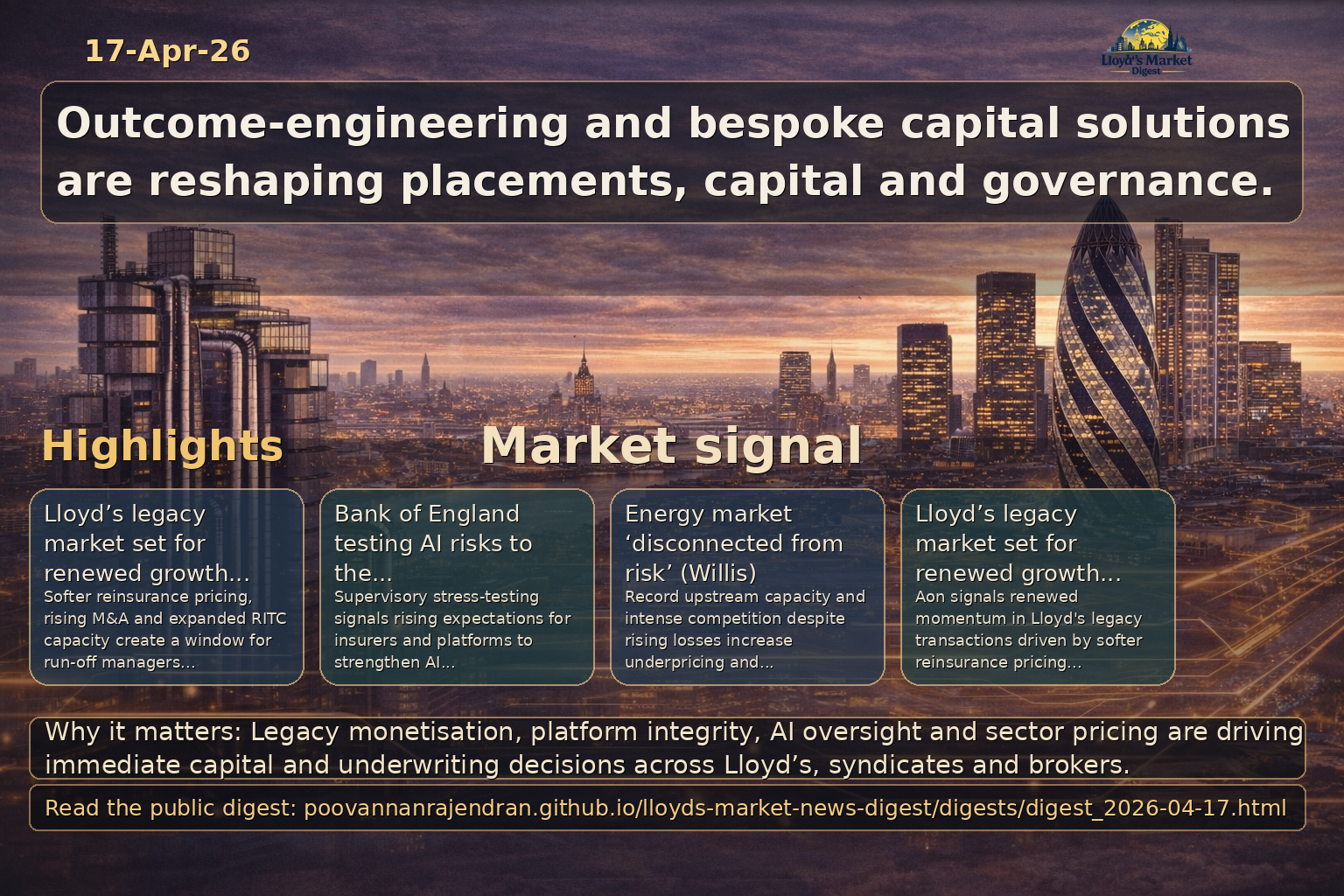
Why it matters: Aon signals renewed momentum in Lloyd's legacy transactions driven by softer reinsurance pricing, rising M&A and expanded RITC capacity, creating a strategic growth pathway for run-off specialists, syndicates and brokers.
- Syndicates and run-off managers: scale capability and capitalise on RITC demand by standardising valuation and commutation approaches to accelerate deal execution.
- Brokers and placement platforms: develop dedicated run-off placement desks and digital workflows to capture mandate origination and streamline transfer processes.
- C-suite action: review closed-year exposures and capital efficiency options (RITC, commutation, portfolio sale) to monetise legacy liabilities while market capacity and pricing remain favourable.
Source: insurancetimes.co.uk
Why it matters: Aegis London’s appointment of a high-profile non-executive with governance and utility sector experience underscores the market emphasis on board-level expertise to navigate complex capital, regulatory and enterprise-risk decisions.
- Improve board composition: syndicates should purposefully recruit NEDs with cross-sector risk, regulation and capital markets experience to strengthen oversight.
- Signal to stakeholders: enhanced governance supports confidence from capital providers and corporate cedants seeking disciplined specialty partners.
- Leverage external insight: boards should translate public-utility and infrastructure governance practices into improved resilience and long-tail risk oversight for syndicates.
Source: fca.org.uk
Why it matters: FCA warning on an unauthorised firm highlights the persistent threat of scams and unauthorised intermediaries operating in the UK. For Lloyd’s market participants, such entities can create counterparty, reputational and claims‑flow exposure when they purport to place or service specialty business without appropriate oversight.
- Tighten broker and MGA onboarding: require FCA permissions checks, proof of regulated status, and enhanced KYC/KYB before accepting business or premium flow.
- Harden platform controls: implement automated screening against FCA Warning List and block suspect domains or counterparties within placement platforms.
- Strengthen client and intermediary communications: proactively notify clients and cedants of unauthorised firm warnings and provide clear escalation and refund/recourse procedures.
Source: fca.org.uk
Why it matters: The Elvitix warning is another example of unauthorised operators potentially targeting UK customers and intermediaries. In specialty lines, such firms can masquerade as niche brokers or digital marketplaces, undermining trust in placement chains and exposing syndicates to latent operational and fraud risk.
- Expand due diligence to international intermediaries: require evidence of local regulatory status, financials and professional indemnity when accepting cross‑border business.
- Audit placement lifecycle: ensure full audit trails from quote to premium remittance to detect introductions from unauthorised sources early.
- Update contractual protections: insert representations, indemnities and remediation clauses for placements introduced via third parties or unvetted digital channels.
Source: fca.org.uk
Why it matters: Warning about an online trading/invest platform underscores risks where platforms purport to offer financial services without authorisation. For Lloyd’s market brokers and syndicates using or integrating with trading‑style investment or fund platforms, this raises questions on platform governance, client protection and claims on coverage sold through such channels.
- Validate platform regulatory status before integration: require written confirmation of permissions and scope of activities, and conduct security and controls assessments.
- Protect policyholders and counterparties: clarify in placement documents whether platform activity affects policy terms, premium security or claims handling and ensure FSCS/ombudsman limitations are communicated where relevant.
- Implement incident and recall procedures: create rapid response protocols for de‑listing or quarantining business placed via suspect platforms and for notifying affected cedants and brokers.
Source: fca.org.uk
Why it matters: The FCA’s simpler short selling rules change reporting mechanics and increase use of aggregated net short disclosures. For listed insurers, reinsurers and broker‑dealers involved in hedging, collateral and capital markets activity, the changes affect market transparency, liquidity monitoring and counterparty risk management.
- Reassess hedging and disclosure practices: review short position monitoring and reporting procedures to align with aggregated disclosure and new submission timetables.
- Update liquidity and stress testing: incorporate scenarios for reduced transparency and potential concentrated shorting events that may affect listed carriers and reinsurers.
- Engage with counterparties and data providers: ensure access to aggregated short position feeds and factor the new reporting regime into pricing, collateral requirements and counterparty exposure limits.
Source: fca.org.uk
Why it matters: Year 2 Consumer Duty Board reports signal heightened regulatory focus on governance, outcome monitoring and remediation. Lloyd’s managing agents, brokers and placement platforms operating across complex distribution chains must ensure board‑level oversight of product design, value delivery and customer outcomes, including for wholesale and specialty clients.
- Elevate Board reporting and KPIs: mandate regular Board dashboards on customer outcomes, distribution performance, complaints trends and remediation actions across brokers and platforms.
- Standardise outcome metrics across the chain: require brokers, MGAs and platforms to report common data points (e.g., time to settle, dispute ratios, fee transparency) to demonstrate compliance.
- Audit third‑party distributors and platforms: perform targeted reviews of platform UX, disclosures, claims handling and value metrics to identify and remedy outcome deficits before regulator intervention.
Source: insurancejournal.com
Why it matters: Bank of England stress testing of AI risks signals rising supervisory expectations for financial‑system participants, including insurers, to manage model risk and the systemic effects of AI.
- Governance uplift: Syndicates must strengthen AI governance, documentation and model validation to meet supervisory scrutiny and internal audit expectations.
- Contracting with insurtechs: Brokers should embed model‑risk warranties and validation rights when delegating pricing or claims automation to third parties.
- Platform compliance: Placement platforms need to evidence AI impact assessments and change‑control processes for automated decisioning tools.
Source: businessinsurance.com
Why it matters: A court finding in favor of the insurer highlights heightened judicial scrutiny of coverage triggers and exclusions for sensitive professional and personal conduct exposures — a matter directly relevant to specialty underwriters at Lloyd's and brokers placing sexual misconduct and professional liability risks.
- Reinforce underwriting clauses: Syndicates should review and tighten exclusions and insuring clauses for sexual misconduct and criminal acts to reduce ambiguity at placement.
- Broker disclosure and placement fidelity: Brokers must ensure full, documented disclosures and precise placement language to avoid allocation disputes and carrier rescission risk.
- Claims and reputational management: Insurers and MGAs should fortify investigative protocols and coordinated communication plans given high reputational sensitivity and potential market contagion.
Source: businessinsurance.com
Why it matters: A ruling that reinsurers must pay in a dispute over a fund manager’s financial restatement underscores treaty interpretation risk for financial lines and errors & omissions exposures — with direct consequences for treaty wording, collateral demands and capacity planning across Lloyd’s and global reinsurers.
- Treaty drafting and trigger clarity: Syndicates and cedants should tighten reinsurance language on triggers, restatement-related coverage and discovery periods to limit secondary disputes.
- Collateral and recovery stress-testing: Placement teams must stress-test retrocession and collateral arrangements; reinsurer payment obligations can materially affect syndicate capital and liquidity.
- Claims allocation governance: Broader adoption of formal allocation and dispute resolution clauses will reduce protracted recoveries and protect brokered panel capacity.
Source: businessinsurance.com
Why it matters: Marsh’s Q1 commentary — easing rates alongside expanding AI use — signals a market softening that increases pressure on underwriting discipline while accelerating broker and platform adoption of automation for pricing and placement efficiency in the specialty and Lloyd’s ecosystems.
- Margin protection as rates soften: Syndicates must tighten appetite and enforce minimum terms to avoid margin erosion as broker leverage grows in a softer market.
- Controlled AI deployment: Brokers and placement platforms should implement governance, model validation and audit trails for AI-driven pricing and placement to satisfy Lloyd’s and regulator expectations.
- Competitive placement strategies: Brokers will leverage AI-enabled analytics to accelerate multi-carrier submissions; syndicates should improve API connectivity and selective capacity allocation to capture profitable business.
Source: globalreinsurance.com
Why it matters: Willis highlights a structural disconnect in the global energy market — record upstream capacity and intense competition persist despite rising losses and volatility, increasing the risk of underpricing and accumulation.
- Underwriters and syndicates: intensify loss analytics and aggregation monitoring, and consider tightening terms or capacity limits where models show underestimation of tail exposures.
- Brokers and platforms: prioritise granular risk segmentation, improved data capture and bespoke facultative solutions to differentiate risk and protect client outcomes.
- Strategic focus: assess impact of new entrants and broker-backed facilities on rate adequacy; stress-test portfolios for correlated geopolitical and climate-driven loss scenarios.
Source: globalreinsurance.com
Why it matters: LSM's reorganisation of FinPro underwriting into clearer London and regional leadership underscores a market trend toward specialist, geographically differentiated underwriting and faster decision-making.
- Managing agents: replicate split structures where beneficial to accelerate local decision-making and tailor products to regional risk profiles and distribution channels.
- Brokers: engage early with restructured teams to co-design placements and leverage new leadership for targeted D&O and PI product solutions.
- Placement platforms: enable differentiated workflows and delegation tooling to support London vs regional placements and to reduce friction in binding complex FinPro risks.
Source: globalreinsurance.com
Why it matters: QBE's Asia marine outlook shows divergent exposures across blue-water, brown-water and logistics operators, signalling the need for more consultative underwriting and tailored products in the region.
- Syndicates and underwriters: develop segmented underwriting strategies and bespoke modular products to reflect materially different loss drivers across sub-sectors.
- Brokers: expand advisory and risk engineering services to influence client behaviour, reduce loss frequency and justify improved terms or pricing.
- Platforms and data: invest in digital data capture and analytics to enable real-time risk differentiation and faster placement of complex marine business.
Source: insurancejournal.com
Why it matters: Talent pipeline and culture change are strategic priorities for specialty underwriting, broker distribution and syndicate succession planning.
- Talent scarcity: Underwriting technical skillsets (cat modelling, specialty lines) are critical — syndicates and MGAs must accelerate structured apprenticeship and knowledge-transfer programs.
- Employer branding: Brokers and platforms must adapt proposition and flexible career pathways to attract Gen Z and successor cohorts into specialty roles.
- Operational continuity: Placement platforms should incorporate training modules and institutional memory capture to reduce single‑point expertise risk.
Source: insurancejournal.com
Why it matters: Shifting private reinsurance rates versus public catastrophe funds alters buying behaviour, retention strategy and capacity deployment for U.S. catastrophe layers relevant to global specialty markets.
- Capacity reallocation: Falling private re rates create opportunities for syndicates and reinsurers to pursue US catastrophe layers previously ceded to state funds.
- Broker advisory: Brokers must produce comparative rate/terms analytics versus state Cat Funds to advise retention and financing strategy for carriers.
- Capital efficiency: Placement platforms and capital providers should recalibrate modeled exposures and collateral requirements to optimise retentions and retrocession purchases.
Source: insurancejournal.com
Why it matters: Rapid uptake of micromobility vehicles creates coverage gaps and an addressable specialty market for bespoke liability, motor and embedded offerings distributed by brokers and platforms.
- Product development: Syndicates and MGAs can develop modular liability and physical damage endorsements for e‑bikes and scooters with clear territory and use‑case wording.
- Distribution & placement: Brokers and placement platforms should standardise appetite and data requirements to streamline placements for fleets, shared platforms, and personal coverage add‑ons.
- Data & pricing: Underwriters should form telematics/data partnerships to close information gaps and enable usage‑based pricing and targeted risk mitigation services.
Source: insurancejournal.com
Why it matters: Capital raising by an African trade insurer signals heightened demand for political/war and trade credit capacity — an opening for syndicates and reinsurers to deploy specialty capacity and structured solutions.
- Strategic capacity: Syndicates and reinsurers can structure multi‑layer facilities and coinvestments to support sovereign and trader counterparty limits.
- Broker structuring: Brokers should design blended programs combining trade credit, political risk and traditional marine/hull protections for market expansion.
- Placement facilitation: Placement platforms can enable syndicated facilities and investor channels to mobilise capital more efficiently for regional trade risk growth.
Source: insurancetimes.co.uk
Why it matters: Compromised routers and smart-home device exploitation create a convergence of cyber and physical property risk for high-net-worth portfolios, raising aggregation and coverage clarity concerns for specialty markets.
- Assess accumulation risk: syndicates and MGAs should quantify geographic and appliance-related aggregation from IoT vectors when underwriting HNW property.
- Update coverage and exclusions: lead underwriters should consider cyber-physical extensions or endorsements and clarify coverage boundaries to avoid disputes.
- Broker advisory role: place greater emphasis on pre-placement IoT inventories, mitigation recommendations and insurer-backed risk-reduction services to preserve capacity.
Source: insurancetimes.co.uk
Why it matters: Aon’s elevation of a global commercial lead for risk capital signals growing demand from clients for integrated capital solutions and bespoke placement advice at a time when capital allocation decisions are pivotal for specialty risk underwriting.
- Early engagement on capital: syndicates and managing agents should collaborate earlier with brokers on risk-capital design to secure structured capacity.
- Product innovation: expect acceleration in tailored capital solutions (ILWs, sidecars, blended capital) where brokers act as facilitators between capital providers and carriers.
- Competitive positioning: Lloyd’s syndicates should articulate clear capital and product propositions to remain attractive to advisory-led placement strategies.
Source: insurancetimes.co.uk
Why it matters: Zego’s partnership with Sompo to export a telematics-based motor product to Japan highlights the role of digital platforms and data-driven underwriting in international expansion — relevant to capacity allocation and placement workflows.
- Data-enabled placement: placement platforms and syndicates must ensure technical capability to ingest telematics for pricing and claims assessment.
- Cross-border scaling: brokers should evaluate placement and compliance implications when digital risk products migrate between jurisdictions.
- Capacity opportunities: specialty capacity providers can target usage-based product lines where data enables tighter selection and loss control.
Source: insurancetimes.co.uk
Why it matters: Biba joining the Pet and Equine Insurance Association demonstrates broker influence in niche specialty segments and the value of coordinated data and standards to improve product design and consumer outcomes.
- Data and standards: syndicates should monitor PEIA outputs to align underwriting criteria and reduce claims friction in pet/equine lines.
- Distribution intelligence: brokers gain a stronger voice to shape policy design and claims protocols, improving placement clarity for carriers.
- Collaborative working groups: carriers and broker networks should participate in associations to capture early signals and standardise market practice.
Source: reinsurancene.ws
Why it matters: Aon elevating Jeff Alpaugh to lead Risk Capital commercial strategy signals intensified competition to package capital solutions for clients pursuing large-scale growth and investment; relevant to brokers, placement platforms and syndicates seeking to win mandates that blend insurance and balance-sheet capital.
- Prioritise productising integrated capital solutions (reinsurance, retrocession, sidecars, quota share) to meet corporate clients’ growth financing needs.
- Placement platforms should expand capabilities to originate and syndicate multi-structure transactions linking traditional and alternative capital.
- Syndicates and carriers must monitor broker-led capital positioning to adapt capital deployment and co-investment strategies.
Source: reinsurancene.ws
Why it matters: Travelers’ large Q1 2026 profit uplift from lower catastrophe losses and higher investment income demonstrates insurer earnings resilience, which tends to soften reinsurance buying urgency and supports rate moderation — a core driver of current pricing dynamics affecting Lloyd’s and global specialty placements.
- Expect continued pressure on catastrophe reinsurance pricing where loss experience remains benign; syndicates should re-evaluate attachment strategies and loss-cost modelling.
- Brokers should emphasise value-added risk engineering and multi-year programme design to counteract rate compression and preserve client retention.
- Placement platforms must enable rapid scenario analysis and proof of value for clients to justify renewal spend in a lower-rate environment.
Source: reinsurancene.ws
Why it matters: Marsh leadership’s endorsement of Guy Carpenter’s execution despite a soft property cat market underscores broking network resilience and the ongoing strategic role of large reinsurance brokers in redistributing risk and accessing alternative capital for clients.
- Brokers should leverage scale and analytics to differentiate advisory services when traditional pricing drivers are weak.
- Syndicates need proactive engagement with leading brokers to secure placement flow and collaborate on tailored capacity solutions.
- Placement platforms should integrate broker workflow tools and data feeds to streamline complex treaty and facultative placements.
Source: reinsurancene.ws
Why it matters: Robust Q1 2026 catastrophe bond and ILS issuance confirms sustained investor appetite and creates meaningful non-traditional capacity that alters reinsurance supply dynamics, offering syndicates and brokers alternative risk-transfer channels to manage peak exposures.
- Syndicates should incorporate ILS into capital planning to optimise balance-sheet efficiency and retain underwriting economics where appropriate.
- Brokers must develop ILS origination capability and educate clients on comparative economics versus traditional reinsurance.
- Placement platforms need functionality to support securitisation workflows, investor onboarding and post-issuance reporting to capture ILS deal flow.
Source: reinsurancene.ws
Why it matters: Marsh’s consolidated revenue strength, alongside Guy Carpenter’s modest growth, highlights the advantage of scale in broking and the persistent demand for placement expertise even amid market headwinds; operational and litigation-related income variability remains a governance consideration for C-suite stakeholders.
- Large broking groups can defend share via bundled services (analytics, risk capital, advisory); smaller brokers should specialise or partner to remain competitive.
- Syndicates and carriers should prioritise reliable counterparty assessments and contractual certainty given the financial and litigation risk sensitivity of major brokers.
- Placement platforms must support cost-efficient integration with large broker ecosystems to facilitate high-volume, low-friction placements.
Source: artemis.bm
Why it matters: Discussion of third‑party capital for data centre risk highlights an emerging demand vector for ILS solutions and indicates brokers and Lloyd's syndicates should adapt underwriting and distribution for tech‑focused exposures.
- Emerging exposure: Data centre build‑out creates concentrated, correlated risks well‑suited to bespoke ILS placements and quota‑share style third‑party capital arrangements.
- Broker opportunity: Specialist broking units can originate tailored capital solutions linking institutional investors to data centre risk pools, leveraging catastrophe and parametric structures.
- Underwriting implication: Syndicates must enhance modelling, accumulation controls and product definitions for tech infrastructure risks to remain competitive and credible to capital providers.
Source: artemis.bm
Why it matters: Expert commentary confirming fundamentals underscores persistent investor demand, validating strategic allocation to ILS across brokers, syndicates and Lloyd's placement solutions.
- Market implication: Sustained investor conviction supports continued issuance volumes and tighter pricing—executives should assume ILS remains a core capacity source.
- Opportunity: Brokers can accelerate productisation and shelf transactions to capture repeat sponsorships; placement platforms should streamline due diligence workflows.
- Action: Syndicates and underwriting heads should update capital plans to include increased competition from collateralised capital and explore co-investment or fee arrangements with ILS managers.
Source: artemis.bm
Why it matters: Ariel Re's use of London Bridge 2 PCC evidences Lloyd's‑sponsored vehicles becoming a mainstream conduit for non‑Lloyd's sponsors to access UK/Ils structures—relevant to placement strategy and regulatory positioning.
- Strategic signal: Lloyd's‑sponsored PCCs are gaining traction as an onshore, market‑familiar ILS domicile—placement platforms should prioritise compatibility with these structures.
- Competitive impact: Reinsurers can source retrocession from capital markets while maintaining market relationships via Lloyd's vehicles, pressuring traditional retrocession spreads.
- Recommendation: Broking teams should develop standardised templates and client advisory packages for sponsors considering Lloyd's PCC routes to shorten time‑to‑market.
Source: artemis.bm
Why it matters: Tower Hill's upsizing demonstrates both sponsor demand for larger capital solutions and investor willingness to absorb bigger tranches—relevant for capacity planning and syndicate participation.
- Market dynamic: Upsizing and lower pricing reflect depth of demand for Florida homeowner catastrophe risk—Lloyd's syndicates should reassess appetite and corridor pricing.
- Commercial opportunity: Brokers can position larger, layered transactions and act as aggregators for smaller sponsors seeking economies of scale.
- Operational action: Placement platforms must ensure scalability in documentation, reporting cadence and collateral mechanics to support upsized tranches efficiently.
Source: artemis.bm
Why it matters: Nationwide's repeat sponsorship via Aquila Re signals persistent primary insurer reliance on ILS for multi‑peril, multi‑year protection—important for syndicates and brokers structuring long‑dated capacity.
- Endorsement: Repeat issuance by a blue‑chip sponsor underlines ILS suitability for long‑tenor indemnity covers—encourage syndicates to design complementary offerings.
- Broker role: Reinforce advisory services around indemnity trigger design, aggregation risk and investor communication to preserve pricing and execution certainty.
- C-suite focus: Review capital strategy to incorporate predictable ILS coverage lanes for peak exposures, and consider partnerships with established SPVs for multi‑year programmes.
Source: newsnow.co.uk
Why it matters: IEA analysis and policy guidance materially affect energy-sector exposures underwritten by Lloyd's syndicates and global specialty markets, informing transition-risk stress testing, pricing and capacity decisions for oil & gas, power and renewables portfolios.
- Adjust syndicate appetite and pricing models to reflect IEA scenario trajectories for fossil fuels vs renewables, and reallocate capacity to emerging technology risks.
- Require brokers to deliver scenario-based loss modelling and counterparty stress information for large energy placements and project bonds.
- Revise policy wordings for construction/operational risk on energy projects to capture technology-specific hazards and third‑party liabilities.
Source: newsnow.co.uk
Why it matters: Global food security headlines signal elevated supply-chain, commodity price and trade-credit volatility that translate into higher BI, cargo, marine and agribusiness exposures relevant to specialty underwriters and brokers.
- Increase focus on contingent business interruption, commodity volatility clauses and parametric triggers for crop and supply-chain covers.
- Enhance underwriting data requirements for agribusiness and food processors, integrating yield/price forecasts into pricing and limits.
- Develop coordinated placement strategies via platforms for multi-jurisdictional food-supply portfolios to manage accumulation and reinsure concentration.
Source: newsnow.co.uk
Why it matters: UK food poverty trends highlight domestic socio-economic pressures that can drive regulatory interventions, reputational risk for insurer clients (retailers/food logistics) and potential demand for contingency/social-impact products from specialist syndicates.
- Monitor potential government interventions or subsidy programs that could alter claims patterns for retailers and logistics under policies.
- Advise clients on resilience measures and develop targeted insurance solutions for food distribution, community resilience and social housing partners.
- Position speciality capacity to underwrite innovative social-impact parametric products or public–private relief schemes arising from policy responses.
Source: newsnow.co.uk
Why it matters: Orkney coverage is relevant as a microcosm for offshore and island risks — growing renewables activity, constrained logistics and marine exposures that require Lloyd's expertise in project, construction and operational insurance.
- Anticipate rising demand for construction all‑risk, hull & machinery, and third‑party liability covers tied to tidal and wind projects in island regions.
- Assess logistics and crew-change exposure concentration for island-based projects; adapt policy terms for supply-chain disruption and specialist marine transit.
- Leverage Lloyd's specialty capacity and placement platforms to package bespoke multi-line solutions for local renewables developers and EPC contractors.
Source: newsnow.co.uk
Why it matters: Covid vaccine developments continue to shape public-health liability, product liability and long-term claims patterns; they also affect the design of pandemic exclusions, indemnities and government-backed programmes relevant to syndicates and brokers.
- Revisit product-liability and public-liability wordings to clarify vaccine-related indemnities and carve-outs, and coordinate defence-cost provisions.
- Model long‑tail exposures (long-COVID) for employee benefits and disability portfolios and communicate reserve and capital implications to stakeholders.
- Advise clients on leveraging government-backed schemes and innovative risk-transfer (ILWs, pandemic bonds) where traditional capacity remains constrained.
Source: risk.net
Why it matters: The article’s focus on engineering targeted financial outcomes is directly analogous to demand for bespoke insurance solutions in the Lloyd’s and global specialty market — from parametric covers and layered reinsurance to outcome-based enterprise risk transfer. Syndicates and brokers must translate outcome design principles into insurance product architecture, capital optimisation and distribution via placement platforms.
- Product design: Use outcome-engineering principles to develop parametric and defined-return insurance products that meet clients’ specific loss mitigation objectives, reducing indemnity friction and enabling faster settlement.
- Capital and investment alignment: Coordinate syndicate asset-liability strategies with engineered outcomes to manage volatility, deploy alternative capital efficiently, and offer market-linked or hybrid risk-investment structures to capital providers.
- Distribution and placement: Leverage digital placement platforms and broker workflows to present deterministic outcome scenarios, pricing transparency and faster execution, enabling brokers to sell defined-outcome solutions to corporates and asset managers.