Source: fca.org.uk
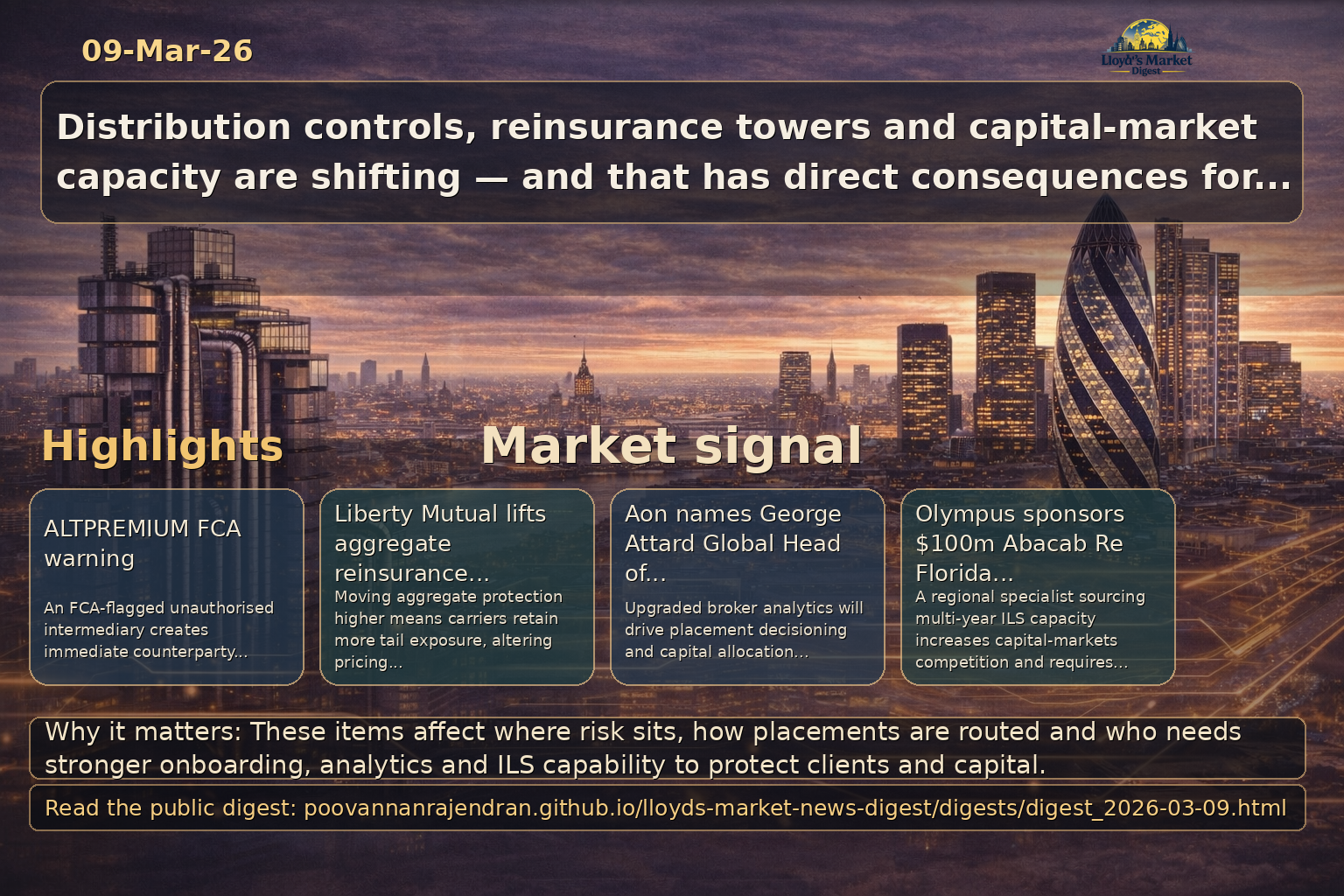
Why it matters: The FCA notification identifies an unauthorised firm potentially offering financial services to UK customers under altpremium.com. For Lloyd’s-focused brokers, syndicates and placement platforms this creates immediate counterparty and distribution risk — policies or premiums routed via unauthorised intermediaries threaten FSCS/Ombudsman protections for clients, increase likelihood of payment fraud or diversion, and can result in regulatory and reputational consequences for underwriters and intermediaries who unknowingly transact.
- Immediate containment: add the domain and firm name to internal watchlists and transaction screening; suspend or authenticate any live or recent submissions linked to the domain and notify affected syndicates and underwriting teams.
- Tighten onboarding and payment controls: refuse new business from unverified/unauthorised intermediaries, require broker regulatory status confirmation, use named regulated intermediaries for placements and employ traceable escrow or segregation for client monies.
- Market reporting & client communications: report the matter to FCA and Lloyd’s Market Supervision if relevant; notify clients and reinsurers of potential exposure; review recent placements for signs of payment diversion, spoofing or forged documentation and escalate to legal/compliance.
Source: artemis.bm
Why it matters: Liberty Mutual raising the attachment point for aggregate protection signals strategic reallocation of tail risk and capital — a response to recent large losses. This shift highlights how global carriers are re-engineering towers to balance per-occurrence and aggregate exposures, with direct implications for pricing, retentions and the role of alternative capital.
- Tail-risk strategy: Moving aggregate protection higher demonstrates a willingness to retain more non-peak-correlated tail exposure, which influences capital planning and the need for bespoke aggregate covers from reinsurers or capital markets.
- Pricing and placement effects: Higher attachment points may compress demand for lower-layer aggregate capacity, alter pricing dynamics across the tower and increase appetite for bespoke solutions, index covers or occurrence-adjusted instruments.
- Syndicate and platform response: Lloyd’s syndicates and placement platforms should proactively model aggregated exposures and offer modular aggregate solutions or capital-efficient wrappers to displaced demand, while advising clients on capital and solvency impacts.
Source: artemis.bm
Why it matters: Aon elevating George Attard to Global Head of Analytics for Reinsurance reflects the centrality of analytics in broking-led capital advisory. Advanced analytics will increasingly determine how capacity is priced, structured and allocated across syndicates, MGUs and placement platforms, reinforcing broker differentiation through tech-enabled advice.
- Enhanced decisioning: Consolidated analytics capabilities enable faster, evidence-based placement decisions, optimization of reinsurance towers and improved capital allocation for insurers and syndicates.
- Competitive advantage for brokers: Brokers with integrated analytics can move beyond execution to strategic capital advisory, influencing where and how risks are placed across Lloyd’s and global specialty markets.
- Integration requirements: Syndicates and placement platforms must ensure data interoperability and workflows that accept broker analytics outputs — integrating models, exposures and reporting to enable real-time placement optimisation.
Source: insurancetimes.co.uk
Why it matters: The Aviva–DLG outcome demonstrates how large-scale retail consolidation can reconfigure distribution economics and talent availability — both directly relevant to Lloyd's syndicates, global specialty brokers and placement platforms seeking to secure profitable specialty flows and underwriting expertise.
- Assess redistribution of personal-lines capacity and reinsurance demand: syndicates and reinsurers should model potential shifts in ceded premium and pricing sensitivity as a large retail portfolio is integrated into Aviva.
- Pursue targeted hiring and retention from displaced staff: c.400 exits create a near-term pool of experienced underwriting, claims and distribution talent that specialty brokers and syndicates can recruit to strengthen capabilities and client access.
- Prioritise platform interoperability and data integration: placement platforms and underwriting teams must ready APIs, onboarding and data-mapping to capture new referral flows and to deliver seamless service as distribution consolidates into fewer, larger carriers.
Source: reinsurancene.ws
Why it matters: Brokerslink's appointment of a Latvian affiliate extends its Baltic footprint and creates a new conduit for SME and corporate risks into specialty markets. This matters to Lloyd's market players and syndicates as it broadens distribution reach, introduces concentration dynamics in previously under-penetrated geographies, and presents partnership opportunities for placement platforms seeking regional origination.
- Strategic: Expect incremental flow of SME and middle-market property, business interruption, liability and professional lines risks; syndicates should assess appetite and consider tailored product/sublimit strategies for Baltic-origin business.
- Operational: Brokers and placement platforms must validate local broker capability, compliance and data standards to ensure smooth handoffs to Lloyd’s-access channels or delegated authority arrangements.
- Action: Syndicate and capacity executives should engage Brokerslink and regional affiliates to establish referral protocols, quick-bind options or delegated authority pilots, and update risk selection criteria to reflect Baltic market characteristics.
Source: reinsurancene.ws
Why it matters: Mission's senior hires strengthen the platform's ability to scale MGAs across the UK and Europe by enhancing account management, technology delivery and programme governance. For Lloyd's, global specialty brokers and placement platforms, this reduces execution risk for partnerships, accelerates time-to-market for new products and makes capacity deployment into MGA-led distribution more attractive.
- Governance: Improved senior oversight and programme management lowers operational and regulatory risk for syndicates contemplating capacity lines or coinsurance into Mission-backed MGAs.
- Technology: A strengthened technology delivery lead signals better integration points for placement platforms and broker systems, enabling faster data exchange, digital placements and enhanced underwriting analytics.
- Commercial: Brokers and syndicates should proactively map integration and commercial models (token binding, APIs, delegated authority SLAs) with Mission to secure preferred access to emerging MGA portfolios and ensure alignment on performance metrics.
Source: artemis.bm
Why it matters: Olympus sponsoring a $100m catastrophe bond marks a notable example of a regional specialty carrier — linked to an MGU — sourcing multi-year capital markets capacity. This demonstrates growing appetite among homeowners specialists for alternative reinsurance solutions and creates competitive dynamics for traditional syndicate and broker-placed capacity.
- Capital diversification: Cat bond issuance provides multi-year, collateralised capacity that can reduce reliance on annual reinsurance placements and improve capital efficiency for regional writers.
- Broker and platform implications: Placement platforms and brokers must develop capabilities to coordinate ILS structuring, investor marketing and post-issuance monitoring alongside traditional treaty placements.
- Syndicate competition and collaboration: Lloyd’s syndicates should assess where they can offer complementary or superior terms relative to ILS (e.g., bespoke underwriting, portfolio diversification) and consider partnerships with MGUs and placement platforms to retain market share.
Source: newsnow.co.uk
Why it matters: Colombia coverage of political, economic and social developments signals increased demand for political risk, trade credit, marine and energy specialty products; exposure growth from infrastructure, tourism and extractives will attract Lloyd's capacity and active broker placement.
- Implication: Elevated political-risk and trade-credit demand — syndicates should reassess country limits, escalation triggers and pricing for LatAm mandates.
- Action: Brokers must prepare modular placement packages (PR, AR, credit, business interruption extensions) and evidence-driven briefs for underwriters to accelerate acceptance.
- Opportunity: Expand facultative and program solutions for energy, marine cargo and tourism sectors; consider local partnerships and delegated authority to capture premium growth while managing accumulation.
Source: newsnow.co.uk
Why it matters: Ongoing UK Covid surveillance and inquiry activity maintain long-tail liability and healthcare claim uncertainty — a structural issue for professional indemnity, employers’ liability, and health providers that syndicates and brokers must account for in reserving, policy wording and pricing.
- Implication: Persistent reserve and litigation uncertainty requires syndicates to stress-test P&L for protracted claims and Long Covid-related BI exposures.
- Action: Placement platforms and brokers should standardise exposure data (elapsed-time, claimant cohorts) to enable quicker retro pricing and syndicate decisioning.
- Opportunity: Develop specialised long-tail claims management and retrocession structures; offer tailored risk-transfer products for healthcare providers and large employers.
Source: newsnow.co.uk
Why it matters: Powys and similar rural UK markets highlight concentration risks in agriculture, SMEs and regional infrastructure, along with financial-access shifts (bank closures) that alter risk profiles and distribution channels for specialty and retail-affinity products.
- Implication: Increased rural concentration and banking hub closures raise operational and credit risk for regional commercial portfolios and business-interruption exposures.
- Action: Brokers should map micro-geographies for accumulation and propose targeted covers (agri-asset, supply-chain continuity) via delegated authority or MGAs to preserve margins.
- Opportunity: Syndicates and platforms can pilot region-specific products distributed through local broker networks and digital touchpoints to capture underserved SME premium pools.
Source: newsnow.co.uk
Why it matters: Glasgow coverage underscores urban exposure dynamics—commercial property, transport, and public-sector liability—which require granular municipal risk modelling and tailored placement strategies from brokers and Lloyd's syndicates.
- Implication: Dense urban exposures amplify aggregation risk (property, transport, commuter liabilities) demanding refined exposure management and catastrophe modelling.
- Action: Placement platforms should prioritise enhanced geo-spatial data feeds and real-time accumulation dashboards to support underwriters and brokers on large urban risks.
- Opportunity: Offer integrated risk solutions (property resilience, cyber for municipal services, transport liability) through coordinated multi-syndicate facilities to capture complex urban accounts.