Source: reinsurancene.ws
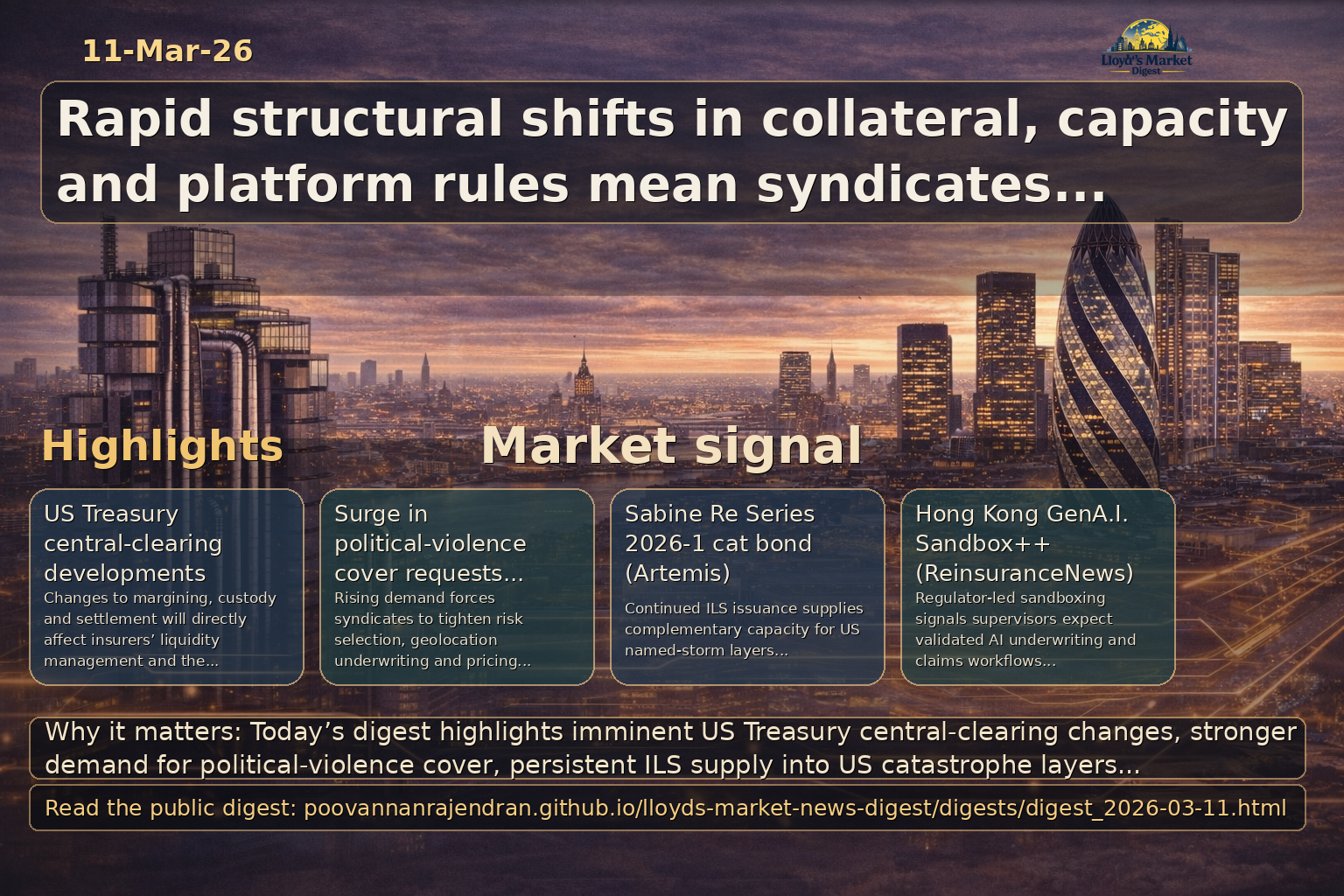
Why it matters: Hong Kong's GenA.I. Sandbox++ initiative signals regulatory engagement on generative AI across insurance and financial services — important for Lloyd's market participants leveraging AI in underwriting, claims, and placement platforms.
- Regulatory sandbox support can accelerate adoption of GenAI tools for pricing, loss modelling and broker platforms, subject to supervisory guardrails.
- Insurers and syndicates should proactively engage with such frameworks to validate AI-driven underwriting and compliance workflows.
- Placement platforms must factor evolving regulatory expectations into vendor selection, data governance and model-risk management.
Source: reinsurancene.ws
Why it matters: DAC Beachcroft's Miami expansion and new US insurance practice strengthens legal support for multinational placements and coverage disputes, relevant to brokers, syndicates and placement platforms operating across North America and Latin America.
- Improves litigative and coverage advisory capacity for brokers and Lloyd's syndicates handling cross-border US and Latin American files.
- Facilitates quicker legal input on complex, high-exposure placements (eg. event cancellation, multibillion-dollar infrastructure losses).
- Enhances support for program documentation, follow-the-fortunes treaty issues and post-loss recovery strategies.
Source: businessinsurance.com
Why it matters: Premium momentum at insurers signals shifts in underwriting discipline and rate adequacy that influence capacity allocation across Lloyd’s syndicates and global specialty markets.
- Rising premiums can restore profitability for specialty carriers and justify increased syndicate capacity, altering broker negotiation dynamics.
- Underwriters at Lloyd’s should reassess treaty and facultative appetite to align with improving rate environments.
- Placement platforms must adapt pricing signals into quoting engines and analytics for faster, more accurate submissions.
Source: businessinsurance.com
Why it matters: A surge in political violence coverage requests directly impacts capacity allocation, pricing, and product innovation for global specialty insurers and brokers.
- Syndicates and carriers will need to refine risk selection, granular geolocation underwriting, and clear war/political violence wordings.
- Brokers should leverage specialized placement platforms and local market expertise to assemble multi-carrier solutions quickly.
- Demand creates opportunity for parametric and contingent business interruption products that can scale with streamlined placement workflows.
Source: businessinsurance.com
Why it matters: Zurich’s acquisition activity illustrates continued consolidation among carriers, with implications for distribution relationships and competitive capacity in specialty corridors such as Ireland.
- Consolidation can shift distribution leverage toward remaining global brokers and influence Lloyd’s syndicate partnerships in the region.
- Acquiring firms typically seek distribution synergies; brokers and placement platforms should evaluate partnership and servicing impacts.
- Syndicates must monitor counterparty integration risks and potential rebalancing of treaty/reinsurance arrangements post‑deal.
Source: businessinsurance.com
Why it matters: A high‑value port seizure dispute underscores exposures from trade disruption and the need for precise political risk and marine war wording in specialty placements.
- Large trade and port losses test policy triggers and allocation between marine, political risk and war products — clarity is essential for limit recovery.
- Brokers must ensure comprehensive submission packages to expedite coverage validation and minimize disputable exclusions.
- Syndicates should reassess appetite for commodity and port exposures and consider bespoke coverage or co‑insuring arrangements.
Source: businessinsurance.com
Why it matters: Profiles of senior broker executives matter because individual leaders shape client strategy, distribution relationships and platform adoption across the specialty market.
- Senior executives influence firm-wide placement priorities and decisions on strategic alliances with Lloyd’s and other carriers.
- Broker leadership continuity impacts client retention, large account servicing and the structuring of complex facultative placements.
- Boards and syndicate managers should track talent movements to anticipate shifts in flow of business and key distribution channels.
Source: globalreinsurance.com
Why it matters: Promoting four experienced underwriters into specialty heads reinforces TFP’s underwriting capability across high-demand global lines and signals a strategic push to capture broker-led flows and syndicate support within Lloyd’s and other placement platforms.
- Depth and pedigree: Senior hires with backgrounds from major brokers and financial institutions enhance market relationships and underwriting credibility, improving access to complex brokered risks.
- Placement and platform impact: Appointing a head of direct & facultative (London) strengthens facultative placement capability and Lloyd’s market connectivity, reducing friction for brokers and improving execution speed on bespoke placements.
- Product and capacity focus: Dedicated leadership for cargo, credit and energy lines enables sharper appetite definition, targeted capacity allocation from syndicates, and more tailored propositions for wholesale brokers and MGAs.
Source: insurancejournal.com
Why it matters: AM Best’s outlook signals pressure on P/C profitability that should prompt Lloyd’s syndicates and global specialty carriers to tighten underwriting, revisit rate adequacy, and coordinate with brokers on placement and exposure management.
- Underwriting: Expect tighter submission standards, more granular exposure rating and selective capacity deployment across syndicates to protect combined ratios.
- Pricing and reinsurance: Increased emphasis on reinsurance placement and retrocession strategy to blunt higher loss-cost inflation.
- Broker engagement: Brokers and placement platforms must prepare to justify rate relief with loss-cost analytics and negotiate capacity across admitted and surplus markets.
Source: insurancejournal.com
Why it matters: Small-business property risk trends matter to commercial lines underwriters and brokers active in mid-market placements; aging tenant-occupied stock raises loss frequency and resilience gaps that affect syndicate exposures.
- Risk selection: Underwriters should reassess occupancy, lease arrangements and responsibility for loss mitigation when pricing small-business accounts.
- Value-add services: Brokers can differentiate through risk engineering, loss-prevention programs and retrofit financing solutions that reduce claims severity.
- Product innovation: Opportunity for specialty carriers to expand tailored SME solutions (parametric, supply-chain contingent BI) distributed via placement platforms.
Source: insurancejournal.com
Why it matters: Florida’s Citizens clearinghouse bill could materially reshape distribution flows by channeling commercial policies through a centralized mechanism, affecting wholesale brokers, capacity allocation and Lloyd’s access to ceded risks.
- Concentration risk: Centralized offloading may concentrate homogeneous risks, influencing syndicate appetite and reinsurance structuring.
- Broker role: Large wholesale brokers may gain operational control of placement workflows; smaller brokers should evaluate platform partnerships or interoperability requirements.
- Regulatory and political risk: Uncertainty around adoption and state-level responses will require scenario planning from carriers and placement platforms.
Source: insurancejournal.com
Why it matters: The appellate ruling on replacement-cost conditions reinforces the commercial importance of explicit policy conditions and timely mitigation — priorities for claims teams, underwriting guidelines and broker advisories across specialty portfolios.
- Policy clarity: Syndicates and carriers must ensure replacement-cost and repair-timeliness clauses are unambiguous to limit contentious litigation.
- Claims protocols: Enhanced claims supervision and clear timelines for insureds reduce loss creep and potential for inflated recoveries.
- Broker obligations: Brokers should document post-loss advice and manage client expectations to avoid disputes that can drive adverse precedent.
Source: insurancejournal.com
Why it matters: Clusters of spoofed or anomalous ship movements near the Strait of Hormuz signal elevated operational and war-risk complexity for marine insurers, P&I clubs and brokers arranging hull, cargo and war-risk covers.
- War-risk pricing and exclusions: Underwriters will likely demand higher premiums, tighter exclusions and enhanced surveys for transits in contested waterways.
- Operational risk: Disrupted AIS/trackability undermines loss prevention and claims triage, increasing reliance on on-the-ground intelligence and charterer disclosures.
- Placement complexity: Brokers and digital platforms must enhance capability to aggregate voyage-level intelligence and present dynamic risk appetites to syndicates.
Source: reinsurancene.ws
Why it matters: Historical industry commentary underlines persistent themes around cost-of-capital, underwriting discipline and market cyclicality that remain highly relevant to Lloyd's syndicates, specialty carriers and brokers assessing capacity strategies.
- Reinforces the need for underwriting discipline as a core strategic priority for syndicates and specialty carriers when allocating capital.
- Offers a long-run perspective useful for brokers advising clients on pricing cycles and capacity sourcing across global specialty lines.
- Acts as a reminder that capital providers and placement platforms scrutinise cost-of-capital and profitability metrics when deploying capacity.
Source: reinsurancene.ws
Why it matters: The DUAL–Liberty Specialty Markets partnership expands property and financial lines capacity in Latin America, directly affecting brokers and syndicates working regional programs and placement strategies.
- Increases locally available capacity for middle-market placements, reducing reliance on foreign facultative arrangements for Latin America.
- Signals insurer appetite for region-specific program business, encouraging brokers to develop tailored submission strategies for Mexico and Central America.
- Creates opportunities for Lloyd's syndicates and global specialists to partner or compete on delegated and treaty placements in the region.
Source: reinsurancene.ws
Why it matters: Global Indemnity's improved underlying underwriting performance and stable premium base highlights profitable underwriting disciplines that are relevant comparators for specialty carriers and syndicates evaluating portfolio mix and reinsurance strategy.
- Improved accident year underwriting (ex-catastrophe) is a metric syndicates and placement platforms monitor to benchmark underwriting adequacy.
- Stable investment income and controlled GWP growth underscore the importance of balanced capital deployment for specialty insurers.
- Catastrophe impacts (eg. Californian wildfires) emphasize reinsurers' and brokers' need for robust catastrophe modelling and treaty design.
Source: risk.net
Why it matters: Although focused on US Treasury markets, the FICC’s clearing access models and enhanced risk tools have direct relevance to Lloyd’s syndicates and global specialty insurers because treasury securities comprise a large portion of insurer investment portfolios and are frequently used as eligible collateral for reinsurance, retrocession and margining. Changes to margining, custody and settlement workflows will affect liquidity management, capital allocation and the design of broker placement platforms.
- Assess clearing access models and counterparties: determine whether to access FICC via direct membership, sponsored access or third‑party clearing arrangements and quantify the impact on balance‑sheet usage, capital charges and counterparty concentration.
- Revise collateral and liquidity policies: update eligible collateral schedules, intraday liquidity plans and reinsurance collateral agreements to reflect potential margining, haircut and settlement timing changes driven by central clearing.
- Accelerate platform and operational integration: ensure brokers, syndicates and placement platforms support central clearing workflows (collateral movement, reporting, custody connectivity) and coordinate with custodians/clearing members to minimise placement friction and settlement risk.
Source: artemis.bm
Why it matters: This Series 2026-1 cat bond illustrates a repeat sponsor using a Bermuda special purpose insurer to collateralise multi-year named-storm reinsurance for a US admitted homeowners/property portfolio. For Lloyd's syndicates, global specialty carriers and brokers it signals sustained interest from institutional investors in primary US natural catastrophe exposure, the growing role of offshore SPIs in placement, and the operational requirements of servicing collateralised, multi-year programs.
- Market and capital impact: Institutional capital supplied through cat bonds can act as complementary or competing capacity to Lloyd's syndicates, particularly in peak peril US homeowners and named-storm layers—pressure on rate and terms where alternative capital is active.
- Broker and placement implications: Brokers must integrate ILS distribution capabilities and coordinate with digital placement platforms and syndicates to structure and market multi-year, collateralised covers that meet both investor and sponsor requirements.
- Operational, modelling and capital management: Syndicates and carriers need enhanced catastrophe modelling, collateral monitoring, and multi-year exposure management processes; retrocession and capital allocation strategies should be re-evaluated in light of persistently available ILS capacity.