Source: businessinsurance.com
Why it matters: Regulatory approval for Allianz Jio and Kiwi insurers in India underscores continued market entry and partnership activity in growth markets — relevant to brokers and Lloyd's syndicates pursuing distribution and platform integration.
- Brokers should map distribution partnerships in India to align cross-border placements and local admitted cover needs for multinational clients.
- Syndicates and capital providers must assess how new entrants affect local capacity, pricing and treaty appetite for specialty risks.
- Evaluate placement platform connectivity and regulatory onboarding processes for seamless cross-border policy issuance and claims handling.
Source: fca.org.uk
Why it matters: The warning on Global Share Investment evidences continuing activity by unauthorised entities that can impersonate intermediaries or solicit premium‑type payments—directly relevant to brokers, syndicates and placement platforms that rely on trusted counterparty identity.
- Enforce pre‑placement verification of counterparty FCA authorisation (FRN checks) and embed automated Warning List feeds into broker onboarding.
- Require premium payment routing only to contracted, regulated PSP accounts; disallow ad‑hoc bank‑detail changes without dual confirmation via known channels.
- Include specific contractual audit and indemnity clauses for business introduced by third parties that later prove unauthorised or fraudulent.
Source: fca.org.uk
Why it matters: Optimus Ai Trade highlights the prevalence of fintech‑branded unauthorised operators; Lloyd's brokers and placement platforms increasingly interact with digital trading/payment front ends that may not be regulated.
- Subject fintech partners to fintech‑specific due diligence: verification of regulatory permissions, evidence of client money segregation and operational controls.
- Contractually require service continuity and data access clauses; test settlement flows in controlled pilots before broad adoption.
- Stress test cyber and fraud cover interplay—ensure policy wording captures losses arising from third‑party platform failures or unauthorised platform representations.
Source: fca.org.uk
Why it matters: Access Tradex appears in the FCA Warning List as an unauthorised trading/payment entity; such names can be used to intercept or misdirect premiums and create settlement failure risk for syndicates and MGAs.
- Centralise and periodically reconcile bank account and routing information for all counterparties and require change notifications through official account managers only.
- Mandate use of escrow or regulated payment facilitators for high‑value or cross‑border premium instalments to reduce diversion risk.
- Integrate Warning List monitoring with placement‑platform onboarding workflows to prevent rapid acceptance of unauthorised vendor integrations.
Source: fca.org.uk
Why it matters: The conviction for an illegal sale‑and‑rent‑back scheme demonstrates cross‑sector fraud methods and the FCA’s willingness to pursue criminal sanctions; risks can bleed into property‑linked specialty lines and distributors handling secured lending products.
- Review underwriting exposure and due diligence on sale‑and‑leaseback or title‑related products; require additional proof of title transfers and pre‑transaction AML checks.
- Require brokers to disclose related‑party funding arrangements and certification that counterparties were authorised to provide credit or mortgage services.
- Coordinate with claims and legal teams to confirm fraud exclusion wording and recovery pathways where policies respond to losses from illegal or unauthorised transactions.
Source: fca.org.uk
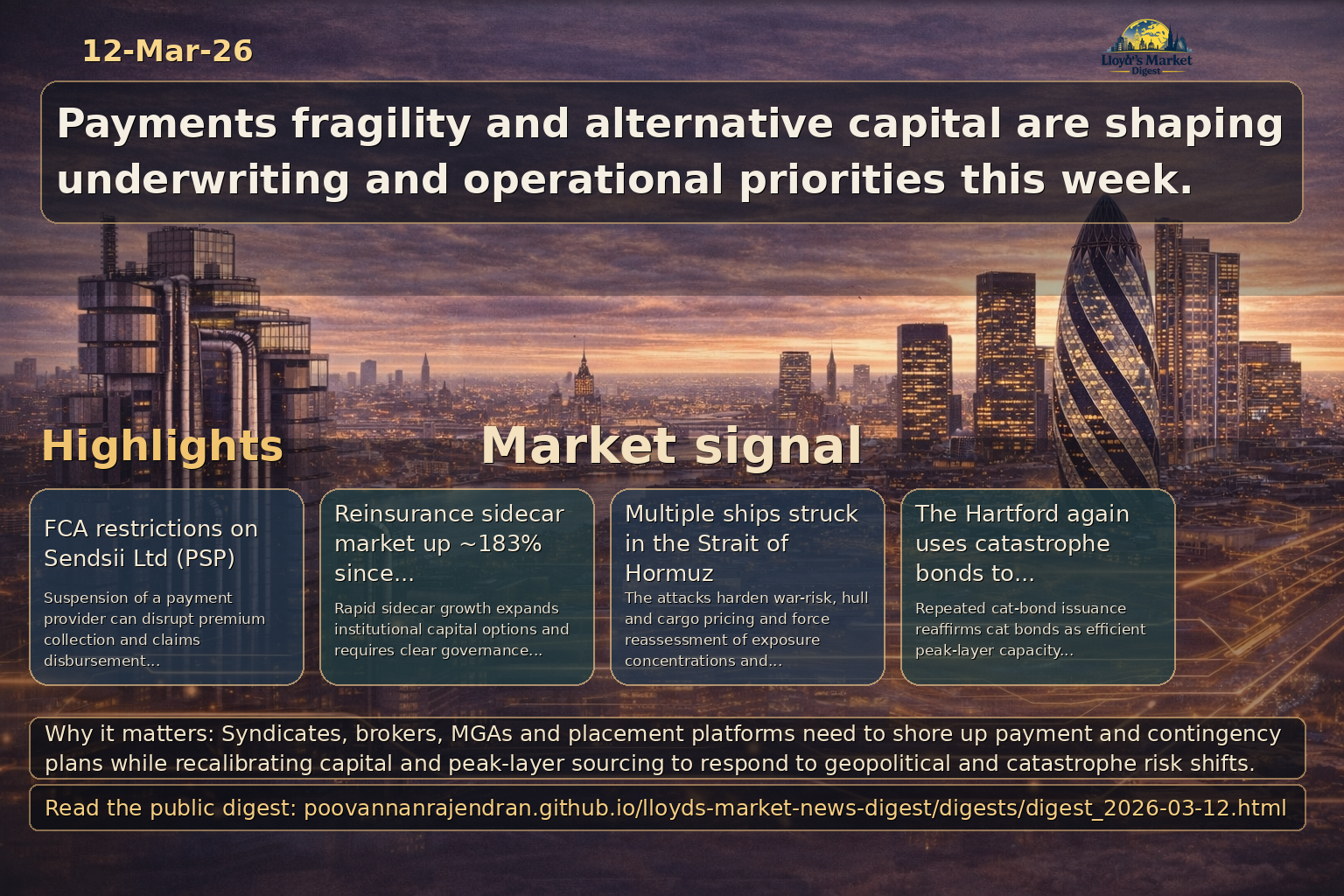
Why it matters: The FCA’s restrictions on Sendsii Ltd (a PSP) illustrate the immediate operational impact when a payments provider’s regulatory status is suspended—critical for premium collection, client money segregation, and claims payment processes used by platforms and managing agents.
- Map all premium and claims payment flows to specific PSPs and require contingency playbooks that can be enacted within 24–72 hours of a PSP suspension.
- Negotiate contractual obligations requiring PSPs to return customer funds promptly and to notify partners immediately of regulatory actions.
- Conduct periodic resilience and regulatory‑status reviews of PSPs, including back‑stop arrangements with secondary regulated payment providers.
Source: businessinsurance.com
Why it matters: Broker expansion into the public sector alters demand patterns for specialty coverages and creates new opportunities for Lloyd's syndicates and placement platforms to supply tailored policy wordings and capacity.
- Public-sector mandates require bespoke coverage, increasing need for specialty wordings and treaty support from Lloyd's syndicates.
- Brokers will leverage placement platforms and data analytics to scale public-sector offerings and meet procurement timelines.
- Insurers and syndicates should reassess appetite and capacity allocation for long-tail public-sector exposures and compliance risk.
Source: artemis.bm
Why it matters: AM Best estimates the collateralised sidecar market expanded ~183% since 2023 (to $16–18bn), demonstrating rapid investor appetite and a broader shift toward sponsored third‑party capital vehicles.
- Capital access: Syndicates and MGAs can accelerate growth by structuring sidecars to attract institutional capital—focus on transparent structures and predictable cashflows.
- Governance & structuring: Establish clear governance, rating considerations and retrocession mechanics to align investor expectations and regulatory constraints.
- Advisor opportunity: Brokers and placement platforms should develop advisory and structuring teams for sidecars, including diligence, documentation and investor roadshows.
Source: artemis.bm
Why it matters: SageSure’s second sponsored sidecar (Seawall Re II) providing $200m demonstrates MGUs using collateralised sidecars to scale catastrophe capacity efficiently without extending balance-sheet risk unduly.
- Scalability: MGAs/MGUs should consider sponsored sidecars to expand underwriting capacity quickly while keeping capital efficient and preserving underwriting returns.
- Contract clarity: Underwriters and brokers must validate cascade mechanics—how sidecar protection flows to captives and underwriting entities—to ensure claims certainty.
- Platform readiness: Placement platforms need standardized investor reporting, transparency on exposures and rapid onboarding for multiple sponsored sidecars.
Source: artemis.bm
Why it matters: The Hartford’s repeated use of catastrophe bonds to extend the top of its reinsurance tower reaffirms cat bonds as an efficient, institutional source of peak-layer capacity for primary carriers.
- Capacity optimisation: Use cat bonds to cap peak exposures and optimize the cost of risk, particularly where traditional reinsurance pricing is less efficient.
- Design & timing: Coordinate trigger design, attachment levels and market timing with investors and rating agencies to maximise pricing and investor appetite.
- Origination capability: Brokers and placement platforms should scale origination and structuring capabilities for cat bonds to service primary carriers seeking top-of-tower solutions.
Source: businessinsurance.com
Why it matters: Hormuz-related shutdown risk elevates property and energy exposures that Lloyd's syndicates and specialty underwriters must reassess for accumulation, supply-chain interruption and contingent BI exposures.
- Re-evaluate accumulation models for petrochemical and energy accounts; consider stricter sub-limits and aggregation clauses across syndicates.
- Brokers should test placement platforms for quick multicurrency, multi-jurisdiction coverage and coordinate conditional clauses for supply-chain interruption.
- Syndicates and reinsurers may need to tighten pricing or limit capacity on exposed accounts until geopolitical risk clears.
Source: businessinsurance.com
Why it matters: Greenlight Re's improved profitability signals improving reinsurance market fundamentals that affect capacity, pricing momentum and retrocession availability for Lloyd's syndicates and brokers.
- Stronger reinsurer results can support increased capacity but may accelerate price hardening normalization across specialty lines.
- Brokers should monitor reinsurer capital flows when structuring program placements and facultative covers for large risks.
- Syndicates can use improved retrocession pricing/terms to optimize aggregate protection; review renewal timing to capture market improvement.
Source: businessinsurance.com
Why it matters: Jet fuel shortages and large fare increases point to supply constraints that increase aviation underwriting volatility and potential liability exposures for carriers writing airline and aviation portfolios.
- Underwriters should stress-test loss-cost assumptions and recalculate premium adequacy for airline accounts facing higher operational disruption.
- Brokers need to pre-position contingency wording and explore parametric or hybrid solutions to manage volatility for airline clients.
- Syndicates may see higher attritional claims and should reassess exposure concentrations on aviation fleets and related supply-chain partners.
Source: insurancejournal.com
Why it matters: Rising frequency and complexity of severe weather events is increasing SME business-interruption (BI) exposures and revealing protection gaps. This drives demand for tailored specialty solutions from Lloyd's syndicates, MGAs and brokers, and for parametric and contingent BI products placed via rapid platforms.
- Underwriters and syndicates should prioritise parametric triggers and granular exposure management for SME portfolios to limit aggregation and speed pay-outs.
- Brokers need to package resilience advisory with cover placement — combining property, contingent BI and supply-chain options to reduce post-event closures.
- Placement platforms and MGAs can scale distribution of micro/SME-specific products, enabling faster quoting and automated claims triggers for weather events.
Source: insurancejournal.com
Why it matters: Drone incidents at a major international hub underscore evolving physical and third-party liability risks around airports and supply chains, exposing potential coverage gaps in aviation hull, ground liability and contiguous business interruption for carriers and airports.
- Syndicates and aviation underwriters must reassess UAV-related physical damage and ground liability exposures, and refine endorsements and exclusions for unmanned systems.
- Brokers should coordinate cross-border placements that combine aviation hull, airline liability and airport operator liability, and advocate for operational risk mitigation clauses.
- Placement platforms that support rapid, multi-carrier and real‑time quoting will be essential for structuring short-notice cover and alerting capacity when critical hubs are impacted.
Source: insurancejournal.com
Why it matters: A large UK consumer class action against a major digital platform highlights escalation in digital marketplace litigation and potential aggregation of product, platform and D&O liability — an emerging area for specialty underwriting and excess layers in the London market.
- Syndicates writing tech, retail and platform operators should stress-test policy wordings for class-action exposure and cross-border aggregation of losses.
- Brokers must ensure layered solutions (E&O, tech E&O, product liability, D&O) are aligned and that excess/reinsurance placements reflect potential cross-jurisdictional aggregation.
- Placement platforms should enable consolidated visibility of limits and aggregations across markets to support clients facing systemic digital-liability litigation.
Source: insurancejournal.com
Why it matters: Multiple ships struck in the Strait of Hormuz represent a significant escalation of maritime war/terror exposures, with immediate implications for war-risk pricing, P&I claims, cargo losses, rerouting costs and global supply-chain interruption.
- Immediate hardening of hull, cargo and war-risk markets is likely; syndicates and reinsurers must re-evaluate exposure concentrations in MENA transit corridors.
- Brokers should prepare for rapid placement needs, consider alternative routing solutions for clients, and negotiate contingent BI and increased war-risk limits.
- Placement platforms and market utilities must enable fast multi-carrier slips and coordinated attestations to restore commerce and deploy available capacity efficiently.
Source: insurancejournal.com
Why it matters: A substantial PRA fine for solvency miscalculation in a UK insurer underscores regulatory scrutiny of capital modelling, Solvency II reporting and governance — a material consideration for syndicates, capital providers and delegated authority arrangements in the Lloyd's ecosystem.
- Syndicates and capital backers should revalidate model governance, data controls and run regular reverse-stress and peer reviews to avoid regulatory action.
- Brokers and MGAs will face tougher due diligence from capacity providers on underwriting controls and reporting accuracy in delegated arrangements.
- Placement platforms should support transparent capital and exposure reporting features to streamline audits and demonstrate compliance to regulators and reinsurers.
Source: insurancetimes.co.uk
Why it matters: A market-level analysis that highlights evolving personal injury dynamics, regional broker expansion and supply‑chain cost pressures—factors that materially affect specialty appetite, pricing and distribution into Lloyd's and syndicates.
- PI and claims evolution requires syndicates to revisit liability wordings and reserve assumptions for specialty portfolios.
- Regional broker footprint expansion is a feed source for London Market placements — syndicates should streamline referral and binding processes.
- Supply‑chain shocks increase loss frequency/severity in certain specialty classes; underwriters must reflect this in rate and capacity strategy.
Source: insurancetimes.co.uk
Why it matters: ManyPets' move from third‑party platforms to an in‑house stack exemplifies how insurers and MGAs are using data and platform control to sharpen pricing and product development relevant to placement platforms and syndicates.
- In‑house platforms improve data quality and speed of feedback loops, enabling finer risk segmentation for specialty underwriters.
- Reduced dependence on third‑party placement systems can alter broker integration needs and negotiable API interfaces.
- Syndicates gain more actionable submission data, enabling dynamic pricing and faster capacity decisions for niche product lines.
Source: insurancetimes.co.uk
Why it matters: WBN's leadership framing brokers as an extension of corporate risk management underscores the growing advisory role of brokers and networks in originating and placing complex specialty risks into Lloyd's and global capacity.
- Broker networks coordinate cross‑border placements—critical for syndicates writing multinational specialty exposures.
- Advisory‑led relationships increase demand for value‑added capacity and risk engineering services from syndicates.
- Syndicates and placement platforms should formalise API and documentation workflows to support networked placements.
Source: insurancetimes.co.uk
Why it matters: A 'Page Not Found' record in the archive flags content accessibility and archival integrity—operationally relevant where market intelligence gaps can hinder timely underwriting and distribution decisions.
- Gaps in public archive access can impede due diligence on vintage market commentary that informs pricing and reserving.
- Syndicates and brokers should invest in reliable proprietary feeds or third‑party intelligence providers to avoid blind spots.
- Placement platforms must ensure consistent knowledge management and archival APIs for underwriters and distribution partners.
Source: insurancetimes.co.uk
Why it matters: Wakam's partnership with a specialist broker to launch a digital motorcycle product illustrates the hybrid model (digital underwriting + broker expertise) that syndicates and MGAs should monitor for capacity opportunities.
- Digital underwriting partners accelerate niche product launches, creating short windows for syndicates to provide capacity.
- Specialist brokers preserve community trust and distribution reach—critical for underwriting performance in hobbyist or affinity segments.
- Syndicates should assess delegated authority and data feeds when supporting digitally underwritten niche lines.
Source: reinsurancene.ws
Why it matters: Historical archive content provides context on prior market cycles and precedent commentary from reinsurers — useful for senior teams assessing long-term trends in catastrophe exposure, pricing cycles and market penetration strategies.
- Source of historical market commentary (e.g., Swiss Re) to inform current catastrophe and penetration strategies.
- Useful for modelling market cycle behaviour and benchmarking syndicate pricing actions over time.
- Research asset for brokers and placement platforms preparing market intelligence for clients and capital partners.
Source: reinsurancene.ws
Why it matters: Pen Underwriting entering the UK mid-market PI segment highlights MGU/MGA expansion into higher-fee professional lines — directly relevant to brokers, Lloyd's syndicates and placement platforms managing distribution and capacity sourcing.
- Expands specialist capacity distribution channels for mid-market PI, influencing broker placement strategies.
- A-rated insurer backing makes the product credible for syndicates seeking co-insurance or retrocession opportunities.
- Signals need for placement platforms to support nuanced appetite segmentation between SME and mid-market PI.
Source: reinsurancene.ws
Why it matters: AM Best’s report showing fewer US P&C impairments reduces counterparty credit concerns — a stabilising signal for reinsurance and retrocession purchasers and for syndicates assessing collateral and credit exposure.
- Lower impairment frequency eases counterparty risk premium and may reduce collateral demands in treaty placements.
- Impacts syndicate credit reviews and due diligence processes when choosing reinsurers or retrocession partners.
- Brokers can leverage improved solvency metrics when negotiating terms on behalf of cedants.
Source: reinsurancene.ws
Why it matters: Private ILS momentum underscores the importance of alternative capital for specialty risks — a structural input for Lloyd's syndicates, global reinsurers and broking platforms structuring catastrophe and non-traditional capacity solutions.
- Private ILS provides incremental, flexible capacity that can influence pricing and terms in London placements.
- Syndicates and MGAs should cultivate channels to private ILS funds to diversify capital stacks.
- Placement platforms need capabilities to present and transact with private ILS investors alongside traditional markets.
Source: reinsurancene.ws
Why it matters: IFC’s guarantee facility for ZEP-RE signals targeted public-sector support to expand regional reinsurance capacity — relevant for Lloyd's market participants and brokers pursuing emerging market growth.
- Guarantees improve creditworthiness of regional reinsurers, making them more attractive co-insurers or retrocession partners.
- Creates opportunities for London brokers and syndicates to expand underwriting footprint in Africa with mitigated credit exposure.
- Placement platforms should track public guarantee programs as enablers of new distribution corridors and product offerings.
Source: newsnow.co.uk
Why it matters: Banking sector developments affect asset values, counterparty credit, premium financing and liquidity for syndicates and brokerages — directly impacting investment returns, capital calculations and the viability of financed placements.
- Asset & capital stress: re‑assess fixed income and bank exposure marks in syndicate portfolios; stress test impacts on SCR/ECA and potential margin calls from reinsurers or collateral providers.
- Premium finance & counterparty risk: review broker/policyholder premium‑finance concentrations, tighten credit terms and increase monitoring of broker trust account resilience.
- Distribution liquidity: evaluate settlement timelines for large claims and renewals; ensure placement platforms and MGA partners have contingency liquidity arrangements to avoid client service disruption.
Source: artemis.bm
Why it matters: Guy Carpenter highlights growing use of collateralized ILS and parametric transfers to meet capacity needs for digital infrastructure and correlated power-grid exposures, signalling a shift toward structural capital solutions.
- Product strategy: Develop parametric triggers and tailored ILS structures for data centres and digital infrastructure to provide rapid, scalable capacity aligned to correlated operational risks.
- Placement/Platform action: Equip placement platforms with parametric product modules, standardised triggers and investor-ready documentation to accelerate market uptake.
- Risk & modelling: Invest in granular correlation modelling and aggregation management to avoid unintended accumulation and to make parametrics acceptable to institutional ILS investors.
Source: artemis.bm
Why it matters: Beazley’s agreement to acquire renewable-energy MGA kWh Analytics illustrates strategic M&A to secure specialist underwriting capability and parametric/revenue-firming product expertise for the energy transition.
- Strategic implication: Consider M&A or partnership routes to onboard data-led underwriting teams and revenue/parametric product capabilities rather than building in-house from scratch.
- Integration focus: Prioritise integration of modelling platforms, delegated authority governance and MAP / specialty underwriting alignment to realise scale benefits quickly.
- Distribution/placement: Brokers and placement platforms should catalogue renewable parametric products and streamline delegated-authority oversight to support efficient placement into specialty carriers.
Source: newsnow.co.uk
Why it matters: The 2026 FIFA World Cup concentrates insurable exposures across multiple jurisdictions and classes (event cancellation, public liability, travel, cyber, contingent business interruption), challenging syndicate capacity, slip structuring and cross‑border regulatory compliance for brokers and placement platforms.
- Underwriting & product: reassess event cancellation, contingent BI and public liability exposure aggregation across 16 host cities; consider layered wordings and explicit cyber/terrorism sublimits.
- Placement strategy: coordinate multinational slips, local admitted requirements and use of binding authorities/coverholders to deliver single‑risk capacity while tracking inconsistency in policy terms.
- Reinsurance & capital: stress treaty attachments for peak accumulation scenarios and pre‑negotiate retrocession to protect capital against concurrent large losses (terror/civil unrest/cyber).
Source: newsnow.co.uk
Why it matters: Appointment of a new Iranian supreme leader and the context of recent strikes materially increases geopolitical and sanctions risk for exposures to Iran and regional operations, affecting war risk placements, sanctions compliance and treaty dispute potential for Lloyd's syndicates and global brokers.
- Sanctions & compliance: immediately refresh sanctions screening, embargo lists and KYC for all Iran‑linked insureds, brokers and counterparties; engage legal teams to interpret secondary sanctions risk.
- Policy language & coverage triggers: review and tighten war/political violence exclusions, special endorsements and contingent cover wordings; communicate changes to brokers and global clients.
- Market positioning: limit direct underwriting in affected territories, consider enhanced pricing on regional risk corridors and secure reinsurance capacity specifically for politically induced losses.
Source: newsnow.co.uk
Why it matters: Escalation of missile strikes and cross‑border incidents around Russian regions like Bryansk increase military and state actor risk exposure for property, political violence, supply‑chain and energy underwriting — raising aggregation concerns for syndicates with CIS exposures.
- Aggregation & accumulation: run immediate geo‑spatial accumulation modelling for Russian and neighbouring exposures; quantify treaty exhaustion risk and adjust facultative placements as needed.
- Wording & claims preparedness: confirm war, sabotage and state‑action wordings; brief claims teams on potential mass casualty and cross‑border incident scenarios with local partner contacts.
- Distribution & reinsurance: advise brokers to seek specific facultative capacity or bespoke placements for high‑severity exposures and pre‑negotiate retro limits to protect excess layers.
Source: newsnow.co.uk
Why it matters: Sustained protests in Iran drive elevated political violence and civil unrest exposures for property, business interruption and energy sectors; they also complicate compliance, claims access and indemnity certainty for Lloyd's market participants.
- Coverage & exclusions: ensure political violence and civil commotion wordings are explicit; consider temporary suspension of new exposure intake in high‑risk urban centres until position is clear.
- Claims & field operations: establish rapid response protocols with local adjusters and security partners; anticipate elevated claims for BI and property with potential for protracted settlement timelines.
- Broker guidance & client communication: instruct brokers to update clients on coverage limitations, increase surveillance of insured assets and advise on risk mitigation measures to preserve insurability.