Source: fca.org.uk
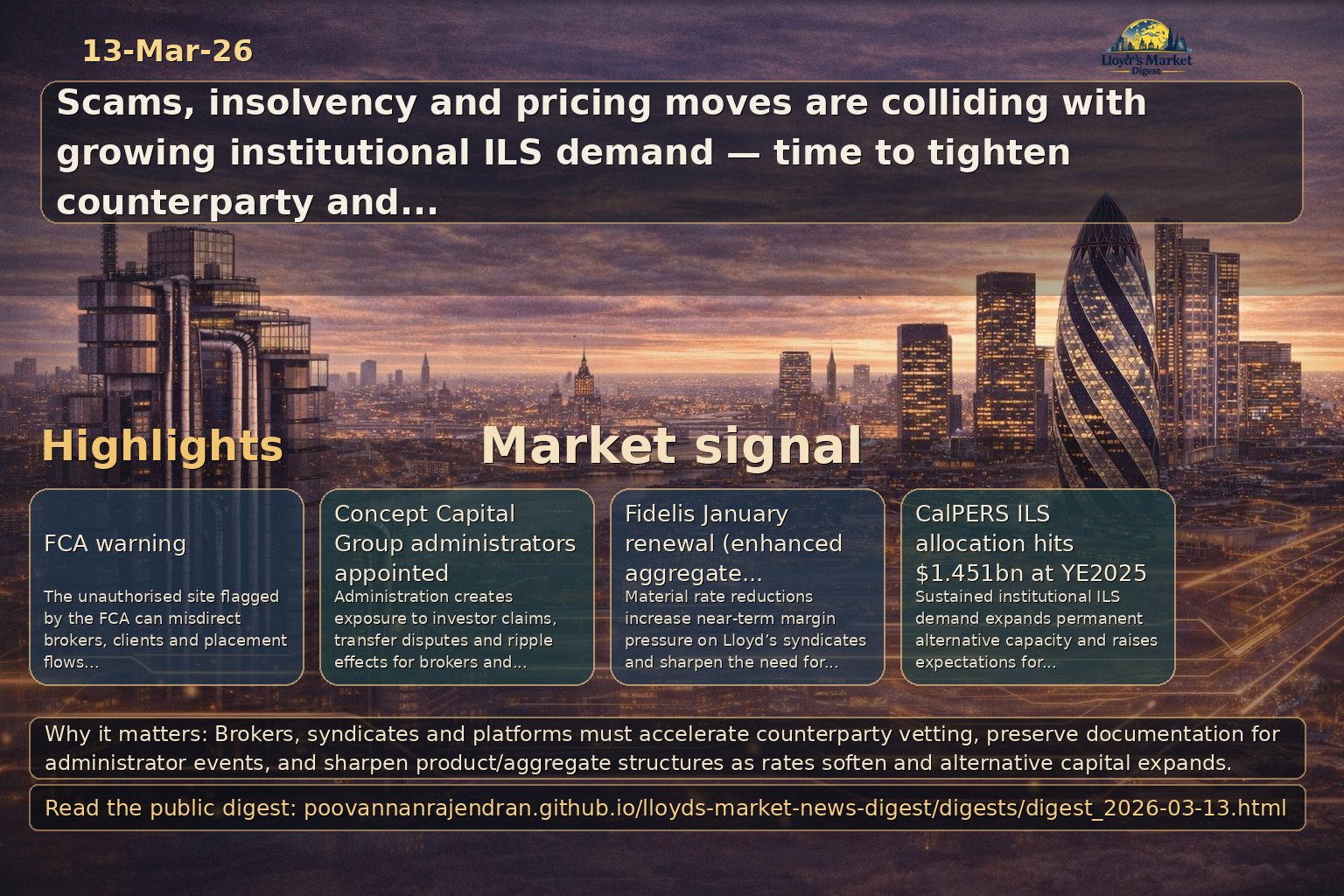
Why it matters: FCA warning about an unauthorised site indicates active impersonation/scam risk that can misdirect brokers, clients and placement flows — a direct threat to placement integrity, client money protection and syndicate reputation.
- Immediate counterparty checks: verify any unfamiliar counterparty or referrer against the FCA Warning List and the FCA register before engagement or transfers of client money.
- Client and broker communications: push proactive alerts to clients and distribution partners about impersonation scams and clear instructions on how to verify authorised intermediaries.
- Operational controls: enforce two‑factor confirmation for new payment instructions, update vendor/introducer onboarding and add unauthorised URLs to platform blocklists.
Source: fca.org.uk
Why it matters: Another FCA warning for an unauthorised operator reinforces pattern risk of fraudulent platforms seeking to exploit distribution gaps; this elevates AML/CTF and reputational exposure across brokers and placements.
- Enhance AML and screening: integrate automated checks for newly reported unauthorised entities into broker and platform onboarding workflows.
- Harden placement platform integrations: require contractual warranties and audit rights from third‑party platform providers and introducers to reduce exposure to unauthorised activity.
- Escalation and reporting: establish rapid incident playbooks to notify syndicates, reinsurers and regulators if an unauthorised actor is detected in a placement chain.
Source: fca.org.uk
Why it matters: A further FCA warning around an unauthorised financial services promoter highlights persistent targeting of UK channels; repeated incidents suggest systemic scanning of broker directories and platforms for vulnerabilities.
- Periodic supplier audits: mandate periodic verification of introducers and marketing partners cited on broker and platform sites to detect impersonation or unauthorised promotion.
- Brand protection: coordinate with legal and communications teams to monitor and rapidly takedown fraudulent sites impersonating market participants.
- Training and governance: require intermediaries to evidence training on recognising and escalating suspected unauthorised activity as a condition of panel membership.
Source: fca.org.uk
Why it matters: FCA review of second‑charge mortgage intermediaries underscores heightened expectations on affordability assessments, fee disclosure and the Consumer Duty — a template for regulatory priorities that will increasingly apply to specialty distributors and product design.
- Review advisory and underwriting standards: ensure broker scripts, affordability models and product suitability frameworks meet Consumer Duty expectations and document decisions.
- Fee transparency and disclosure: update client disclosures and remuneration reporting to eliminate any appearance of steerage or undisclosed incentives.
- Supervisory testing: implement targeted file reviews and stress testing of vulnerable customer outcomes to pre‑empt regulatory findings and remedial orders.
Source: fca.org.uk
Why it matters: Administration of Concept Capital Group demonstrates the escalation path from FCA enforcement to insolvency and asset freezes; such outcomes can trigger investor claims, transfer disputes and ripple effects for brokers and platforms that handled or promoted the products.
- Exposure assessment: perform a rapid review of any historical placements, referrals or introductions linked to the failed entity and quantify potential claims or conduct liabilities.
- Engage with administrators and counsel: preserve documentation, confirm claim filing deadlines and coordinate with syndicates/reinsurers on potential contingency reserves.
- Contractual safeguards: re‑assess contractual terms with introducers and product promoters to include indemnities, audit rights and clear termination triggers for regulatory action or insolvency.
Source: businessinsurance.com
Why it matters: Brown & Riding appointing a casualty practice head strengthens broker distribution for casualty placements, intensifying competition for specialty syndicates and affecting broker-led placement strategies.
- Improves broker capability to structure complex casualty placements, increasing pressure on syndicates to respond with differentiated appetite and terms.
- May catalyze new or expanded relationships between the broker and Lloyd's syndicates seeking casualty business flow.
- Signals ongoing talent migration that influences client relationships, placement authority use, and broker negotiation leverage.
Source: businessinsurance.com
Why it matters: A court-affirmed dismissal in a wrongful-death context affects employer liability exposure and claims frequency assumptions relevant to casualty underwriters and brokers placing high-risk worksite business.
- Reinforces the importance of precise policy wordings and exclusions for employers liability and third-party actions when negotiating placements with syndicates.
- May reduce near-term loss frequency in segments where similar factual defenses apply, affecting reserves and pricing discussions with reinsurers.
- Brokers should counsel clients on operational risk controls and documentation to preserve coverage defenses and mitigate claim escalation.
Source: businessinsurance.com
Why it matters: Marsh Risk partnering with Skyward on the Uber program illustrates continued convergence of global brokers, MGAs and tech-enabled placement platforms to deliver usage-based mobility coverages at scale—an opportunity for specialty capacity providers and Lloyd's distribution channels.
- Highlights demand for modular, data-driven policies that require flexible binding authorities and rapid quoting workflows from syndicates and MGAs.
- Represents a distribution model where global brokers and placement platforms coordinate capacity placement, underwriting data flows and claims orchestration.
- Syndicates and reinsurers should review appetite for embedded mobility risks and consider tailored product structures and reinsurance attachments.
Source: businessinsurance.com
Why it matters: Dual expanding U.S. surety limits increases alternative capacity in a specialist line, creating competitive dynamics for brokers and potentially reducing placement friction for large public and private construction bonds.
- Adds high-limit capacity that can accelerate placements and reduce the need for layered structures, benefiting brokers handling large contracts.
- May exert pricing pressure on incumbent surety providers and influence Lloyd's syndicates that write ancillary construction and infrastructure exposures.
- Underwriters and risk managers should reassess collateral and credit exposure models; reinsurance programs may need adjustment to reflect increased direct-retro capacity.
Source: businessinsurance.com
Why it matters: An OSHA citation vacated in a railcar-unloading injury case alters regulatory enforcement risk assessments for transportation and logistics accounts—key classes for casualty syndicates and specialty brokers.
- Shifts the regulatory risk profile for transportation clients, with potential implications for loss control requirements and premium adjustments by underwriters.
- Encourages brokers to integrate stronger compliance and safety evidence into submissions to protect clients and influence coverage terms.
- Syndicates should re-evaluate reserve adequacy and loss mitigation clauses where OSHA exposure may be volatile due to enforcement interpretations.
Source: reinsurancene.ws
Why it matters: MSIG Asia’s senior leadership reconfiguration signals a renewed, executive-level focus on international strategy across Southeast Asia — relevant to syndicates and brokers positioning for regional placement and partnership opportunities.
- Strategic alignment: Elevated Group-level roles indicate potential shifts in MS&AD’s international appetite and preferred reinsurance/partnership structures relevant to Lloyd’s syndicates.
- Placement impact: Brokers should re-evaluate regional programme designs and counterparty selection in anticipation of changes to capacity or retentions across SE Asia.
- Market entry/relationships: Syndicates and platforms seeking Asia expansion should engage early on strategic priorities (capital, co-insurance, treaty terms) tied to the new leadership roadmap.
Source: reinsurancene.ws
Why it matters: W. R. Berkley’s regional executive appointment underscores continued emphasis on disciplined commercial underwriting and distribution execution in the U.S. mid‑market — a focal segment for specialty placements and broker relationships.
- Underwriting direction: New regional leadership typically re-calibrates product focus and appetite; brokers should confirm sector prioritisation and underwriting KPIs for southeastern accounts.
- Distribution and service: Expect renewed emphasis on operational excellence and broker servicing standards that affect delegated authority and binding workflows.
- Competitive dynamics: Syndicates and MGAs operating in comparable mid-market niches should monitor potential shifts in pricing and terms driven by Berkley’s regional strategy.
Source: reinsurancene.ws
Why it matters: Ariel Re’s hire of an experienced property reinsurer with modelling and claims background reinforces the premium on technical underwriting talent as property/cat capacity is actively managed across the market.
- Technical capability: Talent with integrated modelling/claims experience enhances risk selection and pricing precision for E&S and cat-exposed treaties, a differentiator for reinsurers and syndicates.
- Treaty design: Brokers should expect more granular submission requirements and modelling validation as underwriters leverage technical hires to tighten terms.
- Talent competition: Syndicates and capital providers must prioritise hiring and retention of integrated modelling-underwriting talent to sustain competitive advantage.
Source: reinsurancene.ws
Why it matters: Ascot’s appointment of a U.S. CFO strengthens financial governance and capital management capability for a global specialty group — important for Lloyd’s and U.S. placement confidence and strategic capital allocation.
- Capital deployment: Stronger U.S. finance leadership supports disciplined capital allocation, potentially unlocking capacity for syndicate-led or treaty-bound growth initiatives.
- Regulatory engagement: A senior U.S. finance executive improves regulatory and tax planning coordination that affects product structuring and cross-border placements.
- M&A and scaling: Enhanced finance capability signals readiness to scale U.S. operations or pursue strategic acquisitions — a factor for broker relationships and counterparties.
Source: reinsurancene.ws
Why it matters: The Marsh Risk–Apollo facility for Uber’s autonomous vehicle expansion is a prototype for broker‑led, programmatic capacity that combines tailored underwriting, fleet-data integration and layered re/insurance — a model syndicates and placement platforms must master.
- Programmatic placement model: Demonstrates broker-led, bespoke facility structuring for complex emerging risks; syndicates should position to provide layered capacity and quota-share solutions.
- Data and aggregation: Effective underwriting will rely on telematics and operational data; platforms that integrate exposure aggregation tools gain commercial advantage.
- Scalability and partnerships: Opportunity for syndicates and MGAs to co-develop standardized templates for AV exposures and to participate in scalable pool/co-insurance arrangements.
Source: artemis.bm
Why it matters: Fidelis’ January renewal, delivering enhanced aggregate protection and ~20% lower rates, is emblematic of market softening that directly impacts Lloyd’s syndicates’ underwriting economics and capital planning. It reinforces the need for differentiated capital solutions, disciplined accumulation controls and stronger placement advisory capabilities.
- Market softening: Material rate reductions at renewal increase near-term margin pressure for capacity providers and highlight the need for underwriting differentiation.
- Portfolio focus: Syndicates should prioritise loss-cost segmentation, alternative structures (parametric/aggregate triggers) and retrocession strategies to protect returns.
- Advisory role: Brokers and placement platforms must demonstrate value beyond price—structuring efficient aggregate programs and multi-year placements that stabilise client outcomes and protect capacity.
Source: artemis.bm
Why it matters: CalPERS’ material ILS allocation demonstrates sustained institutionalisation of the asset class, increasing permanent alternative capital available to the market. This changes capacity dynamics for syndicates, creates opportunities for bespoke sponsored vehicles and raises expectations for investor-grade governance and reporting from brokers and placement platforms.
- Institutionalisation: Large public pensions adopting ILS supports long-term issuance and creates predictable demand for catastrophe bonds and collateralised reinsurance vehicles.
- Product design: Syndicates and brokers should develop multi-year and institutional-friendly structures (fee transparency, governance, reporting) to capture this capital efficiently.
- Distribution & platforms: Placement platforms must offer investor-standard due diligence, performance reporting and operational workflows to win allocations from large allocators such as CalPERS.
Source: artemis.bm
Why it matters: The CEA’s expanded risk-transfer program and a record 36% cat bond share underline that public-sector cedants are increasingly turning to capital markets. That trend pressures traditional reinsurance pricing and requires Lloyd’s syndicates and brokers to innovate on layered towers and hybrid placements.
- Market competition: Growing cat bond penetration into state programs intensifies competition with traditional capacity providers and can compress spreads for similar perils.
- Tower structuring: Brokers should prioritise integrated solutions that combine collateralised notes and treaty placements to optimise cost and attachment strategy for cedants.
- Risk management: Syndicates must reassess US earthquake accumulation, scenario testing and retrocession buying, and leverage placement platforms to access collateralised investors quickly.
Source: artemis.bm
Why it matters: HOOPP’s increased ILS allocation signals persistent appetite among large defined-benefit plans for catastrophe and reinsurance-related strategies. For Lloyd’s and global specialty players, pension demand supports product diversification and the scaling of private ILS and quota-share structures.
- Stable capital pool: Pension allocations support demand for both public cat bonds and private reinsurance placements, enabling larger multi-year or evergreen vehicles.
- Syndicate opportunity: Underwriters can structure bespoke, yield-enhancing reinsurance programs aimed at institutional investors while managing basis and credit/collateral considerations.
- Broker capabilities: Successful access to pension capital requires platforms that provide institutional-grade transparency, co-investment options and clear alignment of incentives.
Source: artemis.bm
Why it matters: The Tremont Re (Plymouth Rock) deal pricing materially below guidance highlights robust investor demand and the potential for cedants to secure lower-cost alternative capacity. This affects treaty pricing negotiations, the attractiveness of sponsor-led deals and the bargaining position of brokers and placement platforms.
- Pricing signal: Below-guidance pricing indicates strong investor appetite and may set a new baseline for named-storm transactions, pressuring traditional reinsurance rates.
- Issuer advantage: Cedants and their brokers can capitalise on favourable pricing windows to lock-in multi-year, collateralised protection with improved economics.
- Distribution execution: Placement platforms and lead brokers that can demonstrate deep investor reach and marketing precision will extract better terms for sponsors and influence secondary market dynamics.
Source: newsnow.co.uk
Why it matters: Coverage and pricing implications arise from rising antisemitism and community exposures described in the Judaism feed: increased demand for political violence, terrorism, property, event cancellation, D&O/reputational and kidnap & ransom protections for organisations and venues. Syndicates and brokers must assess aggregation, reputational contagion and community concentration in portfolios.
- Reassess aggregation and accumulation models for communities, cultural institutions and events; adjust limits and facultative referral thresholds.
- Review and, where needed, update political violence/terrorism wordings, exclusions and communicable reputational coverages to avoid coverage gap or unintended exposure.
- Engage brokers, MGAs and placement platforms to offer bespoke packages (security risk engineering, event risk management, crisis PR and contingency placements) and ensure compliance with sanctions/AML checks for international donors and partners.
Source: newsnow.co.uk
Why it matters: Frequent active‑shooter incidents in the US create acute pressures on casualty, employers' liability, event and GL portfolios. Brokers and syndicates must factor increased frequency/severity into pricing, capacity allocation and event‑specific underwriting, and ensure rapid placement capacity via platforms for high‑exposure public venues.
- Incorporate active‑shooter scenario stress tests into casualty and event portfolios; recalibrate pricing, deductibles and aggregate limits where concentration is identified.
- Require strengthened risk mitigation evidence (security plans, emergency response, staff training) as precondition to capacity — documentable for underwriting files and placement platforms.
- Ensure placement platforms and claims teams are prepared for large, potentially multi‑jurisdictional exposures (fast claims intake, catastrophe teams, specialist defence counsel panels).
Source: newsnow.co.uk
Why it matters: UK–Iraq relations and regional instability continue to influence political violence, war, energy and logistics exposures for London Market accounts. Syndicates writing onshore Iraq and supporting UK firms operating in Iraq must manage war/terror layers, sanctions screening, supply‑chain disruption and contingency planning for expatriate and local staff risk.
- Revalidate appetite and capacity for onshore Iraq and regionally exposed energy/infrastructure risks; consider tightened terms for war & terrorism and explicit sanctions carve‑outs where applicable.
- Strengthen pre‑placement due diligence (sanctions, ownership, supply‑chain mapping) and coordinate with brokers on risk transfer strategies including layered reinsurance and facultative placements.
- Enhance continuity and placement platform capabilities for remote underwriting (digital evidence collection, local risk surveys, security partner validation) and ensure syndicate readiness for rapid escalation and claims handling in hostile environments.