Source: fca.org.uk
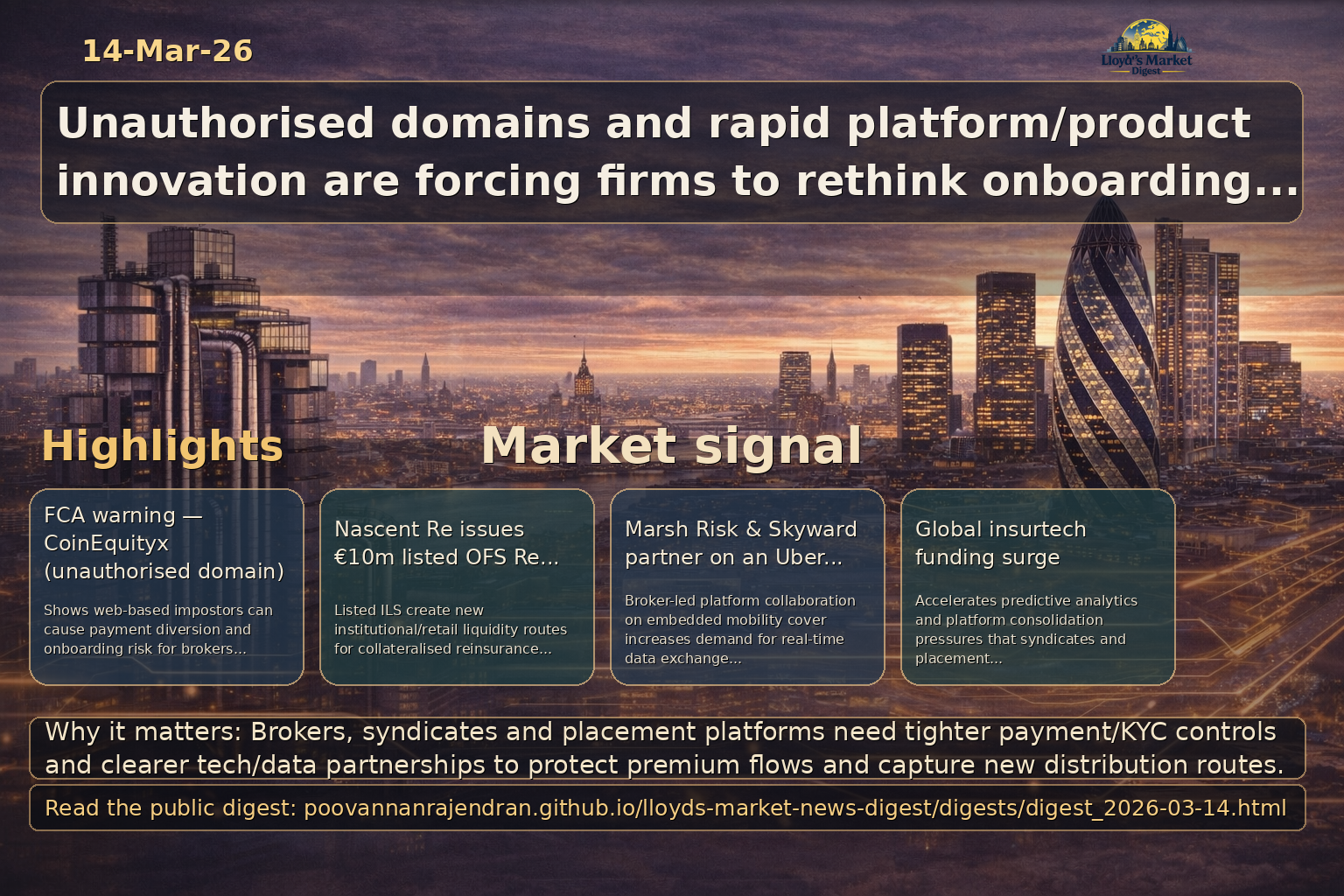
Why it matters: FCA warning on an unauthorised firm (CoinEquityx) signals ongoing use of online platforms to target UK clients — a direct operational and reputational threat to brokers, placement platforms and syndicates that rely on clear payment and client onboarding channels.
- Require mandatory FCA register checks and digital domain verification before onboarding or accepting funds from new intermediaries or clients.
- Implement strict payment‑routing controls (pre‑match account verification, escrow for new relationships) to prevent diversion of premiums.
- Communicate warnings to distribution networks and update E&O and cyber policies to cover fraud and misdirected premium exposures.
Source: fca.org.uk
Why it matters: CapitalFM.cc is an example of unauthorised web‑based operators that can be used to defraud retail and corporate clients; such schemes create downstream risk for brokers and placement platforms if clients claim mis‑selling or loss of funds tied to insurance solutions.
- Train brokers and platform onboarding teams to identify red‑flag domains and social‑media impersonation commonly used in scams.
- Require proof of FCA authorisation or legitimate overseas equivalence and maintain an escalation protocol for suspicious counterparties.
- Coordinate reporting and intelligence-sharing with Lloyd’s Market Association and FCA to limit recurrence and protect client trust.
Source: fca.org.uk
Why it matters: A named unauthorised entity (DIVERSIFIED CONGLOMERATE SOLUTIONS) illustrates how broad or plausible corporate names are misused to suggest legitimacy — increasing the chance that brokers or clients inadvertently engage with frauds that reference insurance or investment products.
- Enhance counterparty identity verification (beneficial ownership, company registry checks) for any firm presenting as a 'conglomerate' or multi‑product provider.
- Introduce mandatory senior management attestations from new intermediaries that they are authorised to advise on or place insurance-related investments.
- Review client-facing communications templates to ensure they include guidance on verifying legitimate intermediaries and the absence of FCA seriatim.
Source: fca.org.uk
Why it matters: The FCA ban of Kasim Garipoglu underscores regulatory willingness to remove senior individuals for sustained non‑compliance and AML/control failures — a clear signal to Lloyd’s market firms to scrutinise fitness and propriety of counterparties and key hires across brokers and platforms.
- Tighten pre‑hire and counterparty screening for senior roles: regulatory history, enforcement databases and references verifying compliance conduct.
- Require placement platform operators and brokers to publish and enforce fit‑and‑proper attestations for named executives and key compliance functions.
- Reassess reliance on third‑party compliance attestations; demand documentary evidence of effective AML and compliance frameworks before partnering.
Source: fca.org.uk
Why it matters: primeinsurances-assets.com is a domain that leverages the word 'insurance' to imply legitimacy — creating particular risk for insurance intermediaries and clients who may be misdirected, exposing brokers and syndicates to payment‑diversion claims and reputational fallout.
- Enforce bank account validation protocols for premium flows and require independent confirmation of payee identities for high‑value transfers.
- Maintain a blacklist and monitoring feed for domains impersonating insurance brands; inform distribution partners and clients promptly when threats are detected.
- Assess cyber and fidelity cover adequacy for misdirected premiums and fraud loss, and consider issuer‑level exclusions or sublimits tied to unauthorised counterparty incidents.
Source: businessinsurance.com
Why it matters: Senior hire at Brown & Riding for casualty practice leadership underscores specialist broker capacity-building in casualty placements—a competitive signal to Lloyd’s syndicates and placement platforms.
- Enhances broker capability to originate and place complex casualty risks, increasing flow to specialty markets
- Strengthens broker negotiating leverage with syndicates and can accelerate bespoke program development on placement platforms
- Creates opportunities for syndicates to partner on differentiated casualty solutions and for platforms to streamline complex submission handling
Source: reinsurancene.ws
Why it matters: Gallagher India’s liability leadership hires reflect sustained investment by global brokers in specialty liability capability—relevant to syndicates seeking diversified treaty and facultative flows from India and South Asia.
- Syndicates should monitor broker capability investments in liability as a signal of growing appetites and potential portfolio diversification in South Asia.
- Brokers should formalise product and data-sharing agreements with syndicates to convert new national liability demand into stable delegated authority programs.
- Insurer strategy teams ought to evaluate pricing and claims reserves for liability lines entering higher-frequency markets due to increased distribution focus.
Source: artemis.bm
Why it matters: Nascent Re’s listed OFS Re preferred shares represent product innovation and broadened distribution channels, offering new routes to institutional and retail liquidity for collateralised reinsurance.
- New distribution pathways: listed ILS instruments can improve price discovery and secondary liquidity for ILS sponsors and investors.
- Platform opportunity: placement platforms and managed service providers can integrate listed issuance capabilities to capture additional market share.
- Strategic partnerships: Lloyd’s syndicates and specialty carriers should evaluate partnerships or parallel structures to access equity‑like alternative capital.
Source: businessinsurance.com
Why it matters: Broker-led platform collaboration (Marsh + Skyward) on a mobility program demonstrates the growing role of brokers and their platform units in designing and placing embedded specialty products for large tech clients.
- Validates broker-driven productisation and platform-enabled placement as a route to scale mobility and usage-based risks
- Increases demand for real-time data exchange and modular coverages from syndicates and underwriting platforms
- Requires syndicates and capacity providers to adapt appetite, pricing models and service levels for programmatic, high-frequency exposures
Source: businessinsurance.com
Why it matters: Dual’s expansion of U.S. surety limits signals active capacity deployment by a Lloyd’s-affiliated managing agency into an underserved speciality line in North America.
- Augments Lloyd’s-related supply of surety capacity, relieving broker placement constraints for larger bonds
- Heightens competition in specialty surety pricing and can shift placement dynamics toward carriers offering broader limits
- Has reinsurance, capital allocation and collateral-management implications for syndicates backing surety lines
Source: businessinsurance.com
Why it matters: Vacatur of an OSHA citation in a railcar unloading injury case affects employer liability exposure and claims attribution for transport and industrial risks—areas significant to specialty underwriters and brokers.
- May alter loss-cost assumptions and reserve development for transport, logistics and industrial casualty portfolios
- Pushes brokers to revisit contract wordings, indemnities and evidence standards when structuring placements
- Encourages syndicates and insurers to tighten underwriting criteria and to invest in client loss-control and risk-engineering services
Source: businessinsurance.com
Why it matters: Ascot’s appointment of a U.S. CFO reflects strategic capital and growth focus in the U.S. market by a global specialty insurer with Lloyd’s connectivity—material for distribution and syndicate relationships.
- Signals prioritisation of U.S. product expansion and potential increase in capacity offered to brokers and placement platforms
- May accelerate investment in digital placement tools, claims infrastructure and tailored U.S. product governance
- Impacts reinsurance program design and syndicate integration as finance leadership aligns capital deployment with market growth objectives
Source: insurancejournal.com
Why it matters: Surge in insurtech funding, especially AI- and insurer-backed rounds, materially affects distribution, underwriting tools and platform competition relevant to Lloyd's brokers, syndicates and placement systems.
- Insurer/reinsurer-backed investments accelerate strategic partnerships and potential white-label underwriting tools that will alter broker value propositions.
- AI-centric insurtechs will increase availability of predictive analytics, pressuring syndicates to adopt advanced models or risk being outcompeted on pricing and selection.
- Mega-round activity increases M&A and platform consolidation risk — placement platforms must reassess integrations, vendor risk and route-to-market strategies.
Source: insurancejournal.com
Why it matters: Strong 2025 US P/C and auto underwriting results may be transient; cyclical softening or claim inflation can affect global specialty exposures, reinsurance demand and syndicate capital plans.
- Temporary combined-ratio improvement can induce complacency; syndicates should test downside stress scenarios tied to severity re-acceleration and reserve development.
- Improved results reduce immediate reinsurance purchases but heighten countercyclical risk if conditions reverse — brokers must advise on timing of program renewals and layering.
- Auto-market dynamics are a key driver of overall P/C results; placement platforms need to preserve flexibility to adjust auto appetite and facilitate efficient term and facultative placements.
Source: insurancejournal.com
Why it matters: Sanlam's warning on protracted Middle East conflict underscores contagion risk for investment returns, inflation, borrowing costs and trade disruption — factors that materially affect Lloyd's syndicates with Africa/EM exposure and global specialty portfolios.
- Investment-market shock and rising rates reduce insurers' investment income and can pressure capital adequacy and syndicate return targets.
- Trade and transport disruption elevates marine and commodity-linked exposures; war-related endorsements and cargo/warlike-exposure plead for immediate review.
- Brokers should re-evaluate client country risk profiles and demand granular war restriction language; placement platforms must surface country/commodity flags to underwriters.
Source: insurancejournal.com
Why it matters: A telecom cyber incident with claimed mass-data exposure increases loss-severity expectations for network/service-provider cyber claims and informs capacity decisions across Lloyd's and specialty cyber markets.
- Large telecom breaches raise aggregate exposure and systemic concentration concern, prompting syndicates to re-price cyber capacity and tighten aggregation controls.
- Brokers need to guide clients on incident response cover limits, allocation of first- and third-party costs and multi-carrier placement strategies.
- Placement platforms and MGAs should require stronger pre-bind controls and evidence of client cyber hygiene to access top-tier capacity.
Source: insurancejournal.com
Why it matters: Rapid growth in satellite intelligence capabilities (and ICEYE's scale ambitions) creates new data sources for underwriting, claims verification and parametric products, expanding specialty opportunities for Lloyd's and syndicates.
- High-frequency, high-resolution satellite data improves loss detection, model calibration and post-event claims validation for property, marine and natural catastrophe lines.
- Growth in the space sector generates direct space-insurance and supply-chain risks that specialty underwriters and brokers should incubate as a distinct market segment.
- Brokers and placement platforms can leverage satellite services to accelerate binding decisions, support parametric triggers and reduce loss adjustment friction.
Source: insurancetimes.co.uk
Why it matters: Sharp EV value declines squeeze motor pricing accuracy, reserve adequacy and claims exposure modelling, affecting syndicate profitability and broker placement advice.
- Recalibrate pricing models and reserve assumptions to reflect accelerated EV depreciation and secondary-market dynamics.
- Integrate third‑party vehicle intelligence feeds into placement platforms and binder wording to improve exposure accuracy at quote and placement.
- Brokers to upskill client advisory on replacement value, endorsement options and alternative risk transfer where residual values diverge from underwriting assumptions.
Source: insurancetimes.co.uk
Why it matters: Marsh and Apollo’s dedicated AV facility for Uber exemplifies how specialty capital and programme underwriting can unlock emerging mobility deployments—setting a blueprint for bespoke capacity arrangements and platform‑aligned facilities.
- Syndicates and Lloyd’s managing agents should assess appetites for AV liability layers and consider lead capacity or quota share structures tied to telematics/operational controls.
- Placement platforms need API and data ingestion enhancements to support rapid quoting, standardized AV endorsements and performance‑linked pricing.
- Brokers to pursue tailored programme structures and operational KPIs with underwriters, focusing on risk transfer, performance data rights and scaled excess capacity.
Source: insurancetimes.co.uk
Why it matters: Regional broker expansion highlights continued demand for local distribution and HNW advisory, informing syndicates’ channel strategy and placement platform onboarding for smaller brokers.
- Syndicates to evaluate regional broker panels and streamline delegated authority products to capture local HNW and SME flows efficiently.
- Placement platforms should simplify onboarding and EDI for family‑owned and regional brokers to broaden distribution without excessive operational friction.
- Brokers to leverage local presence to upsell specialist products (HNW, commercial packages) and to form partnerships with specialty underwriters for bespoke capacity.
Source: insurancetimes.co.uk
Why it matters: Rising staged accidents, contrived losses and a broker abuse case underline systemic intermediary and claims fraud risks that can materially affect loss ratios and reputational exposure across the market.
- Implement enhanced KYC, intermediary monitoring and periodic audits for brokers and binding authorities to reduce ghost broking and internal abuse.
- Accelerate claims analytics, fraud detection models and cross‑market intelligence sharing, particularly for motor schemes and staged‑accident patterns.
- Review contract terms and recovery/cancellation clauses with brokers, and require data sharing and transparency clauses for delegated authorities.
Source: insurancetimes.co.uk
Why it matters: FTI’s finding that European M&A gravity is shifting to continental markets signals strategic reallocation of capital and distribution focus—impacting syndicate growth strategies and broker consolidation plans.
- Reassess M&A pipelines and deployment strategies: prioritise continental Europe targets for inorganic growth and distribution scale where valuation momentum exists.
- Adjust underwriting footprints and regulatory resource allocation in response to increased continental activity and potential cross‑border consolidation.
- Brokers and placement platforms to prepare for integration workstreams and interoperability demands from pan‑European consolidations and new regional partnerships.
Source: reinsurancene.ws
Why it matters: Historic archive material highlights precedent events (cat losses, carrier quarterly results) that inform current catastrophe modelling, reserving practices and underwriting cycle memory for syndicates and reinsurers.
- Use historical catastrophe and P&C performance narratives to stress-test current accumulation assumptions and reserving practices.
- Validate pricing cadence against historical market responses to large loss years to inform syndicate appetite and quota share strategies.
- Leverage archival loss and underwriting outcome data when discussing longevity and cyclicality with capital providers and Lloyd’s managing agents.
Source: reinsurancene.ws
Why it matters: AM Best’s upgrade of CapSpecialty underscores how balance-sheet strength and ERM quality can unlock superior ratings — a template for specialty underwriters seeking capacity and favourable reinsurance terms.
- For syndicates and specialty carriers: highlight capital and ERM improvements to rating agencies to secure better retrocession and collateral terms.
- Brokers should promote rated strength to clients and reinsurers when negotiating program placements and fronting arrangements.
- Assess competitor rating trajectories to anticipate shifts in capacity allocation and potential premium rate pressure in specialty niches.
Source: reinsurancene.ws
Why it matters: FTI Consulting’s observation of rising European insurance M&A (including MGAs, brokers and carriers) signals continued consolidation and platform roll-ups that affect distribution economics and Lloyd’s placement strategies.
- C-suite should evaluate inorganic growth or partnership options to scale MGAs and digital placement capabilities in key European markets.
- Brokers and syndicates need to model counterparty concentration and integration risk as M&A reshapes intermediary networks.
- Prioritise due diligence on target portfolios for underwriting quality, data assets and platform synergies that accelerate virtual placements and delegated authority growth.
Source: reinsurancene.ws
Why it matters: Survey findings that AI-related risks rank highest among C-suite long-term concerns highlight the need for Lloyd’s, syndicates and brokers to embed AI governance across underwriting, pricing and claims processes.
- Immediate action: define AI risk appetite, model validation standards and third-party data governance for underwriters and platform partners.
- Brokers and placement platforms should ensure AI-driven pricing tools are explainable to clients and compliant with regulatory expectations.
- Insurers and syndicates must invest in actuarial and data-science controls to prevent adverse selection and model drift in AI-augmented underwriting.
Source: artemis.bm
Why it matters: Recruitment of senior ILS capital markets talent by Price Forbes signals intensified broker competition to win ILS mandates and underscores the importance of integrated capital‑raising capabilities.
- Broker differentiation: firms investing in senior capital markets hires will have an edge in origination and investor access.
- Mandate selection: syndicates and sponsors will increasingly select brokers based on demonstrated ILS distribution and structuring expertise.
- Platform integration: placement platforms should prioritise investor relations and capital markets teams to convert mandate wins into executed deals.
Source: artemis.bm
Why it matters: Confirms catastrophe bonds’ role as a de‑correlated capital solution during macro and geopolitical stress — relevant to syndicates, brokers and placement platforms positioning ILS to investors.
- Investor demand: asset managers view cat bonds as an uncorrelated, fixed‑income like refuge — emphasise this in investor roadshows.
- Capital strategy: syndicates and Lloyd’s managing capacity should treat ILS as a strategic complement to retrocession and quota shares.
- Execution: brokers and placement platforms must offer rapid marketing and transparent risk metrics to capture flows during windows of heightened demand.
Source: artemis.bm
Why it matters: Heritage’s tightened price guidance for Citrus Re illustrates issuer sensitivity to market appetite and the need to calibrate economics to attract ILS investors.
- Deal economics: tighter pricing affects sponsor retention and expected cost of capital — syndicates should model impact on renewals and retro purchases.
- Timing and positioning: brokers must advise sponsors on optimal launch windows and investor segmentation to achieve target take‑up.
- Competitive implications: pricing pressure signals increased investor selectivity; placement teams should emphasise unique triggers and diversification benefits.
Source: artemis.bm
Why it matters: Extensions and markdowns on FloodSmart Re tranches following NFIP Helene losses highlight concentration and liquidity risk in flood‑linked ILS, with implications for pricing, secondary markets and sponsor disclosures.
- Secondary market stress: marked‑down tranches reduce investor appetite for near‑term flood issuance — prepare for wider spreads and contingent liquidity issues.
- Risk modelling and disclosure: brokers and syndicates must enhance flood modelling, basis‑risk assessment and transparent investor disclosure to restore confidence.
- Contingency planning: placement platforms and originators should develop predefined remediation and extension protocols for event‑impacted deals.
Source: newsnow.co.uk
Why it matters: Regional news aggregators (Lincolnshire) provide near‑real‑time local incident reporting that underwriters, claims teams and brokers can use to validate exposures, accelerate triage and monitor accumulation in localised portfolios.
- Underwriting: Early indicators of property, flood or infrastructure incidents in specific counties enable cleaner exposure modelling and faster appetite adjustments for regional risks.
- Claims response: Local headlines can accelerate initial claims triage and mobilise adjusters/third‑party service providers more quickly following an incident.
- Broker intelligence: Regional feeds augment client monitoring and help brokers identify cross‑sell or placement needs tied to local developments.
Source: newsnow.co.uk
Why it matters: A winter sports topical feed is directly relevant to specialty lines (sport/entertainment, travel, accident & health, event cancellation) and to syndicates underwriting seasonal high‑hazard portfolios; real‑time coverage informs underwriting limits, seasonal pricing and operational readiness for peak claims.
- Risk selection: Timely reporting on resort closures, weather incidents and infrastructure failures supports dynamic underwriting of winter sports and leisure portfolios.
- Claims and loss mitigation: Early visibility of avalanches, transport disruption or mass casualty events enables faster channeling of catastrophe response resources and specialist adjusters.
- Distribution and product design: Brokers and placement platforms can use topical alerts to offer short‑term products, targeted endorsements and enhanced communications to brokers and affinity partners during peak seasons.
Source: newsnow.co.uk
Why it matters: City‑level feeds (Norwich) highlight urban risk dynamics — local regulatory changes, infrastructure projects, crime and travel disruption — that affect SME, property and municipal portfolios written by syndicates and distributed through brokers or digital placement platforms.
- Portfolio accumulation: City‑specific reporting helps underwriters detect concentration risks across commercial property and municipal exposures within local geographies.
- Regulatory and operational impact: Local policy changes or infrastructure developments reported at city level can influence coverage terms, exclusions and pricing for urban risks.
- Market intelligence for brokers: Brokers and platforms can leverage city feeds to tailor client advisory, refine renewal strategies and prioritise engagement with sectors affected by local developments.