Source: fca.org.uk
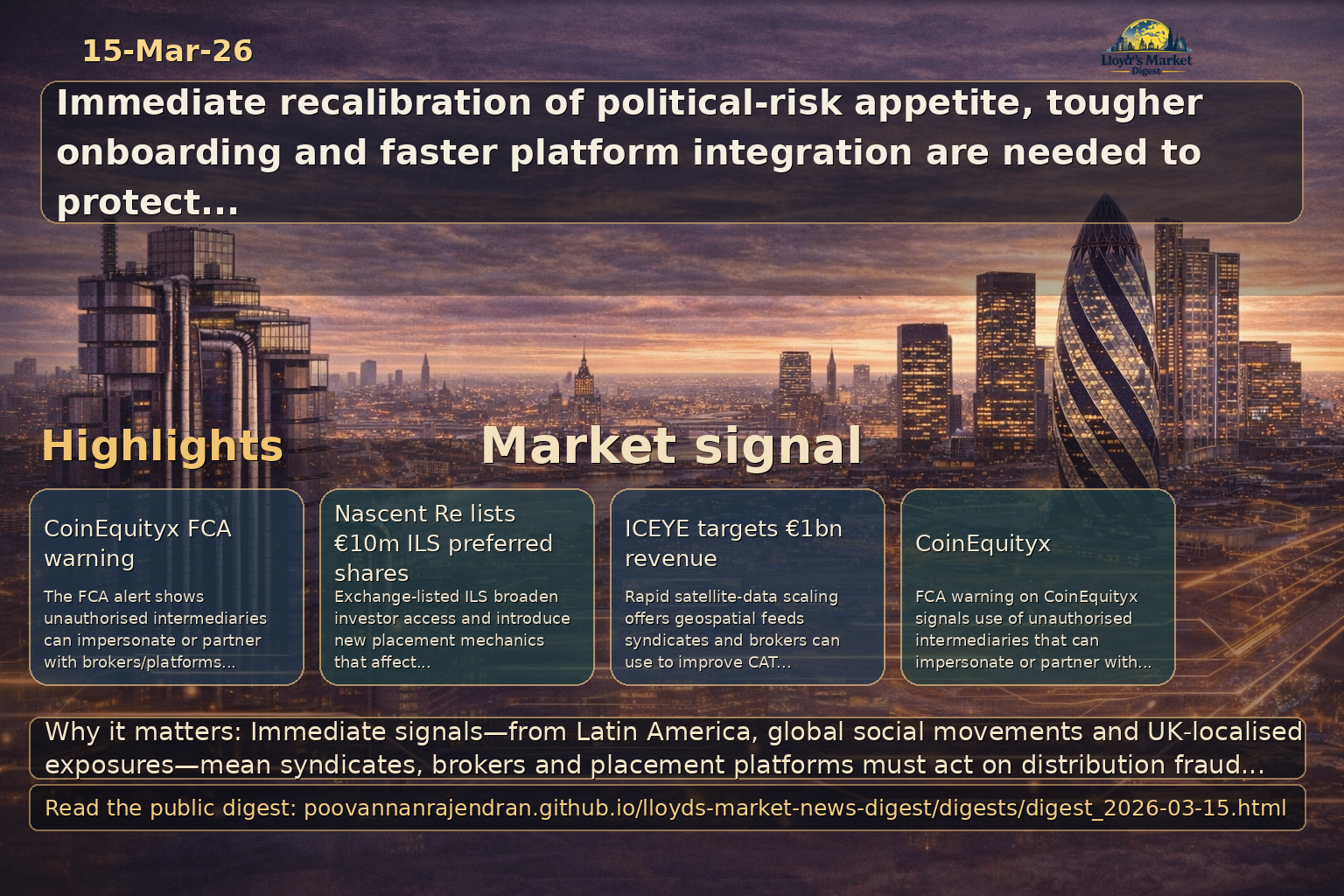
Why it matters: FCA warning on CoinEquityx signals use of unauthorised intermediaries that can impersonate or partner with specialty brokers and placement platforms to access UK retail and corporate capital. For Lloyd’s and global specialty, these schemes create counterparty, custody and distribution risks that can circumvent FSCS protections and expose syndicates to settlement and fraud losses.
- Immediate: confirm that distribution lists, API integrations and electronic placement channels exclude unauthorised entities and domains linked to CoinEquityx; block and monitor inbound leads from flagged sources.
- Control: raise KYC/KYB thresholds and real-time transaction monitoring for broker-originated premium flows to detect diversion to unauthorised accounts.
- Strategic: coordinate with platform providers and market associations to share indicators of compromise and adopt a joint watchlist for unauthorised or suspicious trading/placement identities.
Source: fca.org.uk
Why it matters: CapitalFM.cc FCA warning highlights recurring pattern of unauthorised online firms targeting UK clients which can leverage digital distribution to infiltrate specialty risk flows. For brokers, syndicates and placement platforms the primary threats are client fund diversion, phishing via trade documentation and contamination of placement chains.
- Immediate: validate electronic placement partner whitelists and require evidence of FCA authorisation or appropriate passporting before any engagement with UK risks.
- Control: implement enhanced email, document and beneficiary validation controls for incoming premium/instruction messages to reduce risk of fraudulent rerouting.
- Strategic: require placement platforms to certify vendor and intermediary onboarding practices, and include audit rights for syndicates and delegated authorities.
Source: fca.org.uk
Why it matters: DIVERSIFIED CONGLOMERATE SOLUTIONS FCA warning is consistent with the market trend of illegitimate conglomerate-style branding used to win trust of brokers and cedants. This elevates brand-reputation risk for syndicates and distribution partners who may be named in scams or see clients misdirected to unauthorised entities.
- Immediate: circulate the FCA warning to distribution teams and delegated authority managers; instruct staff to escalate any client contact claiming affiliation to that name.
- Control: mandate additional confirmation steps for new corporate counterparties (company searches, directors’ checks and operational site verification) before exposure is accepted.
- Strategic: incorporate public warning feeds into broker onboarding platforms and CRM systems so market intelligence is surfaced automatically to underwriters and placement operations.
Source: fca.org.uk
Why it matters: The FCA ban on Kasim Garipoglu for lack of honesty and integrity exemplifies individual-level governance failures that can propagate through firms providing FX/contract trading services; analogous risks exist where principals of brokers, MGAs or platform operators lack fitness and propriety. For Lloyd’s and specialty markets, this underscores the need for rigorous senior-person screening and remediation of governance gaps in third-party partners.
- Immediate: screen partners, senior brokers, coverholder principals and platform executives against FCA bans and public enforcement lists; escalate any positive matches to compliance and legal for action.
- Control: strengthen fit-and-proper assessments as part of delegated authority and third-party onboarding, including deep-dive background checks and ongoing attestations from senior management.
- Strategic: require contractual representations and termination rights tied to regulatory enforcement events, and run periodic integrity audits for high-volume brokers and placement partners.
Source: artemis.bm
Why it matters: Nascent Re's admission of listed ILS preferred shares to an exchange represents a step-change in product distribution and liquidity for reinsurance transformers, broadening investor access and introducing new placement mechanics for collateralised reinsurance.
- Liquidity and investor breadth: exchange-listed ILS products can attract retail and institutional investors seeking regulated, tradable exposure, expanding the capital pool beyond traditional ILS funds.
- Platform competition: technology-driven reinsurance transformers reduce friction for collateralised transactions and present an alternative distribution channel to Lloyd's and traditional SPV issuance models.
- Operational considerations: syndicates and brokers should evaluate how listed instruments affect deal timing, disclosure requirements and secondary pricing dynamics when structuring ILS.
Source: insurancejournal.com
Why it matters: Surge in insurtech funding—led increasingly by insurers/reinsurers and AI-focused startups—creates strategic imperatives for syndicates, brokers and placement platforms to integrate advanced data, automation and vendor partnerships into specialty distribution and underwriting.
- Syndicates and reinsurers should establish ten‑week pilot gates for AI/insurtech integrations that prioritize explainability, data governance and measurable UW lift.
- Brokers must curate preferred-vendor lists and negotiate API/placement integrations to reduce time-to-bind for specialty and facultative placements.
- Placement platforms should accelerate API-first architectures, vendor due diligence tooling and workflow automation to monetize demand from "mega‑round" scale vendors.
Source: insurancejournal.com
Why it matters: Stronger-than-expected U.S. P/C (auto-driven) 2025 results improve near-term profitability but are viewed as temporary—requiring Lloyd’s syndicates and brokers to plan for reversion and correlated pressure on capacity and pricing across specialty classes.
- Syndicates should maintain underwriting discipline and reserve stress tests reflecting reversion scenarios; avoid opportunistic premium cuts funded by rate complacency.
- Brokers need to model client hedging and mid-term adjustment clauses for auto exposure shifts and translate those impacts into multi-line renewal strategies.
- Placement platforms must ingest loss-cost trend inputs from auto analytics into multi-line pricing tools and provide scenario stress-testing features to underwriters.
Source: insurancejournal.com
Why it matters: Sanlam’s warning on a protracted Iran war highlights contagion risks for African and global operations—translating into higher claims frequency/severity via inflation, supply‑chain disruption and travel interruption that affect marine, trade credit and political risk portfolios.
- Underwriters should re-evaluate PV/war aggregates and incorporate forward-looking fuel and freight price stress into exposure modelling.
- Brokers must proactively advise clients on supply‑chain clauses, contingent BI and commodity price pass-through mechanisms in renewal discussions.
- Placement platforms need rapid re-underwriting workflows and ad‑hoc capacity brokering features to handle surge demand for contingency covers and voyage rerouting.
Source: insurancejournal.com
Why it matters: Telus cyber breach and alleged supply‑chain intrusion reinforce systemic cyber vulnerabilities and aggregation exposure—pressuring carriers, MGAs and brokers to tighten vendor controls and enhance incident response capabilities within policy offerings.
- Underwriters should require enhanced vendor risk attestations and consider aggregated exposure limits and conditional sublimits for large telecom and supply‑chain counterparties.
- Brokers must prioritize incident response services and cyber hygiene incentives in placement negotiations to reduce loss magnitude and improve client resiliency.
- Placement platforms ought to integrate real-time breach feeds and standardized IR vendor selection into the quoting and binding process to speed claims mitigation.
Source: insurancejournal.com
Why it matters: ICEYE’s rapid revenue scale and government demand for satellite intelligence underscore a maturing geospatial data market that syndicates and brokers can leverage for CAT modelling, parametric product development and accelerated claims validation.
- Syndicates should pilot satellite-data-enhanced underwriting for marine, energy and property portfolios to improve exposure granularity and pricing accuracy.
- Brokers can use geospatial feeds to structure parametric triggers and shorten claims settlement cycles for clients exposed to named perils and transit disruptions.
- Placement platforms must support ingestion of geospatial APIs to enable automated trigger evaluation, proof-of-loss substantiation and faster binding of parametric placements.
Source: insurancetimes.co.uk
Why it matters: EV used-vehicle value erosion materially alters motor underwriting economics, residual value risk, and salvage recovery assumptions that underwriters, syndicates and MGAs rely on for pricing and reinsurance placement.
- Reassess motor pricing models and residual value assumptions; incorporate daily market valuation feeds into underwriting and claims reserving.
- Engage placement platforms and brokers to update policy limits, gaps (e.g., GAP cover) and endorsements tied to EV depreciation.
- Coordinate with reinsurers on residual value exposure and consider tailored facultative or parametric covers for large EV portfolios.
Source: insurancetimes.co.uk
Why it matters: The Marsh–Apollo AV facility demonstrates a scalable model for providing captive-like capacity for platform owners and OEMs; it signals demand for bespoke underwriting solutions in autonomous mobility that syndicates and specialty carriers should adapt to.
- Evaluate syndicate participation in white‑label or exclusive facilities for mobility platforms, balancing primary/excess liability appetite and retentions.
- Develop standardized AV coverage language and data-sharing agreements to support underwriting and loss prevention.
- Position placement platforms to streamline submission, telemetry ingestion and real-time risk monitoring for AV programmes.
Source: insurancetimes.co.uk
Why it matters: Regional broker expansion (TL Dallas in Harrogate) underlines continued demand for localised HNW and commercial distribution; syndicates and global brokers should align distribution strategies and support via placement technology and delegated authority models.
- Strengthen regional distribution partnerships and offer delegated authority or appetite letters to grow HNW and SME segments outside London.
- Enable remote placement through platform integrations and provide underwriting authority tiers tailored for regional brokers.
- Deploy training and product collateral for brokers entering new regions to ensure consistent wholesaling and claims handling standards.
Source: insurancetimes.co.uk
Why it matters: Allianz's fraud figures, including broker abuse and ghost broking, highlight systemic marketplace integrity risks for carriers, syndicates and platforms — threatening loss ratios, costs and reputation across motor and personal lines.
- Tighten broker onboarding, KYC and ongoing accreditation for distribution partners and placement platforms to mitigate ghost broking.
- Invest in analytics-driven fraud detection across submission and claims flows and share intelligence with market peers and Lloyd’s mechanisms.
- Review commission structures and oversight for intermediaries to reduce incentives for broker misconduct and improve controls.
Source: insurancetimes.co.uk
Why it matters: FTI Consulting’s M&A barometer showing a shift of deal activity toward continental Europe requires Lloyd's market participants to revisit cross-border growth, partnership and capital deployment strategies.
- Prioritise strategic continental partnerships or acquisitions to retain market share and access expanding European niches.
- Assess syndicate and broker footprints for continental distribution, considering regulatory, tax and passporting implications post-deal.
- Prepare investor relations and capital plans to support cross‑border M&A and respond to competitive consolidation.
Source: reinsurancene.ws
Why it matters: The Reinsurance News archive entry documenting 2016 P&C catastrophe impacts (Swiss Re, Aspen) serves as a historical marker of cyclical loss drivers; useful to Lloyd’s syndicates, specialty underwriters and brokers for benchmarking catastrophe modelling, reserve adequacy and pricing trajectory over cycles.
- Reinforces need for syndicates to validate catastrophe models against historical event-driven earnings volatility and reserve sensitivity.
- Brokers and placement platforms should use archival loss episodes to stress client portfolios and inform capacity conversations with delegated authority partners and reinsurers.
- Action: incorporate historical cat-loss scenarios into underwriting appetite reviews and capital stress tests to maintain disciplined rate adequacy and avoid margin erosion.
Source: reinsurancene.ws
Why it matters: AM Best’s upgrade of CapSpecialty highlights counterparty rating migrations that influence capacity sourcing and collateral expectations across specialty placements; material for brokers, syndicates and platforms assessing carrier panel strength and terms.
- Upgrades change the risk profile of admitted carriers used by brokers and MGAs, potentially increasing appetite for larger or more complex placements tied to stronger-rated capacity.
- For Lloyd’s syndicates and reinsurers, carrier rating moves affect retrocession purchasing and counterparty exposure limits within facultative and treaty programs.
- Action: implement continuous counterparty monitoring in placement workflows and adjust collateral, facultative acceptance and capital allocation strategies in response to rating drift.
Source: reinsurancene.ws
Why it matters: FTI Consulting’s note on a 14% rise in European insurance M&A and geographic deal shifts signals consolidation in brokerages, MGAs and service providers—directly relevant to Lloyd’s distribution strategy, syndicate access and placement platform partnerships.
- Consolidation alters broker counterparty landscapes and can concentrate distribution power; syndicates must diversify broker relationships and refine appetite for aggregated broker risk.
- MGAs and platforms acquired by strategic buyers may accelerate delegated authority scale, requiring stronger oversight, data integration and audit capabilities from carriers and Lloyd’s managing agents.
- Action: evaluate M&A impact on panel composition, placement fees and data flows; prioritize strategic alliances or inorganic growth to secure access to high-value distribution channels.
Source: reinsurancene.ws
Why it matters: Survey findings that AI-related and technological risks top long-term emerging risks for C-suite respondents are directly pertinent to underwriters, claims operations, model governance teams and placement platform vendors in Lloyd’s and global specialty markets.
- Underwriters must embed AI risk considerations into product design, policy wordings and exclusions where model-driven exposures or algorithmic decisioning create novel liability layers.
- Placement platforms and brokers need robust model governance, explainability and cyber-resilience controls to mitigate operational and reputational contagion from AI failures.
- Action: develop cross-functional AI risk frameworks covering underwriting, claims automation, vendor management and regulatory compliance; prioritize scenario testing of adverse AI outcomes in enterprise risk planning.
Source: artemis.bm
Why it matters: Price Forbes Re's hire of a senior ILS capital markets executive signals elevated competition among brokers to originate and execute ILS and alternative-capital solutions — an important capability vector for Lloyd's syndicates seeking diverse funding sources.
- Origination capability: strengthened capital markets teams enhance broker ability to place larger, more complex ILS transactions and to access a broader investor base for syndicates.
- Talent migration: movement of experienced ILS professionals between placement firms and MGAs or risk platforms accelerates market sophistication and deepens transactional expertise.
- Strategic partnerships: syndicates and specialty carriers should prioritise relationships with brokers possessing proven capital-raising capability to optimise timing and structure of alternative capital placements.
Source: artemis.bm
Why it matters: Market commentary positioning catastrophe bonds as a refuge under geopolitical volatility underscores ILS appeal as a low-correlation allocation that can support alternative capital growth relevant to Lloyd's syndicates and global specialty players.
- Investor flows: heightened demand from allocators seeking macro-insulated yield increases competition for high-quality ILS capacity, reducing reliance on traditional retrocession and syndicate capital.
- Strategic implication for syndicates: opportunity to diversify capital stack by partnering with ILS sponsors or offering syndicate-led collateralised structures to capture yield-seeking capital.
- Distribution play for brokers/placement platforms: clear sales narrative to institutional investors strengthens origination value and premium for well-modelled, transparent structures.
Source: artemis.bm
Why it matters: Heritage's decision to hold target quantum while lowering price guidance signals tighter pricing dynamics and robust investor interest — a direct read-through for syndicates and brokers on expected funding costs and investor negotiating leverage.
- Pricing pressure: tighter guidance suggests stronger bid-side conditions that can compress sponsor costs of capital, but also shorten windows for syndicates to source capacity at historical spreads.
- Origination strategy: brokers must time marketing and tranche sizing precisely to capture demand without over-exposing sponsors to adverse pricing moves.
- Market benchmarking: syndicates and placement teams should use such transactions as comparators when setting expectations for premium adequacy and alternative capital substitution.
Source: artemis.bm
Why it matters: Extensions and markdowns on FloodSmart Re tranches following NFIP's Helene loss indicate stress in public-sponsored flood ILS, with material implications for secondary pricing, capacity availability for flood risks, and reputational/structural scrutiny of government-backed securitisations.
- Capital impairment risk: marked-down tranches and maturity extensions point to potential principal losses that will reshape investor risk appetites for flood perimeter products.
- Capacity and pricing impact: private flood reinsurers and Lloyd's syndicates may face higher demand for primary flood coverage while retrocession and ILS capacity retracts or reprices.
- Contract and model review: brokers and placement platforms must re-evaluate attachment points, contract language and catastrophe modelling assumptions when structuring flood ILS to restore investor confidence.
Source: newsnow.co.uk
Why it matters: Brazil is a strategically important emerging market for global specialty and reinsurance; ongoing political developments, urbanisation and Amazon-related exposures materially affect underwriting, environmental liability and distribution strategies.
- Reassess political-risk and macro-economic exposures ahead of the 2026 election cycle; model tail scenarios for currency, sanctions and regulatory change.
- Increase capacity for environmental liability and catastrophe covers tied to Amazon deforestation and urban flood risk; consider parametric triggers to expedite payouts.
- Deepen partnerships with local brokers and MGAs to capture urban SME growth while ensuring compliance with evolving Brazilian regulatory and tax frameworks.
Source: newsnow.co.uk
Why it matters: News flow around Jair Bolsonaro and related political dynamics in Brazil drives election volatility and policymaking uncertainty — key inputs for political-risk, facultative reinsurance and credit lines written by Lloyd's market participants.
- Implement election-season stress tests across political-risk and trade credit portfolios; price in increased volatility and potential for abrupt policy shifts.
- Expand rapid-response claims and crisis teams for clients exposed to politically motivated losses, including business interruption and K&R products.
- Use scenario-driven underwriting to adjust appetite for government contracts, energy projects and infrastructure exposures tied to shifting political agendas.
Source: newsnow.co.uk
Why it matters: Broad social movements amplify reputational, operational and physical risks for corporates and insured assets; these trends increase demand for political violence, event cancellation and contingent business interruption coverages used by brokers and syndicates.
- Embed protest and social-movement indicators into portfolio monitoring and early-warning dashboards to flag concentration risks.
- Standardise endorsements and exclusions for political violence and civil commotion across specialty lines to reduce claims ambiguity.
- Offer integrated crisis-management and contingency packages via placement platforms to large corporates and event organisers to win placement volume.
Source: newsnow.co.uk
Why it matters: Protest-specific activity drives localized property and liability losses, supply-chain disruption and heightened claims frequency — a core concern for specialty underwriters and placement platforms servicing multinational clients.
- Tighten underwriting in protest-prone jurisdictions with granular risk gradation and dynamic pricing reflecting real-time intel.
- Develop modular policy language covering public liability, property damage and business interruption tied to civil unrest.
- Enable broker-facing analytics on protest risk via placement platforms to accelerate accurate risk transfer and avoid last-minute capacity shortfalls.
Source: newsnow.co.uk
Why it matters: Ipswich represents the type of regional UK commercial hub where SME, manufacturing and logistics exposures aggregate; such concentrations are relevant to Lloyd's syndicates and brokers targeting mid-market distribution and delegated underwriting.
- Map SME and industrial concentration to quantify flood, fire and supply-chain exposures at borough level; recalibrate aggregate limits where necessary.
- Design tailored SME packages (property, cyber, liability) for regional brokers and deploy via digital placement channels to improve quote-to-bind speed.
- Coordinate with local brokers on catastrophe preparedness and risk mitigation programmes to reduce claims frequency and support underwriting stability.