Source: insurancetimes.co.uk
Why it matters: Atrium’s hire of a head of outwards reinsurance strengthens programme design capability for a Lloyd’s insurer, directly affecting brokers and reinsurers involved in London placements.
- Enhances design and placement of outward programmes to align with capital objectives and risk appetite.
- Reinforces disciplined reinsurance buying, which supports long-term market relationships with reinsurers.
- Bolsters broker confidence when negotiating facultative and treaty placements for Lloyd’s-originating risk.
Source: fca.org.uk
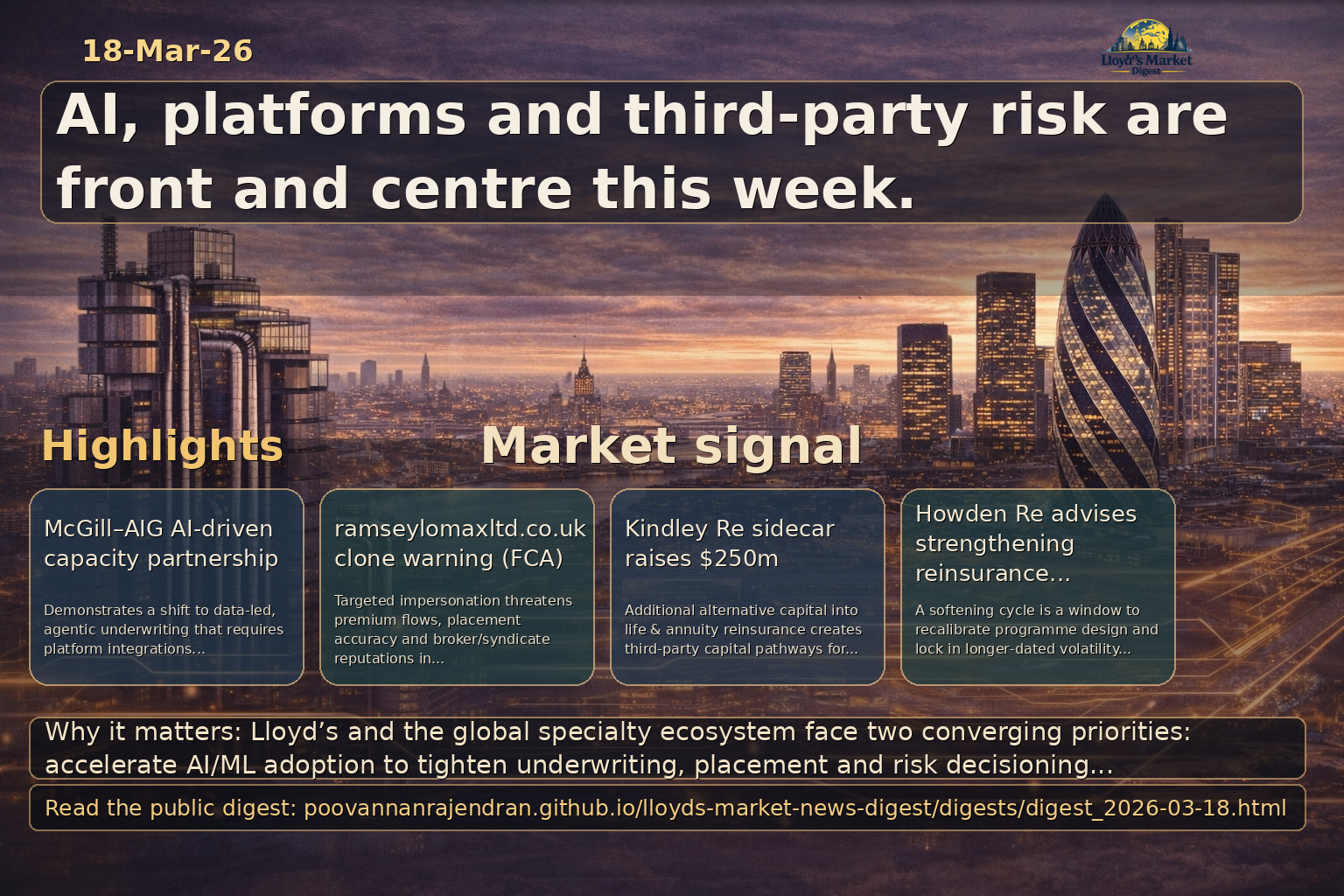
Why it matters: A clone site impersonating an FCA‑authorised firm evidences targeted social‑engineering against UK clients and intermediaries; such impersonations threaten premium flows, placement accuracy and broker/syndicate reputations in specialty lines.
- Immediate action: validate counterparty identity on all premium and instruction flows (call‑back to registered FCA numbers, electronic certificate checks) and block transactions until verified.
- Platform controls: enforce domain and email authentication (SPF, DKIM, DMARC) and marketplace listing verification for placement portals and third‑party broker interfaces.
- Communications: issue proactive client and distribution partner alerts outlining verification steps; coordinate with carriers to confirm contract terms and premium routing to mitigate misdirected payments.
Source: fca.org.uk
Why it matters: Unauthorised providers promoting financial services signal a broader targeting of advisory channels and retail investors; brokers and syndicates must assume such actors can impersonate market participants or solicit insurance‑adjacent products to underlying clients.
- Due diligence: expand AML/KYC checks to include recent warning lists and IP/domain intelligence during broker and MGAs onboarding.
- Distribution risk: require proof of authorisation and written confirmation of regulatory status before accepting business or co‑broking arrangements.
- Incident playbook: integrate detection of unauthorised promotions into cyber and fraud response plans; preserve evidence and notify regulators promptly to limit contagion.
Source: fca.org.uk
Why it matters: Multiple clone identities using names of well‑known lenders highlights scalable impersonation tactics; for the insurance market this manifests as fraudulent premium financing solicitations, spoofed claims intermediaries, or fake collateral arrangements affecting syndicates and placement platforms.
- Premium finance controls: verify finance providers through independent registries and contract counterparty due diligence before recognising financed premiums on binders.
- Platform verification: introduce automated screening of counterparty names across known clone patterns and block high‑risk inbound communication channels.
- Contract hygiene: require escrowed premium receipt mechanisms or verified bank details for new or changed instructions, and mandate dual approval for account changes.
Source: fca.org.uk
Why it matters: A clone of FCA firms operating under a deceptive domain can be used to harvest broker logins, misroute placement instructions or manipulate renewal notices — direct threats to syndicate underwriting accuracy and platform security.
- Access security: enforce multi‑factor authentication and device posture checks for all broker and carrier portal access; rotate credentials after any suspected exposure.
- Logistics: require confirmation of placement amendments by an independent, registered contact at counterparty firms prior to effecting policy changes.
- Brand monitoring: deploy continuous monitoring for look‑alike domains and rapid takedown arrangements; maintain a central contact to escalate suspected clones to regulators and hosting providers.
Source: fca.org.uk
Why it matters: Entities promoting speculative investment or signal services (eg. 'Gold Signals') can be vectors for phishing and payment fraud targeting high‑net‑worth policyholders and corporate treasury functions, exposing insurers to reputational and recovery costs.
- Client education: advise relationship managers and wholesale brokers to brief corporate and HNW clients on recognising investment‑related scams and verifying any third‑party service tied to premiums or claims.
- Treasury controls: segregate premium receipt and investment instructions; never allow third‑party investment advice to alter payment routing or collateral arrangements without independent verification.
- Recovery posture: ensure legal and claims teams are prepared to pursue rapid injunctions, asset tracing and co‑operation with financial crime agencies when client funds are misappropriated.
Source: insurancetimes.co.uk
Why it matters: The FCA’s handling of MGA regulation and MGAA commentary clarifies manufacturing and co‑manufacturing boundaries — a material regulatory development for MGAs, brokers and carriers operating in London.
- Regulatory clarity reduces execution risk for MGA-insurer arrangements and informs delegated authority design.
- May lower compliance burden in certain models while reinforcing the need for clear contractual governance.
- Encourages continued engagement between industry bodies and the regulator, improving predictability for market participants.
Source: insurancetimes.co.uk
Why it matters: FOS and FCA redress system updates materially affect dispute resolution and claims handling practices for brokers, insurers and MGAs within the London market.
- New registration stage should improve case readiness and reduce administrative delays in handling complaints.
- Powers to dismiss matters better suited for court could lower costs and exposures for firms defending complex claims.
- Clarifications to 'fair and reasonable' standards will influence settlement strategies and operational complaints processes.
Source: artemis.bm
Why it matters: Kindley Re’s additional $250m equity illustrates expansion of alternative capital into life & annuity reinsurance, signalling broader investor interest in longevity and mortality risk transfer solutions.
- Creates a third-party capital pathway for life and annuity writers to scale underwriting without proportionate balance-sheet strain—reinsurers should evaluate co-invest models
- Brokers in life & annuity placements can leverage sidecar-like structures to match institutional capital to specific product portfolios
- Syndicates and platforms focused on life risk should enhance investor reporting and governance frameworks to attract repeat institutional capital
Source: artemis.bm
Why it matters: Hannover Re’s growth in securitised reinsurance and ILS collateral volumes reflects reinsurers’ expanding role as originators, sponsors and fronting partners—shaping distribution, capacity and structuring for the broader market.
- Increases competitive pressure on traditional retrocession markets while offering cedants more bespoke capital market solutions
- Provides syndicates and brokers with additional sponsor and fronting pathways to access institutional investors and ILS funding
- Placement platforms should map Hannover Re-style capabilities to client needs to expedite securitisation or fronted transactions
Source: businessinsurance.com
Why it matters: Fuel and war-risk surcharges by a major cargo operator amplify underwriting and placement implications for marine and supply-chain portfolios, directly affecting London market and global specialty brokers and syndicates.
- Immediate upward pressure on cargo rates and reallocation of premium to war/terrorism and commodity-linked surcharges.
- Greater segmentation of war-risk capacity; syndicates and reinsurers need clearer wordings and exclusion management to prevent accumulation risk.
- Brokers and placement platforms must proactively communicate coverage gaps to clients, reprice transit exposures and offer alternative parametric or contingency solutions.
Source: businessinsurance.com
Why it matters: Echo Re’s planned branch in GIFT City represents a strategic onshore reinsurance expansion into India, with implications for market access, competitive capacity and broker distribution strategies in Asia.
- Increases locally domiciled capacity, offering cedents onshore options that may compete with Lloyd’s and international reinsurers for Indian business.
- Facilitates streamlined placements and regulatory efficiency, reducing friction for brokers arranging reinsurance and retrocession in-market.
- Signals need for London and global brokers to reassess distribution models and partner with onshore reinsurers or placement platforms to retain client flows.
Source: businessinsurance.com
Why it matters: SiriusPoint’s launch of a London specialty division is a direct competitive development for the Lloyd’s marketplace and specialty syndicates, affecting capacity dynamics and broker relationships in the London hub.
- Represents strategic onshore underwriting presence aiming to capture specialty lines that have historically flowed to Lloyd’s syndicates.
- Will require brokers and placement platforms to evaluate SiriusPoint as an alternative capacity source and to integrate its product appetite into placement strategies.
- May accelerate market consolidation and push syndicates to differentiate via service, distribution partnerships and bespoke policy forms.
Source: businessinsurance.com
Why it matters: Operational disruptions at a major port raise concentrated accumulation and transit risk for cargo insurers and syndicates, prompting urgent reappraisals of marine exposure and supply-chain policies.
- Concentrated rerouting and delay exposures can lead to correlated losses across cargo portfolios and stress accumulation thresholds in syndicates’ books.
- Heightened demand for war/strikes/port disruption endorsements and potential for higher deductible or premium adjustments on affected trade lanes.
- Brokers should advise clients on contingency coverage, clause updates, and consider parametric triggers as part of holistic transit risk placement.
Source: businessinsurance.com
Why it matters: Public profiles of industry executives provide indicators of sector leadership, network influence and potential strategic shifts that brokers and syndicates monitor when forming alliances and placing business.
- Leadership visibility affects counterparty selection by brokers and syndicates and can presage strategic partnerships or product initiatives.
- Profiles help market participants assess experience relevant to specialty lines, underwriting governance and distribution priorities.
- Tracking executive movement supports talent-succession planning and identifies potential new points of entry for placement platforms seeking partnerships.
Source: globalreinsurance.com
Why it matters: Howden Re’s advisory that cedents should strengthen reinsurance protection as primary rates ease is material for Lloyd’s syndicates, global specialty carriers and brokers because it signals a window to recalibrate programme design, reduce earnings volatility and capture long‑term client relationships in a softening market.
- Boards should mandate a programme review to convert short‑term pricing gains into longer‑dated volatility protection (higher limits, layered time‑bound covers, parametric overlays).
- Syndicates and reinsurers should use the current competitive environment to competitively price structured and multi‑year solutions while enforcing underwriting discipline to avoid margin erosion.
- Brokers and placement platforms must proactively advise clients on retrocession strategy, aggregation monitoring and contract wordings to lock in protection before risk appetites normalise.
Source: globalreinsurance.com
Why it matters: The McGill–AIG AI‑driven capacity arrangement demonstrates a shift to data‑led, agentic underwriting across broker platforms; this has direct implications for subscription markets, Lloyd’s managing agents and capacity allocation models tied to platform automation and governance.
- Evaluate platform integrations and data pipelines to enable real‑time eligibility checks and automated capacity allocation while preserving manual escalation paths for complex risks.
- Implement robust model and AI governance (validation, audit trails, explainability) as underwriters and syndicates rely on agentic tools to accept capacity commitments at scale.
- Review capital and concentration controls: platform‑driven scaling can increase correlated exposures — require live aggregation dashboards and dynamic limit controls across syndicates and reinsurers.
Source: globalreinsurance.com
Why it matters: Price Forbes’ expansion of a Singapore treaty team with senior hires reinforces the strategic importance of Asia for reinsurance distribution; for Lloyd’s and global specialty providers this increases treaty flow, creates placement opportunities and intensifies competition for regional premium pools.
- Managing agents and syndicates should deepen broker engagement in Singapore to secure treaty and facultative flow and consider dedicated market desks or delegated authority partnerships.
- Placement platforms should optimise APAC workflows, timezones and regulatory interfaces to capture ceded premium and improve hit‑rates for treaty submissions.
- Talent retention and succession planning in regional broking teams are critical to sustaining onshore client relationships and converting treaty placements into long‑term capacity relationships.
Source: globalreinsurance.com
Why it matters: QBE Re’s appointment of a Southeast Asia head signals reinsurer commitment to on‑the‑ground underwriting and portfolio management in the region, affecting Lloyd’s syndicates and brokers by shifting competitive dynamics and creating more targeted treaty and facultative capacity options.
- Coordinate underwriting strategies with regional reinsurers — leverage local expertise to develop tailored treaty terms and risk mitigation measures for Southeast Asia exposures.
- Brokers should align placement strategies to new reinsurer underwriting criteria and cultivate long‑term panel relationships to improve placement certainty for Lloyd’s-led risks.
- Syndicates must monitor regional pricing movements and consider bespoke products (flood, typhoon, supply‑chain) backed by locally informed underwriting and catastrophe modelling.
Source: globalreinsurance.com
Why it matters: AM Best’s warning that a prolonged Middle East conflict could test global re/insurance markets is a strategic signal to Lloyd’s, global specialty carriers, brokers and placement platforms that indirect economic impacts — inflation, supply‑chain shocks and financial volatility — may exceed direct insured losses and stress capital models.
- Immediate action: run reverse stress tests and scenario analyses on macroeconomic channels (inflation, interest rates, FX) and trade disruptions to quantify solvency and liquidity impacts across syndicates and retrocession programmes.
- Reassess policy wordings, war exclusions and allocation clauses; brokers should map client exposures and advise temporary reinsurance overlays or exclusions to limit unintended aggregation.
- Ensure placement platforms and capacity partners have contingency playbooks for market dislocation (operational continuity, dynamic pricing feeds, accelerated collateral calls) and communicate solvency‑related indicators to stakeholders.
Source: insurancejournal.com
Why it matters: California private-market withdrawal into the FAIR Plan signals constrained private property capacity and heightened reinsurance and facultative demand from specialty markets, relevant to Lloyd's syndicates underwriting catastrophe-exposed portfolios and brokers managing placement gaps.
- Material shift of lower-risk accounts to state backstops increases adverse selection and elevates loss experience for residual market exposures.
- Creates demand for Lloyd’s/syndicate appetite in catastrophes, parametric products and layered reinsurance to fill gaps or offer alternative cover beyond FAIR Plan’s limited policies.
- Brokers and placement platforms must re-evaluate client placement strategies, pricing adequacy, inspections and risk mitigation conditions to secure capacity for exposed homeowners.
Source: insurancejournal.com
Why it matters: Late notification and insurer recoupment disputes highlight contract certainty and claims governance risks that directly affect excess insurers, reinsurance recoveries and broker duties in casualty and public-entity placements.
- Excess underwriters and syndicates face recoupment exposure when insureds or cedants fail to meet “as soon as practicable” notice clauses; precedent increases vigilance on reporting language.
- Brokers must enforce strict client notification protocols and confirm layered-policy trigger alignment to protect reinsurers and excess capacity from avoidable disputes.
- Placement platforms and claims teams should implement audit trails and notification workflows to demonstrate compliance and limit subrogation/recovery disputes.
Source: insurancejournal.com
Why it matters: Evidence of Iran-influenced navigation routes through the Strait of Hormuz underscores shipper/operator adaptation to sovereign control, raising marine war, hull and cargo exposures that will impact Lloyd’s marine syndicates and brokered war-risk placements.
- Insurers will see elevated frequency of non-standard voyages and potential exclusions related to sanctioned waters, requiring explicit voyage terms and enhanced premiums for Gulf transits.
- Placement platforms and brokers must capture voyage specifics and advise clients on war-risk, kidnap/ransom and hull/machinery endorsements tied to coastal routing.
- Syndicates should reassess pricing, capacity allocation and reinsurance attachment points for Middle East-exposed marine portfolios.
Source: insurancejournal.com
Why it matters: Escalating Middle East hostilities and rising energy costs exacerbate European corporate distress, increasing demand for trade-credit, political-risk and directors & officers (D&O) protection underwritten by specialty and Lloyd’s markets.
- Heightened corporate distress drives claims frequency for trade credit and D&O policies; syndicates must scrutinise collateral, concentration risk and trigger wording.
- Brokers should proactively advise corporate clients on liquidity-preserving insurance solutions including political-risk and supplier-disruption covers.
- Reinsurers and syndicates must stress-test portfolios for correlated insolvency/performance exposures and consider tightening limits or increasing premiums in high-exposure sectors.
Source: insurancejournal.com
Why it matters: IMO commentary that naval escorts are not a panacea reinforces long-term underwriting uncertainty for transits through Hormuz, pressuring marine war-risk underwriting, P&I considerations and placement strategies across Lloyd’s and global specialty markets.
- Naval escorts do not eliminate war/mine risk; underwriters will maintain or widen endorsements and exclusions and demand higher war-risk premiums.
- Brokers and charterers must factor in elevated insurance premiums, additional warranties and voyage rerouting costs when negotiating charters and cargo contracts.
- Placement platforms should enable rapid quote aggregation for war-risk and contingency cover given volatile market conditions and potential sudden spikes in demand.
Source: insurancetimes.co.uk
Why it matters: Markel’s senior hires materially strengthen broker distribution and change-management capability in the UK — directly relevant to broker engagement with Lloyd’s and London specialty capacity.
- Improves broker touchpoints and ease of trading, increasing attractiveness to wholesale brokers and syndicates.
- Signals investment in regional distribution strategy (Manchester/Leeds) that can broaden access to specialty lines and placement flow.
- Enhances change execution capability to align distribution channels with regulatory and market reforms (CDR/MRC implications).
Source: insurancetimes.co.uk
Why it matters: IUA Futures addresses a critical London-market skills gap by delivering technical underwriting, wording and network access that underpin syndicate and broker productivity.
- Bootcamps and policy-wording masterclasses accelerate readiness of entrants to work on complex London and Lloyd’s placements.
- Strengthens pipeline of technically proficient underwriters and brokers for specialty and syndicate desks.
- Facilitates retention through professional networks, reducing recruitment friction for brokers and carriers.
Source: reinsurancene.ws
Why it matters: Historical archive content underscores cyclical underwriting outcomes and catastrophe-driven P&C volatility that remain relevant to syndicates and brokers for benchmarking and resilience planning.
- Provides historical evidence of cat-loss impacts on underwriting results, useful for stress-testing current syndicate portfolios
- Benchmarks prior combined ratios and earnings volatility to inform pricing and capacity discussions with capital providers
- Serves as an archival reference for brokers and platform teams when advising clients on catastrophe protection strategies and reserving
Source: reinsurancene.ws
Why it matters: Certua Life’s embedded distribution model demonstrates how new insurers can use technology to reach underpenetrated protection markets — a distribution evolution brokers and placement platforms must consider.
- Signals growing competition and partnership opportunity for brokers to embed protection into digital channels and platforms
- Creates potential reinsurance demand and partnership openings for syndicates and reinsurers to support innovative distribution models
- Highlights a blueprint for integrating regulatory approvals with tech-enabled distribution relevant to Lloyd’s market distribution strategies
Source: reinsurancene.ws
Why it matters: BirdsEyeView’s CERA platform (with high-resolution peril models and forthcoming AI co-pilot) materially changes exposure management and underwriting precision — a strategic tool for syndicates, carriers and brokers.
- Street-level wildfire, cyclone and earthquake models improve risk selection, pricing accuracy and placement arguments to capital providers
- Quarterly updates and a CERA AI co-pilot can accelerate submission handling and decisioning on digital placement platforms
- Enhances model governance and auditability required by Lloyd’s and large brokers for treaty and facultative placements
Source: reinsurancene.ws
Why it matters: SCOR’s earnings recovery and upgraded outlook reflect reinsurer balance-sheet strength that influences market capacity, retrocession pricing and treaty negotiations relevant to syndicates and brokers.
- Demonstrates available reinsurance capacity and willingness to underwrite higher-return strategies, affecting treaty structuring
- Improved capital metrics reduce counterparty credit concerns for Lloyd’s syndicates and wholesale brokers
- Provides a pricing and capacity signal that brokers can leverage during renewal conversations with clients
Source: reinsurancene.ws
Why it matters: Swiss Re’s analysis on ultra-processed food liabilities highlights an emergent long-tail casualty risk that specialty underwriters, brokers and placement platforms must monitor and price accordingly.
- Identifies potential growth in product-liability litigation exposure that could reshape appetite in food and consumer product classes
- Advocates for proactive policy design, exclusions and aggregation management by syndicates and carriers
- Requires brokers to update client risk disclosures and risk-transfer solutions to mitigate evolving litigation trajectories
Source: bankofengland.co.uk
Why it matters: CP5/26 is directly relevant to Lloyd's managing agents, syndicates and the brokers and placement platforms that support them because it reframes liquidity expectations and the treatment of cash, intragroup funding and collateral in a market where timely settlement and capital flows are central to capacity, underwriting and reinsurance placement.
- Immediate liquidity modelling: run forward-looking liquidity stress-tests under the consultation's proposed time horizons and assetEligibility assumptions to quantify additional liquid buffer requirements and the impact on syndicate capital allocation and ledger liquidity.
- Platform and settlement review: map end-to-end cash and collateral flows across brokers, placement platforms and syndicate accounts; identify concentration points, shorten settlement cycles where possible and develop pre-funding or contingent settlement solutions to avoid market disruption.
- Regulatory engagement and governance: coordinate a market response (via Lloyd’s Market Association and major brokers), update liquidity governance and contingency funding plans, and prepare operational/legal changes for intragroup limits, collateral terms and reporting enhancements demanded by the PRA.
Source: artemis.bm
Why it matters: BirdsEyeView’s CERA platform raises the precision of nat-cat analytics, affecting underwriting, exposure aggregation and placement optimization across Lloyd’s syndicates and global specialty portfolios.
- Enable more granular risk selection and pricing at street-level resolution to reduce accumulation risk and improve syndicate portfolio decisions
- Integrate updated wildfire, cyclone and earthquake models into placement platform workflows to support clearer client conversations and tailored retrocession strategies
- Require internal model validation, data ingestion pipelines and broker training to capitalise on enhanced analytics during renewals and submissions
Source: artemis.bm
Why it matters: Pool Re’s return to the cat bond market via a Baltic PCC issuance signals demand for market-based terrorism retrocession and creates placement timing and capacity implications for specialty brokers and syndicates.
- Reinforces capital market appetite for political/terrorism peril structures—syndicates should assess implications for appetite and pricing of UK-exposed portfolios
- Placement platforms must be prepared for sovereign/mutual-sponsored deal mechanics, investor due diligence and timing around pricing and settlement
- Opportunity for brokers to package complementary retrocession/ILS solutions for cedants seeking multi-layer terrorism protection
Source: artemis.bm
Why it matters: W. R. Berkley’s increased use of the Lifson Re sidecar illustrates primary insurers’ reliance on collateralised vehicles to scale capacity efficiently—relevant to capital strategy and competitive dynamics for Lloyd’s syndicates.
- Demonstrates how sidecars can be leveraged to shift risk off-balance-sheet and optimise return on equity—boards should evaluate similar structures where appropriate
- Increases competition for primary risk and may compress spreads for syndicates relying on traditional retrocession channels
- Placement platforms and brokers should position sidecar-friendly transaction templates and investor communications to accelerate execution
Source: risk.net
Why it matters: Risk.net's CRO survey shows operational risk and AI adoption are near-term board priorities, directly affecting underwriting models, broker workflows and placement platforms across specialty markets.
- Elevate model governance: implement independent validation, explainability and version control for AI/ML pricing and triage tools used by syndicates and brokers to reduce model risk and regulatory exposure.
- Third‑party oversight: enforce rigorous due diligence and contractual SLAs for cloud and data vendors supporting placement platforms to mitigate concentration and service‑outage risk.
- Operational controls and culture: embed AI risk scenarios into enterprise stress tests, incident playbooks and training for underwriters and brokers to preserve underwriting quality and client trust.
Source: risk.net
Why it matters: LSEG’s TradeAgent proposition highlights how platformised post‑trade solutions can reduce fragmentation, a lesson directly applicable to post‑placement reconciliation, accounting and reinsurance settlement in the specialty market.
- Treat post‑placement as strategic: evaluate standardised platforms for premium reconciliation, bordereau exchange and reinsurance settlements to reduce operational costs and failure points across brokers and syndicates.
- Prioritise common data standards: invest in and adopt interoperable data schemas and API integrations to improve straight‑through processing between MGAs, brokers, syndicates and placement platforms.
- Assess build vs partner: conduct a cost‑benefit and resilience analysis to decide whether to integrate with established post‑trade vendors or develop proprietary capabilities, with explicit KPIs for uptime, latency and data quality.