Source: reinsurancene.ws
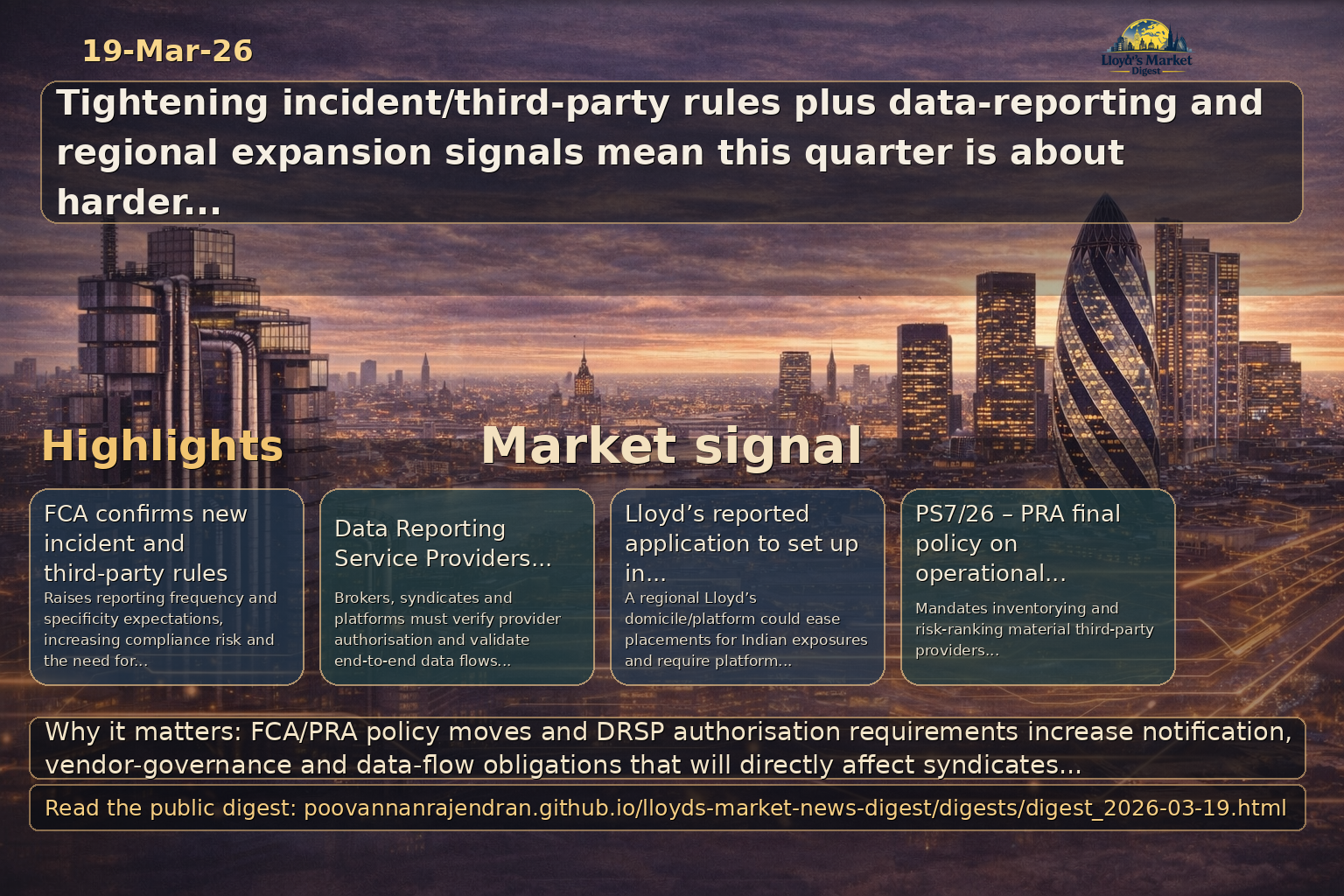
Why it matters: Reports that Lloyd's has applied to set up in India's GIFT City represent a strategic initiative to extend marketplace presence, access local capacity and support global brokers and clients with a regional domicile and platform.
- Market access: Lloyd's presence in GIFT City could ease placements for brokers with Indian exposures and attract regional cedants seeking international capacity without UK-only structures.
- Regulatory and tax efficiency: Syndicates and managing agents should assess capital, reporting and tax implications of operating within an IFSC framework to optimise deployment strategies.
- Platform readiness: Placement platforms and brokers should prepare for integration with new Lloyd's regional systems and potential product innovations tailored to the South Asian risk landscape.
Source: fca.org.uk
Why it matters: The FCA's confirmation of clearer incident and third‑party reporting rules raises reporting frequency and specificity expectations. For Lloyd’s syndicates, global specialty brokers and placement platforms — all heavily dependent on cloud providers, data vendors and intermediation platforms — this increases compliance risk, operational exposure and the need for faster, co‑ordinated incident response.
- Immediate: conduct a prioritized third‑party dependency inventory and map reporting responsibilities across syndicates, brokers and platform vendors to meet the tightened notification timelines.
- Contractual: update service level agreements and breach notification clauses with core providers (cloud, market data, platform vendors) to ensure regulatory reporting obligations can be met and liability is clarified.
- Resilience: test end‑to‑end incident detection and notification paths (internal teams, placing platforms, market systems and FCA reporting) with tabletop exercises and update governance to ensure executive escalation triggers.
Source: fca.org.uk
Why it matters: DRSPs (ARMs, APAs, CTPs) are central to market transparency and regulatory reporting. Authorisation/verification requirements mean brokers, syndicates and placement platforms must ensure their chosen providers meet FCA standards, and that data flows, reconciliation and publication processes are robust for supervisory reporting and market integrity.
- Assessment: review and document which DRSP categories you rely on (ARMs/APAs/CTPs), verify provider authorisation status with the FCA, and validate end‑to‑end data flow and reconciliation processes.
- Integration: upgrade APIs, reporting pipelines and data governance controls on placement platforms and broker systems to meet DRSP format and timeliness expectations and reduce reconciliation risk for syndicates.
- Contingency: develop DRSP continuity plans and fallbacks (including contractual rights and alternate providers) to mitigate service disruption risk and ensure regulatory reporting obligations remain deliverable.
Source: reinsurancene.ws
Why it matters: Arrowhead Programs' consolidation of professional lines capabilities reflects a broader trend of MGAs and programme managers centralising expertise, which affects distribution dynamics and capacity deployment across specialty lines.
- Distribution efficiency: Brokers should expect simplified product interfaces and faster placement cycles from unified programme groups, requiring adjustments in broker-panel workflows.
- Capacity alignment: Syndicates and carriers must reassess capacity commitments to consolidated MGAs, focusing on scaled underwriting governance and performance metrics.
- Platform integration: Placement platforms should prioritise connectivity to aggregated MGA product suites and standardized data to support volume and automated placements.
Source: businessinsurance.com
Why it matters: Legislative changes setting liability minimums for events affect primary and excess liability demand, policy limits and attachment points — relevant to brokers placing event programs and syndicates underwriting event/excess exposures.
- Brokers should proactively advise event clients on required limits and design placement structures that manage attachment and aggregate risk
- Syndicates underwriting event liability must reassess exposure concentrations in jurisdictions adopting new minimums
- Placement platforms need to incorporate jurisdictional liability rules and automated limit-checking into submission validation
Source: businessinsurance.com
Why it matters: A court granting maximum benefits in a truck driver back-injury case signals elevated severity outcomes for commercial auto and workers’ compensation exposures. That outcome has direct implications for specialty casualty underwriters, broker pricing strategy, reinsurance layers and claims-reserving practices across Lloyd’s syndicates.
- Reassess casualty pricing and appetite: syndicates and delegated underwriters should re-evaluate loss assumptions, attachment points and reserves for U.S. trucking exposures.
- Strengthen claims management and medical cost containment: brokers and carriers must prioritize networks, case management and litigation defence strategies to limit severity trend impact.
- Adjust placement and reinsurance structures: placement platforms and cedents should review facultative/reinsurance terms and consider tighter underwriting information requirements for motor and occupational exposures.
Source: businessinsurance.com
Why it matters: Proposed Louisiana legislation to create a medical claims database and revise fee schedules will increase claims transparency and put downward pressure on medical payment rates. For insurers and brokers working in U.S. specialty casualty, that regulatory shift affects reserving, pricing models and the competitive position of carriers offering workers’ comp and medical payment coverages.
- Monitor regulatory rollout and data access: placement platforms and underwriters should secure timely access to the database to recalibrate loss-cost models and underwriting guidelines.
- Update pricing and network strategies: brokers need to evaluate provider networks, utilization management and fee-schedule impacts when advising clients and negotiating placement terms.
- Engage proactively with regulators and clients: syndicates and carriers should participate in stakeholder discussions to shape implementation and prepare compliance, claims analytics and IT integration plans.
Source: businessinsurance.com
Why it matters: Marsh’s finding that terrorism insurance take-up has declined over five years highlights waning buyer demand for standalone terrorism coverage. For Lloyd’s and global specialty markets this reduces ceded premium pools but raises concentration and tail-risk considerations for insurers that continue to provide capacity.
- Re-evaluate product positioning and bundling: carriers and brokers should consider integrated property-casualty packages, parametric triggers or modular endorsements to regain buyer engagement.
- Reassess capacity allocation and stress testing: syndicates must model lower premium volumes and higher per-event concentration, adjusting reinsurance and capital planning accordingly.
- Use placement platforms to simplify access: brokers should leverage platforms to present modular terrorism solutions, scenario analytics and clearer cost-benefit narratives to clients.
Source: businessinsurance.com
Why it matters: CRC Group’s launch of an Insurisk Data Centers product underscores targeted innovation in high-value property and cyber-adjacent lines. Data center coverage represents a growing specialty niche where detailed engineering, cyber exposure analysis and streamlined placements are commercially attractive to Lloyd’s syndicates and global brokers.
- Integrate specialized underwriting and cyber analytics: syndicates should combine property, business interruption and cyber causal analysis, and insist on standardized data sets for effective risk selection.
- Partner on risk engineering and loss-prevention services: brokers and capacity providers can differentiate by offering pre-bind engineering, resilience assessments and incident-response coordination.
- Deploy placement-platform workflows: use digital platforms to standardize questionnaires, enable faster binding, and capture loss-prevention metrics to improve pricing accuracy and portfolio oversight.
Source: insurancetimes.co.uk
Why it matters: The Sodalis acquisition of Amiga Specialty is emblematic of MGAs being aggregated into global specialty platforms—relevant to Lloyd's syndicates and brokers seeking scalable underwriting partnerships and distribution reach.
- Opportunity for syndicates to access an underwriting-led MGA platform that can source niche specialty risks and accelerate delegated authority arrangements.
- Brokers should reassess placement strategies to leverage MGA-led capacity pools and API-enabled binding, while preserving negotiation leverage on complex risks.
- Operational due diligence priority: integration of data, regulatory oversight, and reinsurance/retrocession alignment as MGAs scale internationally.
Source: insurancetimes.co.uk
Why it matters: The Glasgow historic building fire highlights concentration and severity risks in heritage property portfolios—an immediate concern for property underwriters, syndicates and brokers placing business interruption (BI) cover.
- Expect reassessment of occupancy, construction and aggregation exposures; syndicates may tighten wordings, exclusions, or increase premiums for historic masonry/timber-floor properties.
- Brokers and placement platforms should demand enhanced risk engineering data and loss-prevention protocols to support capacity and limit term deterioration.
- Reinsurers and syndicates will revisit aggregation modelling and catastrophe scenarios for urban historic clusters, informing capital allocation and appetite.
Source: insurancetimes.co.uk
Why it matters: The MoneySuperMarket and Blue Light Card partnership illustrates continued retail distribution innovation and affinity channel growth that can shift volumes away from traditional broker channels into comparison-led journeys.
- While consumer-focused, the development signals pressure on brokers to differentiate through bespoke specialty advice and value-added placement services that comparison engines cannot replicate.
- Placement platforms should monitor affinity pipeline strategies and consider API-level distributor integrations to capture niche affinity flows or white-label opportunities.
- Syndicates writing personal lines should reassess product packaging, digital quoting speed and commissions structure given downstream comparison-engine influences on pricing transparency.
Source: insurancetimes.co.uk
Why it matters: EY's creation of a commercial and specialty insurance unit signals consulting momentum behind specialty market transformation—relevant for Lloyd's, syndicates and brokers planning operating-model change.
- Advisory focus on specialty operating models will accelerate cloud migration, target-operating-model redesign and front-to-back automation affecting syndicate cost structures.
- Brokers and managing agents should proactively engage consultancies to benchmark distribution economics and placement throughput against evolving specialty peers.
- Consulting-led segmentation underscores need for tailored governance and regulatory frameworks for specialty products and delegated authorities.
Source: insurancetimes.co.uk
Why it matters: Aon reporting meaningful enhancements to employee benefits underscores intensified competition for underwriting and broking talent—a strategic issue for specialty desks and syndicate capability retention.
- Syndicates and brokers must view benefits and flexible working as components of talent risk management to retain technical underwriting expertise critical for complex specialty lines.
- Human capital investments support succession planning for delegated authority management and reduce operational concentration risk from key underwriters.
- Executive teams should align compensation and benefits design with remote/field risk engineering roles to sustain client-facing technical capacity.
Source: reinsurancene.ws
Why it matters: Archive listing provides historical pricing and margin commentary useful for benchmarking current Lloyd's and global specialty market cycles and underwriting margin trajectories.
- Use archival pricing/margin commentary to calibrate current cycle positioning and to validate syndicate rate adequacy assumptions.
- Inform long-tail reserve and catastrophe modelling by comparing past nat-cat impacts and margin attrition patterns.
- Support strategic communications with capacity providers by referencing historical stabilisation signals when negotiating terms.
Source: reinsurancene.ws
Why it matters: Investment by B.P. Marsh into Ventura underscores continued investor appetite for Lloyd's/London-focused niche brokers and the strategic value of energy-specialist distribution in the market.
- Start-up broker funding signals opportunity for incumbents and syndicates to engage early with niche distribution for energy placements.
- Brokers and placement platforms should map potential new bilateral or delegated authorities with Ventura-style specialists to secure differentiated access to energy risks.
- Capacity providers should assess economics of providing capital to broker-led platforms given potential for bespoke terms and enhanced placement efficiency.
Source: reinsurancene.ws
Why it matters: Fidelis Partnership's substantial written premium and MGA/cell growth highlights the continued expansion of managed platforms and the scale-up of multi-provider arrangements relevant to Lloyd's and global specialty capacity strategies.
- Growth of Pine Walk MGA cells indicates syndicate and capacity-provider interest in modular, cell-based distribution—relevant for capital allocation and partner selection.
- Sustained EBITDA and margin performance supports investor appetite for high-conviction underwriting platforms; review reinsurance and retrocession strategies to protect returns.
- Brokers must consider implications for placement routes as larger MGA platforms absorb specialty flow that historically went through traditional syndicates.
Source: bankofengland.co.uk
Why it matters: SS1/26 sets PRA expectations for how firms must report operational incidents that threaten firm safety, policyholder protection or UK financial stability. For Lloyd's market entities and placement platforms this defines the scope, timing and granularity of incident notifications and creates an enforceable standard of operational resilience ahead of the 18 March 2027 effective date.
- Confirm applicability: map Lloyd’s managing agents, syndicates, brokers and platform functions to the PRA categories and identify which incidents trigger reporting obligations.
- Update incident playbooks and escalation paths to meet PRA timing and content requirements, including clear roles for syndicate staff, delegated authority managers and brokers handling notifications.
- Conduct data and systems readiness assessment to ensure timely collection and secure transmission of incident data from placement platforms and third‑party providers to support accurate PRA reporting.
Source: bankofengland.co.uk
Why it matters: PS7/26 finalises policy on operational incident and third‑party reporting, addressing consultation responses and reducing administrative burden while maintaining PRA oversight of outsourcing and material third‑party arrangements. This directly affects how syndicates, carriers and brokers must notify the PRA of MTP arrangements and material changes to outsourced services, including platform dependencies used for global specialty placements.
- Inventory and risk‑rank third‑party/service provider arrangements used in underwriting, claims and placement platforms; identify MTPs and update contracts to include notification and audit rights aligned with PRA expectations.
- Implement a proportionate MTP governance framework—vendor due diligence, continuous monitoring, escalation triggers and contingency/resilience plans—to demonstrate control without undue operational overhead.
- Engage with market utilities, delegate management teams and cross‑market broker platforms to establish standardized data templates and notification workflows to reduce duplication and support PRA supervisory oversight.