Source: artemis.bm
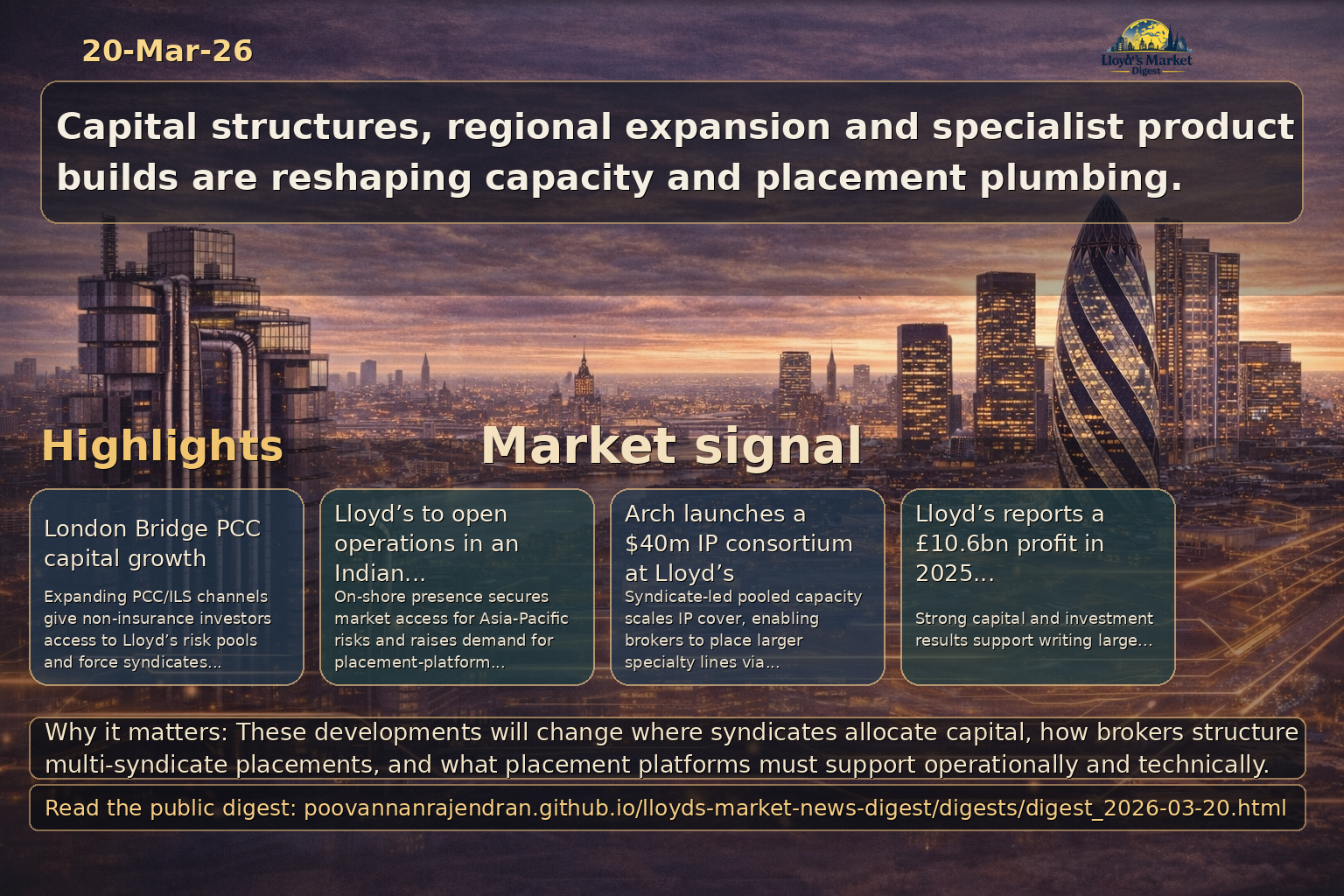
Why it matters: Lloyd’s strategic push for greater capital flexibility and the growth of London Bridge PCC structures (US$2.9bn in 2025) directly influence how capital allocators access diversified insurance risk and how syndicates optimise capital efficiency.
- Align product and capital strategy to attract varied investors: managing agents should offer structures that deliver targeted risk‑adjusted returns to both insurance and non‑insurance allocators.
- Maximise use of PCC/ILS channels: leverage London Bridge and similar vehicles to deploy capital efficiently while retaining market presence.
- Upgrade placement platform integrations: ensure placement systems support PCC/ILS documentation, SPV flows and investor reporting to expedite capital deployment.
Source: businessinsurance.com
Why it matters: Lloyd’s establishing operations in a major Indian financial hub is a strategic decision to secure market access, enhance distribution and support syndicate underwriting of Asia‑Pacific risks.
- Facilitates direct Lloyd’s capacity for local risks and improves service levels for cedants and brokers in India.
- Enhances data collection and loss‑modelling capabilities for regional perils—informing pricing and facultative decisions for syndicates.
- Creates demand for placement‑platform integrations and local compliance frameworks to accelerate cross‑border placements.
Source: globalreinsurance.com
Why it matters: Lloyd's 2025 performance and Patrick Tiernan's five‑year strategy emphasise underwriting discipline, capital strength and return optimisation, setting a market tone that will influence pricing, capital deployment and syndicate entry/expansion decisions during a more competitive phase.
- Syndicate executives should prioritise capital allocation to lines that sustain improved combined ratios and demonstrate clear return targets rather than pursuing volume-driven growth.
- Brokers need to recalibrate placement strategies to balance client demand for capacity with the market's emphasis on disciplined pricing—focusing on differentiated products and risk engineering support.
- Placement platforms and market infrastructure must deliver enhanced analytics, currency and capacity management tools to support syndicates and brokers navigating FX impacts, diversified capital pools and multi‑syndicate placements.
Source: globalreinsurance.com
Why it matters: Arch's launch of an intellectual property consortium at Lloyd's demonstrates a syndicate-led, collaborative approach to scale capacity and product breadth for a rapidly growing IP risk perimeter—highlighting how specialised cover can be delivered via pooled syndicate structures.
- Brokers should develop integrated IP risk advisory and placement capabilities to aggregate exposures, document enforceability metrics and structure multi‑syndicate placements effectively.
- Syndicates evaluating participation in product‑specific consortiums can achieve capacity diversification, share loss volatility and accelerate go‑to‑market for niche covers without sole balance‑sheet concentration.
- Placement platforms must support consortium mechanics—streamlined slip/binder processes, coordinated capacity allocation and specialist policy wordings—to shorten time‑to‑placement and improve end‑to‑end client experience.
Source: insurancejournal.com
Why it matters: Lloyd's CEO's public commitment to keep Middle East war cover available signals market intent to support critical marine and energy flows despite elevated risk — affecting broker strategy, syndicate appetite and platform operational readiness.
- Market signal: Availability paired with hardening terms offers brokers a path to place complex risks; expect Lloyd's syndicates to allocate constrained capacity selectively with strict voyage and activity limits.
- Operational readiness: Placement platforms must ensure live capacity visibility, rapid evidence‑of‑cover issuance and pre‑agreed clause libraries to expedite placements during volatile windows.
- Reinsurance coordination: Syndicates should align reinsurance strategy with public statements to avoid capacity shortfall; brokers must manage client expectations on premium and coverage timing.
Source: insurancetimes.co.uk
Why it matters: Lloyd's reported a £10.6bn profit with GWP growth and strong investment returns, yet underwriting results softened and COR rose slightly — a clear mandate to translate capital strength into consistent underwriting performance.
- Reinforces Lloyd's capital advantage and market ability to support large, complex specialty risks, influencing syndicate capacity allocation.
- Higher investment returns offset some underwriting pressure, but the slight COR deterioration increases scrutiny on pricing adequacy and claims inflation management.
- Brokers and placement platforms should anticipate selective capacity deployment and sharper underwriting requirements from syndicates seeking improved margins.
Source: insurancetimes.co.uk
Why it matters: Lloyd's new five-year strategy re-centres the market on underwriting performance, efficiency and maximising capital advantage — a directive that will shape syndicate behaviour, platform investment and broker engagement.
- Expectation of tougher underwriting standards and returns-focused capital deployment from syndicates; marginal capacity may be repriced or withdrawn from lower-return niches.
- A renewed push on efficiency signals accelerated investment in placement platforms, data connectivity and straight-through processing to reduce operating drag across the chain.
- Brokers should align product strategies to Lloyd's priorities, demonstrating underwriting insight and quality of submission data to secure preferred capacity.
Source: insurancetimes.co.uk
Why it matters: Sunsetting the original Blueprint Two vision demonstrates Lloyd's move from ambitious programmes to pragmatic reform execution; this has direct implications for platform projects, syndicate operations and market confidence.
- Market leadership is signalling a pivot from conceptual transformation to deliverable, incremental changes — syndicates must prioritise near-term operational fixes alongside longer-term investments.
- There is reputational and operational risk in large programme resets; brokers and placement platforms should seek clarity on roadmap and data/tech standards to minimise commercial disruption.
- Opportunity exists for third-party platform providers and specialist vendors to bid for modular solutions as Lloyd's seeks pragmatic delivery partners.
Source: reinsurancene.ws
Why it matters: Arch's launch of a $40m IP consortium at Lloyd's demonstrates active capacity expansion for intellectual property risk, validating growing broker demand for large-line specialty solutions and the Lloyd's market's ability to assemble multi-syndicate capacity.
- Capacity signal: Lloyd's is positioning to lead on IP liability and enforcement products — syndicates should assess appetite and backers for adjacent technology and media risks.
- Broker leverage: Brokers can access larger line sizes and multi-syndicate facilities to place complex IP portfolios for corporates and tech clients.
- Product design: Opportunity to standardise policy wordings across consortium participants to accelerate placement throughput on Lloyd's placements platforms.
Source: reinsurancene.ws
Why it matters: Lloyd's 2025 results—10% profit increase and GWP growth to £57.9bn with solid investment returns—signal robust market performance but also competitive pricing and FX headwinds affecting margins and capital allocation.
- Confirms Lloyd's remains an attractive capacity pool—capital providers and syndicates can consider measured growth while safeguarding underwriting discipline.
- Price compression (reported) and FX impacts require focus on expense efficiency and margin management across syndicates.
- Brokers should leverage Lloyd's capacity but structure placements to protect margin and consider currency hedging or clauses where appropriate.
Source: reinsurancene.ws
Why it matters: Lloyd's new strategy following the partial sunset of Blueprint Two prioritises an ecosystem of interoperable solutions, common data standards and reduced placement friction—directly relevant to syndicates, brokers, MGAs and platform providers.
- Mandates vendor and platform alignment to new data and interoperability standards—providers must engage early to influence implementation and maintain market access.
- Creates opportunity to reduce friction in placement processes; syndicates and brokers should pilot integrations that streamline quote-to-bind cycles.
- Encourages governance participation from market participants to shape standards, protecting commercial interests while realising operational efficiencies.
Source: fca.org.uk
Why it matters: An unauthorised entity operating under a corporate-sounding name can expose brokers, managing agents and syndicates to unprotected transactions and reputational risk, particularly where investment or premium-handling services are offered without FCA authorisation.
- Confirm regulatory status: treat any counterparties claiming investment or fiduciary services as high-risk until FCA authorisation or registration is independently verified.
- Limit exposure: avoid accepting instructions or novations from unauthorised firms and ensure contracts preserve right to refuse unfamiliar entities until KYC/AML and regulatory checks are complete.
- Client protection: inform clients that transactions with unauthorised firms fall outside FSCS and FOS protections and log warnings in placement records and audits.
Source: fca.org.uk
Why it matters: A firm presenting as a financial/acquisition entity may be used to solicit corporate funds or collateral in connection with placements or premium finance schemes; such unauthorised actors increase counterparty, credit and settlement risk across international specialty transactions.
- Enhanced onboarding: require corporate counterparties to provide corroborating company registry data (e.g., Companies House), audited financials and verified senior contact details before releasing placement documents or collateral.
- Payment governance: implement strict rules against changing bank instructions by email alone; require in-person confirmation or secure signed amendments routed through known compliance contacts.
- Market alerting: brokers and managing agents should circulate succinct warnings to placement platforms and syndicates when unauthorised or suspicious entities are identified, enabling rapid collective mitigation.
Source: artemis.bm
Why it matters: Howden Re’s analysis flags that higher catastrophe loss loads combined with fading pricing tailwinds require immediate reassessment of reinsurance strategy across cedants and intermediaries.
- Reassess treaty structures and retentions: model heightened loss loads and test multi‑year programme stability under softer rate scenarios.
- Prioritise diversified capacity sources: blend traditional reinsurers, ILS and collateralised solutions to protect underwriting margins.
- Advise clients on margin compression: brokers should develop forward‑looking placement strategies and cost‑of‑risk narratives for C‑suite decision makers.
Source: artemis.bm
Why it matters: The upsizing and extension of Accelerant’s Flywheel Re sidecar demonstrates continued investor willingness to provide collateralised reinsurance capital, and validates technology‑enabled risk exchange models as viable placement channels.
- Explore sidecars and collateralised capital partnerships: syndicates can access flexible, investor‑backed capacity for growth or to manage peak aggregate exposures.
- Evaluate tech‑enabled distribution benefits: placement platforms should assess integration with risk exchanges to increase speed and transparency of capital sourcing.
- Ensure alignment on term and governance: legal, capital and performance metrics must be clearly structured to preserve underwriting control and investor return profiles.
Source: businessinsurance.com
Why it matters: Prolonged Middle East conflict increases frequency and severity uncertainty for specialty lines and reinsurance, directly affecting Lloyd’s syndicate aggregate exposures and pricing assumptions.
- Elevates short‑tail and protracted political violence exposures—impacting war, kidnap & ransom and marine cargo portfolios.
- Drives reinsurance and facultative demand as syndicates seek to limit aggregation risk and preserve capital.
- Brokers and placement platforms must reassess conflict clauses, escalation triggers and aggregation modelling when structuring global placements.
Source: businessinsurance.com
Why it matters: QBE taking full control of its Indian JV signals consolidation of capacity and distribution strategy in a high‑growth market—relevant to syndicates, brokers and platforms seeking partnerships or alternative capacity lines in India.
- May expand local capacity for international placements and influence pricing in Indian specialty lines.
- Creates potential for strategic partnerships between Lloyd’s brokers and QBE for on‑shore underwriting solutions.
- Signals competitive pressure for other global carriers to localize operations or reconfigure placement terms in India.
Source: businessinsurance.com
Why it matters: HDI Global expanding cyber offerings in Japan highlights continued growth in cyber demand across APAC and the need for tailored coverage and placement solutions.
- Reinforces opportunity for Lloyd’s syndicates and specialty brokers to provide excess and tailored cyber capacity in Japan.
- Heightens requirement for cyber risk data, model validation and standardised policy wordings across brokers and platforms.
- Operational incidents and supply‑chain exposures in APAC increase cross‑border aggregation risk for global cyber portfolios.
Source: businessinsurance.com
Why it matters: Profile of Phil Hobbs—useful for market intelligence and relationship mapping between Lloyd’s brokers, syndicates and the Business Insurance editorial ecosystem.
- Identifies a thought leader or contact whose commentary can influence market perception and placement behaviour.
- Helps syndicates and brokers track media coverage that may affect client sentiment and market reputational risk.
- Supports targeted engagement strategies for distribution and thought leadership in specialty lines.
Source: globalreinsurance.com
Why it matters: Gallagher Re's appointment of Alkis Tsimaratos to lead international priorities signals a broker strategy focused on stronger senior client relationships, product capability integration and cross‑market coordination—critical as syndicates and clients seek tailored global solutions.
- Broking leadership should be leveraged to consolidate complex global placements and synchronise product development with syndicate appetite across regions.
- Syndicates must engage proactively with expanded broker coverage models to access aggregated client insight and to shape scalable product constructs.
- Placement platforms and operations teams should prioritise workflows and data integration that support multi‑jurisdictional, product‑rich placements to realise broker value at pace.
Source: insurancejournal.com
Why it matters: Local exemption of small building permits shifts repair and renovation activity out of regulated inspection frameworks, increasing frequency and severity risk in personal lines and small commercial residential portfolios — a concern for Lloyd's syndicates writing US excess and specialty property and for brokers placing layered programs.
- Underwriting: Expect elevated frequency of substandard repairs and code non‑compliance; syndicates should tighten submissions, require post‑loss inspection protocols and adjust territory‑specific rates.
- Placement: Brokers and platforms must flag permit‑related exposure to carriers, implement additional warranties/clauses and increase use of post‑bind inspection surveys for residential schedules.
- Claims & reserving: Anticipate higher disputed liability and latent defect claims; technical teams should review endorsement language, exclusion scope and reserve adequacy for smaller but more numerous losses.
Source: insurancejournal.com
Why it matters: A proposed federal reinsurance backstop (US Re) could materially alter demand for private reinsurance and capital deployment in the US homeowners market, with downstream effects on Lloyd's capacity allocation, pricing dynamics and brokers' placement strategies.
- Capital allocation: Syndicates must model scenarios where a backstop reduces peak loss exposure but compresses premium pools, potentially crowding out private capacity in lower‑severity layers.
- Market positioning: Brokers should engage on design details, advocate for market‑friendly terms and prepare alternative structures (parametric, layered private reinsurance) if the backstop distorts pricing signals.
- Regulatory & reputational risk: Lloyd's and global specialty players need contingency plans for changes in competition, pricing transparency and moral hazard; governance teams should monitor legislative progress and stress test portfolios.
Source: insurancejournal.com
Why it matters: Escalating legal actions and regulatory attention on toxic fume events expose aviation liability and medical monitoring regimes to potentially long‑tail claims, directly impacting aviation liability appetite and reserves for specialty syndicates and MGAs.
- Liability exposure: Underwriters should reassess limits and aggregate exposure for airline and crew injury lines, incorporating scenario testing for chronic and neurocognitive claim trajectories.
- Wording & underwriting: Brokers must revisit policy language, exclusion scope and maintenance‑related warranties; placement platforms should collect detailed maintenance, seal‑type and inspection data to support pricing and coverage decisions.
- Claims management: Prepare for protracted litigation and medical monitoring programs; syndicates need to review reinsurance recoveries, accumulation controls and reserving methodologies for latent injury claims.
Source: insurancejournal.com
Why it matters: India's insurer‑backed support for small exporters facing elevated war‑risk and freight costs signals increased public‑private collaboration and a surge in demand for short‑term cargo, credit and war‑risk solutions — a near‑term opportunity for Lloyd's capacity and specialty brokers.
- Opportunity to deploy capacity: Syndicates can offer targeted war‑risk, freight and political risk products for SMEs, leveraging Lloyd's brand and agility on bespoke, single‑voyage covers.
- Product design: Brokers and platforms should develop faster, lower‑cost binding workflows, consider parametric triggers for corridor disruptions and structure layered covers combining public schemes and private placement.
- Pricing & exposure management: Underwriters must price for higher frequency and volatility on affected routes, employ tighter voyage restrictions and reassess aggregation from route concentration.
Source: insurancetimes.co.uk
Why it matters: Senior advisers advocate exporting insurance-grade risk modelling beyond the sector; for Lloyd's market players, this reinforces the strategic value of advanced modelling for underwriting, portfolio management and product innovation.
- Advanced risk modelling should be embedded into syndicate underwriting and portfolio steering to quantify cascading societal and climate exposures.
- Brokers can differentiate by advising clients with model-driven resilience strategies and by packaging risks more transparently for syndicate appetite discovery.
- Placement platforms and MGAs need interoperable modelling outputs to speed placement and reduce friction in complex specialty submissions.
Source: insurancetimes.co.uk
Why it matters: The taxi fleet product launch highlights ongoing niche product innovation in motor lines where specialty capacity and tailored underwriting can win broker-led business.
- Product targets non-standard and complex motor risks, offering an avenue for syndicates and MGAs to deploy differentiated capacity in a challenged motor market.
- Optional long-term agreements appeal to fleet clients seeking price stability — an underwriting construct brokers can use to lock in profitable relationships.
- Placement platforms should enable efficient renewal workflows and data capture for high-frequency fleet business to reduce friction and claims leakage.
Source: reinsurancene.ws
Why it matters: The archive index highlights the volume and continuity of market commentary and historical pricing cycles — a reminder for C-suite leaders to benchmark current strategy against prior cycles when assessing capacity, reinsurance and pricing decisions.
- Market intelligence: Use historical archives to stress-test rate adequacy and capital plans across repeated cat and market cycles.
- Strategic planning: Syndicates should reference prior repositioning events to optimize appetite and retro/reinsurance placement timing.
- Brokers/platforms: Maintain searchable submission histories to demonstrate loss experience and to support algorithmic pricing models.
Source: reinsurancene.ws
Why it matters: India's consideration of a war-risk fund for ships signals sovereign intervention where commercial war-risk capacity tightens — material for Lloyd's maritime syndicates, global brokers and placement systems handling marine war and kidnap/political violence exposures.
- Capacity implications: Government-backed funds can stabilise premium volatility but may crowd or complement private capacity; syndicates should reassess appetite for transits through conflict zones.
- Broker strategy: Brokers must advise clients on layered solutions combining market cover, state-backed facilities and route risk management.
- Placement platforms: Integrate conditional workflows and documentation for government-backed or hybrid public-private war-risk placements.
Source: artemis.bm
Why it matters: Hiscox’s consolidation of third‑party capital under Hiscox Capital Partners signals market consolidation of unified capital platforms, improving investor access and creating new distribution and partnership dynamics for brokers and syndicates.
- Assess partnership opportunities with unified capital platforms: syndicates can secure stable, long‑term capacity via tailored quota‑share and ILS vehicles.
- Leverage platform scale to meet institutional investor demands: brokers should package diversified risk pools and governance frameworks attractive to LPs.
- Monitor competitive repositioning: rival managing agents may need similar consolidated propositions to retain investor relationships and distribution efficiency.
Source: artemis.bm
Why it matters: Record‑level cat bond issuance projections indicate expanding ILS capacity, altering the supply dynamic for catastrophe protection and offering alternative funding routes for Lloyd’s syndicates and global specialty players.
- Consider issuing and allocating to ILS: syndicates and carriers should evaluate cat bonds as a cost‑efficient tranche for tail risk transfer.
- Refine trigger and structuring expertise: brokers must ensure trigger design aligns with sponsors’ loss profiles and investor appetites.
- Integrate ILS into placement platforms: placement systems and advisory teams should institutionalise ILS workflows for primary and retro placements.
Source: risk.net
Why it matters: The article outlines how AI can industrialise the challenge process for operational risk scenarios — a capability directly applicable to Lloyd’s syndicates, global specialty carriers and the platforms and brokers that support placement and capital allocation. Operational risk scenario analysis underpins capital, resilience and underwriting decisions; AI-driven automation promises improved speed, consistency and audit trails but raises governance, explainability and third-party risk issues that are material for regulated entities and market infrastructure providers.
- Strategic opportunity: AI can standardise scenario generation, surface hidden vulnerability patterns and accelerate validation cycles, enabling syndicates and managing agents to conduct more frequent and granular capital and underwriting stress tests with clearer audit trails.
- Governance and risk: Deploying AI increases model risk and regulatory exposure — explainability, performance monitoring, independent challenge functions, and data lineage must be embedded into deployment plans to satisfy PRA/FCA expectations and Lloyd’s market standards.
- Practical actions: implement cross-functional pilots linking underwriting, actuarial and platform teams; define data and feature governance (including sensitivity to adverse data biases); and establish rigorous vendor due diligence and contractual SLAs for any third-party AI solutions used in placement platforms or risk analytics.