Source: globalreinsurance.com
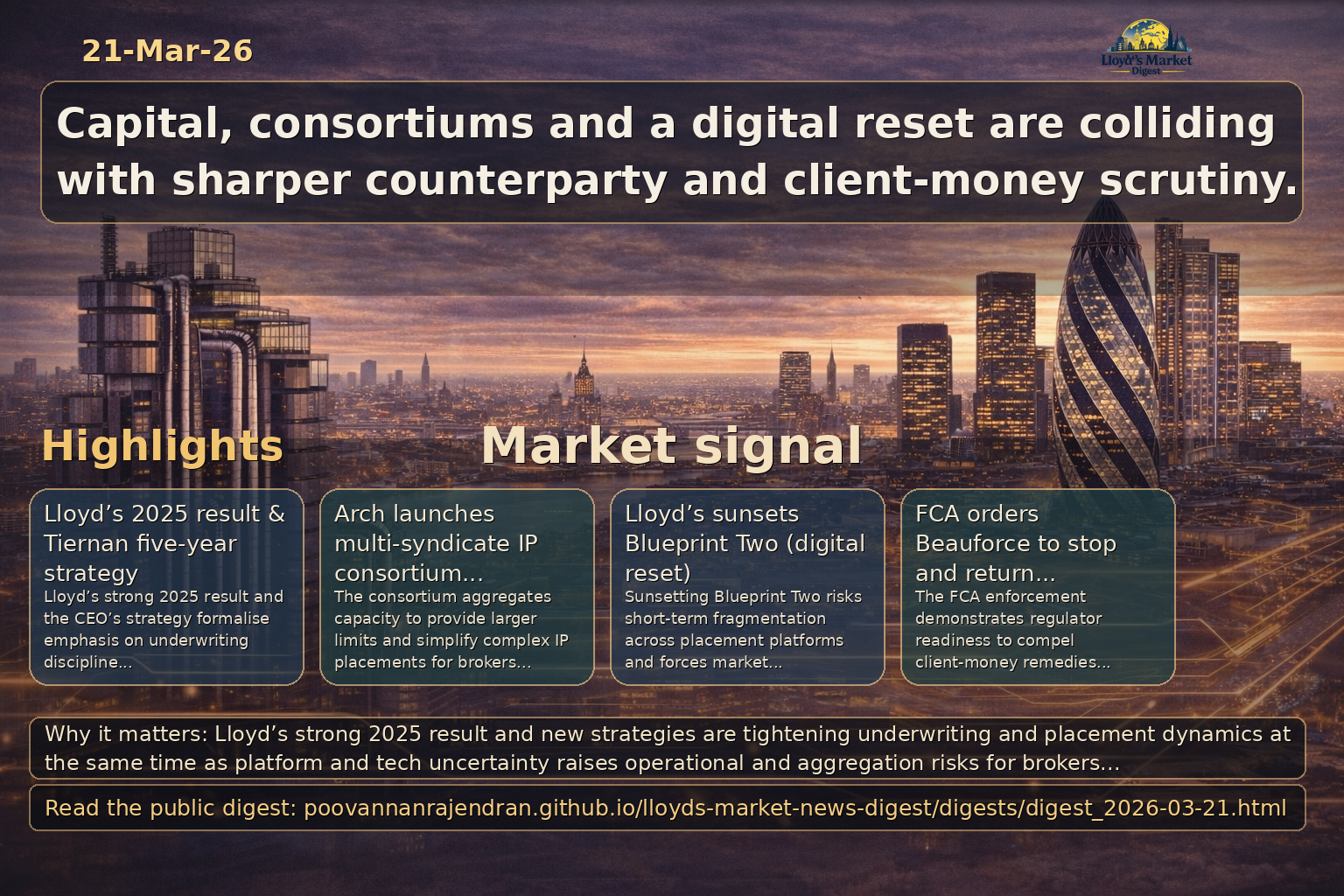
Why it matters: Lloyd’s strong 2025 result and CEO’s five-year strategy formalise a market-wide emphasis on underwriting discipline, capital efficiency and returns — a strategic framework that will shape syndicate appetites, pricing trajectories and broker placement approaches in a more competitive cycle.
- Reinforces underwriting and capital allocation discipline across syndicates, likely tightening appetite for marginal risks and increasing scrutiny during pricing negotiations.
- Growth driven by new entrants and expansion raises capacity and competition, pressuring margins and elevating the role of placement platforms and broker value-add.
- Solid combined ratio and investment strength will support selective growth but signal to brokers and clients that returns, not volume, will drive capital deployment decisions.
Source: globalreinsurance.com
Why it matters: Arch’s launch of a multi-syndicate IP consortium at Lloyd’s responds to rising demand for IP protection and demonstrates a collaborative model for aggregating capacity and broadening cover — an important precedent for specialty product delivery and placement efficiency within the Lloyd’s ecosystem.
- Aggregated syndicate capacity creates the scale to offer larger limits and more comprehensive IP suites, simplifying complex placements for large corporate clients.
- Addresses a clear market need as intangible assets become central to enterprise value, creating cross-sell opportunities for brokers and specialty platforms.
- Exemplifies syndicate collaboration and product-led consortium structures that placement platforms must support to streamline binding, data exchange and claims coordination.
Source: insurancetimes.co.uk
Why it matters: Arch’s IP consortium at Lloyd’s is a coordinated, multi‑syndicate response to rising IP loss exposures across technology, life sciences and manufacturing — signalling a step‑change in specialty product capability at Lloyd’s.
- Immediate implication: provides a clear capacity pathway for brokers placing IP risk and reduces reliance on bespoke, single‑underwriter solutions.
- Recommended action: brokers should map client IP exposures to the consortium offering and engage early on limits, defence and enforcement features.
- Risk/opportunity: creates underwriting and claims proficiency advantages for participating syndicates; success depends on cohesive claims governance and third‑party claims management.
Source: insurancetimes.co.uk
Why it matters: The decision to sunset Blueprint Two represents a pivotal reset in Lloyd’s digital strategy and forces reassessment of how the market approaches digitisation, placement platforms and shared infrastructure.
- Immediate implication: uncertainty around a unifying market digital roadmap will create short‑term fragmentation among platform initiatives and vendor relationships.
- Recommended action: syndicates, brokers and platform owners should convene to define pragmatic, interoperable priorities (API standards, data standards, placement workflow) rather than large singular 'moonshot' projects.
- Risk/opportunity: the reset offers a chance to pilot pragmatic, interoperable solutions that can be scaled; failure to coordinate risks duplicated spend and continued placement friction.
Source: insurancetimes.co.uk
Why it matters: Lloyd’s £10.6bn profit and improving investment returns confirm market capital strength and capacity growth, but a marginal deterioration in underwriting result and COR highlights persistent underwriting discipline requirements.
- Immediate implication: ample capacity and attractive returns create opportunity for measured growth in specialty lines, subject to underwriting oversight.
- Recommended action: allocate incremental capital to high‑return specialty classes, while strengthening loss‑making portfolio reviews and rate adequacy checks.
- Risk/opportunity: strong capital base supports product innovation and new consortiums, but watch underwriting margin creep and claims inflation to avoid profitability dilution.
Source: fca.org.uk
Why it matters: FCA warning on 'Help for Homes' is a direct signal that unauthorised actors are targeting UK customers and can infiltrate broker distribution chains, creating settlement, reputation and client remediation exposures for Lloyd's market participants.
- Immediate action: confirm whether any brokers, intermediaries or platform partners have exposure to or relationships with the entity; suspend dealings pending verification with the FCA Warning List.
- Client protection: review client notification and remediation protocols where referrals or placements passed through the firm, and prepare customer communications and FSCS/complaints disclaimers where applicable.
- Controls: incorporate explicit verification steps in broker onboarding and renewal workflows (FCA Register cross-checks, domain and email authentication, contract clauses requiring regulatory status confirmation).
Source: fca.org.uk
Why it matters: Warning for 'www.profit-home.com' underscores persistent phishing/unauthorised-product risk that can misdirect premium flows and mislead retail customers sold through general insurance and specialty distribution networks.
- Distribution hygiene: mandate that brokers and MGAs validate referral sources and screen inbound leads for domains and entities flagged on the FCA Warning List prior to accepting business.
- Transaction monitoring: require placement platforms to flag and quarantine payments or instructions originating from suspicious domains pending provenance checks.
- Brand & legal protection: update standard agency and placement agreements to require immediate notification of any FCA warning affecting a connected party and permit suspension of flows.
Source: fca.org.uk
Why it matters: Propiteer Capital PLC appears on the FCA Warning List as unauthorised — an example of specialist or corporate-structured entities presenting as legitimate counterparties to brokers and syndicates, with potential downstream client money and indemnity implications.
- Counterparty due diligence: require enhanced KYC/KYB for corporate entities used as funding or premium collection vehicles, including verification of FCA authorisation status where UK customer exposure exists.
- Escrow and custody: avoid routing client funds through newly created corporate entities without independent escrow arrangements and contractual rights to recall funds.
- Market communication: circulate targeted alerts to underwriting and distribution teams to prevent inadvertent engagement and to preserve syndicate underwriting discipline.
Source: fca.org.uk
Why it matters: FCA enforcement order against Beauforce Corporation demonstrates regulator willingness to restrict firms and order return of client money — a precedent relevant to Lloyd's brokers and platforms that use third-party service providers holding client funds or advising on debt/structured products.
- Senior manager checks: integrate formal verification of senior manager status and disqualification checks into onboarding for any firm acting in an advisory, custody or client-money capacity.
- Client money contingency: ensure contractual rights and operational plans exist to recover client funds quickly from third-party accounts, including direct access to bank statements and segregation verification.
- Regulatory mapping: map which distribution partners fall under FCA supervision vs Annex 1 registration and adjust oversight frequency and audit scope accordingly.
Source: fca.org.uk
Why it matters: FCA CEO commentary on how technology is changing pensions highlights regulator focus on data transparency, digital engagement and platform accountability — directly relevant to placement platforms, broker portals and syndicate reporting mechanisms.
- Data governance: prioritize integration of transparent dashboards and standardized data feeds for brokers and syndicates to improve visibility of exposures, premium flows and client outcomes.
- Platform resilience: accelerate investment in API security, identity controls and audit trails to satisfy regulatory expectations on consumer-facing digital channels and intermediary portals.
- Consumer outcomes: embed guardrails in digital placement workflows (clear disclosures, simple remediation paths) to reduce conduct risk when platforms engage retail or employer-sponsored clients.
Source: reinsurancene.ws
Why it matters: MS Amlin Syndicate’s improved underwriting profits and combined ratio in FY25 demonstrate disciplined underwriting can deliver superior returns even in a softening rate environment — a benchmark for syndicates and brokers on capacity allocation.
- Use syndicate performance as a market barometer for appetite and potential capacity shifts across property and specialty lines
- Allocate client placements to syndicates demonstrating consistent underwriting discipline and return-on-capital metrics
- Incorporate syndicate performance into strategic negotiations on capacity, co-insurance and facultative terms
Source: businessinsurance.com
Why it matters: High-severity marine casualty in a geopolitically sensitive waterway amplifies war, pollution and charterer liability exposures — forcing rapid re-underwriting of marine programs and reshaping capacity needs across Lloyd’s and global specialty markets.
- Claims and long-tail environmental liabilities: expect multi-line exposures (hull, cargo, P&I, pollution legal liability) and protracted remediation claims that stress syndicate reserves and reinsurance layers.
- Brokers to reprioritise placement strategy: require clearer war-risk endorsements, pollution sub-limits, and owner/operator warranties with tightened voyage/route clauses.
- Placement platforms must support rapid rewording and aggregation reporting (voyage-level exposure feeds) to enable underwriters to price and stitch capacity across multiple syndicates and reinsurers.
Source: businessinsurance.com
Why it matters: Triglav’s significant premium growth signals regional rate adequacy and specialty expansion potential — a data point for syndicates and brokers assessing competitive capacity allocation in EMEA specialty lines.
- Indicator of hardening or profitable growth: syndicates should benchmark Triglav’s product mix to validate opportunities to redeploy capacity into niche lines or geographies.
- Brokers should reassess panels: strong premium growth can change leverage in negotiations on terms and attachment points with regional carriers.
- Potential for market consolidation or partnerships: C-suite should monitor leadership moves and distribution agreements that could affect Lloyd’s brokers and MGAs competing for similar accounts.
Source: businessinsurance.com
Why it matters: Swiss Re’s observation about secondary-account dominance in insured losses underscores accumulation concerns beyond primary exposures, with direct implications for retrocession purchasing, capital allocation and modelling for syndicates and brokers.
- Aggregation risk and capital modelling: Lloyd’s syndicates must validate secondary-account drivers in their CAT and non-CAT models to avoid underestimating tail exposures.
- Reinsurance strategy: brokers should structure reinsurance placements that explicitly address secondary-account concentration, including triggers and exhaustion sequencing.
- Placement platforms and data partnerships need to feed granular loss-driver information (geography, peril correlation) to cedants and reinsurers to price and manage secondary-account risk more accurately.
Source: businessinsurance.com
Why it matters: QatarEnergy’s force majeure declaration after regional attacks crystallises complex contingent business interruption, supplier disruption and political-risk exposures across energy insurance programmes — a direct stress-test for specialty markets and placement documentation.
- Broader BI and contingent exposure: syndicates with energy portfolios should quantify contingent BI triggers and review reinsurance reinstatement language for correlated geopolitical events.
- Contractual and underwriting clarity: brokers must ensure force majeure, war and SRG (state-sponsored) coverage terms are explicit, with clear notification, mitigation and salvage obligations.
- Operational readiness of platforms: placement systems must enable swift programme amendments, endorsement issuance and claims triage across multiple insurers and jurisdictions.
Source: businessinsurance.com
Why it matters: Commercial decisions by Indian tanker owners to route vessels through Hormuz increase voyage-level war risk concentrations, affecting premium adequacy, capacity allocation and syndicate underwriting discipline for marine lines.
- Concentration and routing risk: underwriters should demand voyage-level disclosure and consider differential war premiums or excluded transits for high-risk corridors.
- Brokers to enhance risk profiling: integrate AIS/voyage data into placement discussions and negotiate trip-specific terms or premium loadings to reflect changed exposure.
- Placement platforms must support dynamic risk scoring and real-time voyage analytics to enable tailored, timely placements and to avoid inadvertent aggregation across programmes.
Source: globalreinsurance.com
Why it matters: Gallagher Re’s elevation of an experienced product and international leader signals intensified focus on aligning reinsurance solutions with large, cross-border clients and on scaling product capabilities—affecting broker negotiating leverage, placement strategy and how syndicates access multinational risks.
- Consolidates client relationship management and product oversight to streamline cross-border placements and improve consistency for multinational accounts.
- Supports stronger broker bargaining position with syndicates by demonstrating leadership continuity and enhanced product sophistication.
- May accelerate development and distribution of differentiated reinsurance products, increasing integration needs with placement platforms and digital placement workflows.
Source: insurancetimes.co.uk
Why it matters: AI is being leveraged both by insurers for detection and by organised fraud actors for recon and automation — creating an asymmetric threat to claims integrity, underwriting data and placement platforms.
- Immediate implication: claims leakage and false‑positive/false‑negative detection risk will rise without investment in advanced analytics and shared fraud indicators.
- Recommended action: accelerate cross‑market intelligence sharing between brokers, syndicates and MGAs and invest in AI explainability and human‑in‑the‑loop controls.
- Risk/opportunity: deploy defensive AI capabilities to protect margin and use vendor partnerships to scale detection across placement platforms.
Source: insurancetimes.co.uk
Why it matters: ANV Group’s acquisition of Iris strengthens a platform‑to‑Lloyd's distribution corridor — combining wholesale Lloyd's placements, bespoke intermediary services and an MGA incubation capability.
- Immediate implication: enhanced access to Lloyd’s capacity and a broader distribution toolkit for brokers and retail partners.
- Recommended action: prioritize integration plans that preserve Lloyd’s placement relationships and accelerate cross‑sell between Blink and Vivid Underwriters.
- Risk/opportunity: consolidation delivers scale and faster go‑to‑market for niche products but requires disciplined governance to protect syndicate appetite and service levels.
Source: reinsurancene.ws
Why it matters: A second US SCS event producing >$1bn insured losses within the same week signals elevated near-term frequency and aggregation risk for specialty portfolios. This amplifies pressure on treaty and retrocession capacity, drives immediate facultative demand, and forces syndicates and brokers to re-evaluate accumulation assumptions, pricing and placement strategies ahead of renewals.
- Aggregation and modelling: Two large SCS events in quick succession spotlight limitations in current convective storm aggregation modelling; syndicates and insurers should re-run accumulation scenarios and adjust CAT attachments and ILS considerations.
- Capacity and pricing implications: Expect tightened retrocession availability and upward pressure on reinsurance pricing and attachment points, prompting brokers to seek alternative structures, increased facultative placements and earlier engagement with capital providers.
- Placement and operational response: Placement platforms and broker-led workflows must enable faster, more transparent facultative and treaty negotiations, support real-time exposure analytics for underwriters and improve claims data feeds to restore market confidence.
Source: artemis.bm
Why it matters: Zenkyoren's $100m Nakama Re sponsorship signals continued reliance by large Japanese cedants on capital markets to underpin earthquake towers, reinforcing demand for diversified ILS capacity.
- Placement/platform: Bermuda SPV routing confirms attractiveness of established offshore structures for Lloyd's syndicates and platforms to coordinate with global brokers.
- Capital/strategy: Reinforces trend of using ILS to reduce balance-sheet volatility for large cedants and opens up capacity for syndicates to partner on layered towers.
- Market implications: Continued issuance from repeat sponsors sustains secondary market liquidity and supports pricing benchmarks for Japan quake peril.
Source: artemis.bm
Why it matters: Pool Re's targeted £100m retrocession via a fourth Baltic terrorism catastrophe bond highlights public-private use of ILS to manage systemic terrorism exposure and to stagger retro maturities strategically.
- Risk transfer: Using cat bond retrocession reduces concentration on government-backed balance sheets and creates re-leveragable capacity for Lloyd's and global specialty markets.
- Brokers/platforms: Requires sophisticated placement and investor outreach, increasing demand for brokers and platforms capable of structuring terrorism-specific triggers.
- Syndicate opportunity: Provides Lloyd's syndicates with a pathway to participate in specialty terrorism risk via quota-share or follow capacity on retro structures.
Source: artemis.bm
Why it matters: One Alliance North America's debut $100m One Shield Re cat bond demonstrates first-time sponsor activity from domestic US specialty writers, expanding the issuer base in the ILS market.
- New entrants: First-time sponsors increase investor diversification and create opportunities for syndicates to offer alternative retro and fronting arrangements.
- Distribution: Bermuda-domiciled issuance underscores the continued role of offshore platforms and brokers in onboarding US-domiciled specialty risk to global ILS investors.
- Product impact: Multi-peril homeowners exposure entering ILS channels will affect pricing benchmarks and capacity allocation for US nat-cat and homeowners portfolios.
Source: artemis.bm
Why it matters: Leadenhall's observation that cat bonds/ILS exhibit materially lower volatility during geopolitical stress strengthens the investment case for ILS allocation among institutional investors.
- Investor demand: Lower correlation with macro-driven markets can increase institutional appetite for ILS, enlarging the capital pool available to Lloyd's syndicates and specialty brokers.
- Capital strategy: Syndicates and MGAs can leverage expanded ILS demand to optimize capital efficiency and develop hybrid reinsurance placements.
- Placement dynamics: Platforms and brokers will need to better articulate diversification benefits and stress-case performance to capture growing institutional flows.
Source: artemis.bm
Why it matters: Gallagher Re's $1bn estimate for the US severe convective storm outbreak underscores ongoing headline nat-cat loss potential that pressures reinsurance pricing and capacity allocation across specialty lines.
- Pricing/terms: Repeated billion-dollar SCS events accelerate hardening in regional reinsurance and facultative markets, influencing Lloyd's syndicates' underwriting appetite and rate adequacy.
- Broker role: Brokers must refine event modelling and loss attribution to optimize placements and advise clients on program design and alternative capital options.
- ILS interaction: Elevated event frequency may increase demand for parametric or blended ILS solutions that provide rapid liquidity to insureds and cedants.
Source: newsnow.co.uk
Why it matters: Ministry of Justice coverage can presage changes to civil justice procedures, legal aid, prosecution priorities and court capacity—each of which influences the frequency, timing and cost of insurance claims. For the Lloyd’s ecosystem, such shifts affect syndicate loss pick, broker placement strategy and placement-platform workflows, particularly for long-tail specialty lines and complex liability exposures.
- Monitor regulatory and court reform announcements as early indicators of claims-cost pressure and tail risk; translate developments into scenario stress-tests for syndicate underwriting and central reserving.
- Direct brokers and placement platforms to reassess contract wordings, exclusions and limits for D&O, professional indemnity and casualty lines where public policy shifts may increase litigation or regulatory enforcement.
- Prioritise investment in claims analytics, legal intelligence and digital claims integration across platforms to shorten cycle times, improve reserve accuracy and maintain competitive quoting for complex global specialty risks.
Source: risk.net
Why it matters: The article’s focus on automating and structuring the challenge process is material to Lloyd’s and global specialty markets because scenario analysis underpins underwriting limits, capital planning, and placement decisions; adopting AI tools will change how syndicates, managing agents and brokers generate, test and defend extreme‑loss assumptions.
- Underwriting and pricing: AI‑driven scenario engines can accelerate generation of extreme‑event narratives and loss distributions, enabling faster, more granular pricing decisions—but require alignment between syndicates and brokers on inputs and assumptions.
- Governance and regulatory risk: Industrialised challenge processes alter model risk profiles; C-suite and risk committees must strengthen validation, documentation and third‑party oversight to satisfy Lloyd’s, PRA and international regulators.
- Placement and platform integration: Placement platforms and brokers can embed scenario outputs to triage submissions and structure capacity, but must ensure traceability and audit trails so that syndicates can reproduce and challenge AI‑derived scenarios during binding and capital reviews.