Source: insurancetimes.co.uk
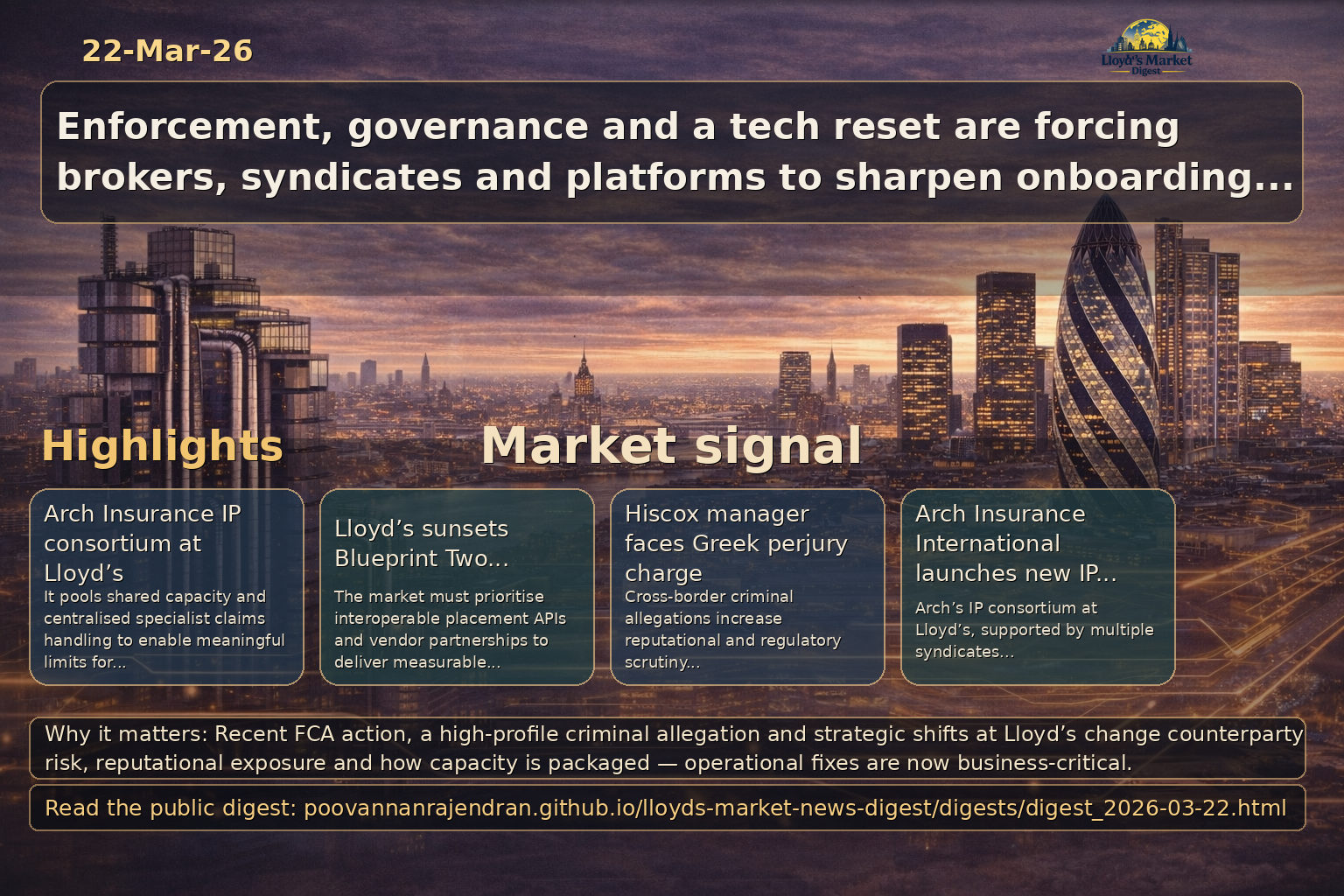
Why it matters: Arch’s IP consortium at Lloyd’s, supported by multiple syndicates, signals market recognition of IP liability/enforcement as a growing specialty class requiring pooled capacity and specialist claims handling.
- Shared capacity model: consortium approach mitigates single-syndicate concentration risk while enabling meaningful limits for complex IP exposures.
- Specialist claims proposition: centralised claims management (Arch’s third-party team) ensures consistent handling and faster resolution — attractive for corporates in life sciences, software and manufacturing.
- Productisation signal: broader syndicate participation indicates a market opportunity to standardise forms, endorsements and firefighting playbooks for IP risk.
Source: insurancetimes.co.uk
Why it matters: The decision to sunset Blueprint Two is a pivotal strategic moment for Lloyd’s digital agenda — the market must shift from monolithic moonshots to interoperable, vendor-led placement platforms and incremental delivery that materially improves broker-syndicate interactions.
- Reset digital expectations: prioritise delivery of interoperable APIs, digital placement hubs and straight-through processing for core lines rather than large single-programme bets.
- Governance and vendor strategy: syndicates and managing agents should accelerate pragmatic partnerships with proven platform vendors and broker-led initiatives to restore market confidence.
- Opportunity for differentiation: brokers and platforms who can demonstrate measurable placement efficiency and risk data fidelity will capture disproportionate share of Lloyd’s-bound business.
Source: fca.org.uk
Why it matters: FCA warning about an unauthorised firm illustrates ongoing fraud vectors that can be used to misdirect insureds or intermediaries, creating direct client-money and reputational exposure for brokers, syndicates and placement platforms.
- Mandate immediate verification of FCA authorisation for any counterparty and block unauthorised entities from placement workflows and client-payment channels.
- Ensure client-money segregation rules and intermediary custodial arrangements prevent routing funds to unregulated entities lacking FSCS protection.
- Escalate suspected impersonation or targeting activity to compliance and notify the FCA promptly; update client-facing guidance to raise awareness.
Source: fca.org.uk
Why it matters: Another FCA warning for a website operating without permission reinforces the frequency of online offerings posing as legitimate insurance or investment conduits — a material operational risk for digital placement and distribution channels.
- Integrate automated checks of FCA Warning List and firm register into onboarding and referral systems used by brokers and platforms.
- Prohibit counterparties from receiving premium flows unless authorised or covered by qualifying custodian arrangements and confirm FSCS/ombudsman access where applicable.
- Run targeted client-education campaigns and transaction-monitoring alerts for payments directed to newly-identified suspicious domains.
Source: fca.org.uk
Why it matters: Warning on 'Propiteer Capital PLC' demonstrates the potential for corporate impersonation and misuse of corporate names to solicit business; this matters for wholesale brokers and syndicates who may be approached for capacity or distribution.
- Require corroboration of corporate identity (Companies House, FCA register, senior manager validation) before entering distribution agreements or accepting electronic instructions.
- Include contractual warranty and indemnity clauses addressing misrepresentation and fraud in placement and intermediary contracts.
- Coordinate with placement-platform providers to disable or flag counterparties pending verification and maintain auditable verification logs.
Source: fca.org.uk
Why it matters: FCA enforcement restricting Beauforce and ordering return of client money highlights senior manager suitability and client-funds vulnerabilities — a cautionary example for brokers and syndicates relying on third-party firms for distribution or debt/collections services.
- Conduct enhanced senior manager due-diligence (including public disqualifications) for third parties in custody, claims-handling or debt management roles.
- Audit third-party bank arrangements and require contractual rights to review client-money reconciliations; establish trigger-based reviews where counterparty conduct is questioned.
- Confirm insurance and indemnity coverage for losses arising from third-party misconduct and maintain rapid client-communication protocols in enforcement events.
Source: fca.org.uk
Why it matters: FCA commentary on how technology is changing the pensions conversation signals broader digitalisation trends that affect placement platforms and brokers — creating data-integration opportunities alongside governance, consumer protection and cyber-resilience obligations.
- Assess platform roadmaps to ensure secure data sharing and interoperability with client dashboards while preserving regulatory consents and data minimisation principles.
- Embed strengthened cyber and privacy controls into placement and distribution tech due diligence, including supplier penetration testing and incident response alignment with syndicate carriers.
- Leverage improved transparency tools to enhance client engagement on risk transfer solutions, but implement guardrails to prevent mis-selling or inappropriate automated recommendations.
Source: businessinsurance.com
Why it matters: The allegation against a senior manager at a global specialty insurer has immediate implications for Lloyd’s market participants and intermediaries: it increases reputational vulnerability, invites regulatory and cross-border legal inquiry, and spotlights deficiencies in placement oversight and personnel vetting that can affect syndicate appetite and distribution relationships.
- Immediate governance review: Conduct a top‑to‑bottom assessment of fit‑and‑proper checks, supervisory controls and incident escalation procedures at managing agents and brokers to limit reputational contagion.
- Placement and platform auditability: Require placement platforms and brokers to produce immutable audit trails, decision‑logs and client instructions to demonstrate record integrity for compliance and legal defence.
- Capacity and counterparty management: Reassess syndicate exposures to the insurer, adjust delegated authority/lines if necessary, and prepare stakeholder communications and legal contingency plans to preserve market confidence.
Source: insurancejournal.com
Why it matters: A Florida appellate ruling that a supermarket had no duty to protect customers from an unforeseeable shooting affects premises liability exposures and the interpretation of duty‑of‑care in casualty coverages underwritten by Lloyd's syndicates and specialty carriers.
- Underwriting: Reassess premises liability appetites and pricing where security mitigations, local crime data and foreseeability arguments materially affect loss probability.
- Policy wording & claims handling: Review duty‑to‑defend, exclusion language and evidentiary standards used by syndicates and brokers to manage allocation of liability in mass‑violence scenarios.
- Broker advisory: Brokers should update client risk‑engineering requirements and placement documentation to capture security protocols, incident reporting and indemnity positions for retail/wholesale accounts.
Source: insurancejournal.com
Why it matters: U.S. force deployments and closure threats to the Strait of Hormuz materially increase war/terror and political risk exposures across marine, energy and commodity supply chains — a direct stress to war‑risk cover, reinsurance layers and capacity in the Lloyd's market.
- Coverage triggers & pricing: Syndicates must revisit war‑risk endorsements, premium differentials and trigger language for hull, cargo, energy and commodity business as risk migration accelerates.
- Capacity & aggregation: Brokers and platforms should flag accumulation concerns and stress test retrocession and reinsurance layers for simultaneous energy/marine losses.
- Placement operations: Rapid war‑risk lifts, sanctions screening and alternative routing advisory services are required; platforms must enable expedited binder placements and real‑time risk aggregation.
Source: insurancejournal.com
Why it matters: Criminal allegations involving a manager at a London‑listed insurer raise governance, cross‑border enforcement and whistleblower risk implications for D&O, EPLI and the underwriting reputations of firms operating across Lloyd's and international jurisdictions.
- D&O / EPLI exposures: Underwriters should reassess policy aggregation on firms with cross‑border investigations and the potential for systemic defence costs and indemnity drains.
- Regulatory & reputational risk: Syndicates and brokers must enhance KYC, regulatory‑action monitoring and disclosure protocols to capture escalation from whistleblower claims to criminal processes.
- Contracting & placement: Placement platforms and brokers should ensure enhanced disclosure clauses, consent‑to‑settlement mechanics and notification triggers for cross‑jurisdictional legal actions.
Source: insurancejournal.com
Why it matters: UK efforts to deepen financial‑services ties with the EU have direct consequences for Lloyd's distribution, market access, and the operational models of syndicates, managing agents and brokers serving European business.
- Market access strategy: Lloyd's and managing agents should update contingency plans for EU servicing — entity structures, passporting equivalents, and local placement platforms to sustain capacity deployment.
- Distribution & compliance: Brokers must align contractual certainty, data flows and client servicing models with evolving equivalence or mutual recognition outcomes.
- Product & platform implications: Opportunity to expand pan‑European specialty offerings if regulatory alignment improves, but requires investment in EU‑centric placement capabilities and compliance frameworks.
Source: insurancejournal.com
Why it matters: A $63m legal claim tied to football transfer financing highlights contingent credit, sponsor and D&O exposures that sit squarely within specialty lines frequently placed through Lloyd's brokers and alternative capital providers.
- Contingent credit underwriting: Underwriters should increase scrutiny of private‑credit counterparties, loan covenants and payment waterfalls that create insured loss triggers for contingent liabilities.
- Broking diligence: Brokers need enhanced financial due diligence, fraud and related‑party screening for sports and entertainment finance placements to manage downstream claims risk.
- Cross‑product spillovers: Syndicates should consider potential knock‑on exposures to event cancellation, trade credit and D&O lines from high‑profile financing disputes.
Source: insurancetimes.co.uk
Why it matters: AI is shifting the fraud threat landscape while also offering defensive tools; insurers, brokers, MGAs and Lloyd’s syndicates must treat AI as both an operational risk and a force-multiplier for claims and KYC workflows.
- Elevated fraud sophistication: expect automated social engineering and synthetic claims — invest in AI-native detection, identity verification and anomaly analytics.
- Underwriting and placement implications: brokers and syndicates should harden evidence requirements, provenance checks and admissibility standards during placement.
- Market collaboration opportunity: Lloyd’s and major brokers should explore shared intelligence feeds and standardised counter-fraud APIs to scale detection across syndicates.
Source: insurancetimes.co.uk
Why it matters: ANV Group’s acquisition of Iris underscores continued consolidation of intermediary platforms to secure Lloyd’s access, MGA incubation capability and broadened distribution channels.
- Enhanced access to Lloyd’s capacity: acquiring a Lloyd’s wholesale broker strengthens platform negotiating leverage with syndicates and improves placement efficiency.
- Platform-to-MGA pipeline: Vivid Underwriters’ incubation model demonstrates how platforms convert talent into controllable capacity sources for syndicates and corporate partners.
- Distribution scale and cross-sell: platform M&A accelerates product distribution (Blink Intermediary Solutions) and creates leverage on commission/share terms with upstream carriers.
Source: insurancetimes.co.uk
Why it matters: Ecclesiastical’s improved profitability and stable GWP growth illustrate that disciplined specialty underwriting and focused product propositions remain financially rewarding in the current cycle.
- Underwriting discipline pays: sustained underwriting profit reinforces the value of rate adequacy and selective risk acceptance in specialist niches.
- Benchmark for syndicates: Lloyd’s capacity providers should calibrate appetite toward segments demonstrating margin resilience rather than indiscriminate growth.
- Distribution alignment: brokers and MGAs offering specialist-led coverage can command stronger placement terms when partnered with disciplined carriers.
Source: artemis.bm
Why it matters: Zenkyoren's $100m Nakama Re issuance underscores sustained use of capital markets by large mutual sponsors for aggregate Japanese earthquake protection, and highlights cross-jurisdictional SPV structuring relevant to brokers and Lloyd's syndicates offering reinsurance alternatives.
- Reaffirms demand for multi-year aggregate earthquake capacity — opportunity for syndicates and ILS investors to provide capacity layers.
- Placement platforms and brokers must streamline cross-border SPV setup, collateral arrangements and regulatory compliance between Singapore/Bermuda and investor jurisdictions.
- Underwriters should model portfolio accumulation to integrate capital-market layers with traditional reinsurance towers and present coordinated offers to cedants.
Source: artemis.bm
Why it matters: Pool Re's targeted £100m Baltic terrorism catastrophe bond illustrates a government-backed mutual using ILS for retrocession and staggered maturities — a structural development with direct implications for UK specialty capacity and retro market design.
- Staggering retro maturities creates a continuous supply path for terrorism retrocession — brokers and platforms can package staggered issuance to smooth client renewals.
- Government endorsement reduces counterparty and basis risk, improving investor appetite and potentially compressing premium for cedants.
- Lloyd's syndicates and specialty underwriters should evaluate complementary terrorism offerings and adapt accumulation controls to accommodate ILS-backed retro layers.
Source: artemis.bm
Why it matters: One Alliance North America's debut One Shield Re issuance signals growing entry of US retail-specialist sponsors into the catastrophe bond market, expanding the universe of counterparties and peril profiles that Lloyd's syndicates and ILS investors must underwrite and support.
- First-time sponsors increase deal flow and diversification — placement platforms and brokers should simplify onboarding and standardize documentation to capture new issuances.
- Multi-peril homeowners exposure increases demand for U.S.-centric modeled capacity and nuanced underwriting of secondary perils.
- Brokers and syndicates should prepare investor-ready analytics and robust basis-risk disclosures to attract capital and secure competitive terms for debut sponsors.
Source: artemis.bm
Why it matters: Leadenhall's analysis that cat bonds and ILS show lower volatility during geopolitical stress reinforces the asset class narrative for institutional investors and supports the strategic use of ILS by syndicates and brokers to stabilize capital stacks.
- Evidence of relative stability under stress strengthens the case to allocate incremental institutional capital into ILS, expanding aggregate market capacity.
- Brokers and placement platforms should leverage this performance narrative in fund-raising and renewal discussions to reduce cost-of-capital for cedants.
- Syndicates can integrate ILS into capital management strategies to hedge tail correlated exposures and enhance balance-sheet resilience.
Source: artemis.bm
Why it matters: Gallagher Re's assessment that the recent U.S. severe convective storm outbreak will generate around $1bn in industry losses highlights escalating frequency/severity of SCS events, pressuring pricing, aggregation limits and retrocession demand across Lloyd's and global specialty markets.
- Increased frequency of large SCS events will drive rate-on-line adjustments and may reduce available capacity for exposed portfolios unless supplemented by ILS.
- Brokers must present updated aggregation and accumulation analyses at renewal to ensure adequate placement strategies and prevent unintended concentration risk.
- Expect growing ILS issuance targeting U.S. convective perils; placement platforms need rapid execution capabilities and robust catastrophe models to capture demand.
Source: newsnow.co.uk
Why it matters: Although this MoJ news feed is primarily political and public-policy oriented, developments reported can influence the claims landscape, regulatory expectations and reputational exposures relevant to Lloyd’s syndicates, global specialty brokers and placement platforms. Legal decisions, policy debates and changes in enforcement priorities can drive frequency and severity of coverage disputes, prompt contractual redrafting, and require adjustments in underwriting appetite and distribution strategies.
- Claims and litigation: High-profile legal developments or shifts in enforcement can increase litigation frequency and complexity, necessitating closer liaison between syndicates’ legal teams and claims handlers to reassess reserves and litigation strategies.
- Wording and regulatory risk: Policy wordings and exclusions may need revision in response to changes in judicial interpretation or government-led reform; brokers and placement platforms should pre‑emptively review standard clauses for ambiguity and contract certainty.
- Reputational and distribution impact: Political controversies or policy decisions publicised by the MoJ can create reputational risk for insureds and intermediaries, affecting client retention and placement terms; underwriters and platforms should integrate heightened escalation protocols and PR coordination into placement workflows