Source: fca.org.uk
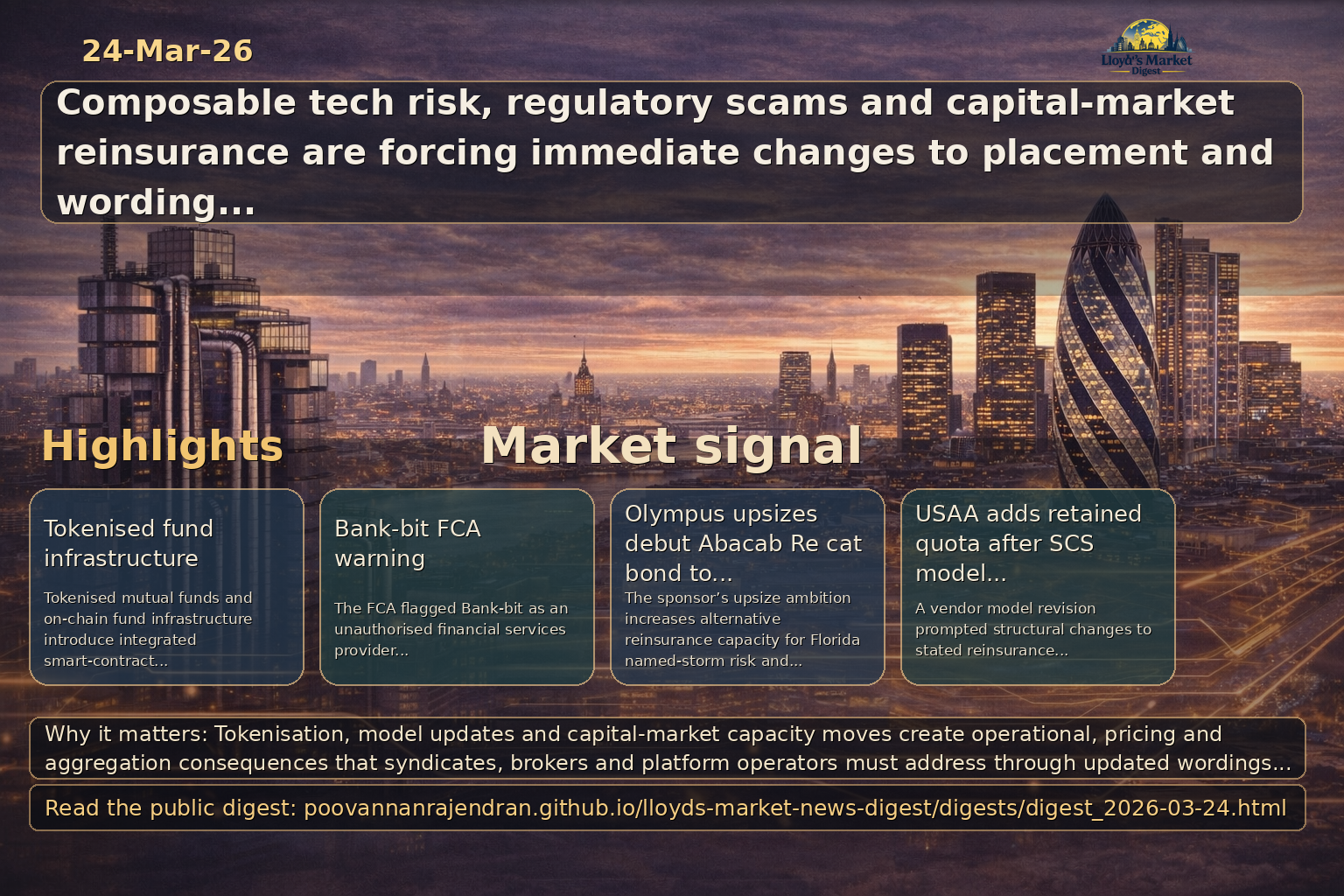
Why it matters: The FCA warning for Bank-bit indicates an unauthorised entity offering financial services which may be targeting insurance-related payments or clients. For Lloyd’s brokers and placement platforms this creates direct risk of premium diversion, uninsured purchases and client losses that can funnel reputational and regulatory consequences back to placing brokers and syndicates.
- Immediate action: notify distribution teams and platform ops to block engagement and flag any historical transactions linked to the Bank-bit domain.
- Transaction controls: require confirmation of payer identity, bank-account ownership and use regulated trust/premium funds channels before allowing placements or policy inception.
- Due diligence: add the entity to internal watchlists, require broker attestations for counterparties, and escalate any client complaints or suspected losses to compliance and legal.
Source: fca.org.uk
Why it matters: Market Master Pros being listed as unauthorised signals potential misuse of market-facing branding to solicit business or collect premiums outside regulated channels. Such actors can compromise placement platform integrity and create downstream exposure for syndicates underwriting risks believing placements are intermediated by authorised brokers.
- Broker controls: instruct brokers to verify counterparties on the FCA register and require documentary evidence of regulatory status before accepting new referrers or distribution partners.
- Platform governance: review onboarding rules on electronic placement platforms to block domains and named entities flagged by regulators and implement regular sweep checks.
- Remediation: audit recent placements for any links to this entity, notify impacted clients, and prepare remediation/notification pathways with compliance and claims teams.
Source: fca.org.uk
Why it matters: Qanotarytx’s FCA warning represents a credible fraud vector where unauthorised actors may impersonate notaries, intermediaries or advisors to facilitate counterfeit documents or payments. For syndicates and specialty brokers, this raises the stakes on documentation integrity, policy validation and post-bind audit processes.
- Documentation verification: mandate independent verification of critical documents (e.g., beneficiary instructions, endorsements) where originator identity is in question.
- Post-bind controls: implement enhanced post-bind audits for placements sourced via less-established channels and suspend claims payments where documentation provenance is unclear pending investigation.
- Regulatory liaison: coordinate with legal/compliance to report suspected fraud to authorities, update market notices for Lloyd’s brokers and platform operators, and document steps taken to mitigate contagion.
Source: artemis.bm
Why it matters: Olympus’s aim to upsize its debut Abacab Re catastrophe bond reflects sponsor appetite to source multi-year, capital-markets-backed Florida named-storm protection and indicates investor receptivity as price guidance eases.
- Upsize ambition (to $100–150m) increases available reinsurance capacity for Florida homeowners exposure, offering an alternative to traditional reinsurers and Lloyd’s syndicates.
- Lowered price guidance suggests improving investor demand dynamics for US wind risk, which placement teams should factor into timing and structuring decisions.
- Brokers and placement platforms should anticipate multi-tranche structuring and investor segmentation opportunities when marketing debut sponsor transactions to maximize uptake.
Source: artemis.bm
Why it matters: USAA’s decision to add a retained quota share layer after an SCS model update illustrates how model revisions materially reshape stated reinsurance terms and capital allocation for multi-peril aggregate cat bonds.
- Model updates can materially change expected loss profiles, prompting sponsors and reinsurers to renegotiate retention and limit structures—critical for syndicates and placement advisers to monitor.
- Placement platforms and brokers must be prepared to rework deal economics and investor disclosures rapidly when vendor model outputs evolve.
- Investors in cat bonds and capital-market intermediaries need robust model governance and sensitivity analysis to manage repricing and structural changes.
Source: globalreinsurance.com
Why it matters: LSM’s appointment of a property divisional director signals a deliberate move to integrate and scale UK and MENA property underwriting, aligning strategy, people and distribution to capture specialty commercial property flows.
- Creates a single, integrated underwriting unit to improve risk selection, pricing consistency and capital deployment across UK and MENA property portfolios.
- Strengthens broker relationships and facultative/direct placement capability by offering a clearer underwriting proposition to wholesale and London brokers.
- Positions Liberty to respond to climate-driven loss trends with coordinated strategy, enabling faster product adjustments and targeted reinsurance buys.
Source: globalreinsurance.com
Why it matters: Analysis of the protection gap and the role of space-based data underscores a structural imperative: specialty underwriters and syndicates must adopt advanced data sources to improve catastrophe modelling, expand parametric solutions and close coverage shortfalls.
- Satellite and remote-sensing data enable more granular risk assessment, supporting Lloyd’s syndicates and reinsurers in refining pricing and capital allocation for extreme weather exposures.
- Creates new product opportunities (parametrics, index-linked cover) that brokers and placement platforms can package for corporates in high-exposure regions.
- Necessitates investment in data partnerships and platform integration across MGAs, managing agents and brokers to operationalize faster underwriting and claims settlement.
Source: globalreinsurance.com
Why it matters: Acrisure London Wholesale’s launch of an aviation division reflects brokers’ push to vertically deepen specialty capabilities on wholesale platforms, capturing specialist risk flows and strengthening London distribution for aviation risks.
- Enhances supply of specialist placement capability in the London market, increasing choice for clients and brokers seeking tailored aviation coverage and capacity solutions.
- Signals intensified competition for senior specialty broking talent, which influences placement market dynamics and could accelerate fee/commission structure reviews.
- Supports closer collaboration with Lloyd’s underwriters and global syndicates as aviation risks require bespoke program design and reinsurance layering.
Source: globalreinsurance.com
Why it matters: Starr’s acquisition of IQUW materially scales its global specialty and reinsurance platform, significantly expanding its London market footprint and underwriting capacity at Lloyd’s and in Bermuda.
- Increases Starr’s standing within the Lloyd’s ecosystem, enhancing its negotiating leverage with brokers and expanding capacity for specialist and treaty placements.
- Strengthens reinsurance and retrocession capability across the combined entity, improving capital efficiency and enabling participation in larger, more complex risks.
- Creates integration priorities: harmonizing underwriting appetites, distribution channels (including MGAs) and placement platform interoperability to realise scale benefits.
Source: insurancejournal.com
Why it matters: Executive risk perception is misaligned with existential perils; brokers and syndicates must recalibrate advisory and product design to close the gap between client concern and insurable catastrophic exposures.
- Brokers should reframe client conversations to align perceived risks (supply chain, tariffs, staff costs) with insurable solutions and aggregated balance-sheet exposures.
- Syndicates must evaluate product positioning and appetite to capture demand where executives underestimate insurable catastrophic exposures—opportunity to design hybrid or parametric solutions.
- Placement platforms should surface analytics that translate client survey signals into targeted cover recommendations and stress scenarios for underwriters.
Source: insurancejournal.com
Why it matters: Terrorism capacity growth and falling premiums create a buyer's market, pressuring specialty pricing and profitability—London capacity participation and global brokers need disciplined underwriting response.
- Syndicates should reassess exposure-based pricing frameworks and incorporate geopolitical stress-testing rather than rely on benign recent loss experience.
- Brokers can exploit pricing competition to expand placement volumes but must manage risk accumulation and recommend layered reinsurance or facultative protections.
- Placement platforms should highlight capacity sources and aggregate limit tracking to prevent silent accumulations as price-driven demand rises.
Source: insurancejournal.com
Why it matters: AI is material to underwriting efficiency, claims handling and broker workflows; market participants who fail to modernize risk losing placement speed and client insight in a digitally enabled distribution environment.
- Underwriting functions should prioritize data hygiene, integrated models and proof-of-value pilots that deliver faster, defensible decisioning for specialty and treaty placements.
- Brokers and placement platforms must invest in AI-enabled triage and risk-matching to shorten lead times and increase hit rates on complex placements.
- Leadership needs an upskilling and talent-retention strategy coupled with governance and model oversight to address regulatory and conduct risk of AI deployment.
Source: insurancejournal.com
Why it matters: Court rulings denying duty to defend in large-scale tech litigation underscore the centrality of precise coverage triggers and intentional-acts exclusions—material for D&O, tech E&O and cyber placement strategies used by brokers and Lloyd's underwriters.
- Syndicates and placement teams should review policy wordings, defense-cost provisions and intentional-acts carve-outs across tech and social-media exposures to reduce ambiguity.
- Brokers must advise clients on likely coverage gaps and consider tailored liability programs (e.g., media liability, reputation cover) where CGL triggers are uncertain.
- Claims and legal teams should coordinate with underwriting to simulate litigation scenarios that could produce coverage disputes and inform pricing and reserve sufficiency.
Source: insurancejournal.com
Why it matters: The issue roundup provides a consolidated market view—useful for syndicates and brokers to prioritize thematic response across pricing, litigation, AI, and nat-cat dynamics in placement strategies.
- Senior leaders should treat curated market research as the basis for monthly strategy reviews linking underwriting, broking and capital allocation decisions.
- Placement platforms ought to ingest such issue-level intelligence to update appetite matrices and underwriter workflows in near real-time.
- Allocate a cross-functional task force to convert recurring issue themes into actionable product or wording updates for next renewal season.
Source: insurancetimes.co.uk
Why it matters: Escalation in the Middle East amplifies war, marine and supply-chain exposures that materially affect underwriting, reinsurance and capacity allocation across the London market and global specialty lines.
- Re-rate and tighten: Expect higher war/maritime premiums, tighter coverages and more frequent use of war exclusions and premiums clauses.
- Reinsurance and capital: Increased aggregation risk will pressure retro placements and raise cost of capital for syndicates writing global cargo and energy exposures.
- Placement implications: Brokers must validate manifest-level exposure, refine voyage-level wordings and secure specialist war-capacity or follow-market solutions.
Source: insurancetimes.co.uk
Why it matters: Regional broker M&A reinforces distribution scale and local market penetration, shaping how syndicates and carriers access SME and commercial retail flows.
- Distribution leverage: Acquisitions expand broker bargaining power with carriers and can channel more targeted specialty business to syndicates.
- Integration risk: Legacy systems and client retention require disciplined onboarding and potential platform investment to preserve placement efficiency.
- Opportunities for syndicates: Steady regional flows offer underwriting predictability for delegated authority and scheme-based appetite.
Source: insurancetimes.co.uk
Why it matters: Projected UK home market losses reduce insurer profitability, prompting reallocation of capital and potential withdrawal from low-margin retail segments—creating opportunity for specialty reinsurance and Lloyd's capacity deployment.
- Profit pressure: A higher net combined ratio will force insurers to re-price or limit capacity, affecting broking strategies and consumer placement outcomes.
- Capital reallocation: Reduced returns in personal lines can accelerate capital flow into specialty and wholesale classes where margins and rate adequacy are stronger.
- Syndicate strategy: Lloyd's syndicates can selectively deploy capacity into commercial and specialty classes, leveraging broker relationships to access higher-quality risks.
Source: insurancetimes.co.uk
Why it matters: Brokers' strong preference for regional insurer presence underscores the continued value of local underwriting relationships alongside digital placement—critical for delegated authority and complex specialty placements.
- Relationship premium: Face-to-face underwriting teams improve mutual understanding of risk and support long-term delegated authority programmes.
- Hybrid distribution: Insurers should combine regional underwriting footprints with digital placement for scale and faster binding decisions.
- Syndicate access: Local presence strengthens broker-led flows into Lloyd's and wholesale markets, sustaining scheme and appetite distribution.
Source: insurancetimes.co.uk
Why it matters: HDI's fleet portal demonstrates how telematics and claims analytics can be integrated into a one-stop platform to improve loss control, transparency for brokers and underwriting outcomes for specialty motor capacity.
- Loss prevention: Telematics-driven coaching reduces frequency/severity, improving portfolio loss ratios and allowing more competitive motor capacity offers.
- Broker transparency: Real-time fleet performance dashboards enhance client advisory, renewal retention and placement accuracy.
- Platform interoperability: Syndicates and MGAs should prioritise API integrations to ingest telematics for pricing, mid-term adjustments and portfolio monitoring.
Source: reinsurancene.ws
Why it matters: Historic market reporting provides context on past industry loss experience and sector-level transactions that continue to shape risk appetite and capital allocation in the specialty and Lloyd's markets.
- Historical catastrophe loss data and prior large-stake sales inform current capacity pricing and underwriting appetite in Lloyd's syndicates.
- Archived coverage of major reinsurance deals and industry commentary helps brokers benchmark deal structures and client advisory positions.
- Useful for trend analysis when assessing long-term capital cycles and the impact on placement platform demand.
Source: reinsurancene.ws
Why it matters: Announcement of Starr's agreed acquisition of IQUW signalled a strategic consolidation that directly affects syndicate counts, capacity sources and broker placement strategies in the London market.
- Acquisition brings two Lloyd's syndicates and a Bermuda reinsurance platform into a larger specialty group, altering competitive dynamics for broker placements.
- Expected to expand underwriting bandwidth across specialty lines, creating new multi-jurisdictional placement options for brokers and clients.
- Flags integration priorities for syndicate governance, capital allocation and maintaining distribution relationships post-deal.
Source: reinsurancene.ws
Why it matters: Completion of Starr's IQUW acquisition confirms immediate market impact: enlarged Lloyd's presence, rebranding of reinsurance capabilities and a shift in capacity composition for specialty placements.
- Raises Starr to a top-ten managing agency at Lloyd's, influencing broker negotiation leverage and appetite for large or complex placements.
- Consolidates Bermuda reinsurance operations under Starr Re, expanding inward reinsurance capability available to cedants and brokers.
- Immediate integration risks and opportunities for syndicate capital optimization, underwriting guidelines alignment, and cross-border platform synergies.
Source: reinsurancene.ws
Why it matters: Sustained expansion of captive cells in Tennessee highlights growing alternative capital and domiciliary competition that influence reinsurer and Lloyd's capacity placements.
- Ongoing captive growth increases directly-retained risk and reduces ceded reinsurance demand in certain corporate segments.
- Competitive captive domiciles offer brokers and clients structured alternatives to traditional Lloyd's and Bermuda placements.
- Insurers and syndicates should monitor captive trends to anticipate shifts in risk transfer volumes and bespoke fronting opportunities.
Source: reinsurancene.ws
Why it matters: Bulk buy-in activity in the pensions market has collateral implications for life/reinsurance capacity, longevity risk transfer demand and capital deployment priorities for reinsurance players.
- Large buy-ins drive demand for life and longevity reinsurance structures, affecting capacity allocation among global reinsurers and Lloyd's life syndicates.
- Brokers servicing pension schemes need to align placement strategies with insurers offering robust reserving and administration capabilities.
- Such transactions can free sponsor balance sheets but also concentrate liability profiles that attract specialist reinsurers and longevity-focused capital.
Source: risk.net
Why it matters: Tokenised mutual funds and similar institutional tokenisation create a new layer of interconnected technology, operational and legal exposures that can generate claims across cyber, technology E&O, crime/custody and professional indemnity lines. For the Lloyd’s market and global specialty brokers, the article’s focus on integrated composable risk — smart contracts, oracle networks, blockchain infrastructure and on/off‑chain compliance — directly affects underwriting, placement workflows and capital aggregation. Syndicates and placement platforms must recognise that failures may be systemic (platform/oracle outages) or idiosyncratic (smart contract bugs, custody mis‑management) and that traditional policy language, evidencing and settlement processes are often insufficient.
- Underwriting adaptation: Update appetite and policy wordings to address smart‑contract failure, oracle/data integrity and custody exposures. Introduce affirmative cyber/tech covers or clear exclusions, require audited smart‑contract code and documented custody arrangements as part of binding authority and submission standards.
- Broker and placement practice: Require enhanced technical and operational due diligence from clients and platform providers — smart‑contract audits, oracle SLA evidence, proof of on/off‑chain reconciliation and custody proof — and embed contractual warranties and remediation obligations into placement documentation.
- Market‑level risk management: Coordinate across syndicates, coverholders and platforms to standardise audit/assurance frameworks, stress‑test aggregation scenarios, engage regulators on permitted business models, and consider market solutions (reinsurance pools, parametric triggers, or placement platform certification) to manage systemic and aggregation risk.
Source: artemis.bm
Why it matters: Hannover Re’s Kaith Re private cat bond highlights reinsurers’ growing role as intermediaries into the ILS market and the use of Bermuda-domiciled vehicles to provide bespoke capacity for property catastrophe risks.
- Demonstrates strategic use of reinsurer-sponsored vehicles to access capital markets capacity that complements Lloyd’s and specialty reinsurance appetite.
- Signals increased prevalence of private, smaller-scale cat bond placements that require bespoke structuring and bilateral investor relationships, relevant to brokers and placement platforms.
- Even modest ticket sizes are strategically important: repeat issuance builds track record for sponsors and supports alternative retrocession and capital diversification for syndicates and global specialty insurers.
Source: artemis.bm
Why it matters: NormanMax’s hire to drive Latin and South America growth underlines the expansion of parametric solutions backed by a Lloyd’s syndicate and the strategic push to capture regional demand for fast-pay, index-based covers.
- Strengthens Lloyd’s parametric presence in LatAm—relevant to global specialty brokers seeking rapid-claim-settlement solutions for emerging market exposures.
- Placement platforms must integrate parametric structuring and regional data partnerships to support scaling in LatAm and adjacent markets.
- Signals partnership and distribution opportunities for brokers, reinsurers and syndicates to design hybrid programmes that combine parametric triggers with traditional indemnity layers.
Source: artemis.bm
Why it matters: Growth in Coca‑Cola’s pension fund ILS allocation to $266m signals sustained institutional investor interest in insurance‑linked securities, supporting liquidity and pricing for catastrophe bonds and collateralised reinsurance programmes.
- Institutional allocations underpin market depth for ILS issuance, enhancing the capacity available to syndicates, reinsurers and placement platforms.
- Sustained pension participation supports product innovation and may lower cost of capital for sponsors seeking diversified reinsurance through ILS channels.
- Brokers and placement teams should highlight institutional demand when structuring shelf programmes and pitching private placements to optimize investor engagement.
Source: newsnow.co.uk
Why it matters: Air accident coverage remains a focused specialty exposure for Lloyd’s syndicates and global brokers—claims severity, hull losses and liability remain high-impact and require tightened underwriting and rapid placement capabilities.
- Reassess aviation hull and third-party liability deductibles and sub-limits in line with recent incident trends to protect syndicate balance sheets.
- Ensure brokers and MGAs have streamlined placement workflows on electronic platforms to secure immediate capacity following an accident.
- Coordinate with claims teams on repatriation, salvage and major-loss vendors to accelerate FNOL, reserving and remediation payments.
Source: newsnow.co.uk
Why it matters: South Pacific exposures concentrate nat-cat and sovereign tail risks—rising frequency/intensity of extreme events affects property, marine and political risk portfolios distributed across specialty markets.
- Validate accumulation models for island jurisdictions; run scenario stress tests for simultaneous multi-island events to quantify syndicate aggregate limits.
- Engage with fronting brokers to refine policy wordings for parametric, hybrid and traditional indemnity solutions tailored to island-state governments and tourism sectors.
- Preposition claims and reinsurance recovery protocols and confirm access to local adjusters and logistical partners for rapid response.
Source: newsnow.co.uk
Why it matters: Earthquake activity is a direct trigger for large property and business-interruption losses; Lloyd’s syndicates and brokers must monitor seismic alerts to manage accumulation and capital deployment across portfolios.
- Integrate near-real-time seismic feeds into exposure-management systems to flag potential accumulations and activate contingency plans.
- Review BI and contingent BI policy terms, supply-chain clauses and aggregation language to reduce ambiguity in multi-site loss events.
- Coordinate retrocessional and reinsurance activations in advance, ensuring placement platforms can execute rapid multi-layer liftings if triggered.
Source: newsnow.co.uk
Why it matters: Tonga-specific seismic events highlight concentrated sovereign and hospitality sector exposure; localized large-magnitude events can drive claims, humanitarian response costs and reinsurance recoveries.
- Perform a Tonga exposure sweep across portfolios (tourism, marine, property) and quantify probable maximum loss metrics to the syndicate level.
- Design or expand parametric triggers for small island states to enable faster payouts and reduce claim handling friction.
- Strengthen broker-led client advisory on mitigation and post-event recovery funding; ensure placement platforms support swift policy amendments or supplemental capacity.
Source: newsnow.co.uk
Why it matters: European trade zone developments drive regulatory, customs and supply-chain uncertainty—impacting trade credit, political risk and marine cargo underwriting across Lloyd’s and global specialty brokers.
- Monitor regulatory divergence and tariff developments to adjust coverages for import/export interruptions and contingent political risk exposures.
- Work with placement platforms to adapt trade-credit and political-risk appetite, and to structure short-term facultative capacity during rapid market shifts.
- Advise corporate clients on contract clauses (INCOTERMS, force majeure) and model supply-chain BI scenarios that reflect changing trade-zone arrangements.