Source: artemis.bm
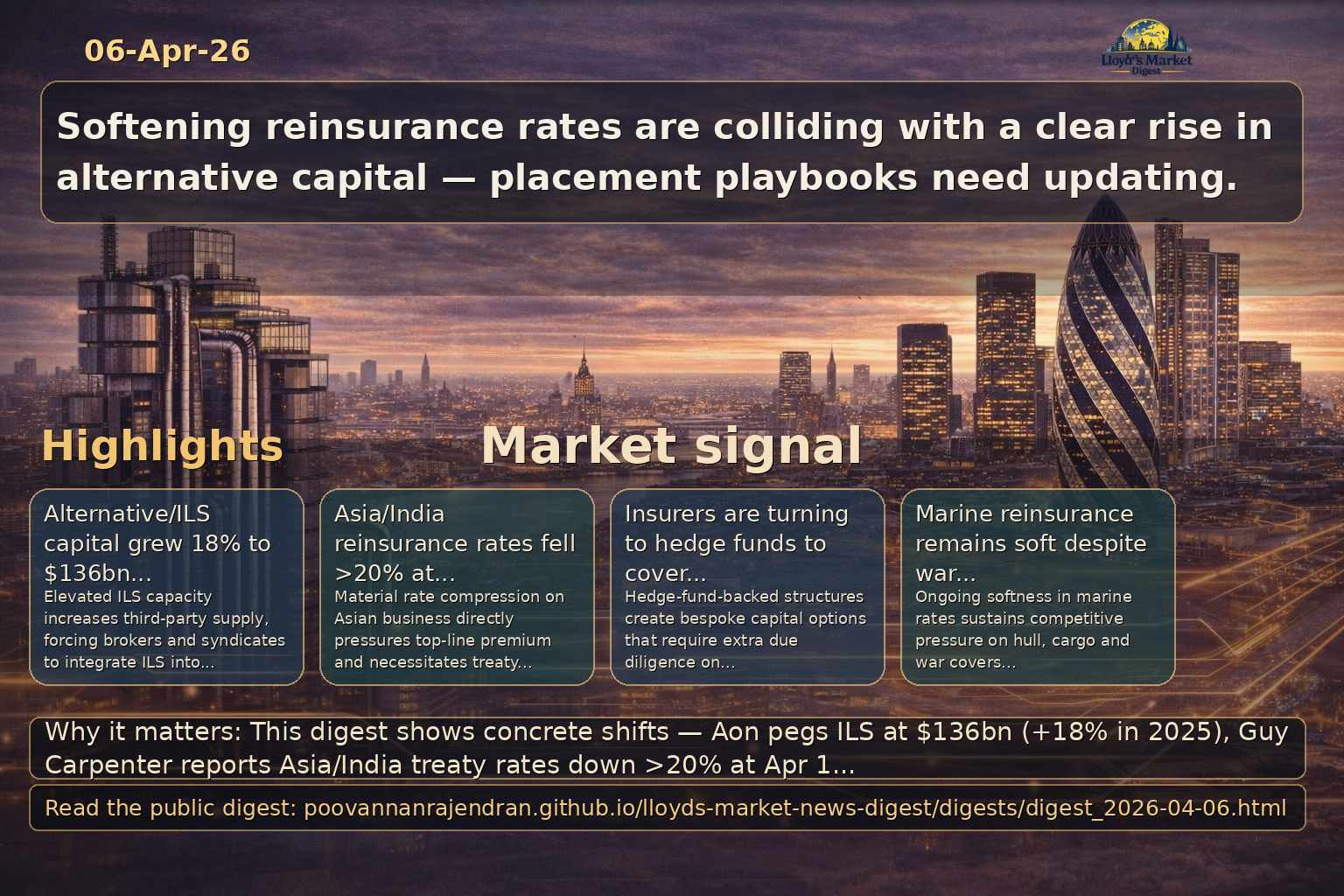
Why it matters: Aon’s estimate that alternative/ILS capital rose 18% to $136bn in 2025 underscores a structural increase in third‑party reinsurance capacity. For Lloyd’s marketplace participants and brokers this amplifies the need to integrate ILS solutions into placement strategies, reassess pricing power, and manage model and concentration risks tied to growing non‑traditional capital.
- Competitive dynamic: Elevated ILS capacity increases supply for catastrophe and specialty risks, heightening pricing competition and pressuring underwriting margins for traditional syndicates unless offset by strict risk selection.
- Placement strategy: Brokers should formalise ILS integration into client solutions — using cat bonds, sidecars and collateralised retro — to optimise cost of capital and broaden options for large or concentrated risks.
- Governance and risk management: Syndicates and platforms must enhance due diligence on investor models, monitor concentration by peril/geography, and maintain underwriting discipline to avoid erosion of technical profitability despite abundant capital.
Source: businessinsurance.com
Why it matters: A material drop in Saudi insurance profits signals margin compression in a fast-growing Middle East market where Lloyd's and global specialty brokers seek growth — implications for capacity deployment, local partnerships and premium adequacy.
- Reassess exposure to Gulf market segments: syndicates should re-evaluate underwriting appetite and pricing adequacy for commercial and specialty lines in Saudi Arabia.
- Strengthen broker-managed client advisory: brokers must emphasize risk engineering and loss-prevention programs to support renewal conversations and justify rate adjustments.
- Monitor local regulatory and ownership trends: placement platforms should track market-entry rules and capital requirements to identify partnership or distribution opportunities.
Source: businessinsurance.com
Why it matters: A greater-than-20% drop in Asia/India reinsurance rates at April renewals directly affects Lloyd's syndicates and global brokers writing Asian risk, increasing pressure on top-line rates and necessitating strategic capacity and treaty negotiations.
- Reprice portfolios for margin protection: syndicates must model impacts of rate compression on combined ratios and adjust underwriting guidelines where necessary.
- Leverage broker distribution to protect placements: brokers should use market competition to secure capacity while negotiating favorable terms to offset lower rates.
- Adapt treaty and facultative strategies: reinsurance buyers and brokers should explore layered structures, sliding scale arrangements and non-proportional covers to maintain economic balance.
Source: businessinsurance.com
Why it matters: Insurers turning to hedge funds to cover data center risks highlights a shift toward alternative capital and bespoke risk-transfer structures, relevant to Lloyd's syndicates and placement platforms seeking to diversify capital sources for concentrated tech infrastructure exposures.
- Evaluate alternative capital partnerships: syndicates should assess hedge-fund-backed structures for volatility, governance and alignment with syndicate risk appetites.
- Develop standardized documentation and KPIs: placement platforms must create clear legal and performance frameworks for contingent capital and parametric or colocated loss triggers.
- Enhance due diligence and counterparty risk processes: brokers need robust assessments of non-traditional capital providers to preserve settlement certainty and policyholder confidence.
Source: businessinsurance.com
Why it matters: Gallagher Re reporting that marine reinsurance remains soft despite geopolitical tensions underlines continued competitiveness in a long‑standing Lloyd's specialty line and the need for differentiated product and service offerings as rates stay subdued.
- Differentiate through service and product enhancements: syndicates should invest in bespoke solutions, cargo security services and digital documentation to protect margin when rates are low.
- Brokers to prioritize risk selection and portfolio optimization: emphasize high-quality accounts and negotiate improved terms for complex marine risks.
- Prepare for capacity reallocation: placement platforms should monitor capital flows between marine and other specialty lines to identify underserved niches or consolidation opportunities.
Source: businessinsurance.com
Why it matters: Evidence that injury-prevention technology reduces strain has underwriting and claims implications for employers' liability and workers' compensation lines that Lloyd's syndicates and brokers underwrite and advise on.
- Incorporate technology outcomes into underwriting: syndicates should adjust pricing and credits where verifiable injury-prevention metrics exist.
- Brokers to market loss-prevention as a value proposition: use technology ROI data to negotiate better terms and reduce frequency/severity for clients.
- Integrate tech-derived data into placement platforms: enable standardized ingestion of preventative program metrics to streamline underwriting and renewal decisions.
Source: insurancejournal.com
Why it matters: Claims staffing and capability are reframed as source of margin and market differentiation—critical for syndicates and carriers competing on service via brokers and placement platforms.
- Invest in seasoned claims handlers tied to profitability metrics (severity control, subrogation, salvage) rather than purely cycle-time KPIs.
- Align claims capability with broker value propositions to win and retain business on Lloyd’s and electronic placement platforms.
- Quantify ROI through a dashboard linking claims outcomes to retention, cross-sell and pricing accuracy for syndicate underwriting committees.
Source: insurancejournal.com
Why it matters: A Florida appellate reinterpretation of statute-of-limitations on workers’ compensation raises reserve adequacy and reopening risk for long-tail portfolios with US exposures—material to specialty carriers and reinsurers.
- Immediately run a legal-impact and reserve review for exposed US comp portfolios; segregate claims subject to new interpretation for potential reopening.
- Engage with reinsurance partners and retrocessionaires to determine recoverable impacts and treaty wordings on reopened claims.
- Communicate proactively with retail brokers and insureds on potential claims reopening scenarios and underwriting adjustments.
Source: insurancejournal.com
Why it matters: Regulatory monitoring of microplastics and pharmaceuticals signals a lifecycle of scientific and regulatory developments that could expand environmental, product and bodily-injury liabilities relevant to specialty lines.
- Update underwriting questionnaires and due-diligence for industries with exposure (water utilities, manufacturers, agriculture) to capture emerging contaminant risk.
- Review pollution and product-liability wordings for clarity on emerging contaminants; consider carve-outs, sub-limits or capacity ring-fencing where scientific uncertainty is highest.
- Partner with brokers to map client supply chains and advise on mitigation, monitoring programs and disclosure expectations to protect placement outcomes.
Source: insurancejournal.com
Why it matters: Public statements and policy shifts that threaten maritime security for key chokepoints increase war/marine and energy-market volatility—directly impacting Lloyd’s marine and political-risk underwriting and pricing.
- Reassess war-risk exposure accumulations and prohibitive-territory definitions; stress test appetite for tanker, cargo and hull lines under sustained route disruption.
- Coordinate with Lloyd’s brokers and MGAs to refresh emergency placement playbooks, alternative routing endorsements and client communication templates.
- Monitor market pricing and capacity movements closely; be prepared for short-term premium spikes and reinsurer capacity reallocations.
Source: insurancejournal.com
Why it matters: Instability in private credit and BDCs poses contagion risk to insurer investment portfolios, collateralized reinsurance structures and alternative-capital channels used by syndicates and placement platforms.
- Conduct portfolio stress tests focused on illiquid private-credit holdings and counterparty exposure from collateralized deals and sidecars.
- Re-evaluate collateral and margin triggers in alternative-capital agreements; negotiate liquidity protections with platform partners and placement counterparties.
- Plan capital contingency options (capital calls, quota-share adjustments, access to Lloyd’s central resources) to preserve underwriting capacity during dislocations.
Source: newsnow.co.uk
Why it matters: Supermarkets represent a concentrated source of physical and contingent exposures—large footprints, complex cold‑chain logistics, high daily transaction volumes and supplier networks create aggregation risk for property, spoilage, product recall and BI lines important to Lloyd’s and specialty underwriters.
- Underwriters must model concentration and correlation scenarios across major supermarket chains to quantify peak accumulation from property damage, supply‑chain interruption and food safety events.
- Brokers should promote comprehensive cover packages (product recall, contamination, spoilage, non‑damage BI) and negotiate clear aggregation and sub‑limit language to avoid unclear overlap at placement.
- Placement platforms need to support granular exposure visualisation (store‑level, distribution centre, supplier dependencies) to enable syndicates to set attachment points and capacity limits more precisely.
Source: newsnow.co.uk
Why it matters: Operational incidents at individual retailers (example: Waitrose) signal practical exposures — staff shortages, theft, disciplinary actions and reputational fallout — that feed into liability, operational continuity and reputational risk underwriting. Such incidents highlight the need for retailer‑specific data and tailored risk mitigation.
- Syndicates should incorporate retailer incident trends into underwriting reviews and consider enhanced risk engineering or conditional terms linked to loss‑prevention measures at store and supply‑chain level.
- Brokers must translate incident intelligence into practical client recommendations (staff training, loss prevention, crime controls) and reflect these mitigations in placement terms and pricing.
- Placement platforms should enable retailer‑level analytics and claims‑trend dashboards so brokers and underwriters can rapidly assess frequency, severity and emerging patterns for tailored cover solutions.
Source: artemis.bm
Why it matters: A potential $600m USAA cat bond, possibly its largest to date and including a Florida tranche, is a high‑profile signal that established sponsors continue to use ILS to access capacity and target region‑specific peril. For Lloyd’s syndicates, global specialty carriers and brokers this could intensify competition for hurricane capacity, influence pricing in 2026 renewals, and shape demand for tailor‑made placements and collateralised structures.
- Market impact: Could mobilise significant third‑party capacity and contribute to downward pressure on reinsurance rates for U.S. hurricane exposure, particularly if upsized and well received by investors.
- Operational action: Brokers and syndicates should revise Florida exposure assessments, stress‑test portfolios for tranche interaction and consider strategic retrocession or quota‑share adjustments to mitigate concentration risk.
- Commercial opportunity: Placement platforms and specialty syndicates can offer differentiated structures (e.g., layered reinsurance, bespoke triggers, collateralised facilities) or co‑invest alongside ILS to capture spread while managing capital strain.
Source: newsnow.co.uk
Why it matters: Hungarian political developments can alter regulatory, trade and sanction environments in Central Europe, creating heightened political risk, foreign investment uncertainty and potential supply‑chain disruptions for insureds operating or sourcing from the region. These shifts are directly relevant to Lloyd’s political risk, trade credit, and multinational property/BI exposures.
- Conduct targeted horizon scanning for legislative or sanction risks in Hungary and adjacent markets; prepare contingency clauses and escalation protocols for placements involving regional exposures.
- Review political risk and trade credit limits for clients with manufacturing, distribution or retail footprints in Hungary; adjust pricing and capacity where bilateral political risk has increased.
- Instruct brokers to obtain local legal and regulatory intelligence, clarify contract certainty, and consider short‑dated or parametric political risk solutions for rapid response to sudden regulatory moves.
Source: newsnow.co.uk
Why it matters: Broad retail industry trends—shift to omnichannel, supply‑chain complexity, and consumer spending volatility—drive increased cyber, contingent BI, product recall and trade credit exposures. Lloyd’s and global specialty markets must adapt underwriting frameworks and placement processes to these evolving risk vectors.
- Syndicates should recalibrate exposure models to reflect omnichannel operational risk: online platforms, last‑mile delivery partners and third‑party logistics increase cyber and contingent BI accumulation.
- Brokers must collect enhanced supply‑chain mapping and inventory flow data from retail clients to accurately assess contingent BI and product recall needs; recommend risk engineering and supplier diversification where necessary.
- Placement platforms should integrate retail POS, inventory and logistics data feeds to enable near‑real‑time underwriting, automated aggregation limits and faster, evidence‑based capacity allocations.