Source: artemis.bm
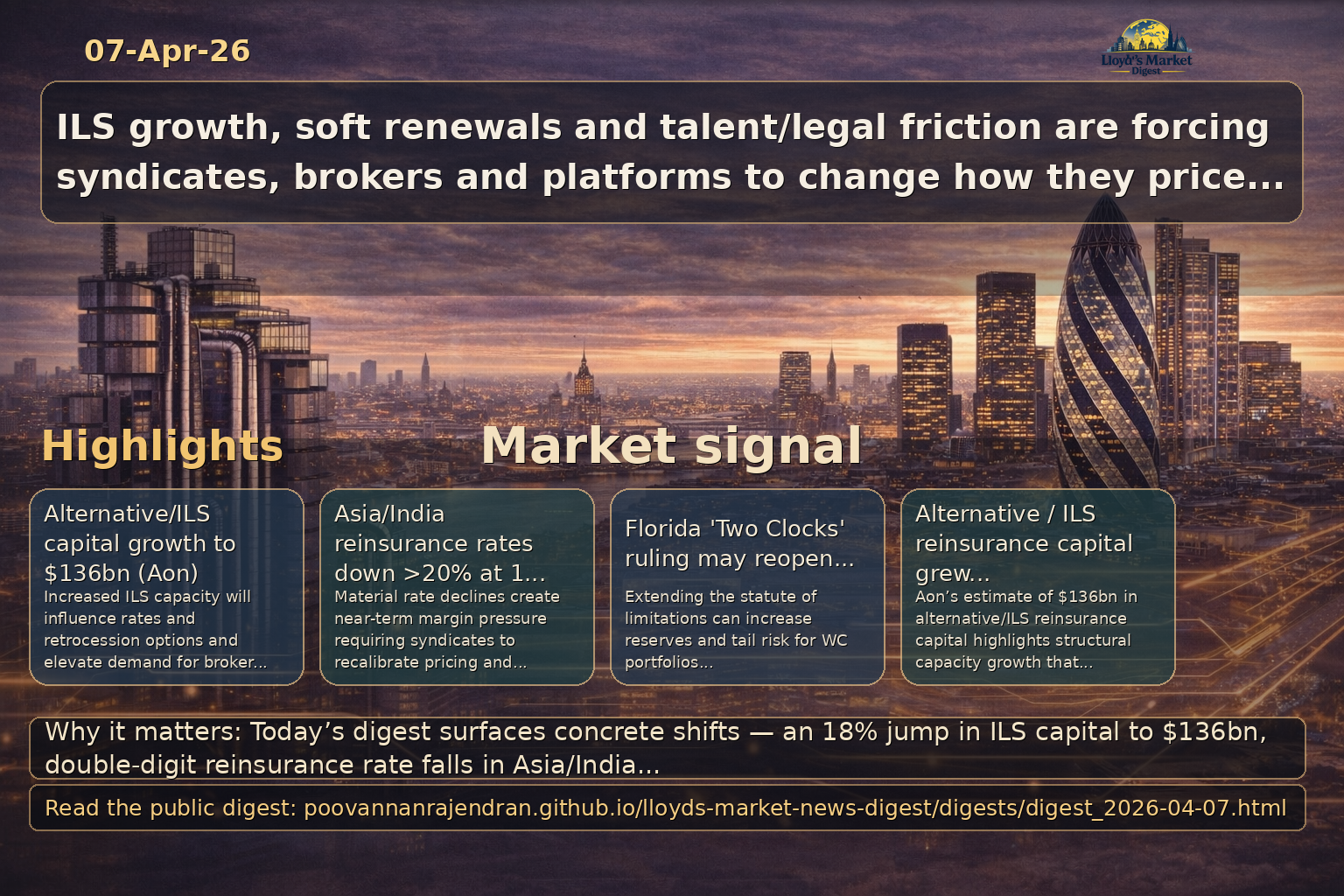
Why it matters: Aon’s estimate of $136bn in alternative/ILS reinsurance capital highlights structural capacity growth that will influence rates, retrocession options and broker advisory models across the Lloyd’s and global specialty markets.
- Record ILS capital increases available capacity, creating downward pressure on pricing for commoditised catastrophe covers and prompting syndicates to emphasise specialty underwriting expertise.
- The broker community’s role in mobilising this capital (exemplified by Aon) elevates placement and structuring services as a revenue and competitive differentiator for market intermediaries.
- Sustained ILS growth requires syndicates and platforms to adapt product design, improve execution speed and offer co‑investment or bespoke terms to retain strategic cedants.
Source: businessinsurance.com
Why it matters: Workers' compensation case studies highlight claims drivers and return-to-work outcomes that inform underwriting assumptions and global program design for specialty syndicates and brokers.
- Review WC claims inflation and chronic pain management trends when underwriting multinational programs.
- Incentivize injury-prevention tech and loss-control services within placement terms to reduce long-tail exposures.
- Use case-study outcomes to refine policy wordings, reserved exposures and captive/retention strategies for large clients.
Source: businessinsurance.com
Why it matters: Product-liability litigation outcomes affect coverage interpretation, reputational risk and class-action exposure — relevant to specialty liability underwriters and brokers placing global product portfolios.
- Reassess product liability appetite and aggregate limits for consumer goods distributed across multiple territories.
- Ensure placement platforms capture defense-cost provisions and cross-jurisdictional coverage triggers clearly.
- Advise clients on recall and crisis-response programs that reduce insurer loss expectations and reputational contagion.
Source: businessinsurance.com
Why it matters: Broker litigation over departing agents underscores counterparty risk, client-book portability and the need for stronger contractual protections—critical for Lloyd's brokers and managing agents reliant on intermediary relationships.
- Audit and reinforce non-compete, non-solicit and confidentiality clauses in producer agreements across jurisdictions.
- Enhance client transfer protocols and retention incentives to limit disruption to syndicate placements.
- Assess implications for platform integration and data ownership to deter opportunistic exits and preserve distribution pipelines.
Source: businessinsurance.com
Why it matters: A sharp profit decline in Saudi Arabia signals regional underwriting and operating-margin stress that should inform capacity allocation and syndicate strategy in MENA markets.
- Re-evaluate exposures and pricing assumptions for regional portfolios, particularly energy and construction lines.
- Consider recalibrating reinsurance support and capital buffers for MENA-exposed business.
- Leverage broker relationships to obtain granular loss-driving intelligence and adjust market entry or expansion plans.
Source: businessinsurance.com
Why it matters: Material reinsurance rate declines in Asia and India indicate a continued soft market that affects Lloyd’s syndicates and specialty carriers' rate adequacy and capacity deployment.
- Stress-test portfolios for margin compression and potential reserve adequacy impacts under softening renewal cycles.
- Negotiate widened placement strategies and tiered capacity to protect margins on low-rate classes.
- Engage alternative capital partners selectively to offset pricing pressure while preserving underwriting discipline.
Source: insurancejournal.com
Why it matters: Directly relevant to syndicates, capacity providers and brokers: reframing claims from cost centre to value driver affects loss ratios, client retention and the economics of delegated authority and digital placement.
- Financial impact: investing in experienced claims teams can reduce leakage, improve recoveries and justify pricing adjustments across specialty lines.
- Operational action: syndicates and managing agents should integrate claims KPIs into underwriting scorecards and capital allocation decisions.
- Distribution implication: brokers and placement platforms should prioritise carriers with demonstrable end-to-end claims capability when advising risk transfer and delegated authority setups.
Source: insurancejournal.com
Why it matters: Employment practices litigation highlights rising EPLI exposure and reputational risk for large employers and sponsors; relevant to underwriters of D&O, EPLI and affinity products placed by specialty brokers.
- Underwriting implication: reassess EPLI appetite and pricing for clients in high-visibility sectors and events, ensure adequate aggregate limits and sub-limits.
- Broker advisory: recommend enhanced HR governance, discrimination training and independent investigations as loss mitigation for clients.
- Claims readiness: carriers and syndicates should validate investigation protocols and communications strategies to limit reputational and indemnity losses.
Source: insurancejournal.com
Why it matters: Court reinterpretation extending the statute of limitations in Florida can materially increase reserves, reopen matters and change tail risk profiles for workers’ compensation portfolios — a direct exposure for specialty writers and reinsurers.
- Reserve and capital: underwriting teams must run targeted portfolio reviews for Florida exposures and consider prospective reserve strengthening.
- Contract and retro design: brokers and placement platforms should examine policy language, retrocession and facultative arrangements for reopening clauses and tail risk protection.
- Pricing and appetite: syndicates should adjust pricing models for Florida accounts and consider tighter underwriting criteria or ceded protection where uncertainty is high.
Source: insurancejournal.com
Why it matters: Emerging monitoring of microplastics and pharmaceuticals signals potential new environmental liabilities and regulatory interventions that will affect environmental and product liability underwriting across specialty classes.
- Horizon scanning: underwriters must incorporate potential future contaminant liability scenarios into PML modelling for environmental and product lines.
- Data and underwriting: brokers should seek sponsors’ environmental testing and mitigation plans; syndicates should invest in exposure analytics tailored to emerging contaminants.
- Regulatory engagement: placement platforms and carriers should track regulatory timelines to pre-position policy forms, exclusions and premiums.
Source: insurancejournal.com
Why it matters: Analysis of US policy on securing global shipping lanes underscores sustained geopolitical tail risk for marine hull, cargo, and energy-related covers; impacts pricing, war risk capacity and placement strategy across international broking desks.
- Market impact: continued threats to shipping lanes drive higher war and strikes premiums and tighter capacity for energy and marine policies.
- Placement strategy: brokers should leverage multi-year programmes and government-backed facilities where available to stabilise coverage and pricing.
- Syndicate response: underwriters must re-evaluate PMLs, voyage exposures and adjust facultative/reinsurance layers in line with changing threat profiles.
Source: insurancetimes.co.uk
Why it matters: The dispute and confidential settlement directly relate to competitive dynamics, recruitment practices and protection of proprietary information that materially affect global specialty brokers, placement platforms and syndicates operating in the Lloyd’s market.
- Commercial impact: Reinforces that large-scale recruitment drives can trigger costly litigation and market disruption; brokers and syndicates should quantify client and placement risk when staff move and embed contingency plans to preserve continuity and premium flow.
- Information governance: Highlights the need for stricter controls on access to confidential placement and client data (role‑based permissions, logging, rapid revocation) and contractual clarity on data ownership between brokers, platforms and carriers.
- Governance and recruitment policy: Prompts review of employment contracts, garden‑leave/non‑solicit terms and hiring protocols for senior book‑holders; also recommends escalation frameworks for immediate platform and carrier notifications to mitigate fronting, solicitation and capacity withdrawal risks.
Source: newsnow.co.uk
Why it matters: Supermarkets present concentrated year‑round exposures: large cold‑chain inventories, last‑mile delivery fleets, food safety liability and narrow margins — impacting underwriting appetite across property, spoilage, motor, product recall and BI classes.
- Cold‑chain and spoilage: require detailed refrigeration maintenance schedules and temperature‑monitoring data to underwrite spoilage and contingent BI exposures accurately.
- Fleet and delivery risk: reassess motor and logistics limits for rapid home‑delivery expansion, including driver vetting, telematics and delegated authority standards for fleet operators.
- Liability and recall preparedness: push for aggregated product recall limits and crisis response protocols as underwriting prerequisites, and coordinate with brokers on packaged recall endorsements.
Source: newsnow.co.uk
Why it matters: Waitrose‑specific operational and reputational issues (shoplifting, employment disputes, supply continuity for premium grocery lines) highlight insurer concerns in retailer underwriting: employee liability, shrinkage, third‑party claims and brand protection.
- Operational risk clauses: require loss prevention and staff‑safety programmes to mitigate frequent low‑severity theft claims that aggregate across portfolios.
- Reputational and D&O exposure: elevated public incidents can translate into D&O and media liability claims—syndicates should flag reputational risk during submission review.
- Broker recommendations: advocate for integrated cover (property, BI, employer liability, media/PR expense) and expedited loss‑notification workflows on placement platforms for consumer‑facing retailers.
Source: artemis.bm
Why it matters: Weekly market highlights signal demand drivers and near‑term loss environment that inform underwriting appetite, pricing strategy and placement timing for Lloyd’s syndicates and wholesale brokers.
- El Niño and related Atlantic hurricane forecasts increase model volatility and require syndicates to reassess exposure aggregation and limit setting.
- Reported 14% decline in US property cat rates after April renewals suggests near‑term pricing pressure—underwriters must balance growth with discipline to protect combined ratios.
- High readership of ILS/cat bond coverage highlights persistent broker and client interest in alternative solutions, necessitating timely offering of ILS and syndicate capacity via placement platforms.
Source: artemis.bm
Why it matters: Zenkyoren’s Guernsey reinsurer demonstrates cedant offshore domiciliation and capital deployment strategies that shift competitive dynamics for Lloyd’s syndicates and create demand for ILS and manager services.
- New Guernsey entity provides Zenkyoren direct access to international risk pools—increasing competition for London market capacity on selected business lines.
- Indication that the reinsurer will invest in catastrophe bonds signals continued sponsor interest in ILS as both buyer and investor, expanding co‑investment and placement opportunities.
- Outsourcing reinsurance operations to Aon Insurance Managers underscores the growing role of broker/managers in structuring, administration and distribution through London and offshore placement platforms.
Source: artemis.bm
Why it matters: A potential $600m USAA cat bond—possibly the largest in its series and the first with a Florida tranche—sets a material precedent for residential reinsurance supply and pricing benchmarks that syndicates and brokers must monitor closely.
- Large sponsor issuance could reset pricing and attachment layers for US residential catastrophe exposure, influencing reinsurance purchasing decisions across carriers and syndicates.
- USAA’s sustained sponsorship track record confirms durable issuer demand for ILS, creating recurring placement opportunities and competitive pressure on traditional reinsurance offers.
- Florida tranche focus increases scrutiny on modelling, correlation and accumulation controls; placement platforms and syndicates should prepare differentiated structures to compete for or complement ILS capacity.
Source: newsnow.co.uk
Why it matters: Taiwan is the global semiconductor hub; disruption would produce acute property, supply‑chain and contingent business interruption losses for manufacturers, OEMs and global logistics networks—directly relevant to syndicates underwriting tech, supply‑chain and trade credit risks.
- Concentration risk: TSMC and tier‑1 suppliers create systemic exposure—underwriters should model single‑point failure scenarios for semiconductor supply and adjust aggregation limits.
- Placement actions: insist on detailed supply‑chain schedules, factory outage triggers and explicit contingent BI wording on platforms to avoid coverage gaps.
- Risk mitigation: recommend layered programmes with parametric triggers for production stoppage, expanded cyber controls for fabs and pre‑placement due diligence on subcontractor resilience.
Source: newsnow.co.uk
Why it matters: China‑Taiwan tensions raise the probability of naval/air incidents, sanctions spillover and trade disruption that affect marine hull/war, cargo, trade credit and political risk products marketed through Lloyd’s brokers and digital placement platforms.
- Wording scrutiny: re‑examine war and political violence exclusions and related ancillary clauses (sanctions, territorial extensions) to minimise latent coverage disputes in contested waters.
- Underwriting impact: expect hardening appetite for exposed transit routes and higher premiums for short‑sea/international container cargo with reroute costs and delay liabilities.
- Operational response: platforms should enable rapid mid‑term endorsements, route exclusions and real‑time voyage screening for brokers managing exposed cargo and energy accounts.
Source: newsnow.co.uk
Why it matters: Escalation on the Korean Peninsula increases regional war, missile and cyber attack risks affecting marine transits, energy shipments and manufacturing supply chains—relevant to syndicates writing marine cargo, energy and cyber policies for Asia‑Pacific operations.
- Exposure mapping: underwriters must map transit corridors and regional supplier nodes for clients with Korean Peninsula dependencies to quantify contingent loss potential.
- Product adjustments: consider missile/war‑risk surcharges and stricter per‑voyage underwriting for vessels trading near the peninsula; expand cyber exclusions addressing state‑sponsored attacks.
- Broker engagement: recommend client contingency plans for alternative suppliers/routes and promote parametric products to transfer latency of conventional claims.