Source: fca.org.uk
Why it matters: The FCA warning on Global Asset Portfolio Limited highlights an unauthorised entity that may be offering financial services to UK-based clients. For Lloyd's brokers, syndicates and placement platforms this represents a direct threat to premium integrity, client protection and the assurance that counterparties are authorised to transact.
- Verify counterparty status before engagement: mandate independent FCA Register checks, corroborate corporate details via verified phone numbers and domain WHOIS checks before sending documents or premiums.
- Protect payment channels: enforce escrow, broker trust accounts or Lloyd's-approved premium trust arrangements; require dual-authorisation for any changes to payment instructions.
- Client and market communication: proactively notify clients and wholesale counterparties of known warnings, update onboarding checklists and maintain an incident escalation path to compliance and the FCA.
Source: fca.org.uk
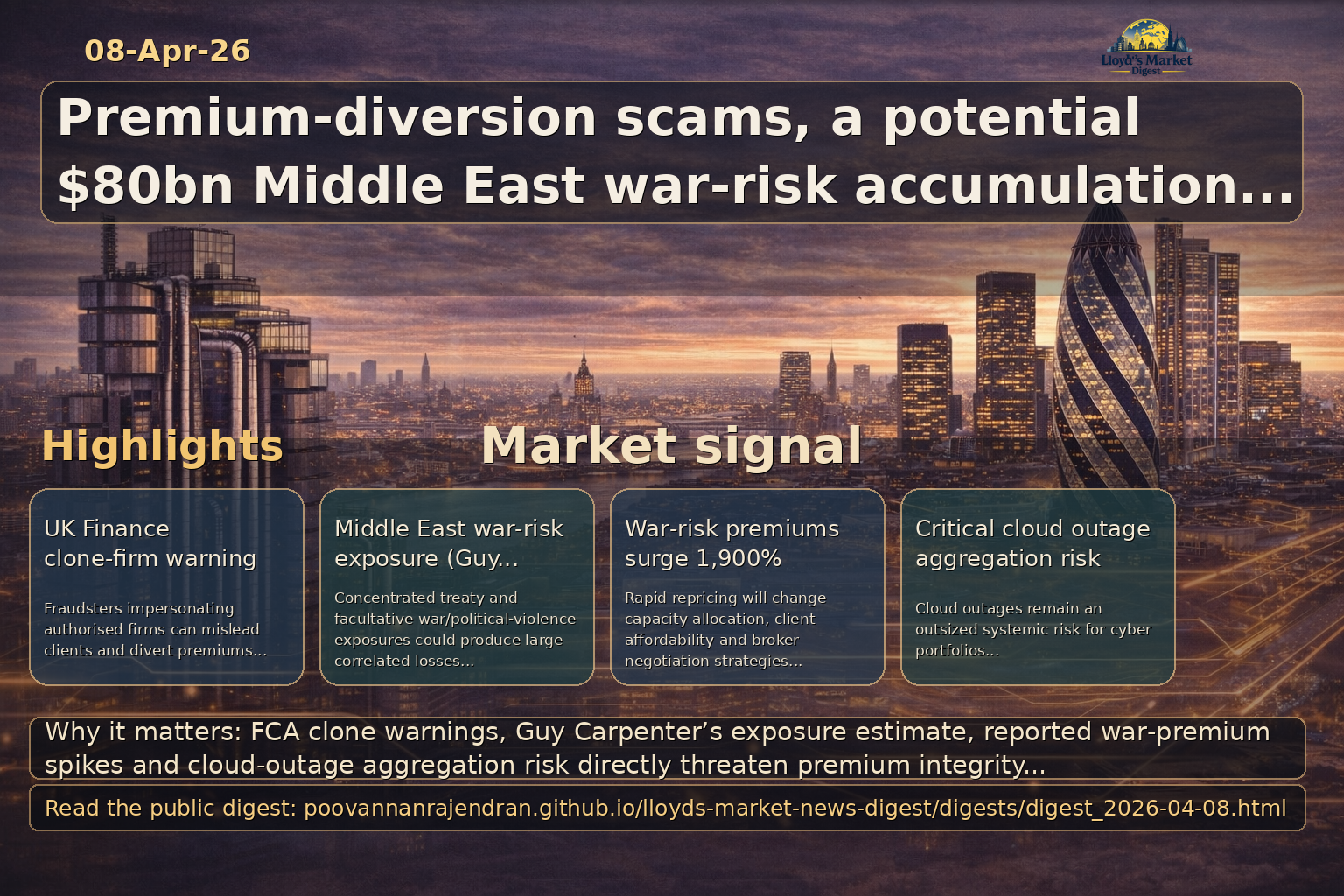
Why it matters: This entry is a clone-firm warning (UK Finance / ukfinance.online) — fraudsters impersonate legitimate authorised firms to mislead clients and divert premiums. Clone activity specifically threatens the integrity of broker-syndicate relationships, electronic placement platforms and market reputation.
- Authenticate digital identities: require cryptographic verification for platform logins and use domain/SSL validation, enterprise email verification and confirmed telephone callbacks against known authorised contact lists.
- Strengthen onboarding and change-control: implement mandatory multi-factor confirmation for changes to remittance details and a ‘cooling’ verification window for high-value placements.
- Escalation and remediation: integrate automated alerts for suspicious domain or telephone matches, report incidents immediately to FCA and instruct legal/PR teams to protect market reputation and affected clients.
Source: fca.org.uk
Why it matters: The Hewitt Venture Group warning signals another unauthorised operator potentially targeting UK customers. For specialty insurance markets, such actors can disrupt distribution, create claims disputes and expose brokers and syndicates to chargebacks and regulatory scrutiny.
- Operational risk controls: require documented proof of authority for intermediaries on every placement and maintain an auditable trail of communications and remittance confirmations.
- Platform governance: placement platforms and coverholders should enforce strict vendor onboarding, periodic re-validation of counterparties and automated checks against FCA warning lists.
- Regulatory alignment and client protection: update AML/KYC procedures to capture unauthorised warning lists, coordinate with compliance teams to notify impacted clients and secure recourse pathways where premiums are misdirected.
Source: businessinsurance.com
Why it matters: Guy Carpenter’s estimate of up to $80bn Middle East war-risk exposure is directly material to Lloyd’s syndicates and global specialty markets that provide treaty and facultative capacity for political violence, terrorism and marine war risks.
- Capacity management: Syndicates should re-evaluate aggregate exposure limits by account, by line and across platforms; consider temporary caps or scaled co-participation to avoid concentration losses.
- Pricing and terms: Brokers must secure transparent premium adequacy and attach tighter territorial/route-specific war endorsements; underwriters should demand stronger risk mitigation and contingency clauses.
- Reinsurance strategy: Placement teams need to coordinate with reinsurers on aggregate collars, ILWs or quota-share adjustments and stress test scenarios for correlated Middle East losses.
Source: businessinsurance.com
Why it matters: A surge in detentions of Panama-flagged ships in China signals heightened operational, survey and P&I exposure for marine hull, cargo and charterers’ liability business — areas where Lloyd’s and specialty marine capacity are significant.
- Underwriting scrutiny: Syndicates and underwriters should demand enhanced vetting, port risk assessments and updated warranty clauses for vessels flagged or trading in high-detainment jurisdictions.
- Broker engagement: Brokers must ensure full-disclosure of vessel and voyage history on placement platforms and push for surveyor/inspection conditions before binding for high-risk trades.
- Claims and sanctions compliance: Placement platforms and carriers should tighten claims checks and sanctions screening, and model potential escalation scenarios into portfolio loss estimates.
Source: businessinsurance.com
Why it matters: Reported 1,900% war-risk premium increases reflect market re-pricing dynamics that will directly affect capacity allocation, client affordability and broker negotiation strategies across the Lloyd’s and global specialty ecosystem.
- Client retention and communication: Brokers should lead proactive client briefings on expected cost moves and consider phased renewal strategies or alternative risk financing to retain critical accounts.
- Syndicate portfolio rebalancing: Underwriters must re-assess risk-adjusted returns, potentially shifting appetite away from heavily impacted sectors or increasing minimum premium floors and WAR endorsements.
- Placement platform implications: Digital platforms should ensure rate transparency, enable rapid comparative quoting and support automated escalation workflows for large-limit or bespoke war placements.
Source: businessinsurance.com
Why it matters: Insurers and brokers adjusting as AI exclusions emerge is relevant to Lloyd’s and specialty lines because evolving product design and exclusion language will affect cyber, professional lines and directors & officers placements conducted through both traditional broking and electronic placement platforms.
- Wordings and precedent language: Syndicates and broking teams must develop consistent, market-accepted AI exclusion/clarification wording to avoid coverage fragmentation and placement disputes.
- Distribution and advisory role: Brokers should map client AI usage exposures, advise on carve-ins/carve-outs and coordinate with specialty underwriters to create tailored solutions where possible.
- Operational controls: Placement platforms and syndicate submission protocols must capture AI-related declarations, model-change disclosures and automated alerts to underwriting committees for materially exposed risks.
Source: businessinsurance.com
Why it matters: Pilot authority to refuse flying in war zones reframes operational risk and the practical application of war-risk cover; this affects underwriting, contract wording and broker advice for airline placements across specialty and Lloyd's markets.
- Underwriting and policy wording: expect pressure to clarify crew authority, insurer liability and war‑risk exclusion/endorsement language to limit ambiguity and moral hazard.
- Placement and pricing: brokers will need to negotiate premium, contingency and delay exposures for airlines operating near conflict zones; syndicates should reassess war‑risk capacity and risk aggregation.
- Operational risk management: carriers and platforms should integrate crew-decision frameworks into risk assessments and incident escalation clauses for faster claims and contingency response.
Source: insurancejournal.com
Why it matters: Direct threats and sustained strikes against Iranian infrastructure materially increase war, political violence and property exposure for marine and energy portfolios and intensify sanction and reinsurance complexity for Lloyd's syndicates and brokers.
- Immediate re-pricing of war and political violence risk with rapid demand for war-risk capacity and special terms from syndicates
- Heightened sanctions, counterparty and claims validation risks require enhanced compliance controls and legal review of war-related wording
- Brokers and placement platforms must enable rapid multi-carrier placements, transparent documentation and crisis-triggered pro rata allocation protocols to preserve capacity and claims readiness
Source: insurancejournal.com
Why it matters: The IEA assessment that the oil and gas disruption is historically severe signals sustained commodity price inflation and prolonged supply-chain shocks, increasing loss severities across energy, property and contingent BI lines and pressuring underwriting and investment returns at syndicate level.
- Sustained higher commodity prices and input costs will amplify business interruption and contingent BI losses, requiring updated exposure and inflation stress tests
- Syndicates should recalibrate modelling assumptions for energy-sector accumulations and reassess retrocession and reinsurance structures to protect capital
- Underwriters and brokers need to prioritize scenario analysis, index or parametric solutions and short-tailed product innovation to limit basis risk and accelerate claim settlement
Source: insurancejournal.com
Why it matters: Widespread damage to Gulf refineries, terminals and petrochemical sites creates concentrated insured losses and potential multi-line accumulation for property, marine, cargo and business interruption portfolios managed or reinsured by Lloyd's syndicates.
- High-limit single-event and correlated loss potential necessitates immediate aggregation analysis and likely temporary capacity caps or stricter line sizes for exposed accounts
- Demand will rise for contingent business interruption, parametric and multi-year solutions; wordings must be tightened around restoration and mitigation obligations
- Brokers should coordinate placement strategies using electronic placement platforms to assemble layered capacity efficiently and to document pro-active risk mitigation commitments from insureds
Source: insurancejournal.com
Why it matters: China's targeting of Taiwan's semiconductor capability elevates systemic supply-chain and technology concentration risk, translating into higher contingent BI, trade credit and political-risk exposures for insureds and creating new underwriting opportunities for specialty syndicates.
- Manufacturing interruption in semiconductors will generate complex contingent BI claims across multiple sectors, requiring tailored coverage triggers and sub-limits
- Increased demand for political-risk, trade credit and D&O protection for technology suppliers and OEMs presents opportunities for syndicates to develop bespoke multi-peril solutions
- Brokers and syndicates should collaborate on sector-specific underwriting frameworks, supply-chain mapping and parametric/supply-chain insurance products enabled via placement platforms
Source: insurancejournal.com
Why it matters: Pilot refusal rights and shifting operational controls in conflict-affected airspace alter airline operational risk profiles and can increase cancellation, liability and hull exposures that aviation underwriters and Lloyd's syndicates must address through wording clarity and capacity planning.
- Potential for increased operational losses from route cancellations and reroutes requires aviation insurers to reassess limits, exclusions and contingent loss exposures
- Policy wordings must explicitly address crew decision-making, commander authority, contractual liabilities and the interplay with war and hull policies
- Brokers should advise carriers on operational risk mitigation, re-evaluate indemnity arrangements and consider parametric mechanisms for rapid airline loss settlement
Source: reinsurancene.ws
Why it matters: Critical cloud outages remain an outsized aggregation and systemic risk for cyber portfolios, directly affecting underwriting, aggregation monitoring and placement strategy across specialty markets.
- Reassess aggregation modelling: integrate cloud-concentration scenarios into portfolio stress tests and treaty structures to quantify systemic accumulation risk.
- Update policy wordings and limits: work with brokers to refine coverage definitions and sub-limits for cloud-dependent BI and service-provider outages.
- Engage tech-enabled underwriting: deploy cloud vendor telemetry and third-party service maps via placement platforms to improve risk selection and pricing.
Source: reinsurancene.ws
Why it matters: Arch’s launch of primary cyber in Canada expands specialist capacity and signals intensified competition for frontline cyber risk placement across brokers and syndicates.
- Leverage expanded capacity: brokers should evaluate Arch CyPro for primary-layer placements to broaden client options and tighten terms for difficult cyber risks.
- Review distribution and engineering integration: syndicates must assess ACRE-style embedded engineering as a differentiator and consider similar capabilities when offering cyber products.
- Align pricing and retention strategy: capital providers to revisit attachment points and reinsurance purchasing given increased primary capacity in the market.
Source: reinsurancene.ws
Why it matters: Evidence of a persistently soft reinsurance market affects renewal dynamics across Lloyd's syndicates and global specialty insurers, influencing capital deployment and capacity appetite.
- Prioritise underwriting profitability: syndicates should maintain disciplined risk selection and avoid top-line growth that undermines combined ratios.
- Negotiate terms strategically: brokers can leverage abundant capacity to secure improved terms for clients while preparing for potential repricing shifts.
- Stress-test capital plans: management teams must model multi-year soft cycles and prepare contingency capital or alternative capital pathways.
Source: reinsurancene.ws
Why it matters: Aon’s appointment to lead real estate and data centre capability underscores broker-led advisory growth where specialization is required to underwrite complex, concentrated infrastructure risks.
- Develop bespoke product offerings: syndicates should craft tailored coverages and limits for data centres and commercial real estate exposures.
- Strengthen placement advisory: brokers to package engineering, financing and insurance advisory to capture higher-value placements.
- Integrate sector expertise on platforms: placement platforms to incorporate data-centre-specific risk modules and underwriting checklists to speed accurate placements.
Source: reinsurancene.ws
Why it matters: Consolidation of life and annuity distribution under a single SPG platform illustrates the trend toward integrated specialty distribution platforms that scale distribution and simplify carrier access.
- Assess distribution partnerships: syndicates and reinsurers should evaluate platform relationships to access niche life and annuity flows at scale.
- Standardise governance and controls: capacity providers must require consistent underwriting standards and reporting from consolidated distribution platforms.
- Explore strategic M&A or alliances: brokers and carriers to consider partnerships or minority investments in consolidated platforms to secure long-term distribution.
Source: newsnow.co.uk
Why it matters: Iran–Pakistan tensions materially affect sanctions exposure, political violence and energy/transport corridors — all areas that drive specialty demand and loss potential for Lloyd’s syndicates and brokered placements.
- Immediate review of sanctions screening and exposure monitoring across placements touching Iran/Pakistan trade lanes; ensure automated negative‑list checks in placement platforms.
- Reassess war, civil commotion and political violence wording in marine, commodity and energy covers; consider adjusted premiums or capacity limits for affected routes.
- Brokers and syndicates to implement escalation protocols for politically sensitive renewals and ensure delegated authority partners apply enhanced due‑diligence and referral requirements.
Source: newsnow.co.uk
Why it matters: Human‑trafficking coverage and reporting highlights systemic AML/KYC and reputational risk for insurers writing cargo, liability, kidnap & ransom, and supply‑chain policies; it also raises regulatory scrutiny on broker conduct and placement transparency.
- Tighten client onboarding and continuous monitoring controls for corporates in high‑risk jurisdictions and sectors; embed human‑trafficking indicators into KYC rulesets on placement platforms.
- Underwriters to review PI, cargo and employer’s liability wordings for exposure to organised‑crime related claims and consider explicit exclusions or enhanced premiums where risk is elevated.
- Coordinate with compliance teams to ensure fast reporting channels to law enforcement and regulators, and ensure claims teams are trained to identify trafficking indicators during loss intake.
Source: newsnow.co.uk
Why it matters: Activity from the British Medical Association signals workforce pressure and industrial action risks that translate into increased clinical negligence, business interruption for NHS/private providers and potential shifts in professional indemnity demand across Lloyd’s specialties.
- Syndicates to stress‑test professional indemnity portfolios for concentration in NHS/private hospital exposures and reassess attachment points for aggregated clinical loss scenarios.
- Brokers should seek bespoke BII and contingency wording clarity for healthcare providers, including explicit labour‑dispute triggers and measurable loss metrics.
- Placement platforms and delegated managers must capture workforce‑strike clauses and supplier‑failure exposures in policy metadata to enable rapid portfolio analysis during labour disputes.
Source: newsnow.co.uk
Why it matters: Political shifts in Scotland and attendant policy changes can affect devolved health and procurement frameworks, premium tax policy and commercial exposure profiles for public‑sector and local authority risk placements.
- Monitor legislative developments and potential fiscal changes (procurement rules, premium tax) that would impact pricing and demand in public‑sector lines and municipal insurance portfolios.
- Brokers and syndicates should map concentration risk by region and public‑service line, updating binding authority instructions where local regulatory changes affect admissibility or capacity.
- Ensure placement platforms reflect regional licensing requirements and enable rapid amendment of policy terms to remain compliant with devolved jurisdictional changes.
Source: newsnow.co.uk
Why it matters: High‑profile cultural controversies in the music sector create acute event cancellation, non‑appearance and reputational exposures — a growing specialty line for Lloyd’s markets and brokers servicing promoters and artists.
- Underwriters to refine non‑appearance and adverse‑publicity triggers in entertainment policies, including conduct‑related exclusions and clear definitions for allowable promoter mitigation.
- Brokers should require event organisers to demonstrate enhanced risk management (security, crowd control, artist vetting) and to provide PR crisis plans as a condition of placement.
- Placement platforms to support rapid issuance of short‑term top‑ups and parametric triggers (e.g., cancellation thresholds) to facilitate agile risk transfer for festivals and tours.