Source: insurancejournal.com
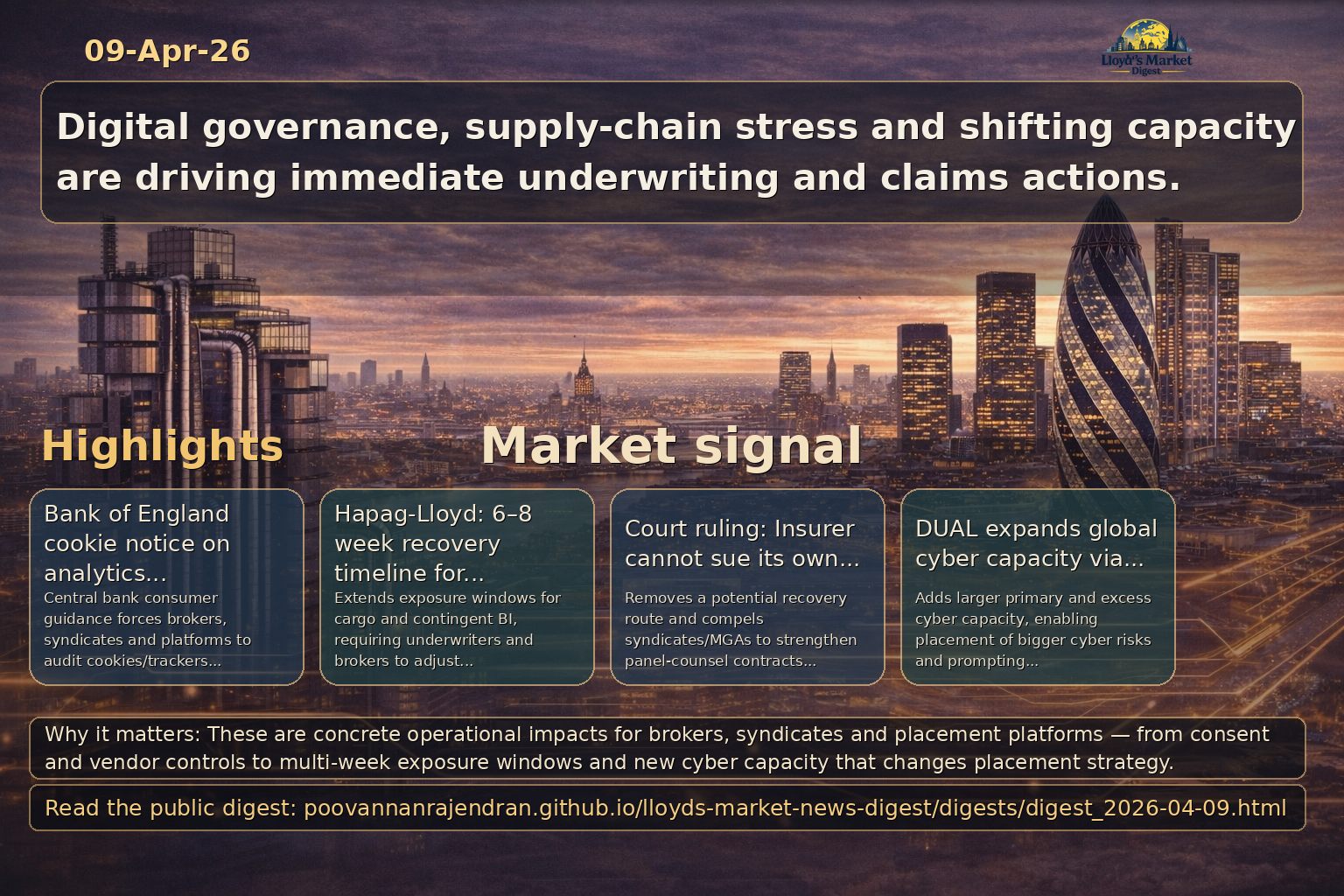
Why it matters: Hapag‑Lloyd’s estimate of a 6–8 week recovery timeline signals protracted supply‑chain disruption and sustained exposure windows for cargo, contingent BI and logistics insurers across global specialty portfolios.
- Extended exposure period: planned underwriting horizons must reflect multi‑week lead times for claims emergence and increased secondary losses.
- Reinsurance program implications: cedants should review reinstatement frequencies and aggregate retentions to account for prolonged accumulation of claims.
- Client communications and contingency planning: brokers need to support clients with scenario-based BI solutions and alternative routing clauses.
Source: insurancetimes.co.uk
Why it matters: Cover profile of a Manchester broker scaling to £20m GWP emphasises a talent-first, partnership-led expansion approach that speaks directly to broker consolidation dynamics and regional opportunity for syndicates and specialty distribution.
- Treat talent as a strategic asset: embed retention, development and partner-led incentive models to preserve service quality during scale.
- Pursue partnership-first expansion: consider JV and affinity partnerships to access regional broking networks without costly geographic M&A.
- Align placement platforms to partner workflows: ensure platform onboarding, data sharing and joint-account handling support partnership-based distribution.
Source: businessinsurance.com
Why it matters: A court decision preventing an insurer from suing its own defense counsel removes a potential recovery route and raises direct implications for claims governance, contractual protections and reserve strategy across Lloyd's syndicates, MGAs and broker-mediated placements.
- Contract and oversight: Syndicates, MGAs and placement platforms must tighten panel-counsel engagement terms—explicit indemnities, liability caps, audit rights and fee approval protocols—to compensate for reduced litigation recourse.
- Claims finance and reserving: Expect pressure on claims spend and decreased ability to recover malpractice-related exposure; underwriters should stress-test reserves, pricing models and reinsurance placements for elevated defense-cost volatility.
- Distribution & advisory role: Brokers and placement platforms should update advisory materials and tender processes to reflect counsel-recourse limitations, ensuring clients and capacity providers understand allocation of legal expense risk.
Source: businessinsurance.com
Why it matters: Labor and ESG issues at manufacturers create contingent exposures across employers’ liability, product liability, supply‑chain interruption and reputational risk — relevant to syndicates underwriting global manufacturing and supply‑chain accounts.
- Underwriting: reassess EPL, product and contingent business interruption terms for suppliers in LATAM and apply enhanced ESG due diligence.
- Brokers: advise clients on contractual indemnities and supply‑chain monitoring to limit downstream claims and support placement of tailored political/social risk covers.
- Placement platforms: incorporate ESG screening and supplier‑risk data feeds to flag higher‑loss‑potential accounts for syndicates and delegated authorities.
Source: businessinsurance.com
Why it matters: Maritime rerouting to avoid Hormuz alters marine exposure profiles, increases freight and war/terrorism clause relevance and elevates political‑risk considerations for energy and commodity trade books underwritten by specialty carriers.
- Syndicates: stress‑test marine and energy portfolios for route deviation and political‑violence accumulation; adjust war/terror limits and premiums where warranted.
- Brokers: ensure war, strike and sanctions wording are current and secure contingency capacity for clients with increased transit risk.
- Placement platforms: offer real‑time geopolitical analytics and dynamic clause libraries to accelerate placement of tailored marine and political‑risk covers.
Source: businessinsurance.com
Why it matters: Strategic insurer–insurtech partnerships to launch cyber programs (Zurich/Cowbell in Australia) underscore the shift to platform distribution, accelerated product rollouts and competitive cyber capacity — a direct signal to Lloyd’s syndicates and MGAs.
- Distribution: Lloyd’s syndicates should evaluate partnerships with MGAs and insurtechs to access local channels and expedite underwriting throughput.
- Product strategy: prioritize standardized, scalable cyber products with delegated authority and clear excess placement pathways for large buyers.
- Placement platforms: invest in API connectivity and real‑time data exchange to support binding authorities and reduce friction in cyber placements.
Source: businessinsurance.com
Why it matters: China’s forthcoming supply‑chain security rules will reshape underwriting of trade credit, marine cargo and political‑risk covers by introducing compliance obligations and amplifying systemic risks for global specialty portfolios.
- Underwriting: update policy language and origin/destination risk assessments to reflect new regulatory compliance requirements and possible export controls.
- Brokers: collect enhanced client compliance disclosures and advise on supply‑chain resilience solutions and trade‑risk mitigation products.
- Placement platforms: integrate regulatory change alerts and compliance checklists to assist underwriters and brokers in rapid re‑pricing and placement.
Source: globalreinsurance.com
Why it matters: Asta’s promotions expand the managing agency’s senior bench, signaling intent to scale underwriting, reinforce broker relationships and support syndicate growth — material for brokers and placement platforms that rely on stable managing agency leadership and clear underwriting authority.
- Underwriting governance: appointment of an experienced chief underwriting officer will sharpen risk selection, pricing and appetite — affecting what risks brokers can place and syndicate underwriting committees will endorse.
- Client and broker engagement: elevation of a COO to managing director is likely to prioritise direct client relationship management and placement responsiveness, improving broker service levels and negotiation leverage.
- Operational scaling and delegated authority: multiple senior hires point to readiness to expand syndicate capacity and delegated authority programs, with implications for placement platform integration and onboarding of underwriting partners.
Source: globalreinsurance.com
Why it matters: Munich Re’s internal promotion to lead credit, surety and political risk underscores a strategic emphasis on financial‑risk solutions and digital business models — important to specialty brokers, syndicates seeking reinsurance capacity, and platforms enabling complex placements.
- Capacity and product depth: centralised leadership for credit/surety/political risk should increase coordinated capacity and bespoke product development for brokered global specialty placements.
- Digital and insurtech acceleration: the appointee’s role in developing digital business models and an insurtech accelerator indicates faster deployment of platform‑based underwriting tools and data‑driven placement channels.
- Regional and distribution reach: the executive’s international background suggests targeted expansion in key markets (EMEA/LATAM), improving Munich Re’s ability to support syndicates and brokers with locally tailored collateral and reinsurance structures.
Source: insurancejournal.com
Why it matters: The proposed $1.6B restitution decision signals material credit and governance exposure for carriers tied to entrepreneurial groups across Bermuda and U.S. jurisdictions, with direct implications for Lloyd’s syndicates that rely on Bermuda capacity partners and third‑party administrators.
- Capital and recovery risk: potential balance‑sheet and collateral strain for Bermuda carriers and any affiliated syndicate capital vehicles, prompting capital adequacy and security reviews.
- Regulatory and reputational scrutiny: heightened FCA/Bermuda/US监管关注 on due diligence, fit-and-proper tests for material owners and management, affecting syndicate appetite for complex corporate structures.
- Broker/syndicate placement impact: increased demand for tighter representation and warranty clauses, expanded fraud exclusions and enhanced KYC/AML conditions in contract wordings.
Source: insurancejournal.com
Why it matters: More than 800 vessels trapped in the Gulf creates concentrated marine and P&I exposures that will test Lloyd’s and global specialty capacity, and force brokers to prioritize short-duration, high-limit war-risk placements and contingency logistics programs.
- Surge in war-risk demand: immediate need for short-term hull and war-risk capacity, with likely premium hardening and stricter war exclusions or endorsements.
- Aggregation and accumulation risk: trapped tonnage produces concentrated losses and contingent BI exposures that require real-time portfolio monitoring by syndicates and reinsurers.
- Broker workflow pressure: brokers must coordinate rapid risk information, voyage-by-voyage declarations and layered placements across treaty, facultative and market capacity.
Source: insurancejournal.com
Why it matters: A temporary US‑Iran ceasefire that coincides with parallel escalation in Lebanon creates asymmetric tail risk — pricing and capacity will oscillate as underwriters balance short windows for transit against credible escalation scenarios.
- Volatility in rate and capacity: two-week windows drive spike-and-reprice dynamics; syndicates should set pre-approved authority levels for rapid response.
- Policy trigger and wording review: need for clarity on ‘safe passage’ definitions, temporal limitations and parametric or event-based triggers in war-risk and contingent BI wording.
- Scenario stress-testing: placement platforms and brokers should provide syndicates with near-real-time exposure aggregates and modeled loss scenarios for Gulf transits.
Source: insurancejournal.com
Why it matters: Maersk’s reluctance to resume normal services underscores carrier operational caution; underwriters face prolonged BI and cargo concentration risk until carriers provide stable routing and service signals.
- Extended suspension risk: underwriters and brokers must price for longer tail BI and increased cargo accumulation at ports or transshipment hubs.
- Client advisory and coverage gap management: brokers should proactively advise cargo owners on reroute costs, contingent BI and express coverage gaps in existing policies.
- Capacity allocation: syndicates may reallocate marine hull and cargo appetite by trade lane and partner creditworthiness until carriers restore normal schedules.
Source: insurancetimes.co.uk
Why it matters: Board-level hiring at insurtech Genasys (including ex-Aviva COO) signals vendor maturation and stronger strategic governance—material for brokers, placement platforms and underwriters evaluating technology partners.
- Reassess vendor strategy and governance: treat key platform providers as strategic partners and require executive-level roadmaps, SLAs and regulatory readiness.
- Pressure-test platform roadmaps: expect accelerated product delivery and integration efforts; secure prioritisation for delegated-authority and placement workflows.
- Use appointments as a trigger for procurement review: revisit commercial terms and integration timelines where board changes indicate a step-change in vendor ambition.
Source: insurancetimes.co.uk
Why it matters: Willis’s renewed multiyear partnership with Premium Credit, expanding finance offers across products, underlines premium finance as a distribution lever that impacts affordability, retention and product reach for brokers and platforms.
- Embed premium finance in placement flows: placement platforms should provide seamless premium finance offers and lifecycle reconciliation to capture new business and improve persistency.
- Quantify capital and cashflow impact: syndicates and underwriters must model financed premium effects on receivables, collections and credit exposure.
- Leverage finance to broaden product coverage: brokers can unlock cross-sell opportunities in segments previously constrained by payment friction.
Source: insurancetimes.co.uk
Why it matters: Liberty appointing an ex-Marsh leader to head delegated authority in UK & MENA highlights carrier commitment to DA growth and integrated business unit operating models—critical for MGAs, coverholders and capacity providers.
- Expect scaling of DA channels: syndicates and capacity providers should formalise DA onboarding, performance metrics and audit frameworks.
- Strengthen data and compliance controls: integrated business models require enhanced data capture, real-time exposure monitoring and platform controls.
- Opportunity for placement platforms: deliver DA-specific modules (authority limits, bordereaux automation, delegated-underwriter workflows) to capture growing volumes.
Source: insurancetimes.co.uk
Why it matters: Record Q1 2026 mega-deals signal renewed M&A momentum that will reshape capacity, broker economics and distribution partnerships across specialty and Lloyd’s-facing markets.
- Scenario-plan for consolidation: model impacts on access to capacity, commission structures and client retention in potential deal scenarios.
- Prioritise integration readiness: brokers and platforms should prepare data, client communications and technology harmonisation playbooks to mitigate churn during transactions.
- Re-evaluate strategic partnerships: syndicates and MGAs need contingency strategies for changes in appetite or capital provision following large-scale M&A.
Source: reinsurancene.ws
Why it matters: Historic Reinsurance News archive material can serve as a reference point for underwriting cycles, catastrophe pricing floors and market precedent useful to Lloyd's syndicates, specialty underwriters and brokers when benchmarking current renewals and modelling.
- Provides archived evidence of prior catastrophe-driven pricing floors and analyst commentary relevant for comparative cycle analysis.
- Useful for underwriting committees and syndicate strategy teams assessing precedent for rate recovery and retention-setting.
- Serves as a background resource for brokers preparing historical context for clients and for modelling loss-settlement expectations.
Source: reinsurancene.ws
Why it matters: DUAL's Liberty-led partnership expands global cyber and technology capacity with higher primary and excess limits — a direct development for Lloyd's syndicates, specialty carriers and brokers managing large cyber placements.
- Enables brokers to place larger mid- to large-market cyber risks with clearer multi-layer capacity, reducing need for complex tower structuring.
- Signals appetite from A-rated capital into cyber, which may influence syndicates' own capacity deployment and retrocession decisions.
- Raises expectations for submission standards and cyber modelling as underwriters scale to support risks up to £5bn revenues.
Source: reinsurancene.ws
Why it matters: APCIA commentary on inflation and legal system impacts highlights ongoing rate pressure and claims-cost trends that influence commercial lines pricing, reserve adequacy and underwriting discipline across global specialty books.
- Confirms a sustained hardening pressure in commercial lines that underpins rate actions and stricter terms from specialty underwriters and syndicates.
- Alerts brokers and risk managers to rising loss-cost assumptions and potential for increased client premium burdens or cover redesigns.
- Strengthens the case for alternative risk transfer and captive usage where traditional market rate adequacy is constrained.
Source: reinsurancene.ws
Why it matters: ARPC’s milestone of over $1bn in cyclone pool claim payments underscores the role of public reinsurance pools in coastal risk financing — an important consideration for syndicates and brokers handling catastrophe-prone business in APAC.
- Public pool activity can reduce private market loss exposure and alter reinsurance purchasing patterns for regional insurers and Lloyd's syndicates.
- Highlights the need for brokers to factor public pool cover and attachment points into program design for cyclone-prone portfolios.
- Reinforces demand for specialist underwriting and modelling capabilities among Lloyd’s and Bermuda market participants focusing on nat-cat risk.
Source: reinsurancene.ws
Why it matters: Marsh Risk’s Cyber ECHO facility expanding to $200m capacity is material for Lloyd's syndicates and brokers: it represents a large, broker-sponsored aggregation vehicle that mobilises cross-market capacity for complex cyber placements.
- Creates a go-to aggregation for high-limit cyber placements, reducing fragmentation and simplifying large-account placement strategy for brokers.
- Draws capacity from Lloyd's, company and Bermuda markets, affecting syndicate participation decisions and appetite calibration.
- May set expectations for coverage breadth (reinstatements, limits) and pricing benchmarks that syndicates must consider when competing on large cyber risks.
Source: bankofengland.co.uk
Why it matters: Although the posting is a consumer notice about cookies, its presence on the Bank of England site is a proxy for the regulatory and reputational standards that counterparties and clients expect. For Lloyd’s market participants, the issues called out—use of analytics, third‑party cookies and consent mechanisms—translate into compliance requirements, vendor risk considerations and client transparency obligations across brokers, syndicates and digital placement platforms.
- Regulatory standard setting: Central bank consumer communications set market expectations for transparent data and consent practices; Lloyd’s firms should align public‑facing notices and consent mechanisms to avoid regulatory or reputational scrutiny.
- Vendor and analytics risk: Third‑party cookies and analytics introduce data flows across platforms and distribution chains. Brokers and placement platforms must inventory trackers, assess cross‑border data transfer exposures and contractually manage vendor obligations.
- Practical next steps: Conduct a cookies and trackers audit on broker/market platforms, update privacy and consent flows to reflect regulator expectations, and embed contractual controls and monitoring for vendors handling analytics or client data.
Source: newsnow.co.uk
Why it matters: News about Mark Rutte and Dutch political developments matters to Lloyd’s market participants because the Netherlands is a significant European centre for re/insurance, regulation and international trade; political shifts can change regulatory settings, influence cross-border business continuity and alter reputational and political-risk exposures.
- Regulatory watch: potential shifts in Dutch/European policy could affect compliance requirements, supervisory focus and cross-border passporting — syndicates must monitor for Solvency/PR changes that affect capital and alternative capital flows.
- Political-risk underwriting: changes in government posture increase the need to stress-test trade credit, political violence, D&O and sovereign risk exposures for European accounts.
- Broker engagement & advisory: brokers should proactively advise multinational clients on continuity planning and consider placement diversification across jurisdictions and platforms to mitigate concentration risk.
Source: newsnow.co.uk
Why it matters: Temperature record coverage is directly material to specialty lines: rising temperature extremes increase frequency/severity of insured perils (wildfire, heat-related business interruption, crop losses) and undermine existing catastrophe models, affecting pricing, capacity and product design at Lloyd’s and global specialty markets.
- Model recalibration: syndicates and reinsurers must accelerate integration of latest climate datasets into catastrophe models and adjust loss-exceedance curves for heat-driven perils.
- Product & pricing actions: underwriters should re-evaluate rate adequacy, deductibles and exposure limits for property, agricultural and energy portfolios; consider development of parametric solutions for rapid pay-outs.
- Distribution & disclosure: brokers and placement platforms must enable granular climate exposure reporting to clients and support parametric/ML-driven placement workflows to speed bind times and improve transparency.
Source: newsnow.co.uk
Why it matters: Coverage and claims trends tied to dogs reflect growing demand and loss drivers in pet insurance, as well as liability risks from animals in urban and commercial contexts — an area of focus for specialty/P&PI (personal & pet insurance) product innovation at Lloyd’s and via MGAs.
- Market growth & claims inflation: rising pet ownership and veterinary cost inflation require reassessment of underwriting terms, premium adequacy and reserve assumptions for pet portfolios.
- Product innovation: opportunities for bespoke specialty products (travel, therapy/working dog liability, breeder/kennel risks) that brokers can syndicate or place via digital platforms.
- Distribution efficiency: placement platforms and brokers should prioritise rapid quoting, behavioural pricing and integrations with veterinary data to reduce friction and improve profitability.
Source: newsnow.co.uk
Why it matters: RSPCA-related coverage signals heightened animal-welfare activity, mass rehoming events and regulatory interventions — relevant to charity/third-sector insurance appetite, animal-disease exposures and reputational risk for underwriters and brokers servicing charities and rescue organisations.
- Charity-sector capacity: syndicates should review terms for animal-welfare charities, including crisis response cover, directors’ & officers’ protection and reputational-risk extensions.
- Contagion & disease risk: mass rehoming and rescue operations can increase veterinary and disease-related claims; underwriters must stress-test animal-disease scenarios and related BI exposures for volunteer-driven organisations.
- Rapid binding & crisis support: placement platforms need streamlined, quick-bind products and claims pathways for charities facing sudden operational surges to ensure continuity of care and manage insurer exposure.