Source: insurancetimes.co.uk
Why it matters: Promotions at Asta, the largest Lloyd's managing agent, signal investment in underwriting and operational capability across multiple syndicates — an important indicator for brokers and capacity partners about the firm's readiness to scale and innovate.
- Syndicate capacity: expect enhanced underwriting coordination across Asta-managed syndicates, potentially leading to larger multi-syndicate placements.
- Placement efficiency: improvements in capability and bandwidth should reduce friction on large or complex risks placed via Lloyd's platforms.
- Strategic signalling: the moves demonstrate a commitment to growth and may influence competitor managing agents to prioritise senior hires and capability expansion.
Source: insurancetimes.co.uk
Why it matters: Axa XL's appointment of a new head of motor underwriting for UK and Lloyd's underscores continued focus by major global specialty carriers on motor fleet profitability and broker relationships within Lloyd's placements.
- Underwriting discipline: expect renewed scrutiny on fleet terms, telematics integration and loss selection as part of profitability drives.
- Broker collaboration: carriers will seek deeper strategic relationships with brokers to deploy tailored fleet programs and telematics-based pricing models.
- Syndicate alignment: Lloyd's-focused motor capacity providers should coordinate product offerings and appetite statements to support multi-carrier placements.
Source: fca.org.uk
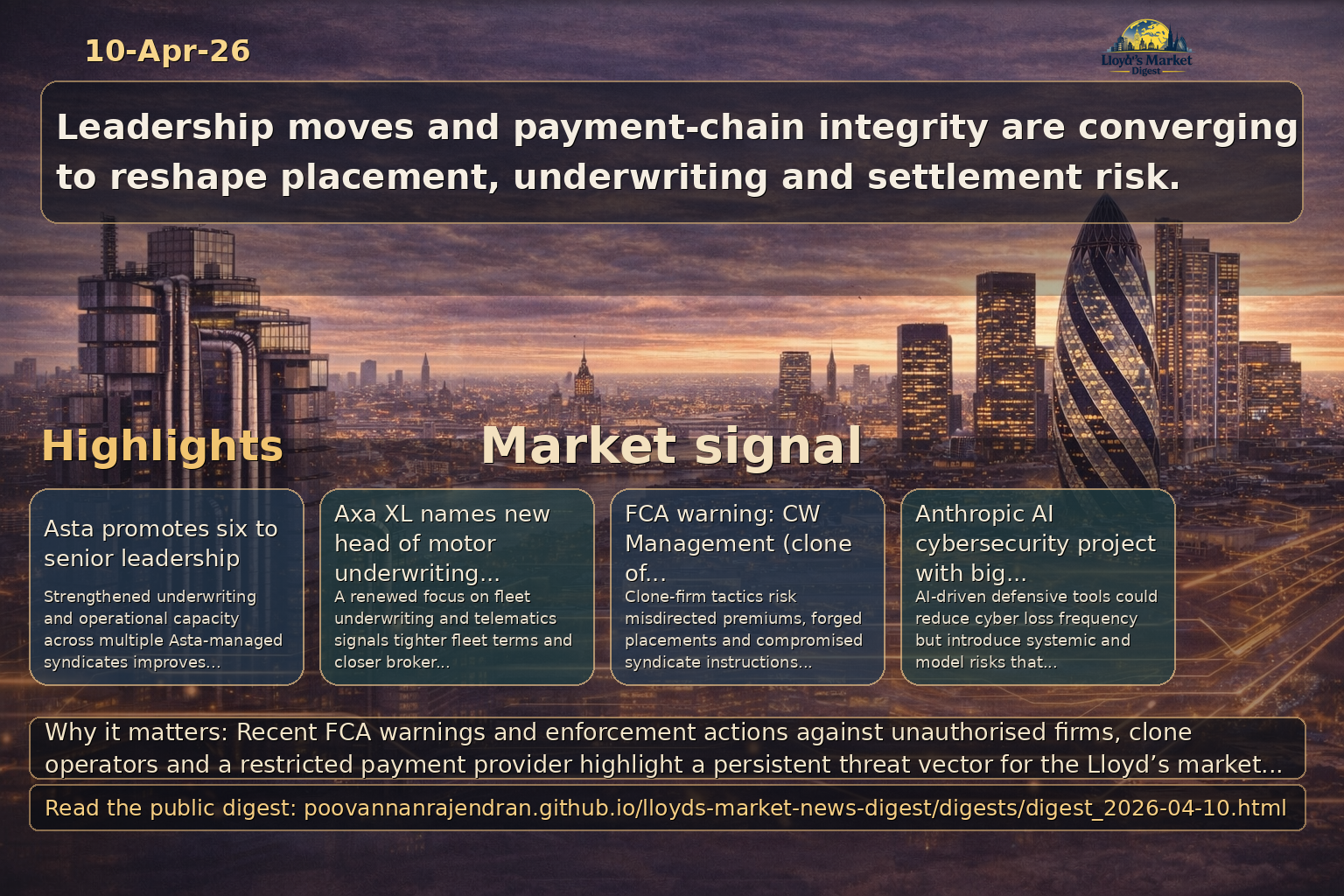
Why it matters: FCA warning on 'Advanced Stocks' indicates an unauthorised entity potentially targeting UK customers — a reminder that unregulated trading/payment intermediaries can intersect with insurance premium finance, broker fee flows and placement payments.
- Validate that any counterparty handling premium collections, premium finance or broker fees is authorised and appears on the FCA register before engagement.
- Require segregation/escrow arrangements for material premium flows and avoid ad hoc payments to unverified third‑party trading or crypto platforms.
- Update broker and MGA onboarding checklists to include negative screening against FCA warning lists and documented escalation routes to compliance/legal teams.
Source: fca.org.uk
Why it matters: FCA notice on 'Gotemp' reflects continued use of unauthorised firms to solicit customers; such firms can be used to launder client funds or impersonate distribution channels important to specialty placements.
- Mandate that brokers and platforms provide proof of authorised status for any payment or distribution partner involved in a placement.
- Conduct periodic reconciliations and touchpoint checks on placement chain to detect routing to unauthorised endpoints.
- Integrate FCA Warning List checks into onboarding workflows for all new counterparties, with senior sign‑off for exceptions.
Source: fca.org.uk
Why it matters: The 'Altura FX' warning underscores FX and payment‑service providers operating outside regulation — a direct operational threat where premiums, claims or reinsurance settlements rely on FX conversion or offshore remittance channels.
- Require approved‑vendor lists for FX and payment services used in premium and claims settlements; prohibit ad hoc FX arrangements without treasury sign‑off.
- Assess treasury exposure: map payment rails used by brokers and clients, and implement approved fallbacks for FX conversion and cross‑border settlements.
- Include contractual SLAs and audit rights for any third‑party payment providers used across syndicates and placement platforms.
Source: fca.org.uk
Why it matters: 'BlockXFx' appears as another unauthorised trading/payment actor; repeated patterns in these warnings indicate opportunistic targeting of retail and corporate clients — a reputational and liability risk if insureds or brokers are exposed via placement channels.
- Perform targeted outreach to wholesale brokers and key clients clarifying approved payment instructions and highlighting the risk of using unauthorised platforms.
- Require multi‑factor verification of new beneficiary/payment instructions, especially when instructions reference crypto or less‑established FX operators.
- Elevate suspicious notifications to a central incident response team and consider notifying Lloyd’s Market Security and legal counsel where exposures are material.
Source: fca.org.uk
Why it matters: The 'CW Management (Clone of FCA Authorised Firm)' warning demonstrates clone‑firm tactics — fraudsters impersonate authorised brokers or firms, risking misdirected premiums, forged placements and compromised syndicate instructions.
- Enforce strict identity verification: verify firm details directly against the FCA register and use authenticated contact details rather than those supplied via email or attachment.
- Require out‑of‑band confirmation (phone to registered number) for any instructions that change banking details or introduce new intermediaries in a placement chain.
- Train market operations and underwriters to recognise clone indicators (domain mismatch, unexpected contact channels) and to suspend payment or placement processing pending verification.
Source: businessinsurance.com
Why it matters: Expanded treatment authority alters medical cost drivers and workers’ compensation exposure profiles relevant to specialty and multinational programs.
- Update workers’ comp and medical benefits underwriting models for regions where non-traditional practitioners have expanded authority.
- Revise claims guidelines and provider network clauses in global programs to control cost inflation and out-of-network risk.
- Collaborate with brokers to reflect treatment-authority changes in loss-cost assumptions and premium adequacy analyses.
Source: businessinsurance.com
Why it matters: Leadership profile signals broker capability and potential shifts in client relationships and Lloyd’s placement strategies.
- Assess how the individual’s expertise aligns with syndicate appetite and specialty desks to prioritize placement access.
- Use the profile to map client segments that may be reallocated or targeted for expanded specialty solutions.
- Monitor for potential cross-firm network effects that could influence lead broker selection on complex placements.
Source: businessinsurance.com
Why it matters: Talent movement and public profile of a broker executive can alter transactional risk distribution and syndicate origination flows.
- Evaluate broker-led transactional capabilities for M&A and rep/war risk placements and their fit with syndicate appetite.
- Engage early with the executive’s desk to secure lead capacity on high-margin specialty placements.
- Track recruiting signal as indicator of shifting market share between global brokers and regional platforms.
Source: businessinsurance.com
Why it matters: Profile of a market executive highlights diversity of expertise and potential influence on platform distribution and syndicate referrals.
- Consider strategic introductions between the executive and syndicates seeking new distribution channels or product partnerships.
- Use the profile to inform succession planning and counterparty risk assessments for broker relationships.
- Leverage public leadership moves when negotiating terms and fees with distribution partners.
Source: businessinsurance.com
Why it matters: Executive background provides insight into broker capability in specialty lines and digital placement engagement that affects Lloyd’s flow of business.
- Prioritize dialogue on digital placement and MGAs where the executive has influence to secure favourable access and data-sharing arrangements.
- Audit the executive’s track record for specialty verticals to match syndicate underwriting targets.
- Anticipate changes in broker-led submission routing that could affect lead underwriter selection.
Source: globalreinsurance.com
Why it matters: Promotions at Asta signal strengthened underwriting and executive capacity within a Davies-owned managing agency, with direct implications for syndicate appetites, broker engagement and placement platforms as the firm scales in the Lloyd’s and global specialty ecosystem.
- Elevated underwriting leadership: Appointment of a chief underwriting officer (David Hopkins, per excerpt) enhances technical authority to refine risk appetite and product strategy—supporting syndicate performance and clearer messaging to brokers and capital providers.
- Client and operational continuity: Promotion of an experienced internal executive to managing director (Clare Barley, per excerpt) preserves institutional knowledge, strengthens broker relationships and improves coordination with placement platforms and trading desks.
- Partnership and growth signal: Multiple senior promotions underscore Asta’s intent to expand capacity and partnership models, improving its competitiveness for delegated authority, attracting reinsurance and capacity partners, and making it a more reliable counterparty for brokers and platform integrators.
Source: insurancejournal.com
Why it matters: Product liability litigation tied to viral marketing campaigns highlights emerging underwriting and claims exposures for food, beverage and consumer-products accounts — relevant to specialty GL, D&O and excess layers.
- Revisit underwriting for social-media driven product promotions: require enhanced product testing evidence, warnings and marketing controls as condition precedents.
- Review policy wordings and sublimits for extreme-consumption exposures and viral challenges; consider specific exclusions or tighter aggregation and allocation language for mass-viral events.
- Brokers should advise clients on crisis-response protocols, preservation of evidence and contractual risk transfer to suppliers/marketers to support defenses and limit excess attach.
Source: insurancejournal.com
Why it matters: An appeals court ruling limiting class-action certification against a utility can materially change loss aggregation, reserve planning and reinsurance/retro structures for wildfire-prone utilities — a direct input into specialty underwriting and retro placements.
- Syndicates and reinsurers should reassess portfolio aggregation and modeled PMLs for utility exposures in light of potential narrowing of class aggregation and liability quantum.
- Placement teams need to revisit attachment points, prospective/retro structures and collateral demands for utility accounts, and re-price structured casualty and retrospective covers accordingly.
- Brokers must monitor jurisdictional precedent and advise clients on litigation and settlement risk, encouraging contract and mitigation measures that reduce catastrophic aggregation potential.
Source: insurancejournal.com
Why it matters: Large technology firms collaborating on AI-enabled defensive cybersecurity capabilities creates opportunities to reduce loss frequency but introduces new systemic and model risks that cyber underwriters, syndicates and placement platforms must quantify and contract for.
- Underwriters should incorporate use of AI-driven security controls into risk calculus and pricing — differentiating between accredited defensive implementations and vendor/tool model risks.
- Draft coverage enhancements and exclusions to address AI-specific failure modes, third-party model vulnerabilities and supply-chain dependencies; include clarity on coverage for AI-generated decisions and automated response actions.
- Brokers and placement platforms should negotiate incident-response retainer terms, forensic coverage and vendor liability transfer clauses to reflect evolving AI-enabled cyber defenses and residual exposures.
Source: insurancejournal.com
Why it matters: Reports of vessel transits through the Strait of Hormuz signal shifts in navigational risk and war/terrorism exposure that affect hull, cargo and energy marine placements, war premiums and route-specific contingency planning.
- Underwriters must reassess voyage-level war and political violence premiums and clause applicability given changing access and risk permutations in the Gulf shipping lanes.
- Syndicates should map concentration of exposure to Gulf trades and energy cargoes, and consider capacity reallocation or tightened terms for transits near contested waters.
- Brokers need to provide clients route-specific advice on alternative routing, increased war risk cover, and the commercial impact of potential premium and delay claims.
Source: insurancejournal.com
Why it matters: Escalation between Israel, Iran and Lebanon that jeopardizes truce and keeps the Strait of Hormuz effectively closed amplifies energy price volatility and war-related marine exposures — requiring immediate portfolio stress-testing across specialty lines.
- Immediate scenario stress-testing for energy-linked portfolios and re-evaluate margin, collateral and capital for underwriters exposed to commodity and marine interruption risks.
- Increase readiness to offer or scale war-risk, kidnap & ransom and political violence products; placement platforms should prepare rapid-issue facilities and tightened endorsements.
- Brokers and syndicates should coordinate on contingency claims handling protocols and client communications to manage volatility, liquidity and reputational risk during sustained disruptions.
Source: insurancetimes.co.uk
Why it matters: Signs of a deteriorating motor underwriting cycle increase the likelihood of smaller carriers exiting, creating consolidation opportunities for larger players and implications for broker panels and capacity sourcing at Lloyd's and specialty markets.
- Capital allocation: consider targeted M&A or quota-share arrangements to capture scale benefits and improve cost base if smaller competitors withdraw.
- Distribution impact: brokers should prepare for concentrated panels and ensure competitive tender strategies that emphasise service and claims handling.
- Syndicate strategy: Lloyd's syndicates with motor exposure must reassess pricing adequacy, retrocession needs and appetite thresholds to protect combined ratios.
Source: insurancetimes.co.uk
Why it matters: A market pivot from price to quality places brokers at the centre of risk advisory, increasing demand for placement platforms, technical broking expertise and differentiated service from Lloyd's syndicates and global specialty carriers.
- Broker differentiation: invest in sector-specialist teams, data analytics and claim prevention services to justify fee models beyond premium discounting.
- Placement platforms: evaluate platform integration to demonstrate placement quality, audit trails and faster syndicate access for complex risks.
- Carrier engagement: syndicates and MGAs should showcase technical services and loss-prevention offerings as part of appetite conversations with broker partners.
Source: insurancetimes.co.uk
Why it matters: Arch's promotion to head of casualty highlights ongoing talent development in specialty lines; such internal succession reduces disruption for brokers and supports continuity of underwriting relationships with Lloyd's-designated capacity providers.
- Relationship continuity: brokers should reconfirm binding authorities and underwriting commitments following leadership changes to avoid placement friction.
- Underwriting strategy: expect renewed focus on product development and regional casualty growth where promoted leaders bring targeted expertise.
- Talent pipeline: managing agents and carriers must formalise succession planning to reassure brokers and wholesale clients about coverage stability.
Source: reinsurancene.ws
Why it matters: Tysers’ appointment strengthens a Lloyd’s broker’s marine & aviation capability with deep cargo and North American market expertise — enhancing placement effectiveness for cargo and stock-throughput business.
- Bolsters Lloyd’s broker underwriting intelligence and client service for global cargo flows, improving syndicate access to quality risks.
- Improves penetration into North American cargo and stock-throughput markets, supporting cross-border placements and capacity sourcing for syndicates.
- Enhances broker-led product development and tailored solutions, increasing the value-add vs. transactional placements for specialty marine insurers.
Source: reinsurancene.ws
Why it matters: Willis Re’s hire of an aviation reinsurance veteran increases advisory depth for complex aviation placements (war, retrocession, satellite), influencing structuring and capacity allocation across markets including Lloyd’s syndicates.
- Strengthens broking capability to structure and negotiate retrocession and war-risk solutions, affecting reinsurance program design and pricing.
- Brings senior-level loss-event experience that supports complex claims positioning and resilience planning for carriers and brokers.
- Elevates market advisory on exposures across airlines, manufacturers and satellite risks, informing syndicate appetite and tailored capacity offerings.
Source: reinsurancene.ws
Why it matters: AXIS Capital appointing a seasoned Chief Commercial Officer signals intensified focus on broker engagement and distribution strategy from a Bermuda-based carrier, with implications for broker negotiation dynamics and syndicate competition for specialty placements.
- Anticipate more coordinated commercial strategies with brokers to drive profitable growth and multi-variant distribution across specialty lines.
- May lead to differentiated product and capacity offers for key broker partners, influencing placement flows to AXIS vs. Lloyd’s syndicates.
- Pressures brokers and placement platforms to demonstrate value in channeling high-quality risks and in facilitating streamlined carrier–broker collaboration.
Source: reinsurancene.ws
Why it matters: Daiichi’s reinsurance of an in-force block to a Bermuda life reinsurer (Prismic Life) illustrates the growing role of Bermuda specialists in balance-sheet management and longevity solutions, relevant to global life reinsurance and transfer channels.
- Validates Bermuda and specialist reinsurers as strategic partners for cedants seeking capital efficiency and longevity risk transfer.
- Signals demand for tailored administration and long-term servicing arrangements, creating opportunities for placement intermediaries specialising in life business transfers.
- Encourages syndicates and platforms to assess lifecycle servicing and run-off solutions when structuring capacity for life and annuity blocks.
Source: reinsurancene.ws
Why it matters: Mezura Capital Partners (Pine Walk / TFP) launching Bermuda-headquartered Capital Solutions reflects growth of structured capital offerings and ILS-like arrangements from MGA/insurer platforms — expanding alternative capital options for syndicates and cedants.
- Introduces additional structured whole-account and retrospective solutions, broadening capital routes for specialty insurers and reinsurers.
- Creates partnership opportunities between syndicates, MGAs and alternative capital providers for casualty and specialty risk solutions.
- Increases the importance of placement platforms capable of integrating structured capital, retrospective covers and bespoke collateral arrangements.
Source: bankofengland.co.uk
Why it matters: The referenced Bank of England page — even where the excerpt focuses on cookie consent — represents an authoritative conduit for policy pronouncements and regulatory guidance. For Lloyd's market participants and global specialty brokers, changes in how the BoE publishes and controls access to information affect surveillance of monetary policy, stress scenarios, customer data handling expectations and the integrity of distribution platforms.
- Treat BoE communications as an input to capital and pricing models: establish automated monitoring (RSS/API/web-scrape with legal clearance) so syndicates and chief actuaries receive policy and macro updates in real time.
- Validate data-governance and consent mechanisms on placement platforms: ensure broker portals and MGAs mirror or respect regulatory expectations on cookies, tracking and customer consent to avoid supervisory scrutiny or client-data breaches.
- Embed BoE publication monitoring into operational-resilience plans: confirm accessibility of official notices across channels, run periodic checks on third‑party platforms used for placements, and align incident response with anticipated policy shocks.
Source: artemis.bm
Why it matters: Zurich's successful upsized Turicum Re 2026-1 issuance demonstrates a major insurer returning to the cat bond market with competitive pricing and sufficient investor demand—directly relevant for market participants re-evaluating alternative capital, placement timing and distribution strategies.
- Capital strategy: Reassess the cost and availability of collateralised cat capacity versus traditional reinsurance and retrocession; maintain preparedness to access the cat bond market to optimise the capital stack.
- Brokers and placement platforms: Emphasise investor engagement and execution efficiency—tighter spreads increase leverage in fee and timing negotiations and favour platforms that can demonstrate depth and speed of distribution.
- Syndicates and product teams: Track collateralised multi‑year capacity into US wind/quake lines; consider adjusting attachment levels, term structures and underwriting cadence to mitigate margin compression.