Source: fca.org.uk
Why it matters: Unauthorised operator (UNIQUEMF) flagged by the FCA increases the risk of clients engaging outside regulated channels, exposing brokers and placement platforms to downstream complaints and loss of premium protection.
- Clients dealing with unauthorised entities for insurance-related products lose FSCS and FOS protections, increasing post-event disputes and claims against brokers or platforms that facilitated contact.
- Brokers and MGAs must enforce counterparty checks and restrict integrations to pre-approved, authorised partners to avoid distribution risk.
- Enhance client communications to clearly state protections and use automated checks on counterparties at onboarding and before any fund movement.
Source: fca.org.uk
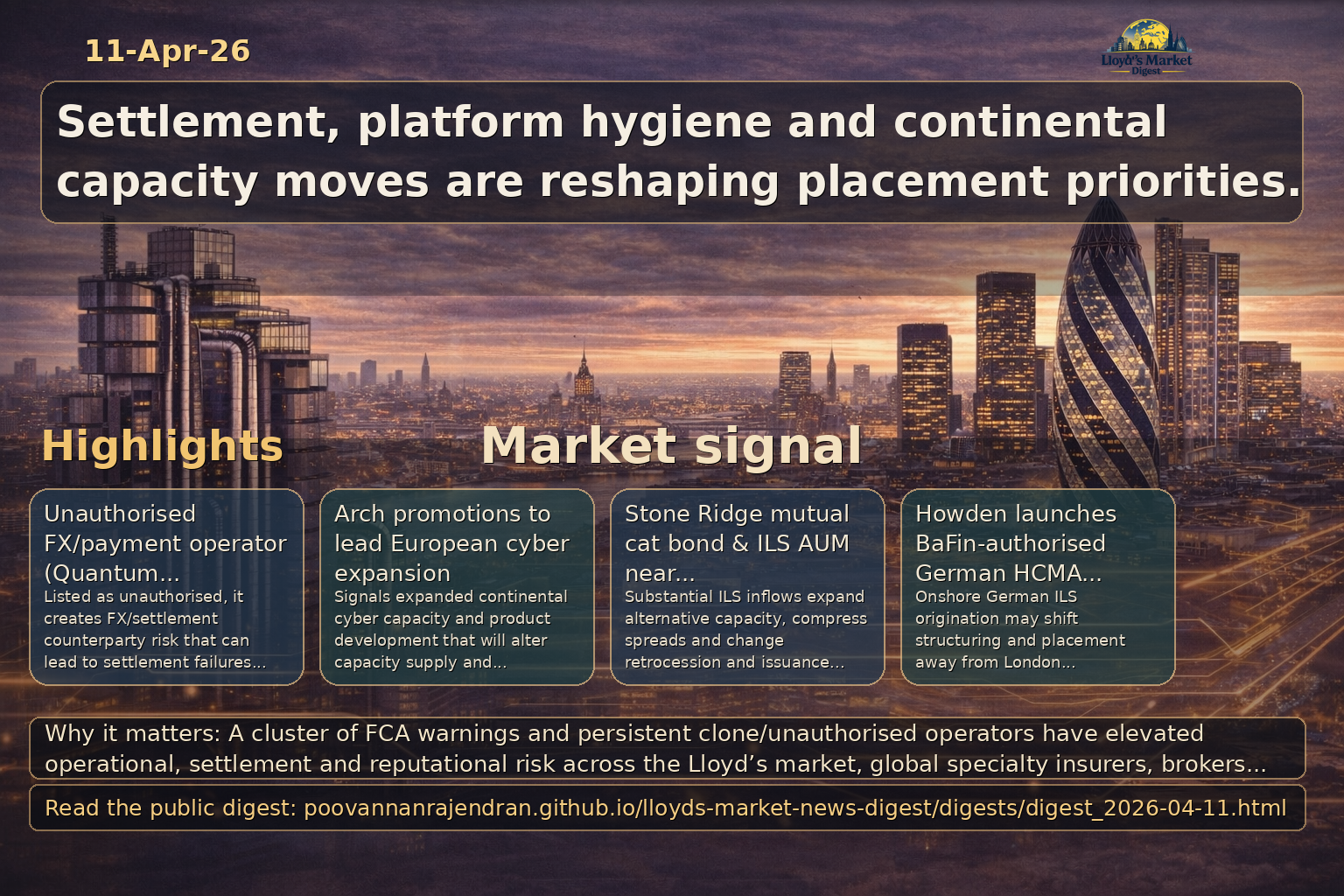
Why it matters: Quantum Xchange Mobile listed as unauthorised signals FX/settlement counterparty risk and potential use of digital channels to impersonate market participants.
- Using unvetted FX or payment providers can produce settlement failures, foreign-exchange execution risk, and unexpected exposures for syndicates and brokers.
- Placement platforms should require treasury and vendor due diligence for any FX or payment integrations and block unregistered entities from platform access.
- Increase monitoring for anomalous communications and confirmations, and mandate out-of-band verification for any change in beneficiary or bank details.
Source: fca.org.uk
Why it matters: FCA analysis on tracking consumer credit journeys signals a regulatory pivot to richer data and analytics — raising expectations for proactive market surveillance and evidence-based interventions.
- Regulator adoption of advanced CRA-derived analytics implies earlier detection of market conduct and consumer harm; Lloyd's stakeholders should expect more targeted supervisory queries.
- Opportunity for syndicates, brokers and platforms to leverage similar data signals to improve fraud detection, credit assessment for insureds, and counterparty monitoring.
- Recommend investing in analytics capability, data-sharing agreements and documented audit trails to demonstrate proactive risk management during regulatory reviews.
Source: fca.org.uk
Why it matters: Advanced Stocks appears as an unauthorised entity warning, reinforcing ongoing threats where purported investment or brokerage services operate outside the regulatory perimeter.
- Potential for firms to solicit investments or premium-like payments without protections, increasing client loss and complaint volume against distribution partners.
- Placement platforms should maintain denial lists and automated screening for known unauthorised names and domains to prevent referrals or listings.
- Reinforce client education on FSCS/FOS limits and ensure commercial agreements require counterparties to be licensed where required.
Source: fca.org.uk
Why it matters: Gotemp flagged as unauthorised reinforces the operational risk that impersonation or unauthorised intermediaries pose to settlement chains and client protection.
- Unauthorised intermediaries can masquerade as legitimate brokers or market platforms, disrupting claims flows and premium collection.
- Brokers and platform operators must execute periodic sweeps of partner lists against FCA warnings and institute mandatory escalation for any suspicious outreach.
- Operational resilience steps: staff phishing training, standardized payment confirmation procedures, and rapid takedown processes for impersonating domains.
Source: businessinsurance.com
Why it matters: Expansion of treatment authority for alternative practitioners alters professional liability and workers’ compensation exposure profiles, requiring updates to underwriting criteria and policy language for healthcare and employer clients.
- Underwriters should re-evaluate professional indemnity and employer liability wordings for exposures tied to non-traditional practitioners and adjust capacity and pricing accordingly.
- Brokers must inventory client exposure where alternative practitioners operate and procure appropriate endorsements or limits to reflect increased scope of practice risk.
- Placement platforms should capture the expanded exposure data fields to support accurate risk selection, analytics and claims forecasting.
Source: businessinsurance.com
Why it matters: War-risk premium stickiness directly impacts specialty lines pricing, capacity allocation and broker negotiation strategies in the Lloyd's market and global specialty placements.
- Maintain strict placement discipline on war-exposed risks and review war clauses and war extensions across syndicates.
- Coordinate with broking desks to reinforce evidence-based pricing and non-aggregation of exposures on platform placements.
- Assess alternative capacity sources (reinsurers, pools, capital markets) for any mandated relief or to support renewals.
Source: businessinsurance.com
Why it matters: VIG Re's reported profit signals selective reinsurer strength that can influence capacity availability and pricing for Lloyd's syndicates and specialty placements.
- Review reinsurance program renewals to capture potential pricing stability or negotiate better terms leveraging profitable reinsurer appetite.
- Monitor reinsurer balance-sheet signals to identify partnering opportunities for syndicates seeking quota share or facultative support.
- Adjust capital allocation strategies if reinsurance pricing and capacity trends allow coordinated expansion in targeted specialty classes.
Source: businessinsurance.com
Why it matters: Zurich's expansion into Poland shifts local capacity dynamics and distribution relationships — relevant to global brokers, MGA strategies and syndicates seeking onshore presence.
- Evaluate implications for cross-border placements and onshore underwriting access when placing EMEA risks through Lloyd's or global carriers.
- Consider strategic partnerships or distribution agreements with local carriers and MGAs to preserve placement flow.
- Ensure compliance and product localization capabilities are embedded on placement platforms to serve new regional mandates.
Source: businessinsurance.com
Why it matters: Steadfast's openness to sale typifies ongoing broker consolidation, which alters negotiating leverage, distribution economics and integration needs for placement platforms and syndicates.
- Map key client and placement dependencies to anticipate changes in broker ownership and resulting shifts in placement flows.
- Prepare integration scenarios for platform connectivity and data sharing to retain placement efficiency post-transaction.
- Reassess commission and service agreements with consolidating brokers to protect margin and service levels.
Source: globalreinsurance.com
Why it matters: The appointments are a direct indicator of Arch's intent to grow European cyber portfolios via local leadership, which alters capacity supply, distribution dynamics and product development timelines that matter to Lloyd's market players, brokers and placement platforms.
- Broker engagement: Brokers should proactively engage Arch’s new regional leads, standardize cyber submission templates and leverage electronic placement platforms to access expanded continental capacity quickly — Iberian brokers in particular should prioritize relationship-building in Madrid.
- Syndicate & capacity impact: Arch’s increased focus on primary and excess cyber provides alternative capital to Lloyd’s syndicates, which may ease capacity constraints but intensify competition on pricing and terms; syndicates should reassess appetite, delegated authority and broker panels accordingly.
- Product and underwriting implications: Accelerated product development (including technology E&O) requires better-prepared risk data and telemetry from clients; brokers and placement platforms must align submission quality and digital workflows to secure favorable terms and retention strategies.
Source: insurancetimes.co.uk
Why it matters: Education–industry partnerships create a predictable talent pipeline and governance familiarity that are critical for underwriting teams, broking houses and syndicates managing specialist lines.
- Develops junior talent with sector-specific awareness, reducing training lag for specialist underwriting desks
- Opportunity for brokers and managing agents to influence curricula and secure hire pipelines aligned to Lloyd’s capability needs
- Recommendation: formalise partnerships and apprenticeships to protect institutional knowledge and support diversity targets
Source: insurancetimes.co.uk
Why it matters: Axa’s delegated authority deal for renewable decommissioning bonds illustrates how DA models are being used to scale capacity for ESG-related specialty exposures.
- Demonstrates appetite to provide long-term capacity for renewable liabilities via delegated authority and scheme frameworks
- Highlights demand for bond and security solutions that relieve operators’ cash-flow and satisfy regulators/landowners
- Action: syndicates and placement platforms should map delegated authority gateways to capture renewable supply-chain risks and streamline appetite documentation
Source: insurancetimes.co.uk
Why it matters: Macquarie-backed Longbrook launching transactional liability shows capital-backed MGAs entering high-margin specialty lines that are frequently placed by global brokers and placement platforms.
- Transactional liability (W&I, tax) is a natural fit for capacity via MGAs supported by institutional capital seeking predictable, bespoke coverage
- Creates placement opportunities for brokers on cross-border M&A where speed and bespoke wording matter
- Recommendation: placement platforms should standardise data and placement workflows for transactional lines to accelerate binding and co-insurance
Source: insurancetimes.co.uk
Why it matters: Ripe’s MGAA membership signals digital MGAs maturing into mainstream specialist providers, increasing the need for integration with broker and syndicate systems and adherence to market standards.
- Validates digital MGAs as credible long-term partners for distribution of niche specialty products
- Implication for Lloyd’s: digital MGAs can be distribution partners or competitors; standard-setting via trade bodies reduces operational friction
- Action: syndicates and platforms should prioritise API/onboarding templates and MGAA-compliant governance to expedite partnerships
Source: insurancetimes.co.uk
Why it matters: Tracker’s recovery performance materially reduces motor claims costs and demonstrates how telematics and recovery partnerships can improve loss ratios for motor portfolios underwritten by syndicates and global brokers.
- Tech-enabled recoveries lower average claim severity and can translate into pricing and capital benefits for motor portfolios
- Strengthens insurer-insurer and insurer-police-manufacturer collaboration models relevant to fleet and telematics-driven placements
- Recommendation: underwriters and platforms should assess telematics/recovery integration as a loss-mitigation underwriting factor and potential differentiator in panel selection
Source: reinsurancene.ws
Why it matters: Archival market reporting provides historical performance context that helps syndicates and brokers calibrate cyclicality, nat‑cat impacts and capital adequacy in Lloyd's and the global specialty market.
- Use historical P&L and nat‑cat loss patterns to validate current catastrophe models and capital plans
- Incorporate archived pricing and underwriting outcomes into scenario testing for syndicate renewals
- Leverage historical transaction outcomes when advising investors and capacity providers on expected returns and volatility
Source: reinsurancene.ws
Why it matters: A major increase in Brookfield Wealth Solutions' group capital highlights continued institutional capital deployment into insurance — a potential source of capacity for large specialty risks and alternative capital participation at Lloyd's.
- Assess opportunities for strategic capital partnerships or quota‑share arrangements with large insurance capital providers
- Revisit syndicate capital structures to incorporate longer‑dated institutional investors seeking yield
- Ensure governance and reporting meet institutional investor expectations to attract stable capacity
Source: reinsurancene.ws
Why it matters: ACORD's M&A findings indicate consolidation is creating shareholder value in many insurer deals — a signal that standards, integration and scale are driving broking and platform strategy relevant to Lloyd's distribution and placement platforms.
- Prioritise data and messaging standards integration when evaluating platform M&A or partnership opportunities
- Brokers should quantify synergies from scale (technology, distribution) when negotiating with syndicates and capital partners
- Use ACORD insights to advise syndicates on likely counterparty consolidation scenarios and their impact on placement volume
Source: reinsurancene.ws
Why it matters: Evercore ISI flagging mounting pressures across P&C signals weakening pricing and margin pressures that will filter into reinsurance buying, syndicate underwriting discipline and broker negotiation leverage at renewals.
- Stress‑test syndicate loss ratio and expense assumptions against softer pricing scenarios
- Brokers should prepare tiered placement strategies to protect client terms if primary pricing deteriorates
- Consider tightening underwriting appetite in lines most exposed to pricing compression and tech disruption
Source: reinsurancene.ws
Why it matters: The somewhat below‑average Atlantic hurricane forecast still heightens the need for disciplined catastrophe exposure management across Lloyd's syndicates and global specialty portfolios.
- Reassess accumulation models and retrocession programmes ahead of the season’s peak
- Ensure placement platforms and brokers have updated CAT‑response protocols and rapid reinsurance procurement workflows
- Coordinate with claims and catastrophe teams to validate response and liquidity plans for a single large event
Source: artemis.bm
Why it matters: Stone Ridge's mutual cat bond and ILS fund AUM approaching $6.5bn signals material inflows to ILS mutual strategies, expanding market capacity and competition for yield — a structural development that affects spreads, placement strategy and syndicate access to alternative capital.
- 24% year-on-year AUM growth implies more investor capital available for cat bonds and ILS funds, increasing competition for issuance and upward pressure on capacity.
- Larger ILS pools are likely to compress spreads and reduce financing costs for cedents, pressuring traditional retrocession margins and syndicate pricing for peak perils.
- Brokers and placement platforms should prioritise differentiated structuring and investor outreach to capture issuance allocation as funds scale up and allocation mandates evolve.
Source: artemis.bm
Why it matters: Howden's launch of a BaFin-authorised German HCMA unit strengthens its European capital markets and ILS distribution footprint, creating a locally regulated origination point that competes with London brokers and supports continental insurers seeking onshore execution.
- A BaFin licence facilitates direct engagement with German and continental clients and assets, reducing execution frictions for Euro-denominated and EU-regulated counterparties.
- This expansion increases competition among brokers for structuring mandates and may shift portions of ILS placement and advisory business away from Lloyd's-centric platforms.
- Syndicates and placement intermediaries should reassess channel strategies and local partnerships to maintain market share in Continental Europe as broking firms offer onshore capital markets solutions.
Source: artemis.bm
Why it matters: CSU's forecast of a 'somewhat below-normal' 2026 Atlantic hurricane season reduces short-term expected loss for US wind perils, which can influence pricing, basis risk assumptions and timing of issuances targeting named-storm protection.
- Lower seasonal activity expectations may soften near-term pricing for US named-storm retrocession and cat bonds, increasing pressure on capacity providers to adjust pricing models.
- Issuers and syndicates should avoid complacency: a below-normal forecast does not eliminate tail risk and may change demand timing for retrocession ahead of pricing cycles.
- Brokers and modelling teams must recalibrate assumptions and client communications on expected losses, attachment strategies and basis risk under El Niño-driven scenarios.
Source: artemis.bm
Why it matters: Mapfre Re pursuing a third Recoletos Re catastrophe bond for at least $200m of US named-storm cover underscores repeat sponsor behaviour and the strategic use of cat bonds to source retrocessional capacity from capital markets rather than traditional retrocession.
- A repeat sponsor approach signals confidence in capital markets execution and that cat bonds are an integrated element of Mapfre Re's retrocession programme.
- The $200m target for named-storm protection indicates ongoing demand for peak-peril capacity and provides investors with a clearly scoped risk exposure aligned to US wind perils.
- Placement platforms and brokers should anticipate repeat issuer timelines and position distribution channels to capture allocations from both institutional ILS funds and traditional reinsurers.
Source: artemis.bm
Why it matters: The Recoletos Re DAC (Series 2026-1) structure — an Ireland-based, collateralised vehicle issuing Class A notes to provide US named-storm retrocession — reflects prevailing SPV domiciliation and collateralisation practices that reduce counterparty risk and broaden investor participation.
- Use of an Ireland DAC continues to be a preferred domicile for European-sponsored cat bonds, offering familiar legal and tax frameworks for global investors and sponsors.
- Fully collateralised notes mitigate counterparty exposure, enhancing investor appetite and potentially lowering required coupon spreads for sponsors.
- Syndicates and brokers should note structural consistency when advising clients: repeatable SPV templates ease execution and shorten time-to-market for future issuances.
Source: newsnow.co.uk
Why it matters: Shifts in UK–Israel diplomatic and trade relations affect political risk, sanctions exposure, cyber/technology trade and defence-related liabilities under specialty portfolios — areas where Lloyd's syndicates and brokers provide targeted capacity.
- Review political violence, trade credit and sanctions screening across placements tied to Israel–UK trade flows; syndicates should reassess war/terror endorsements and treaty limits.
- Underwrite cyber/tech and export-related exposures with heightened diligence on supply‑chain concentration and defence sector counterparties; consider tailored exclusions or enhanced pricing.
- Brokers should prepare contingency placement packages on digital platforms for clients active in Israel–UK corridors, including crisis response and expedited claims protocols.
Source: newsnow.co.uk
Why it matters: Ongoing media coverage of high‑profile public figures increases demand for D&O, media liability, reputation management and legal expense solutions — specialty lines that require precise wordings and capacity at Lloyd's.
- Syndicates and underwriters should reassess limits, reputational risk exclusions and social‑media amplification clauses for celebrity and public‑figure coverages.
- Brokers must coordinate bespoke crisis‑response endorsements (PR, legal defence, privacy remediation) and ensure rapid placement capability via digital platforms.
- Claims teams should establish rapid escalation paths and cross‑jurisdictional legal support given the likelihood of multi‑forum defamation, privacy and disclosure actions.
Source: newsnow.co.uk
Why it matters: Coverage needs for individual public figures (personal security, kidnap & ransom, travel and reputational protection) require specialist underwriting and coordinated placement; high visibility magnifies potential claims and client management demands.
- Ensure availability and pricing of personal security, kidnap & ransom and high‑net‑worth travel coverages with stringent underwriting (security vetting, travel protocols).
- Develop tailored privacy/media defense and reputation restoration packages linked to personal client policies; confirm clear triggers and sublimits.
- Brokers should leverage specialist syndicates and placement platforms to bind rapidly and coordinate global claims handling and security incident response.
Source: newsnow.co.uk
Why it matters: Major incidents in tourist hubs (e.g., bus crashes in the Canary Islands) drive concentrated travel, personal accident and casualty claims, expose insurers to repatriation costs and can create seasonal accumulation risk for Lloyd's capacity providers.
- Expect surge claims across travel PA, medical evacuation and liability lines; syndicates should validate aggregation models and catastrophe attachments for transport incidents.
- Underwriters should reassess pricing and capacity for high‑season tourist destinations, consider tighter terms for tour operators and adjust exposure management practices.
- Brokers must confirm local claims handling agreements, rapid repatriation arrangements and clear notification pathways on placement platforms to minimise client disruption.
Source: newsnow.co.uk
Why it matters: Evolving UK–Spain relations post‑Brexit and incident reporting affecting bilateral travel and trade have implications for marine, transport, export credit and cross‑border regulatory compliance — areas core to Lloyd's global specialty underwriting and broker operations.
- Revisit export credit, marine and transport wordings for jurisdictional and regulatory changes; ensure sanctions and cross‑border compliance are embedded in placements.
- Brokers and placement platforms must map licensing and claims jurisdiction impacts for cross‑border business and update client disclosures and policy schedules accordingly.
- Syndicates should reassess corridor exposures (ports, freight routes, tourism flows) and consider recalibrated capacity or reinsurance protections where concentration risk has increased.