Source: fca.org.uk
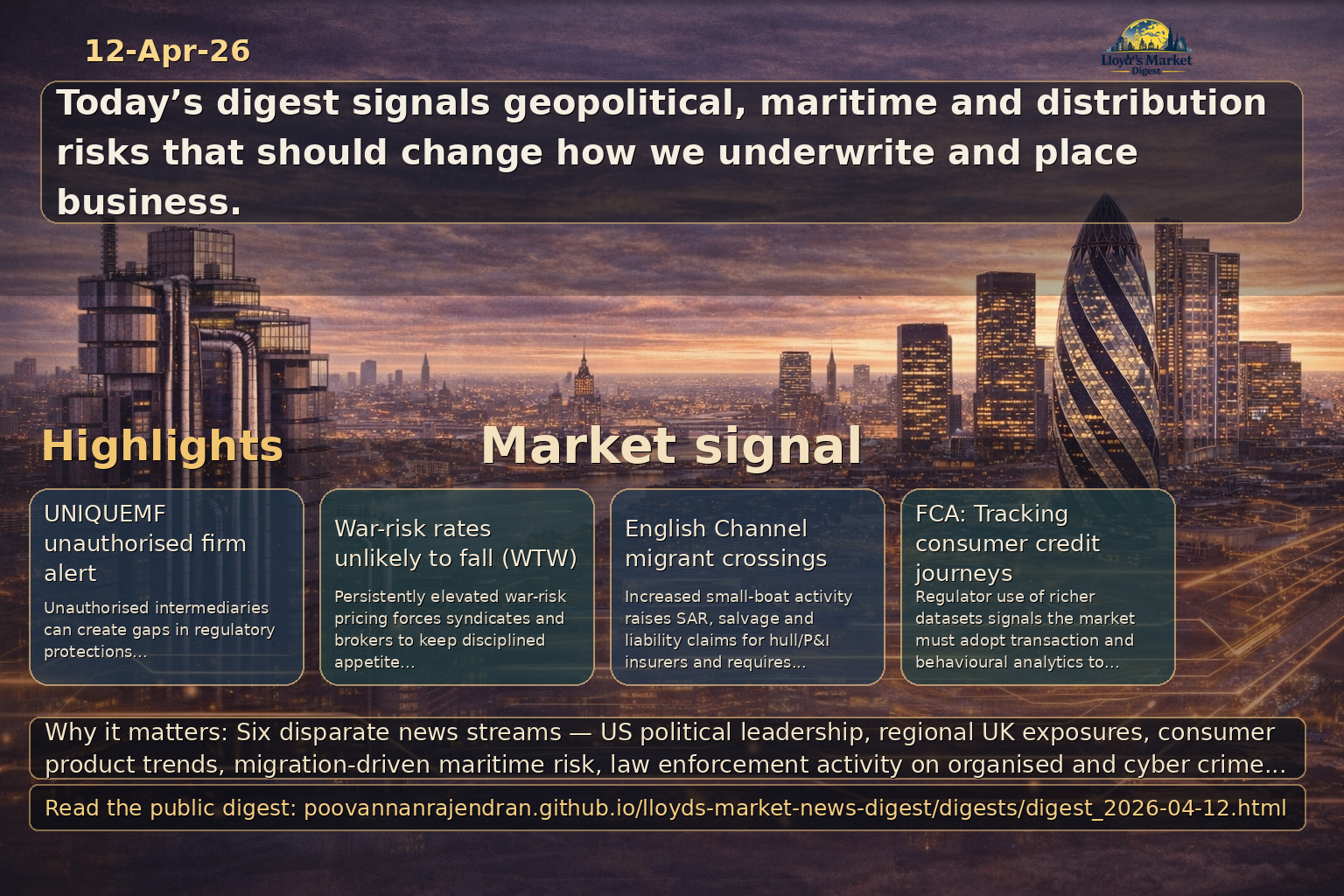
Why it matters: The UNIQUEMF alert illustrates unauthorised firms marketing financial services in the UK. For specialty lines and syndicates, unauthorised intermediaries can create gaps in regulatory protections, expose clients to uninsured outcomes and increase the market's AML and conduct risk profile.
- Due diligence: Require documented proof of authorisation and appointing authority from any intermediary before accepting business; escalate any unknown entities to market compliance.
- Client protection: Ensure placement terms make clear protections (or lack thereof) where intermediaries are unauthorised; where possible route premium flows through authorised, audited entities to preserve FSCS/ombudsman recourse.
- Market governance: Establish a market-wide watchlist and rapid notification process (including Lloyd’s Market Notices or platform alerts) to inform syndicates and brokers when unauthorised operators are identified.
Source: fca.org.uk
Why it matters: The Quantum Xchange Mobile warning signals unauthorised activity potentially exploiting mobile and digital channels. Placement platforms, brokers and syndicates must assume mobile-first impersonation and fintech-style scams can intersect with insurance premium and claims flows.
- Digital controls: Enforce stronger identity verification and device-level security for placement platform users (MFA, device fingerprinting, anomaly detection for logins and changes to payment instructions).
- Payment integrity: Require confirmation protocols for any payment-routing changes communicated via mobile channels and introduce mandatory cooling-off/verification windows for new payee instructions.
- Threat intel: Monitor app stores, social channels and domain registrations for impersonations of firms and platforms; coordinate takedown requests and notify market participants of detected mobile-app clones.
Source: fca.org.uk
Why it matters: The FCA blog on tracking consumer credit journeys demonstrates the regulator's increasing use of richer datasets and advanced analytics to identify risk earlier. For Lloyd's and market participants this should be interpreted as a signal to adopt data-driven surveillance to detect distribution anomalies, fraud patterns and concentration risks across brokers and platforms.
- Capability build: Invest in aggregated transaction and behavioural analytics across broker and platform activity to surface anomalous placement patterns, premium flows and client credit signals.
- Collaboration: Explore secure data-sharing pilots with CRAs, regulators and market utilities to enable timely detection of systemic or concentrated distribution risks while observing data protection requirements.
- Underwriting and controls: Leverage analytic outputs to refine onboarding, KYC and underwriting rules, and to prioritize targeted audits and compliance reviews of brokers and MGAs.
Source: businessinsurance.com
Why it matters: Continued elevated war-risk rates directly affect Lloyd’s war/political violence offerings, specialty underwriters and broker placement strategies for high-severity accounts.
- Syndicates should maintain disciplined appetite and ensure war/political risk overlays remain calibrated to current loss expectations and rerating trends.
- Brokers need to secure capacity early and structure layered placements to manage increasing primary and excess war premium costs.
- Placement platforms must support rapid evidence-of-coverage and war-risk clauses to speed placement while preserving compliance and security protocols.
Source: businessinsurance.com
Why it matters: VIG Re’s profit signals that selective reinsurers are generating returns in specialty niches — a barometer for capacity availability and pricing dynamics relevant to Lloyd’s syndicates.
- Positive reinsurance results may encourage targeted capacity deployment into areas showing profitable technical performance, impacting treaty terms available to syndicates.
- Syndicates should reassess retrocession buys and counterparty credit, factoring in reinsurer profitability-driven appetite shifts.
- Brokers should monitor reinsurer capital movement to time program placements and optimize cost/coverage trade-offs.
Source: businessinsurance.com
Why it matters: Zurich’s expansion into Poland illustrates continuing geographic growth by major insurers — relevant for market access, local capacity and partnership opportunities with Lloyd’s and wholesale brokers.
- Syndicates and global MGAs should evaluate distribution and partnership opportunities to support multinational clients entering Poland or Central Europe.
- Brokers can leverage expanded local insurer footprints to improve onshore capacity and compliance for locally regulated covers.
- Placement platforms need to ensure local regulatory modules and document workflows support cross-border placements efficiently.
Source: businessinsurance.com
Why it matters: Steadfast signalling openness to sale highlights continued broker consolidation — a structural theme that alters negotiation dynamics with syndicates and placement platforms.
- Consolidation reduces the number of large negotiating counterparties and can concentrate buying power, pressuring syndicate margin and commission structures.
- Potential broker M&A activity creates short-term dislocation and opportunities for syndicates to re-evaluate distribution partnerships and exclusivity arrangements.
- Placement platforms should position for integration and scale advantages, offering unified connectivity and data services to consolidated broker groups.
Source: businessinsurance.com
Why it matters: A profile on Ian Williams provides context on leadership background and influence — useful for assessing executive-level relationships with brokers, carriers and distribution channels.
- Underwriters and boards should track leadership pedigrees when evaluating counterparty governance and strategic direction for partner organizations.
- Brokers can use executive profiles to tailor engagement strategies and identify decision-makers for negotiation or partnership discussions.
- Placement platforms should map leadership changes to procurement or IT priorities, anticipating shifts in platform adoption or integration demand.
Source: globalreinsurance.com
Why it matters: Promotions create dedicated senior stewardship for cyber across Europe and Iberia, increasing Arch’s ability to tailor products, engage brokers locally and compete for specialty placements. This affects broker workflows, syndicate competitive positioning and platform routing for cyber business in key continental markets.
- Underwriting and product: Expect accelerated deployment of region-specific cyber products and tighter underwriting discipline—helpful for brokers seeking tailored solutions and for placement platforms evaluating new appetite statements.
- Broker engagement and placements: Local senior leaders in Madrid improve broker access and decision cadence for Iberia and continental Europe, likely shortening quote-to-bind timelines and enabling more direct negotiation on coverage terms and pricing.
- Capacity and competitive dynamics: A focused expansion by Arch may shift placement patterns and capacity allocation in cyber—prompting syndicates and platforms to reassess competitiveness, co-insurance strategies and reinsurance/retro planning to defend market share.
Source: insurancejournal.com
Why it matters: The slowdown in U.S. E&S growth and a material drop in Berkshire Hathaway’s E&S volume signal a rebalancing of capacity and opportunities for syndicates and specialty carriers to reprice and capture displaced risk.
- Reduced E&S growth and Berkshire’s decline create capacity gaps that Lloyd’s syndicates and specialty markets can target via selective appetite expansion and targeted program business.
- Brokers must diversify placements and deepen platform-enabled multi-market submissions to replace large single-carrier dependencies and protect client coverage continuity.
- Underwriters and managing agents should reassess portfolio concentrations, tighten accumulation management, and consider co-insurance or quota-share structures to absorb redirected business efficiently.
Source: insurancejournal.com
Why it matters: Any move toward tolls or restrictions in the Strait of Hormuz would materially affect marine, energy and war/terror covers — driving immediate repricing, capacity reallocation and increased reliance on specialty war risk facilities.
- Potential restrictions on navigation increase volatility in marine and energy exposures, pushing Lloyd’s and global specialty underwriters to adjust war, hull and cargo premiums and policy wordings.
- Brokers should pre-emptively model alternative routing impacts on coverage and engage multiple war risk providers via placement platforms to secure prompt capacity and expedite endorsements.
- Syndicates and reinsurers must scrutinize transit-related policy clauses and sanction/legal exposures, updating underwriting guidelines and accumulation models for concentrated shipping corridors.
Source: insurancejournal.com
Why it matters: Escalating diplomatic demands and conditionalities on ceasefires and asset unfreezing raise political and operational risk across the Middle East, increasing demand for political violence, trade credit and energy interruption solutions provided by Lloyd’s and specialty markets.
- Heightened geopolitical tension elevates tail risk for political violence, terrorism and energy interruption covers, necessitating refreshed scenario stress-testing by syndicates and reinsurers.
- Brokers should proactively advise exposed corporate clients and secure multi-market placements to obtain capacity and crisis clauses that reflect an elevated threat environment.
- Underwriters must revisit territory exclusions, war endorsements and sanction triggers; placement platforms should facilitate rapid redistribution of risk among jurisdictions.
Source: insurancejournal.com
Why it matters: DIFC’s temporary relief measures reduce immediate commercial insolvency pressures and support premium continuity in a key MENA hub, affecting program renewals and the deployment of delegated authority and MGA models.
- Payment flexibility and grace periods help retain corporate accounts, preserving flow business for syndicates and MGAs that operate through or with DIFC-based brokers and intermediaries.
- Brokers and placement platforms can leverage DIFC’s measures to structure staged payment plans and maintain coverage with minimal disruption, improving client retention metrics.
- Syndicates should monitor DIFC developments as an indicator of regional renewal risk appetite and consider tailored program terms or short-term capacity to reinforce market presence.
Source: insurancejournal.com
Why it matters: Zurich’s direct entry into Poland increases local corporate capacity and competitive dynamics, pressuring brokers and Lloyd’s syndicates to recalibrate distribution strategies and consider delegated authority or co-insurance partnerships to retain share.
- Direct insurer expansion raises the bar for brokers to demonstrate added value of Lloyd’s or international placements for large Polish corporates versus local capacity.
- Syndicates and managing agents should accelerate relationship-building with Polish brokers and explore binding authority or local lineslips to maintain access to multinational accounts.
- Placement platforms must support cross-border compliance and multi-jurisdiction quoting to enable brokers to compare direct capacity and syndicate offerings efficiently.
Source: insurancetimes.co.uk
Why it matters: Strategic partnership between insurance leaders and education institutions strengthens the talent pipeline for specialist underwriting, broking and placement roles—critical for Lloyd's and global specialty markets facing skill shortages.
- Develop targeted mentoring and curricula input with Liiba-style programmes to secure early-stage specialist talent for underwriting, broking and claims.
- Use partnerships as a measurable recruitment channel to reduce onboarding time and improve retention for niche lines (energy, transactional liability, specialty casualty).
- Position such initiatives as part of employer branding and market stewardship to attract capital partners and satisfy ESG/boards on human capital development.
Source: insurancetimes.co.uk
Why it matters: Axa's delegated authority tie-up for renewable decommissioning bonds highlights a scalable pathway for syndicates and MGAs to provide specialised collateral and bond solutions supporting the clean energy transition.
- Consider delegated authority schemes to distribute decommissioning bond capacity at scale while retaining underwriting controls and compliance oversight.
- Brokers should package decommissioning solutions into advisory-led placements to reduce operator cashflow risk and meet regulator/landowner requirements.
- Syndicates and placement platforms must ensure robust collateral monitoring and reporting to satisfy capital providers and demonstrate ESG-aligned underwriting.
Source: insurancetimes.co.uk
Why it matters: Macquarie-backed MGA launching transactional liability products (W&I, tax) signals capital-backed MGA expansion into global M&A risk placement—creating alternate capacity channels for brokers and syndicates.
- Brokers should develop distribution frameworks with MGAs to access bespoke transactional liability capacity and streamline placement for cross-border M&A risks.
- Syndicates must assess co-investment or quota-share structures to participate in attractive premium pools while preserving underwriting governance.
- Placement platforms can differentiate by integrating transaction data and policy lifecycle workflows to speed binding and claims handling for M&A products.
Source: insurancetimes.co.uk
Why it matters: Digital MGA Ripe joining the MGAA demonstrates the maturation and institutionalisation of digital MGAs across specialist markets—relevant for distribution, standards and market interoperability.
- Treat MGAA membership as a signal of governance maturity when selecting digital MGA partners for specialist portfolios.
- Brokers and platforms should map digital MGA product feeds into their placement workflows to improve speed-to-bind for niche lines.
- Syndicates should engage with MGAs early to influence product design, data standards and delegated authority SLAs to protect loss ratios.
Source: insurancetimes.co.uk
Why it matters: Tracker's enhanced stolen-vehicle recoveries and police collaboration show how telematics and recovery technology materially reduce claims payouts—offering underwriting and commercial advantages for motor and fleet lines.
- Underwriters can tighten pricing and deductibles for telematics-enabled fleets that demonstrate reduced loss frequency and improved recoveries.
- Brokers should negotiate access to recovery and telematics data as part of placement terms to support differentiated risk selection and client savings.
- Syndicates and MGAs should explore partnership models with recovery providers to offer turnkey reduced-claims propositions alongside delegated authority schemes.
Source: newsnow.co.uk
Why it matters: Senior US political appointments can drive regulatory change, trade and energy policy shifts and staffing at federal agencies — all of which affect US liability, energy and trade-related specialty lines that Lloyd’s syndicates underwrite and brokers place.
- Regulatory and trade policy shifts can change sanction risk, export controls and underwriting appetite for energy and political risk covers.
- Potential re-prioritisation at federal agencies increases legal and compliance uncertainty for US-exposed portfolios and multinational placements.
- Action for brokers/syndicates: closely monitor policy announcements, refresh sanction screening, and prepare conservative wordings and conditional clauses for new or renewing US-facing risks.
Source: newsnow.co.uk
Why it matters: Essex-level reporting underscores persistent regional exposures — transport, flood and infrastructure — that drive underwriting concentration for UK property portfolios held by specialty carriers and affect placement strategy for locally-concentrated risks.
- Concentrated flood and transport disruption exposures can produce correlated losses; syndicates should validate modelled flood and accumulation metrics at postcode level.
- Infrastructure improvements or deterioration influence frequency/severity assumptions for casualty and BI lines tied to regional economy.
- Recommended actions: brokers to run granular exposure aggregation, syndicates to update flood maps and surge scenarios, and placement platforms to flag regional concentration during facultative placement.
Source: newsnow.co.uk
Why it matters: Trends in pet news reflect consumer sentiment, product demand and emerging fraud vectors — relevant to brokers and insurers expanding retail specialty portfolios via digital platforms and affinity distribution.
- Pet insurance continues to be a growth segment with margin upside but increasing claims inflation and behavioural-driven frequency that needs recalibration of pricing models.
- Rising consumer scams and clerk-level fraud threaten distribution trust and raise claims and underwriting fraud exposure for carriers.
- Commercial response: syndicates and MGAs should tighten claims controls and fraud detection, brokers to expand tailored pet offerings on placement platforms, and underwriters to reprice and refine policy limits/exclusions.
Source: newsnow.co.uk
Why it matters: English Channel migrant activity heightens marine liability, hull, hull war, P&I and cargo exposure while introducing complex salvage, rescue and political-risk considerations for carriers and placement platforms handling marine and logistics accounts.
- Increased small-boat crossings raise frequency of SAR (search and rescue) incidents, salvage claims and potential exposure for carriers covering commercial vessels and terminals.
- Political and reputational sensitivities can trigger rapid regulatory intervention and change underwriting appetite for operators and logistics customers.
- Operational guidance: brokers should ensure tight crew and third‑party liability wordings, syndicates to reassess political violence/war endorsements, and platforms to capture voyage-level risk indicators during placement.
Source: newsnow.co.uk
Why it matters: Activity by the National Crime Agency signals intensified enforcement against organised crime, money laundering and cyber-facilitated fraud — key legacy and emerging exposures for Lloyd’s brokers, platforms and specialty insurers handling high-risk or high-frequency transactional business.
- Heightened enforcement increases counterparty, conduct and AML risk for brokers and platforms, with potential for fines and licence scrutiny that can interrupt distribution chains.
- Cybercrime trends translate into elevated cyber claims and contingent exposures, affecting capacity allocation and reinsurance purchasing for cyber portfolios.
- Recommended controls: strengthen KYC/AML processes, enhance cyber underwriting data collection and threat modelling, and coordinate with legal/compliance to update contractual protections and breach response plans.