Source: insurancejournal.com
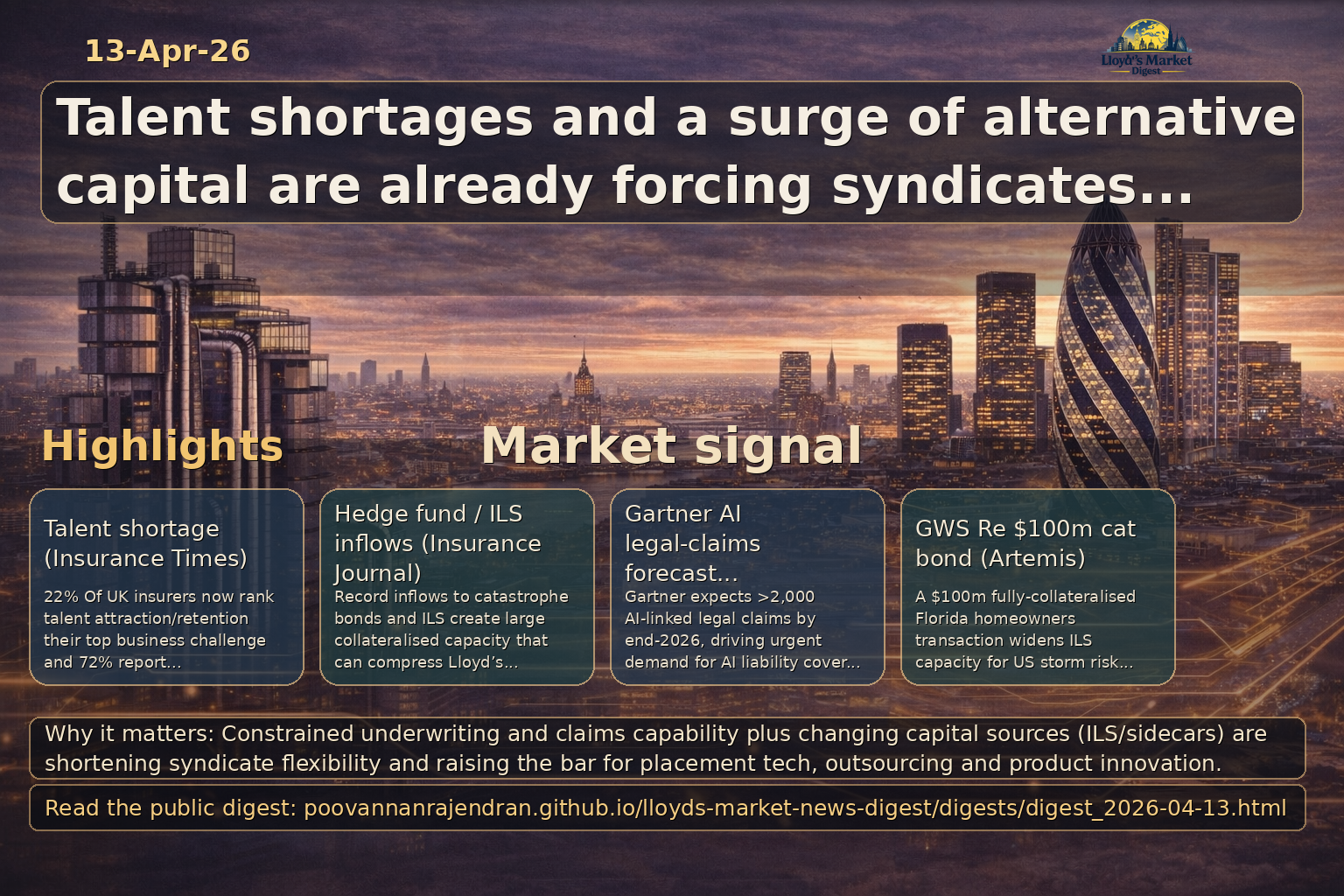
Why it matters: The article documents record inflows of hedge fund and institutional capital into catastrophe bonds and ILS—an evolution that directly affects Lloyd’s syndicates, global specialty capacity, broker placement strategies and the economics of reinsurance.
- Capacity and capital structure: Alternative capital provides large, often lower-cost, collateralised capacity that can crowd out traditional reinsurers and compress margins for Lloyd’s syndicates unless syndicates adjust risk selection or cost of capital.
- Placement and platform evolution: Brokers and electronic placement platforms must enhance capabilities for structuring and marketing hybrid placements that span syndicated Lloyd’s paper, collateralised ILS and sidecar vehicles to meet investor requirements and preserve distribution reach.
- Underwriting, pricing and counterparty risk: Persistent inflows to ILS can mute priced signals during benign years, increasing tail concentration risk. Underwriters and risk managers should reassess accumulation limits, basis risk exposure and the implications for Lloyd’s central and syndicate-level capital modelling.
Source: insurancetimes.co.uk
Why it matters: The article documents a material increase in talent scarcity and longer ramp-up for new hires, with claims management singled out as acutely impacted. For Lloyd's syndicates, global specialty insurers and brokers this translates into constrained underwriting and claims capacity, longer placement and settlement cycles, and heavier reliance on placement platforms and third-party service providers—creating both operational risk and commercial opportunity.
- Underwriting and capacity risk: Shortage of experienced underwriters and adjusters can limit syndicate capacity deployment and force more conservative pricing or reduced lines; executives should assess contingency capacity, adjust appetite and accelerate targeted hiring for critical underwriting classes.
- Placement and broker friction: Slower ramp-up times and stressed claims teams lengthen placement and binding timelines, increasing the importance of streamlined digital workflows and platform-led placements; brokers and placement platforms should prioritize API integration, standardized data submission and managed services to protect placement velocity.
- Talent strategy and tech adoption: Persistent recruitment gaps make retention, reskilling and partnerships essential—invest in accelerated training, apprenticeship schemes, flexible/remote hiring and selective outsourcing (TPAs); concurrently scale automation in claims triage and underwriting analytics to preserve service levels while new-hire productivity ramps.
Source: reinsurancene.ws
Why it matters: Archive content is dated but contains historical market signals (cat loss estimates, capacity movement) useful for benchmarking pricing, reserving and capacity strategy. Treat as historical context rather than current market intelligence.
- Use selective archival data to benchmark catastrophe loss trajectories and reinsurance programme design assumptions when stress-testing 2026–2027 capacity scenarios.
- Cross-reference archive items against current exposure modelling; avoid relying on outdated market structure commentary for current counterparty or capacity decisions.
- Retain archival research for claims development pattern analysis and scenario planning, but prioritise up-to-date actuarial and legal intelligence for product development and placement decisions.
Source: reinsurancene.ws
Why it matters: Gartner’s forecast of >2,000 AI-linked legal claims by end-2026 is a high-priority strategic risk for Lloyd’s syndicates, global specialty brokers and placement platforms: it drives urgent demand for AI liability cover, bespoke wordings, and enhanced underwriting controls.
- Immediate action: syndicates and MGAs should fast-track product development for AI liability — including clear definitions of covered AI actions, allocation of comparative negligence and aggregation triggers.
- Placement platforms and brokers must implement standardized client/insurer AI disclosure templates, technical due diligence checklists and cyber/operational risk questionnaires to inform risk selection and pricing.
- Strategic implication: expect higher litigation-driven attritional losses and accumulation risk; reserving models, reinsurance structures and capacity allocations should be stress-tested for concentrated AI exposures and legal defence costs.
Source: reinsurancene.ws
Why it matters: Euclid Transactional’s senior promotions signal continued investment in transactional MGAs — a distribution and underwriting capacity trend relevant to Lloyd’s, brokers and placement platforms focused on transactional specialty business.
- Implication for capacity: syndicates and brokers should monitor MGAs’ senior hires as indicators of underwriting scale-up and potential shifts in distribution concentration or appetite in transactional lines.
- Operational consideration: growth in transactional MGAs increases demand for standardized placement workflows, API integrations and delegated authority oversight by carriers and platforms.
- Talent strategy: syndicates and brokers must ensure depth in technical underwriting and claims expertise to partner with expanding MGAs and to maintain governance over delegated underwriting and claims decisions.
Source: newsnow.co.uk
Why it matters: A bonds-market news feed is directly material to Lloyd's syndicates, global specialty carriers and brokers: bond yields and credit-market movements drive investment income, influence capital costs, affect collateral and letters of credit pricing, and alter pricing/placement strategies for long-tail and reserve-sensitive lines.
- Reassess asset-liability strategy: review duration matching, liquidity buffers and scenario testing across syndicate portfolios to reflect rising yields or credit volatility.
- Revisit capital and pricing assumptions: update capital models, discount-rate assumptions and premium adequacy for long-tail lines; consider implications for syndicate capacity and reinsurance purchasing.
- Adapt placement and broking strategies: advise brokers and placement platforms to incorporate higher funding costs into deal structuring, explore alternative collateral solutions and promote risk-transfer structures that are resilient to interest-rate shocks.
Source: artemis.bm
Why it matters: A $100m, fully‑collateralised cat bond for a Florida homeowners specialist signals expanding use of ILS for U.S. residential catastrophe risk; this directly affects Lloyd’s syndicates’ capacity positioning, broker placement strategies and the value proposition of Bermuda issuance platforms.
- Market dynamics: First‑time sponsor activity demonstrates widening originators for ILS capital and increases competitive capacity for U.S. named‑storm cover, putting pricing and appetite pressure on traditional Lloyd’s syndicates.
- Placement and distribution: Transaction underscores the central role of Bermuda structures and specialist placement platforms/brokers to bridge U.S. cedants and ILS investors—demanding enhanced ILS capabilities, investor access and tailored structuring from brokerages.
- Strategic and operational implications: Fully‑collateralised design reduces counterparty and credit risk for the cedant, forcing syndicates to reassess capital models and loss absorbency strategies; syndicates and brokers should consider ILS partnerships, dedicated placement desks and targeted product innovation.
Source: newsnow.co.uk
Why it matters: A regional UK political feed (Anas Sarwar) is peripheral to core Lloyd's market dynamics but may presage policy shifts at the devolved level that affect insurers, brokers and public-sector exposures in Scotland. For C-suite and placement teams, this signals a low-probability, medium-impact operational/regulatory monitoring requirement rather than an immediate market driver.
- Maintain a monitoring trigger: track any policy proposals on insurance regulation, procurement or devolved fiscal policy that could alter public-sector exposures or licensing for brokers/syndicates in Scotland.
- Assess contingent operational impacts: review distribution agreements, local broker partnerships and compliance resources to ensure readiness for localized regulatory adjustments or procurement changes.
- Update stakeholder engagement: ensure UK-based broker relations and claims teams have guidance for liaison with Scottish authorities and public-sector clients should policy shifts be signaled.