Source: reinsurancene.ws
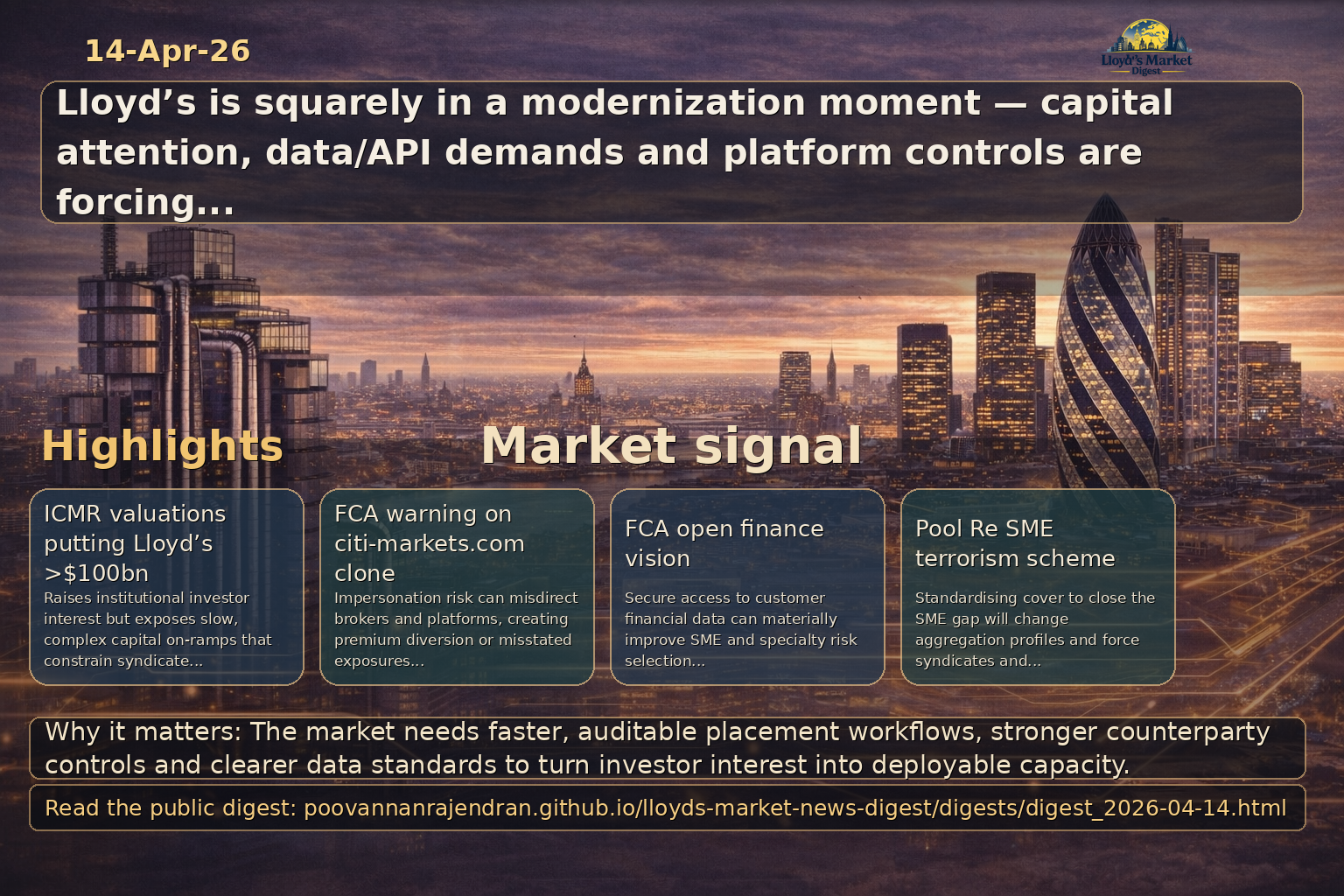
Why it matters: ICMR's valuation framing positions Lloyd's among major financial institutions, underscoring the market's attractive returns while exposing the slow and complex mechanisms for new capital access that affect syndicate growth and investor engagement.
- Investor consequence: A notional >$100bn valuation strengthens the narrative for institutional allocation but highlights the need for streamlined on-ramps, transparent governance and scalable investment vehicles.
- Structural risk/opportunity: Persistent frictions in capital deployment create openings for alternative capital structures, enhanced placement platforms and delegated authority solutions to bridge supply-demand gaps.
- Market governance: Elevated investor attention will increase scrutiny on syndicate performance, disclosure and operational resilience, pressuring market participants to accelerate modernization and capital efficiency.
Source: fca.org.uk
Why it matters: FCA warning about citi-markets.com highlights impersonation risk that can target brokers, underwriting staff and placement platforms via spoofed contact details and false firm identities.
- Immediate counterparty risk: clients and market participants may be misdirected to fraudulent channels, causing premium diversion or exposure misstatement.
- Operational controls: enforce multi-factor verification for new counterparties, require out-of-band confirmation for high-value transactions and update vendor/firm reference checks.
- Market communications: instruct brokers and platform users to verify FCA register details and implement automated screening of incoming emails/domains at the corporate gateway.
Source: fca.org.uk
Why it matters: Paysafe Finance clone incidents demonstrate multi-channel impersonation and potential abuse of trusted addresses that can ensnare SMEs and wholesale brokers operating in specialty distribution.
- SME vulnerability: specialty brokers placing SME business may be targeted with counterfeit payment instructions or fraudulent premium financing offers.
- Platform risk management: require electronic payment controls, segregated accounts for premium handling and automated reconciliation to detect anomalous routing.
- Partner due diligence: upgrade broker onboarding and ongoing monitoring (KYB), and coordinate alerting through market associations and the FCA to reduce repeat exposure.
Source: fca.org.uk
Why it matters: PGIM Pro clone examples including malicious domains underline the threat of credential spoofing, fake portals and phishing designed to penetrate placement workflows and syndicate access points.
- Digital channel attack surface: fake websites and lookalike domains can harvest broker credentials or mislead cedants and MGA partners.
- Technical mitigations: implement domain monitoring, DMARC/DKIM/SPF enforcement, SSO with strong authentication and phishing-resistant credential management for trading platforms.
- Incident response: maintain rapid takedown procedures, notify impacted market participants, and coordinate with FCA and registrars to shut down impersonating domains.
Source: fca.org.uk
Why it matters: The FCA’s open finance vision creates opportunities to enrich underwriting and pricing for specialty and SME-focused lines but requires disciplined data governance, API security and integration with placement platforms.
- Underwriting uplift: secure access to customer financial data can materially improve risk selection, pricing accuracy and claims assessment for SME and specialty portfolios.
- Integration challenges: syndicates, MGAs and brokers must invest in API standards, consent management, data mapping and secure middleware to embed open finance into placement and renewal workflows.
- Regulatory and cyber considerations: implement robust data governance, consumer consent logs, and end-to-end encryption; coordinate with Lloyd’s market systems and platform providers to pilot use cases and share controls.
Source: insurancejournal.com
Why it matters: BoE scrutiny of Anthropic's Mythos AI model signals growing regulatory focus on AI operational resilience — pertinent to insurers and platforms that deploy AI for underwriting, claims and distribution.
- Model governance: Underwriters and platforms must implement robust model risk management, validation and vendor oversight protocols for large AI systems.
- Regulatory alignment: Expect guidance or supervisory attention that will influence procurement, disclosure and third-party testing requirements.
- Operational continuity: Insurers should stress-test AI-dependent workflows (pricing, claims triage) to avoid concentration of operational failure risk.
Source: insurancetimes.co.uk
Why it matters: Premium Credit’s adoption of AI-driven employee compliance tools improves contact-centre competency, reducing operational risk in placement and client servicing workflows.
- Elevates front-line knowledge retention, improving accuracy in placement instruction and disclosure handling to underwriters
- Reduces operational leakage and compliance incidents that can cause disputes with syndicates and carriers
- Supports faster onboarding of distributed broker teams and consistent use of digital placement platforms
Source: reinsurancene.ws
Why it matters: Howden's US Trucking Practice exemplifies broker strategies to marry placement expertise with operational risk advisory, directly impacting how casualty capacity is underwritten and placed in the specialty transport sector.
- Strategic opportunity: Brokers that package insurance with telematics-driven risk engineering and claims advocacy can expand share of wallet with fleet operators and differentiate from capacity-only competitors.
- Operational implication: Syndicates and carriers must support data ingestion, pricing models tied to telematics and faster claims settlement to remain competitive on these tailored placements.
- Platform impact: Placement platforms and delegated authority arrangements need enhanced data connectivity and workflow support to manage complex, bilateral placements and advisory-led submissions.
Source: globalreinsurance.com
Why it matters: The scheme directly addresses a material UK SME terrorism protection gap by using reinsurance pricing levers to make cover standard—an approach with immediate implications for Lloyd’s syndicates, global specialty reinsurers and brokers who place SME property risks. It will change risk aggregation profiles, require product and wordings standardisation, shift distribution conversations, and create opportunities for capacity deployment and new placement workflows on platforms.
- Reassess aggregation and pricing: Syndicates and reinsurers should immediately model potential concentration and accumulation across SME portfolios, recalibrate rates for terrorism peril layers, and evaluate capital and retrocession needs given a likely uplift in insured exposure.
- Adapt distribution and client engagement: Brokers must update submission templates, client advisories and placement strategies to reflect non-removable terrorism wording, proactively communicate value to SMEs, and negotiate reinsurance-backed premium or commission implications with carriers.
- Operationalise standardisation on platforms: Placement platforms and Lloyd’s systems teams need to support standardized policy clauses, enhanced data capture for terrorism exposure, automated endorsements, and compliance checks to handle increased SME volumes efficiently while preserving auditability.
Source: insurancejournal.com
Why it matters: The U.S. homeowners affordability crisis affects property exposures, distribution economics and public/regulatory expectations — relevant to syndicates and brokers who provide primary, excess and reinsurance capacity for U.S. and global property portfolios.
- Underwriting: Expect appetite shifts, tighter terms and higher retentions for coastal and high-loss territories; syndicates must reassess modelling and rate adequacy.
- Distribution & affordability: Brokers and platforms will be pressured to innovate products and alternative risk transfer (parametric, state pools, layered placements) to address affordability and access.
- Regulatory & reputational risk: Heightened scrutiny on insurers’ social licence to operate may prompt regulatory interventions and calls for standardised mitigation programs.
Source: insurancejournal.com
Why it matters: The Pennsylvania Supreme Court decision on sole-proprietor notice reshapes claims handling and statutory interpretation risk for workers' compensation — relevant to specialty underwriters, brokers and policy drafting across jurisdictions.
- Claims handling: Expect closer coordination between claims teams and broker/mga partners on statutory notice requirements and dispute exposure.
- Policy drafting & placement: Brokers should review WC endorsements and placement language to remove or clarify insurer-facing notice obligations where legislatures intend employer notice only.
- Jurisdictional contagion: Syndicates and reinsurers must monitor for similar judicial interpretations in other states that could increase insured-favourable outcomes and claims frequency.
Source: insurancejournal.com
Why it matters: Renewed focus on insuring agreements versus exclusions highlights litigation risk and the need for precise policy wording — a core concern for Lloyd's market placements and global specialty lines.
- Underwriting & wording discipline: Syndicates must standardise clear insuring clauses and exclusion drafting to reduce ambiguity and litigation exposure.
- Broker responsibility: Placement platforms and brokers should implement clause-check protocols and explicitly document client intent to limit downstream disputes.
- Claims & reserves: Expect higher litigation-driven claims costs where ambiguity persists; reserving and reinsurance attachment strategies need stress-testing.
Source: insurancejournal.com
Why it matters: Surging privacy litigation against SMBs creates a scalable source of claims for cyber and privacy products, affecting capacity, aggregation risk and underwriting criteria for specialty cyber carriers and syndicates.
- Aggregation & capacity: Underwriters must model rapid, high-frequency small-claim litigation scenarios and reconsider limits/attachment strategies for SMB-heavy portfolios.
- Product evolution: Brokers and carriers should bundle proactive risk-management (active scanning, continuous monitoring) into placements to reduce loss frequency.
- Distribution focus: Placement platforms can capitalise by offering streamlined SMB cyber products with clear sublimits and legal-defence support.
Source: insurancetimes.co.uk
Why it matters: Senior commercial leadership moves at a global broker strengthen capacity to win and manage large-account placements across Lloyd's and global specialty markets.
- Reinforces broker capability to coordinate complex multi-jurisdictional placements with syndicates and international carriers
- Signals competitive jockeying for FTSE350 and enterprise clients — expect increased bespoke placement demand and tailored cover structures
- Board-level focus on integrating national teams and platform connectivity to accelerate binding decisions and post-placement service
Source: insurancetimes.co.uk
Why it matters: Brokerbility’s support model for independents addresses distribution vulnerability in a consolidating market, preserving specialist access to Lloyd's and niche capacity.
- Provides independents with scale benefits (shared services, buying power) that improve access to syndicates and MGA capacity
- Supports retention of specialist distribution channels important to underwriting diversity at Lloyd's and global specialty markets
- Encourages platform integration and service-led differentiation to compete with consolidated global brokers
Source: insurancetimes.co.uk
Why it matters: Aviva’s refreshed PI on Acturis eTrade and Fast Trade underscores platform-driven underwriting efficiencies that reduce friction in SME placements and speed capacity consumption across markets.
- Platform deployment shortens quote-to-bind time, increasing flow to capacity-holders including syndicates and carrier panels
- Expanded SME limits and simplified question sets will shift small-commercial volume from manual to automated placement workflows
- Brokers and Lloyd’s underwriters must align data, appetite and rule engines to capture micro-segments profitably
Source: insurancetimes.co.uk
Why it matters: Targeted hires into taxi-specialist teams illustrate continued growth in niche retail lines and the need for brokers to maintain technical underwriting and placement expertise.
- Specialist recruitment secures distribution for mono-line portfolios that often rely on specific syndicate or MGA appetite
- Increases capacity for tailored coverage and renewal retention — valuable to syndicates seeking stable niche books
- Highlights importance of regional sales teams and CRM integration with placement platforms to optimise binding and servicing
Source: reinsurancene.ws
Why it matters: Historical archive highlights precedent transactions and market commentary that inform capacity and strategic thinking for today's reinsurers, brokers and syndicates.
- Provides archival context on past capital moves (e.g., asset sales) that shape expectations for current capacity rebalancing.
- Acts as a reminder of cyclical loss events and pricing dynamics that influence syndicate appetite and retrocession strategies.
- Useful for benchmarking market narrative evolution when advising clients or structuring long-term placement strategies.
Source: reinsurancene.ws
Why it matters: Aon’s focus on longevity risk elevates opportunity and exposure management needs for life reinsurers, longevity desks at Lloyd's syndicates and placement platforms offering bespoke hedges.
- Rising longevity prominence drives demand for bespoke reinsurance and buyout-capacity solutions from specialty markets.
- Placement platforms and brokers must develop capabilities to structure multi-year longevity solutions and integrate longevity swaps into balance-sheet planning.
- Syndicates and reinsurers should reassess capital allocation and counterparty exposure as schemes pursue de-risking and buyout strategies.
Source: reinsurancene.ws
Why it matters: KCC modelling of a Great New England Hurricane demonstrates concentrated urban insured values and the modelling granularity required by syndicates and placement platforms for US coastal exposures.
- High concentration of insured value in coastal and urban centres materially affects accumulation management and retrocession buying.
- Syndicates and brokers need to align modelling assumptions with underwriting appetite and limit-setting for low-frequency, high-severity perils.
- Illustrates opportunity for ILS, sidecars and targeted capacity providers to support markets facing acute single-event exposures.
Source: newsnow.co.uk
Why it matters: Abu Dhabi coverage is material to Lloyd's and global specialty markets due to sovereign energy assets, diversification initiatives and onshore capital deployment — all drivers of underwriting opportunity and regulatory considerations for brokers and syndicates.
- Sovereign energy exposures (ADNOC and large infra projects) require tailored excess-of-loss, political risk and contingent business interruption capacity from lead syndicates.
- Market diversification and local content policies increase demand for compliant placement solutions and local partnerships; brokers should prepare segmented program structures.
- Growth in regional capital and sovereign investors creates opportunities for syndicates and platforms to facilitate reinsurance, sidecars and delegated authority arrangements.
Source: artemis.bm
Why it matters: The Artemis roundup aggregates the top ILS, cat bond and reinsurance-capital stories that shape placement and capacity dynamics. Items such as Zenkyoren’s Guernsey reinsurer and ADB-backed sovereign cat bonds are directly relevant to Lloyd’s and global specialty markets because they reflect new capital entrants, offshore vehicle usage for risk segregation, and expanding sovereign risk-transfer activity — all of which influence syndicate capital strategy, broker placement approaches, and platform product development.
- Strategic capital implications: Non-traditional capital and mutual insurers entering reinsurance via Guernsey vehicles increases available capacity and creates potential pricing pressure; syndicates must reassess capital allocation and underwriting leverage for catastrophe-exposed lines.
- Placement and distribution impact: Brokers and electronic placement platforms should adapt documentation, investor outreach and execution workflows to support sovereign and multilaterally sponsored cat bond transactions and offshore reinsurance structures.
- Operational and regulatory considerations: Use of Guernsey domiciles and ADB-sponsored structures highlights the importance of domicile selection, collateralisation conventions and regulatory engagement — critical for syndicates, managing agents and placement systems when supporting ILS and cross-border risk-transfer deals.
Source: newsnow.co.uk
Why it matters: Coverage of high‑profile public figures signals ongoing appetite for media, talent and reputational protection products — a steady source of specialty premium for Lloyd's syndicates and a growth area for broker-led placement innovation.
- Media production and talent deals generate complex media liability, E&O and contingent repute exposures requiring coordinated multi-line capacity.
- Celebrity and public‑profile litigation and privacy incidents increase demand for bespoke reputation management, crisis PR and cyber/privacy insurance wrappers.
- Brokers and platforms must enable rapid, confidential placements and panel coordination to meet timing and discretion requirements of high‑net‑worth and entertainment clients.
Source: newsnow.co.uk
Why it matters: Merseyside reporting, including large public events, is relevant for underwriting and claims forecasting — event liability, casualty frequency and local crime trends affect syndicate loss ratios and capacity allocation for regional business.
- Major events (e.g., Grand National) drive concentrated demand for event cancellation, public liability and prize indemnity coverages requiring coordinated facultative or program placements.
- Local crime and public‑order trends can increase frequency of attritional motor, GL and PR claims, informing rate adjustments and appetite limits for affected lines.
- Underwriters and brokers should monitor regional claim patterns to refine exposure modelling and to design targeted products for event organisers and venue operators.
Source: newsnow.co.uk
Why it matters: Southport coverage highlights inquiry outcomes, emergency incidents and safety issues that have direct implications for public liability, employers' liability and infrastructure underwriting — relevant to syndicates, MGAs and placement platforms structuring local authority or contractor business.
- Inquiry recommendations commonly translate into elevated compliance costs and potential liabilities for local authorities and contractors, increasing severity risk for casualty portfolios.
- Acute incidents (fires, emergency responses) underscore property and business interruption vulnerabilities, supporting demand for resilience and parametric solutions.
- There is an opportunity for brokers and delegated authorities to develop focused programs for public-sector risk pooling, contractor all‑risk and event safety assurance placements.
Source: risk.net
Why it matters: The whitepaper’s integrated client lifecycle model maps directly to Lloyd’s distribution and placement challenges: duplicated onboarding across brokers and underwriters, fragmented KYC/AML processes, and manual documentation that slows placement and increases risk. COOs and platform leads can adapt the framework to reduce friction, shorten time to bind and strengthen regulatory posture.
- Unify onboarding and KYC: a single source of truth for insured and broker data reduces duplicate checks across brokers and syndicates, lowers friction on new business placement, and creates an auditable trail for FCA/PRA and global regulators.
- Embed compliance into workflows: automated documentation, credit checks and disposition rules reduce manual intervention, minimise placement delays and materially lower regulatory and operational risk in delegated authority and slip handling.
- Enable platform connectivity: prioritise API-based integration with placement platforms, ACORD/industry standards and MGAs to unlock straight-through processing, reduce broker/underwriter back-and-forth and achieve scalable growth on flat budgets.