Source: artemis.bm
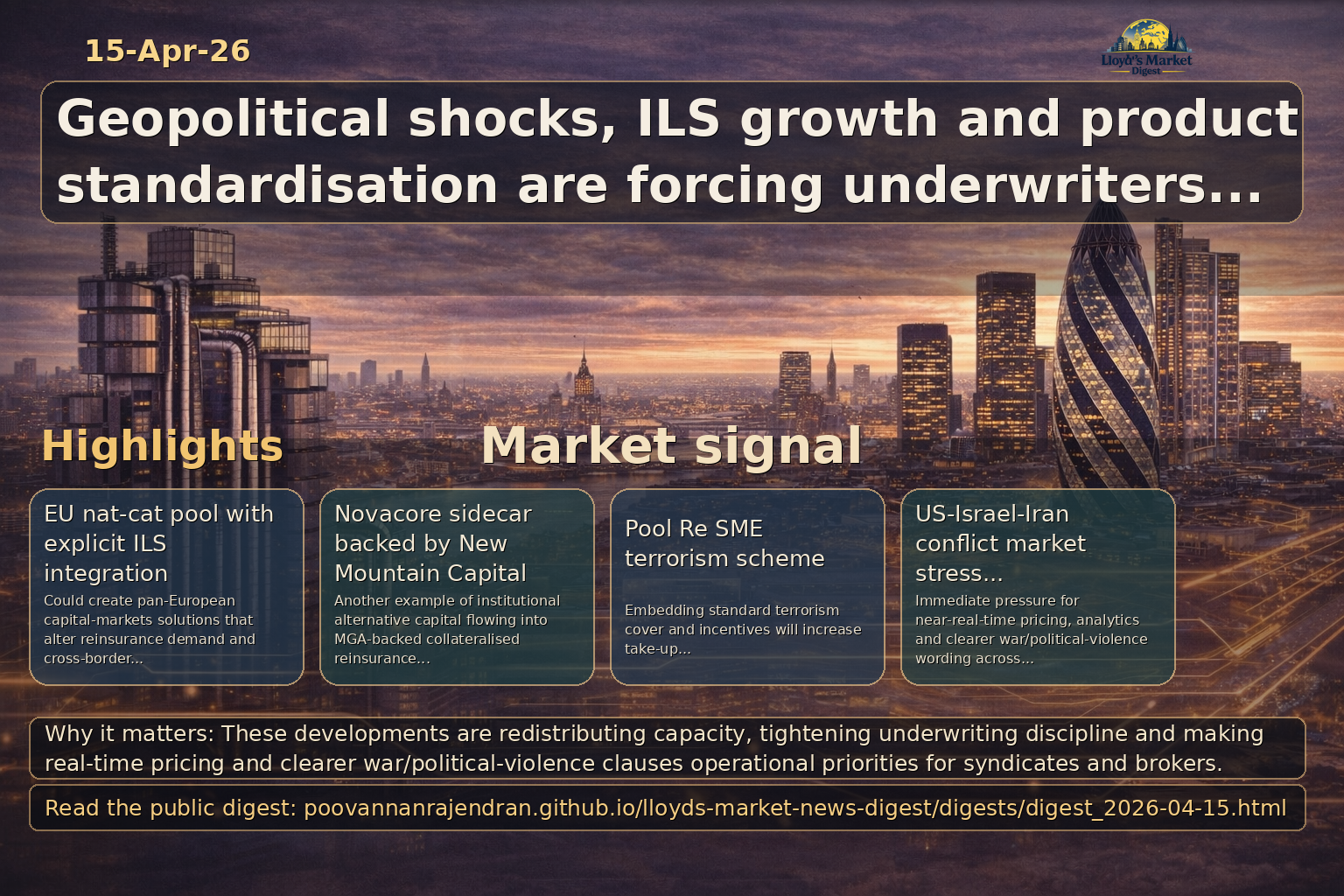
Why it matters: An EU-wide nat cat pool proposal with explicit ILS integration signals potential pan-European capital markets solutions that could alter reinsurance demand and cross-border placement dynamics.
- Strategic implication for Lloyd’s and syndicates: reassess appetite for European nat cat retrocession as pooled mechanisms could commoditise tail risk placement.
- Brokers and placement platforms: prepare cross-jurisdictional product structures and investor communication for EU-backed pool + ILS overlays.
- Operational note: design standardised triggers and model transparency with PCS/Verisk-style data governance to attract institutional ILS capital.
Source: artemis.bm
Why it matters: Novacore’s collateralised reinsurance sidecar backed by New Mountain Capital demonstrates continued flow of alternative institutional capital into MGAs, expanding capacity outside traditional syndicates.
- Syndicates and Lloyd’s managing agents: monitor diversion of capacity to MGA-backed sidecars and evaluate partnership or co-investment opportunities to retain distribution.
- Brokers: expect expanded multi-year, collateralised capacity offerings for placement—adjust broking strategies to optimise terms and security profiles.
- Placement platforms: enhance due diligence and technology to integrate sidecar capital on submissions and automate collateral management workflows.
Source: businessinsurance.com
Why it matters: Estimated bushfire losses highlight natural catastrophe volatility that affects syndicate exposure, reinsurance buying and catastrophe models used by Lloyd’s and specialty underwriters.
- Reassess aggregate exposure and accumulation modelling for Australian wildfire perils across syndicates.
- Review reinsurance and XL programs to ensure adequate protection against correlated nat-cat losses.
- Communicate updated loss trends and pricing impacts to broker partners and placement platforms to align capacity deployment.
Source: businessinsurance.com
Why it matters: Major operational disruption from airline pilot strikes demonstrates concentration exposures and contingent business interruption scenarios relevant to aviation portfolios and global specialty placements.
- Validate strike and labor action exclusions in aviation and supply-chain policies across syndicates.
- Engage brokers to stress-test contingent BI and cargo networks for systemic exposure.
- Incorporate labor unrest scenarios into pricing models and placement guidance for clients with transportation dependencies.
Source: businessinsurance.com
Why it matters: Hedge funds increasing insurance risk funding changes the capital mix available to Lloyd’s and specialty markets, influencing pricing discipline, longevity of capital and structuring of ILS and sidecars.
- Assess the impact of non-traditional capital on capacity volatility and contract terms for syndicates.
- Review governance, reporting and liquidity terms tied to hedge-fund capital to protect underwriting stability.
- Coordinate with brokers to offer differentiated products that leverage stable capital and emphasize long-term relationships.
Source: businessinsurance.com
Why it matters: Middle East conflict-driven supply disruptions affecting manufacturers underscore geopolitical risk accumulation and supply-chain coverage needs for global specialty underwriters and brokers.
- Map supply-chain concentration in exposed regions and update war and trade disruption underwriting guidance.
- Expand political violence and trade interruption capacity where exposure justified, coordinating with reinsurers.
- Equip placement platforms with geopolitical scenario tools so brokers can demonstrate mitigation to clients and underwriters.
Source: businessinsurance.com
Why it matters: Rising focus on AI-related D&O liability signals a material emerging risk for management liability lines across Lloyd’s, specialty carriers and broker portfolios.
- Re-evaluate D&O policy wordings for AI-related operational failures and disclosure obligations.
- Develop risk-control questionnaires and underwriting credits tied to corporate AI governance for placements.
- Partner with placement platforms to flag and price AI exposure consistently for brokers and syndicates.
Source: globalreinsurance.com
Why it matters: The US‑Israel‑Iran conflict acts as an immediate stress test for Lloyd’s syndicates and global specialty underwriters, accelerating demand for modern pricing engines, near‑real‑time analytics and clearer war/political violence wording across placements.
- Implement or accelerate real‑time pricing and scenario analytics for political violence, war, marine and cyber exposures to support binder decisions and syndicate limits.
- Review and standardise war and political violence clauses at syndicate and platform levels; brokers should prepare alternative wording and clear escalation protocols for placements.
- Anticipate capacity shifts as governments offer backstops or reinsurance; placement platforms and brokers must model changed retrocession availability and rapid quota share adjustments.
Source: globalreinsurance.com
Why it matters: The appointment of a senior global property head signals intensified competition among carriers to expand disciplined international property portfolios—this will influence syndicate appetites, pricing discipline and the data quality demanded by brokers and platforms.
- Expect tighter underwriting appetite and selective capacity deployment for international property risks; syndicates will prioritise experienced leadership and accountable metrics.
- Brokers and placement platforms must provide higher‑fidelity, location‑specific risk data (engineering, loss history, supply chain exposure) to access preferred capacity.
- Talent moves increase M&A and poaching risk; C‑suite should prioritise retention of underwriting and data science talent and consider strategic partnerships with specialist MGAs.
Source: globalreinsurance.com
Why it matters: Pool Re’s SME incentive scheme to embed terrorism cover is a structural change for UK SME distribution that reduces protection gaps, shifts reinsurance economics and compels syndicates, brokers and platforms to adapt product design and automation.
- Standardisation of terrorism cover as a non‑removable component will increase take‑up and create a larger, more predictable SME terrorism book attractive to specialty capacity providers.
- Discounted reinsurance costs change pricing models; underwriters should reassess profitability thresholds and consider scaling SME appetite where loss pick‑up supports portfolio diversification.
- Placement platforms and brokers need to support automated inclusion of the standard clause, streamlined evidence collection and reporting to access Pool Re discounts and demonstrate compliance.
Source: insurancejournal.com
Why it matters: Effective, sustained communication between brokers and carriers is critical to preserving capacity, improving placement speed and aligning underwriting strategy — a core competency for Lloyd's brokers and syndicates.
- Formalize joint governance: implement regular executive-level forums and shared KPIs between lead brokers and syndicates to align on appetite, documentation and long-tail exposure handling.
- Invest in placement platforms and CRMs that provide transparent binder status and decision logs to reduce information asymmetry and administrative drag.
- Adopt standardized data templates and pre-negotiated endorsements to shorten placement cycles and reduce slip churn for complex specialty risks.
Source: insurancejournal.com
Why it matters: High-profile DEI enforcement actions signal evolving compliance risk for large vendors and service providers; brokers and carriers must assess contractual and reputational exposures across global supply chains.
- Audit major vendor and technology supplier contracts for DEI-related clauses and potential False Claims Act or public-contractor exposure in key jurisdictions.
- Update diligence and vendor risk frameworks to include legal and reputational screening of diversity programs where government contracting or public funds are involved.
- Communicate policy to clients and underwriters: set expectations around procurement compliance, remedial steps and disclosure requirements that could affect placement or capacity.
Source: insurancejournal.com
Why it matters: Judicial expansion of uninsured motorist coverage to rental-car occupants affects auto liability and UM exposure modeling and policy drafting for carriers operating in U.S. jurisdictions.
- Review and reconcile automotive and rental-car endorsements in U.S. wordings to ensure consistent UM provision and reserve adequacy across book(s) of business.
- Coordinate with U.S.-based brokers and claims teams to update intake scripts and subrogation strategies when rental-vehicle claims arise.
- Reassess pricing and appetite for fleet and short-term rental exposures, factoring in jurisdictional variability in UM law and potential precedent spillover.
Source: insurancejournal.com
Why it matters: Continued stress and capacity withdrawal in Florida's mobile-home insurance market demonstrates how regional risk concentration and insurer runoffs force distribution adjustments and bespoke product responses.
- Evaluate syndicate appetite for secondary-market and legacy mobile-home portfolios, including structured runoff or coinsurance solutions with capital partners.
- Develop tailored underwriting packages and retrofit incentives that address physical durability and rebuild costs for older mobile/manufactured homes.
- Leverage placement platforms and broker networks to create targeted distribution channels and captive or MGAs to fill coverage gaps where primary carriers withdraw.
Source: insurancejournal.com
Why it matters: A multi-year decline in claims volume alters loss-cost assumptions and can influence pricing, reserve strategies and capital allocation across personal and commercial lines that syndicates underwrite.
- Revalidate rate adequacy and catastrophe loadings using the latest claims-frequency and severity trends to avoid procyclical pricing errors.
- Monitor reserve releases and their capital return impacts; coordinate with actuarial and capital teams to redeploy capacity into specialty growth areas.
- Use lower baseline claims activity as an opportunity to tighten underwriting on concentrated or complex risks where frequency reductions may mask latent severity.
Source: reinsurancene.ws
Why it matters: Board-level finance expertise joining a digitally focused insurer signals emphasis on financial rigour, capital strategy and tech-enabled distribution—relevant to brokers and syndicates assessing strategic partners and potential capacity providers.
- Strengthens capital strategy and investor-readiness capabilities that can influence reinsurance structuring and capital raises
- Signals adoption of technology-driven operating models that impact broker distribution and placement data quality
- Improves credibility with institutional capital providers and reinsurers evaluating counterparty governance and scalability
Source: reinsurancene.ws
Why it matters: Senior finance appointment at a major international insurer affects regional capital allocation and administrative efficiency—key inputs for syndicates and brokers working on cross-border programmes and reinsurance treaties.
- Continuity in finance leadership supports predictable capital management and reinsurance purchasing strategies in LatAm markets
- Potential operational and financial optimisation may change cedant retentions and reinsurance demand
- Internal promotion history indicates stability and governance quality for brokers conducting counterparty due diligence
Source: reinsurancene.ws
Why it matters: A senior APAC personal lines underwriting appointment in Singapore reinforces the region's strategic importance and influences product design and distribution partnerships used by global specialty markets and Lloyd's syndicates.
- Leadership with multinational underwriting experience suggests disciplined pricing and standardisation that affects programme placement and appetite
- Singapore-based role enhances connectivity for Lloyd's and international brokers seeking APAC distribution and treaty opportunities
- May accelerate scalable product launches and data-driven underwriting approaches attractive to placement platforms and MGAs
Source: reinsurancene.ws
Why it matters: PwC’s spotlight on asset-intensive reinsurance (AIR) in the Cayman Islands highlights growth of capital-efficient reinsurance structures that impact where syndicates and alternative capital prefer to domiciliate risk and collateral.
- Cayman’s AIR expansion offers syndicates and investors efficient collateralisation and structuring alternatives to traditional reinsurance vehicles
- Regulatory stability and capital market integration make Cayman an attractive hub for bespoke retrocession and seeded collateralised placements
- Brokers and placement platforms must develop structuring capabilities to access AIR products and advise clients on jurisdictional trade-offs
Source: reinsurancene.ws
Why it matters: Pool Re’s supply-side incentive to reinstate terrorism cover for SMEs represents a market mechanism that could materially increase coverage uptake, affecting treaty design, pricing and distribution strategies in the UK commercial lines market.
- Incentivised reinstatement can materially reduce residual terrorism exposure and reshape reinsurance demand profiles for small commercial portfolios
- Programme structure provides a potential template for public-private solutions in other jurisdictions, with implications for syndicates and reinsurers
- Brokers should adapt product bundles and submission strategies to capture reinstated cover opportunities and communicate pricing benefits to SMEs
Source: artemis.bm
Why it matters: PCS’s integrated approach to industry loss estimation is central to ILS trigger design and market confidence, making transparency and methodological clarity a foundation for broader ILS adoption.
- Underwriters and syndicates: require clarity on PCS methodologies when underwriting ILW/industry-loss-triggered solutions to avoid basis risk disputes.
- Brokers and placement platforms: demand standardised, documented loss estimation processes to support investor due diligence and pricing consistency.
- Product design: incorporate alternative trigger options and stress-test against PCS-derived scenarios to manage counterparty and model basis risk.
Source: newsnow.co.uk
Why it matters: IMF activity and macroeconomic programmes influence sovereign solvency and reform trajectories — directly affecting political-risk, sovereign credit and trade-credit insurance demand, plus the capital and investment strategies of Lloyd's syndicates and managing agents.
- Underwriting signals: monitor IMF programmes as indicators of sovereign risk trajectory; adjust political-risk pricing and capacity allocations for countries undergoing conditional lending or austerity measures.
- Investment & capital management: anticipate shifts in interest rates and sovereign yields that affect syndicate asset portfolios and collateral requirements.
- Broker advisory role: brokers should package risk-transfer solutions (political risk, trade credit, debt-restructuring covers) aligned with IMF-engaged sovereigns to support client continuity and market access.
Source: artemis.bm
Why it matters: Florida Peninsula’s upsized $250m Palm Re cat bond at tighter pricing confirms investor appetite for Florida named-storm risk and puts competitive pressure on traditional reinsurance pricing and capacity allocation.
- Lloyd’s/syndicates: anticipate pricing compression in residential catastrophe layers; revisit portfolio aggregation and appetite in Florida.
- Brokers: capitalise on increased capital market capacity to negotiate multi-year placements and blended reinsurance/ILS programmes.
- Placement platforms: ensure capability to manage multi-tranche cat bond placements and coordinate investor roadshows to secure competitive terms.
Source: artemis.bm
Why it matters: People’s Trust inaugural $100m cat bond underscores continued entry of regional US insurers into ILS, diversifying sponsor base and broadening demand for capital markets protection.
- Syndicates and Lloyd’s: expect regional specialists to substitute or supplement traditional quota-share capacity with ILS; re-evaluate retention and appetite for secondary layers.
- Brokers: prepare standardised roadmaps for first-time ILS sponsors, including modeling, trigger selection, and investor disclosure.
- Placement platforms: offer end-to-end services for maiden issuances—SPV setup, investor due diligence, and post-placement reporting.
Source: newsnow.co.uk
Why it matters: Global humanitarian and systemic social issues elevate demand for tailored specialty capacity (NGO, humanitarian logistics, refugee-related exposures) and increase reputational and non-damage business interruption exposures for global brokers and syndicates operating from Lloyd's.
- Underwriting: develop dedicated appetite and wordings for humanitarian aid supply chains, NGO liability and parametric disaster response covers to enable rapid deployment of funds.
- Distribution: enhance broker-syndicate workflows and platform capabilities to place short lead-time, high-impact programmes with clear trigger mechanics and claims fast-track procedures.
- Capital & compliance: review reputational risk policies and sanctions screening; align capital allocation to low-margin but high-impact humanitarian business that supports market reputation and long-term client relationships.
Source: newsnow.co.uk
Why it matters: Pacific Ocean exposures concentrate marine hull, cargo, offshore energy and supply-chain risk; changing weather patterns and strategic trade routes require Lloyd's syndicates to reassess catastrophe modelling, war and cyber exclusions, and placement routing via global broker networks.
- Product & pricing: update modelling for storm surge, tsunami and perils aggregation in Pacific trade lanes; adjust rates and terms for cargo and offshore energy lines accordingly.
- Placement strategy: leverage platform integrations to coordinate multi-jurisdictional placements for complex hull, P&I and cargo programmes with layered reinsurance retention.
- Risk mitigation: work with clients and brokers on pre-approved contingency and continuity clauses for supply-chain interruption to reduce settlement friction and loss severity.
Source: newsnow.co.uk
Why it matters: The Rohingya crisis underscores prolonged political violence, mass displacement and humanitarian logistics risks in Southeast Asia — areas where Lloyd's syndicates and specialty brokers may be called on for NGO, transport and contingent liability placements amid constrained access and elevated political-risk exposure.
- Coverage design: craft policies that combine political violence, kidnap & ransom, and contingency covers for NGOs and contractors operating in protracted displacement zones.
- Claims & operations: establish expedited claims and field-assessment protocols with local partners and cover-holders to address access and verification challenges.
- Market engagement: syndicates should engage multilateral agencies and major brokers to structure modular programmes that balance appetite with reinsurance support.
Source: newsnow.co.uk
Why it matters: UK economic dynamics — inflation, Bank of England policy and GDP trends — materially affect claims inflation, reinsurance pricing, investment returns and the operating environment for London brokers and Lloyd's syndicates.
- Pricing & reserving: increase vigilance on claims inflation across liability and property portfolios; update reserving assumptions and reinsurance buying strategies accordingly.
- Capital returns: factor higher interest-rate environments into asset-liability management and syndicate portfolio strategies to preserve solvency margins.
- Distribution & talent: expect broker consolidation and fee pressure; invest in platform efficiencies and retention programmes to maintain market share and execution capability.
Source: risk.net
Why it matters: The whitepaper outlines a pragmatic, end-to-end approach to onboarding, KYC, legal documentation, credit and offboarding that is directly applicable to Lloyd’s market participants. For brokers and syndicates it provides a framework to reduce placement friction, improve data quality on delegated business and meet rising regulatory expectations while supporting target growth rates without proportional cost increases.
- Prioritise a single client master record shared across brokers, syndicates and platforms to eliminate duplicate KYC and speed bindings; measure improvement via time-to-bind and duplicate-reduction KPIs.
- Automate KYC and document workflows with auditable checkpoints tailored to Lloyd’s/UK requirements and integrate delegated authority checks to reduce regulatory and reputational risk.
- Pilot API-driven data exchange with one placement platform and one syndicate to prove STP gains, then scale using standardised data schemas and vendor-neutral integration