Source: fca.org.uk
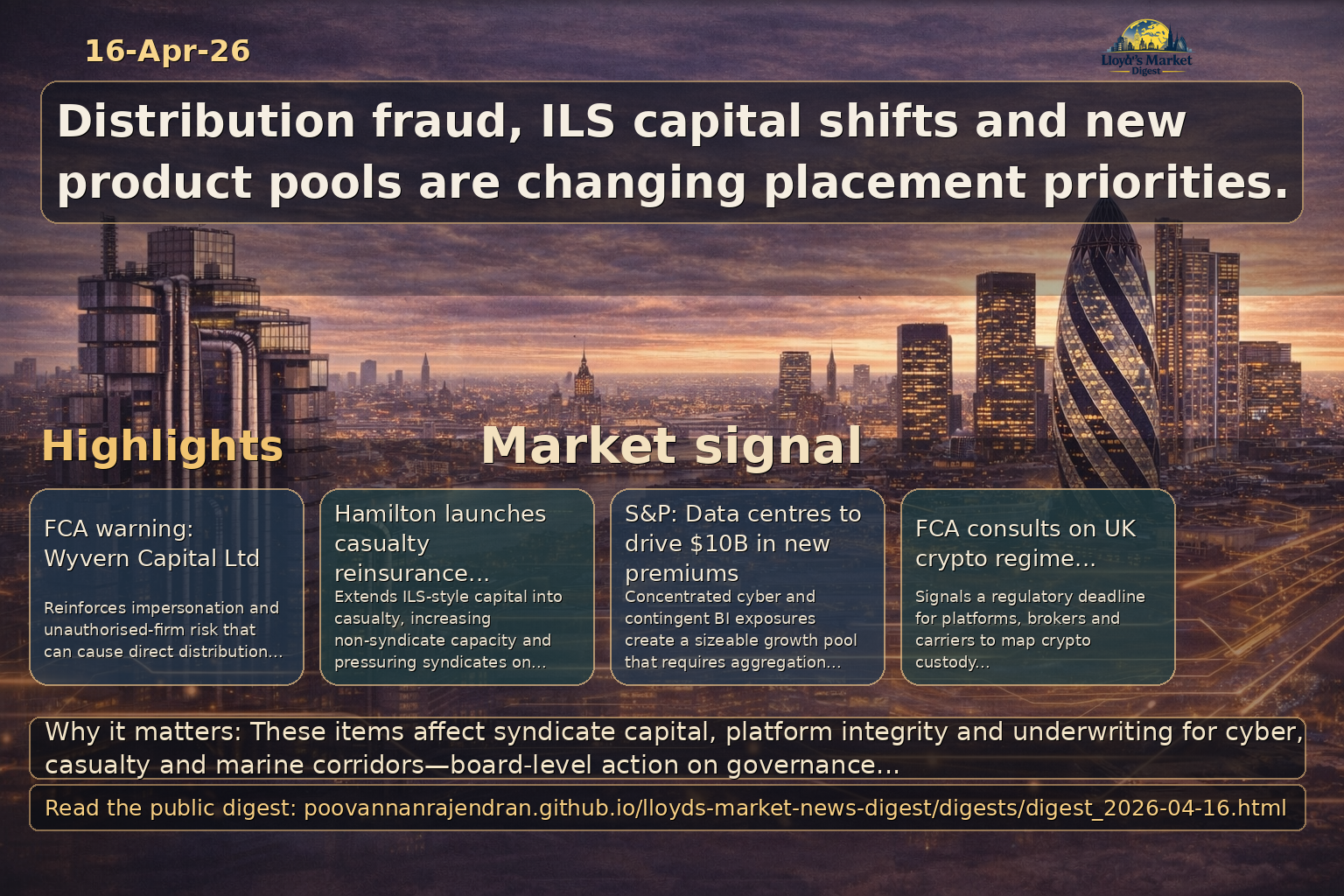
Why it matters: FCA warning on an unauthorised firm highlights the ongoing threat of fraudsters posing as financial or insurance intermediaries; this creates direct distribution, reputational and operational risk for brokers, syndicates and placement platforms that may be referenced or impersonated in client interactions.
- Immediate review and tightening of onboarding and counterparty verification processes for brokers and platforms to detect unauthorised or cloned entities
- Communicate to clients and delegated authorities the firm’s verification channels and escalation paths to reduce successful impersonation and fraud losses
- Coordinate with market bodies and the FCA to share intelligence on impersonation attempts and update placement platform whitelist controls
Source: fca.org.uk
Why it matters: Warning on another unauthorised trading entity underscores systemic distribution vulnerabilities—particularly for international specialty lines where clients and MGAs may rely on digital introductions or offshore intermediaries.
- Mandate enhanced due diligence for overseas introducers and digital lead generators used by brokers and MGAs
- Implement transaction monitoring triggers on new client funds or premium flows routed through previously unvetted entities
- Ensure contract clauses with intermediaries require FCA-authorisation confirmation and indemnities for failures arising from unauthorised counterparties
Source: fca.org.uk
Why it matters: FCA alert on Witzeltrading Market reflects repeated patterns of unauthorised platforms that can be used to solicit premiums or investments; placement platforms and syndicates should assume increased spoofing risk against market-facing portals.
- Upgrade platform authentication (MFA, vendor attestations) and actively monitor for domain spoofing or duplicate sites referencing your syndicate/brokerage
- Run a rapid-response protocol for takedown requests and client advisories if spoofed sites are detected
- Reassess third-party platform integration agreements to include security and reputational breach notification timelines
Source: fca.org.uk
Why it matters: FCA enforcement action progressing against Hartley Pensions and an individual for alleged misappropriation and false information is a salient reminder that governance lapses and dishonest conduct by senior staff create existential risk—relevant to syndicate management, delegated underwriting and discretionary authority arrangements.
- Commission a targeted review of delegation and access controls where individuals can move client funds or alter records without dual oversight
- Strengthen whistleblower channels and forensic-ready recordkeeping across underwriting and claims operations
- Revisit counterparty credit and operational risk limits where key-person or governance weaknesses are identified
Source: fca.org.uk
Why it matters: FCA consultation on the UK’s future crypto regime signals regulatory certainty from October 2027 and has material implications for specialty insurers, insurtech placement platforms and brokers handling cryptoassets (safeguarding, custody, trading platforms).
- Establish a cross-functional crypto readiness programme (legal, compliance, operations, IT) to map products, custody models and distribution lines affected by the regime
- Assess whether any placement, premium, collateral or claims flows touch qualifying cryptoassets and build compliant custody/safeguarding arrangements
- Engage with Lloyd’s market bodies and the FCA consultation to shape guidance around custody standards and platform obligations for tokenised insurance structures
Source: businessinsurance.com
Why it matters: Appointment of a transportation practice leader indicates focused distribution efforts in logistics and marine-related risks — a core exposure for Lloyd’s and specialty markets.
- Enables more precise underwriting and tailored placement solutions for transportation risks
- Highlights increased demand for supply-chain and cargo covers amid global disruption trends
- Syndicates should evaluate appetite and treaty support for expanding transportation portfolios
Source: artemis.bm
Why it matters: Hamilton’s casualty reinsurance sidecar with Sixth Street represents a meaningful extension of ILS-style capital into casualty lines, leveraging a third-party capital platform to provide multi-year underwriting capacity that can compete with Lloyd’s syndicate capital for long-tail business.
- Increases available casualty capacity outside traditional Lloyd’s syndicates, pressuring syndicates to articulate capital and claims-management advantages
- Creates opportunities for brokers and placement platforms to package casualty risk into ILS/sidecar formats; underwriting and legal structures will need to be brokered efficiently
- Necessitates enhanced modelling and reserving transparency for casualty ILS to satisfy institutional investors and support multi-year ceded premium projections
Source: artemis.bm
Why it matters: Moody’s consultations on pooled ILS structures indicate potential standardisation and rating frameworks for aggregated ILS vehicles, which could broaden investor access and change how syndicates and brokers design capital-market transfers.
- A transparent rating approach for pooled ILS would widen investor appetite and could reduce capital costs for sponsors using pooled vehicles versus single-issuer structures
- Syndicates and carriers should track rating criteria to optimise deal structures and documentation required for pooled placements
- Placement platforms could leverage pooled instruments to offer diversified, laddered ILS products—enhancing access for smaller carriers and program writers
Source: businessinsurance.com
Why it matters: S&P's projection that data centres will drive material new premium pools is a strategic growth signal for specialty markets; concentration and cyber/contingent BI exposures require tailored underwriting and placement solutions.
- Concentration & aggregation: Syndicates must assess geographical and vendor concentration to avoid single-event tail risk; update catastrophe models to reflect simultaneous power, network and fire losses.
- Product innovation: Develop layered offerings combining property, cyber, contingent business interruption and dependent third‑party failure coverage with clear sublimits and SLA-linked endorsements.
- Distribution & risk engineering: Brokers and placement platforms should offer engineering surveys, uptime metrics and standardized data exchange to speed placement and differentiate capacity providers.
Source: businessinsurance.com
Why it matters: Improving combined ratios and doubled profits at a major insurer indicate pricing adequacy and disciplined underwriting—benchmarks that will influence capacity deployment and syndicate strategies across global specialty lines.
- Capital allocation signal: Strong results signal potential redeployment of capital into growth verticals (e.g., cyber, data centres, marine war) and increased willingness to support longer-tail specialty risks.
- Pricing & terms leverage: Brokers should recalibrate negotiation tactics as market-level profitability reduces pressure for aggressive rate softening; expect tighter terms for high-frequency loss drivers.
- M&A and reinsurance dynamics: Improved profitability can accelerate consolidation or repositioning; reinsurers may adjust treaty structures, affecting attachment points and multi-year capacity commitments.
Source: businessinsurance.com
Why it matters: Interest from Korean Re to provide cover for Hormuz detours highlights immediate demand for bespoke marine and war-risk solutions as geopolitical tensions reshape route risk and voyage economics.
- Product specificity: Expect demand for distinct covers for rerouting costs, additional fuel/time-on-route exposures, and conditional war/strikes endorsements tied to navigational advisories.
- Brokers’ advisory role: Brokers must quantify incremental voyage costs and detention exposure, structuring packages that incorporate contingency clauses and clear underwriting data (AIS, charterparty terms).
- Capacity & repricing: Syndicates and reinsurers should review war risk appetite and corridor-based pricing; placement platforms can streamline market access for fast‑moving, time‑sensitive marine risks.
Source: businessinsurance.com
Why it matters: Volcanic disruption that halts flights and closes roads underscores persistent event-driven BI and supply-chain vulnerability — an underwriting and placement priority for aviation, cargo and contingent business interruption coverages.
- Aggregation & modelling: Syndicates must incorporate low-frequency/high-impact transport disruptions into aggregation frameworks and stress tests, including secondary knock‑on losses across portfolios.
- Tailored coverage solutions: Opportunity to market parametric triggers, contingent BI modules and hybrid indemnity/parametric contracts to corporates with complex global supply chains.
- Operational response: Brokers and platforms should offer rapid post-event exposure assessments and claims triage workflows to improve client outcomes and reduce friction between insurers and brokers.
Source: globalreinsurance.com
Why it matters: AM Best’s assessment of UAE insurers highlights a regained underwriting profitability driven by rate and discipline while flagging Middle East geopolitical escalation that could concentrate losses and test syndicate appetites, placement certainty and reinsurer capacity.
- Hardening and profitability: rate increases and disciplined underwriting create room for Lloyd’s syndicates to sustain disciplined pricing on Gulf‑exposed business rather than chase volume.
- Accumulation and modelling: underwriters must revisit regional accumulation models for property, energy and marine exposures and consider tighter single‑risk limits or increased reinsurance protection.
- Placement and wording risk: brokers and platforms should validate war/political risk wordings, premium adjustments and client disclosures; expect higher retentions and conditional capacity from reinsurers.
Source: globalreinsurance.com
Why it matters: The Optalitix commentary underscores that volatile geopolitical events demand modern, flexible pricing systems and rapid portfolio analytics — a capability gap for many syndicates, brokers and platforms which, if unaddressed, will impair pricing accuracy and time‑to‑bind in specialty lines.
- Dynamic pricing imperative: real‑time rating engines and scenario stress tools are essential for syndicates to adjust rates, manage exposures and avoid adverse selection during rapid escalation.
- Line‑of‑business shifts: expect demand volatility across political violence, marine hull, energy and terrorism covers; carriers should model substitution effects and potential government backstops.
- Platform and broker capabilities: placement platforms must support rapid indications, transparent assumptions and instant clause management so brokers can capture rate increases and negotiate terms under time pressure.
Source: globalreinsurance.com
Why it matters: The appointment of a senior property underwriting head at HDI Global signals intensified focus on international property underwriting discipline and expansion — a leadership move that will influence market terms, talent competition and syndicate benchmarking in global specialty property risks.
- Underwriting standards and product leadership: a senior hire with international pedigree tightens risk selection and creates comparative benchmarks for syndicates on pricing and coverage terms.
- Talent and competitive dynamics: movement of senior underwriters increases competition for experienced leaders across carriers and Lloyd’s syndicates, affecting continuity and institutional knowledge in complex placements.
- Broker engagement and product evolution: enhanced carrier capabilities will push brokers to refine submission quality, negotiate tighter clauses and adapt placement strategies to carriers’ updated appetites.
Source: insurancetimes.co.uk
Why it matters: Regional broker acquisition demonstrates ongoing consolidation that expands distribution reach and specialist capability (motor fleets) — relevant to syndicates and placement platforms seeking scale and predictable flows.
- Assess reinsurance and capacity offers tailored to acquisitive broker groups to secure scaled placements
- Engage early on integration plans to align product, data and referral flows for fleet and commercial lines
- Monitor overlap with existing panels to avoid concentration risk and exploit cross‑sell opportunities for specialty coverages
Source: insurancetimes.co.uk
Why it matters: Reversal of net policy loss back to brokers in motor indicates improving retention and relevance of broker distribution — implications for pricing, underwriting appetite and placement volumes for carrier and platform partners.
- Recalibrate channel strategies and pricing models to reflect improving broker retention and lower switching rates
- Invest in broker analytics and CRM integrations on placement platforms to sustain the regained momentum
- Work with brokers to optimise submission workflows for motor risks to reduce leakage to direct channels
Source: insurancetimes.co.uk
Why it matters: Clear Group’s acquisition of commercial and personal specialists highlights continued roll‑up activity among consolidators that supply scaled, multi‑product distribution — relevant for syndicates targeting packaged or delegated authority relationships.
- Design modular product suites and delegated authority propositions for consolidators combining commercial and personal lines
- Prioritise data transfer and underwriting KPIs in acquisition integrations to protect loss ratios
- Explore co‑investment and strategic distribution agreements to lock long‑term placement volume
Source: insurancetimes.co.uk
Why it matters: HDI’s build‑out of energy and power capability in the London market signals capacity expansion and leadership intent for complex energy risks — directly relevant to Lloyd’s brokers, syndicates and placement platforms seeking lead markets and technical partners.
- Proactively engage with HDI and similar entrants to structure lead/follow slips for energy portfolios
- Enhance broker submissions with risk engineering data to capitalise on increased technical underwriting capacity
- Syndicates should accelerate talent and engineering investments to retain lead status on high‑complexity energy placements
Source: insurancetimes.co.uk
Why it matters: Ageas joining the Sky Protect panel exemplifies embedded retail distribution partnerships that scale personal lines reach and data‑driven customer acquisition — a model affecting panel management and unit economics for brokers and carriers.
- Evaluate opportunities for co‑branded or white‑label partnerships with consumer platforms to access new cohorts at scale
- Ensure product governance and pricing discipline when entering embedded channels to protect margins
- Integrate data feeds and performance metrics with platform partners to optimise retention and claims outcomes
Source: artemis.bm
Why it matters: Howden Re’s appointment of Grace Kavanagh into Capital Solutions underscores broker-driven emphasis on connecting carrier capital needs with diverse funding sources at Lloyd’s and in the global specialty market, reinforcing the role of brokers as primary architects of modern capital structures.
- Signals brokers’ continued investment in specialist capital teams to source sidecars, collateralised reinsurance and bespoke ILS solutions for syndicates and MGAs
- Strengthens broker capability to navigate Lloyd’s syndicate engagement, fronting arrangements and third-party capital placement across multiple jurisdictions
- Increases demand for placement platforms capable of coordinating complex multi-party transactions and post-placement capital management
Source: artemis.bm
Why it matters: The Enstar–Artex partnership to embed structured exit options into ILS vehicles directly addresses the trapped capital problem, improving investor liquidity and making ILS a more attractive, deployable source of capacity for specialty insurers and reinsurers.
- Exit mechanisms reduce investor duration risk, increase secondary market prospects and could materially improve IRR profiles for ILS investors
- Syndicates and carriers can market collateralised solutions with clearer end-of-life pathways, making capital-raising more straightforward for multi-year programs
- Placement platforms and structurers will need to incorporate exit pricing, legal triggers and run-off counterparty solutions into transaction templates
Source: artemis.bm
Why it matters: Elementum Advisors’ view that the cat bond market requires greater efficiency and talent despite strong issuance highlights structural growing pains: sponsor diversification is positive, but distribution infrastructure and specialist skills must scale to sustain lower spreads and increased issuance.
- Brokers and placement platforms must invest in workflow automation and investor relations to handle increased issuance volumes and maintain liquidity for secondary trading
- Syndicates and carriers can tap competitive priced capital but must demonstrate robust modelling, deal transparency and regulatory compliance to attract ILS investors
- Talent gap in structuring, portfolio management and investor servicing elevates strategic importance of hiring within broker capital-solutions teams and specialist advisory firms
Source: newsnow.co.uk
Why it matters: The item is a local news feed about a violent incident in Peterborough. It does not directly affect Lloyd’s market-wide pricing or capacity, but it is relevant to casualty and local operational risk monitoring, broker advisory services, and exposure aggregation for syndicates and placement platforms.
- Underwriting and claims: Review potential employer and public liability exposure for insureds with operations or assets in the area; violent crime incidents can drive third-party casualty claims and business interruption considerations for local clients.
- Broker and syndicate actions: Opportunity for brokers and MGAs to advise clients on site security, crisis management and reputational response; syndicates should confirm whether existing covers (eg personal accident, employers liability) have any exposure or exclusions triggered.
- Placement platforms and analytics: Flag the location in accumulation monitoring systems and incorporate into geospatial risk datasets; deprioritise for immediate underwriting action but maintain as part of ongoing urban risk trend feeds for model refinement