Source: bankofengland.co.uk
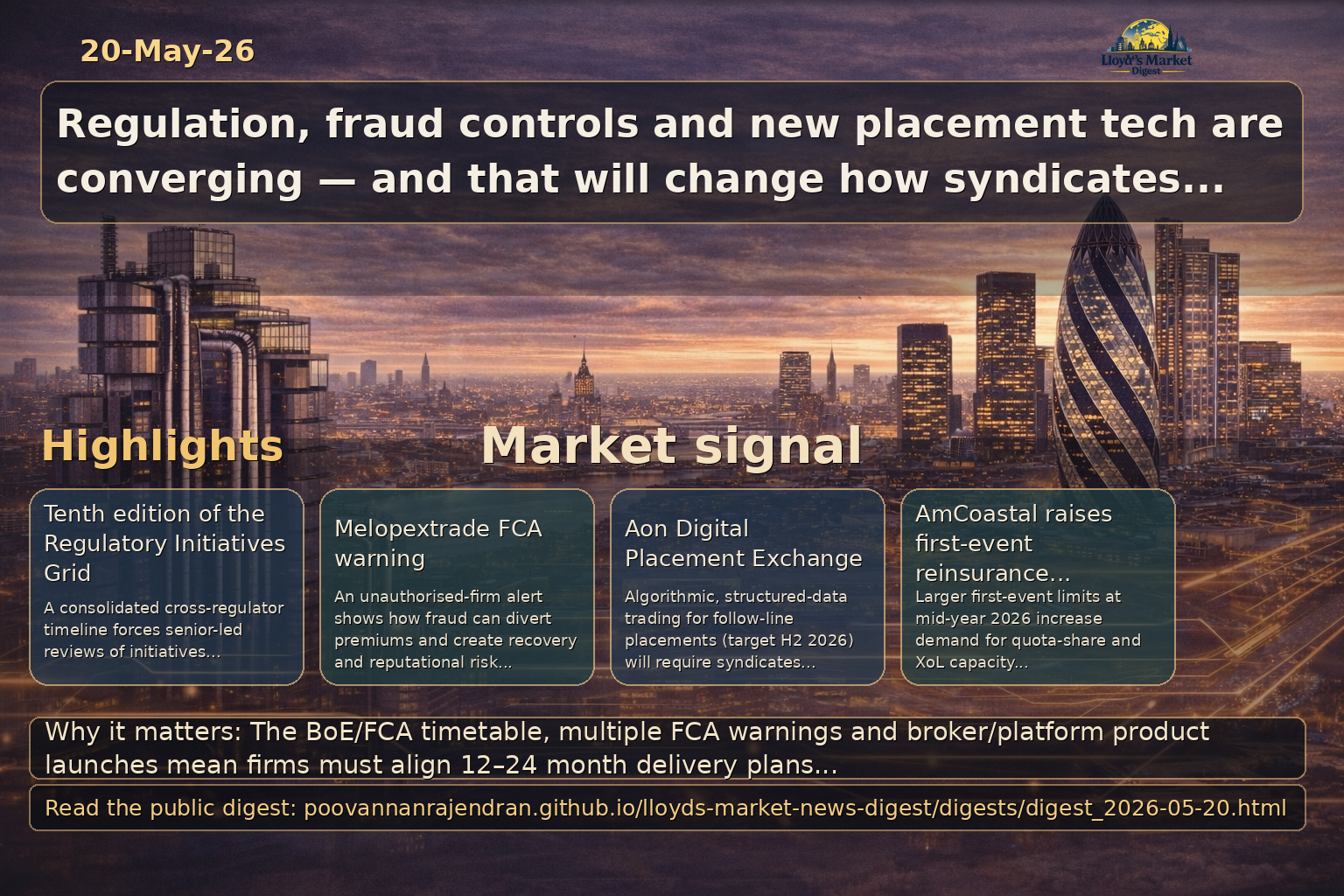
Why it matters: The Grid provides a consolidated timeline and cross-regulator view that materially affects strategic planning across Lloyd's syndicates, managing agents, global specialty brokers and digital placement platforms. It signals coordinated regulatory activity that can drive investment in data, reporting, resilience and market conduct changes — all of which influence underwriting, capital allocation and distribution economics.
- Conduct a senior-led regulatory timetable review aligned to the Grid: map each listed initiative to syndicate, managing agent, broker and platform activities; identify critical delivery dates, resourcing gaps and capital impacts to inform 12–24 month budgets.
- Prioritise data and platform readiness: accelerate API, data lineage and MIS upgrades on placement platforms and broker systems to meet enhanced reporting, auditability and operational resilience expectations; include vendor SLA and contract reviews.
- Coordinate industry engagement and contingency planning: use trade bodies and bilateral regulator engagement to influence implementation windows; prepare operational fallbacks (manual workflows, additional reconciliation capacity) to preserve placement continuity during phased regulatory rollouts.
Source: fca.org.uk
Why it matters: FCA warning on an unauthorised firm underscores persistent external fraud vectors that can expose brokers and syndicates to diverted premiums, client losses and post-event complaints if intermediated routes are compromised.
- Risk: potential misdirection of premiums and client funds; undermines trust in placement chains and creates recovery gaps absent FSCS/Ombudsman protection.
- Action: strengthen counter-fraud checks in onboarding, confirm beneficiary/payment routing via independent verification and embed FSCS/authorisation status checks into broker workflows.
- Monitor: add this firm to internal watchlists, share alert with wholesale distribution partners and escalate suspicious enquiries to compliance and the FCA reporting channels.
Source: fca.org.uk
Why it matters: Apex Trade Vault warning highlights the need for continuous due diligence on counterparties and platforms used in placements to prevent engagement with unauthorised entities that can compromise syndicate exposures.
- Risk: third-party platforms posing as market utilities can create settlement failure, unknown credit exposure and misattribution of policy proceeds.
- Action: require documented vendor authorisation checks, contractually mandate audit rights and ensure payment rails conform to authorised entity lists.
- Monitor: coordinate with brokers and managing agents to verify counterparties before onboarding and circulate FCA warning to front-line placement teams.
Source: fca.org.uk
Why it matters: Knight Pips FCA notice is a reminder that impersonation and unauthorised advisory services threaten client acquisition funnels and can lead to elevated complaint volumes for insurers and intermediaries.
- Risk: clients targeted by impostor advisers may submit fraudulent claims or seek recoveries from legitimate insurers, increasing operational claim handling costs.
- Action: implement client education campaigns, verify intermediaries' FCA registration at point of sale and require brokers to document proof of authorisation.
- Monitor: integrate FCA Warning List screening into CRM and placement platforms to block or flag interactions with listed names.
Source: fca.org.uk
Why it matters: FCA analysis of the claims management market signals regulatory scrutiny on intermediaries that drive claims activity; this impacts loss ratios, distribution practices and relationships between insurers, brokers and CMCs.
- Risk: exploitative CMC practices can inflate claims volumes and costs, distort underwriting data and create class action or systemic reputational risk for insurers.
- Action: review commission arrangements and referral pathways with CMCs, tighten controls on provider networks and require transparency in third-party referral disclosures.
- Monitor: collaborate with brokers and TPAs to track complaint patterns linked to CMC-originated claims and present aggregated data to underwriters for pricing and reserving adjustments.
Source: fca.org.uk
Why it matters: Crypto-Assets247 warning reinforces the intersection of crypto-related products and unauthorised market actors; critical for syndicates and brokers active in digital asset exposures or crypto-linked placements.
- Risk: engagement with crypto-related unauthorised intermediaries may create custody, valuation and settlement ambiguities, increasing counterparty and liquidity risk.
- Action: enforce enhanced KYC/AML for crypto-related counterparties, restrict premium payments in non‑standard digital currencies and require custodial proof for crypto collateral.
- Monitor: align crypto underwriting guidelines with FCA lists and update placement platform policies to prohibit transactions with flagged entities.
Source: businessinsurance.com
Why it matters: Gallagher recruiting former AssuredPartners executives into practice leadership underscores broker consolidation and talent mobility that affect distribution leverage, panel mixes and access to syndicate capacity.
- Expect shifts in broker-syndicate relationships and potential reallocation of preferred lead roles; syndicates should proactively engage to retain strategic access.
- Clients may experience changes in service models and appetite; brokers should communicate continuity plans and any changes to binding authority or platform usage.
- Placement platforms need to maintain interoperability and integration readiness as broker ownership and leadership transitions alter submission flows and technical requirements.
Source: artemis.bm
Why it matters: NJM Insurance's repeat use of a Bermuda SPV for a multi-tranche cat bond demonstrates sustained issuer appetite and creates placement comparators for syndicates and brokers seeking capital market alternatives.
- Repeat sponsorship signals issuer confidence — supports benchmarking of pricing and structure for similar NE US named-storm programs.
- Use of a Bermuda domiciled SPV (Lower Ferry Re) underscores the operational and legal advantages platforms must offer to attract repeat issuers.
- Multi-tranche, multi-year design creates opportunities for syndicates and brokers to propose layered re/ILS solutions and competitive excess capacity allocations.
Source: artemis.bm
Why it matters: AmCoastal’s increased first-event limit for Florida hurricane coverage highlights growing capacity requirements and the need for coordinated placement across global reinsurers, ILS and Lloyd’s syndicates.
- Significant lift in first-event limit increases demand for quota-share and XoL capacity from global markets, including Lloyd’s syndicates and ILS funds.
- Mid-year renewal timing emphasizes the importance of synchronized placement platforms and broker-led market outreach to secure diversified capital efficiently.
- Higher limits and cascading structures will influence pricing, retrocession purchasing and aggregate design decisions for both carriers and their brokers.
Source: artemis.bm
Why it matters: Jamaica’s upsized parametric cat bond — facilitated by the World Bank — signals expanding sovereign demand for swift-pay parametric solutions and increases ILS market depth for regional hurricane exposures.
- Sovereign parametric deals broaden product use-cases and enlarge market capacity, presenting new opportunities for syndicates and brokers to co-design multi-layered protection.
- World Bank facilitation lowers issuance friction for emerging markets, increasing recurring sovereign supply and the need for placement platforms capable of handling parametric specifications and basis risk.
- Parametric structures require robust basis-risk advisory and payout modelling — a service opportunity for brokers and syndicates to differentiate offerings.
Source: businessinsurance.com
Why it matters: Jamaica's increase in its catastrophe bond target to $200M reinforces continued sovereign and government-led use of capital markets to transfer catastrophe risk. This matters to Lloyd's and global specialty players as it alters reinsurance capacity demand, creates structuring opportunities and raises competition from alternative capital vehicles.
- Distribution and structuring opportunity: Syndicates and managing agents can partner with lead brokers and placement platforms to provide structuring, sidecar or coinvestment capacity to sovereign cat deals.
- Pricing and model governance: Underwriters must re‑test catastrophe models and risk-transfer triggers given sovereign exposure profiles; pricing and capital charges should reflect model uncertainty and basis risk.
- Productise and scale: Develop standardized documentation and modular cat-bond products to reduce friction for repeat sovereign and public-sector placements, enabling syndicates to access alternative‑capital economics while preserving Lloyd’s distribution role.
Source: businessinsurance.com
Why it matters: Marsh's acquisition in Japan expands broker scale in a key APAC market, increasing placement leverage and client reach. For Lloyd's and specialty markets this accelerates concentration of distribution power and shifts where and how risk is placed into global syndicates.
- Negotiation dynamics: Larger broker scale amplifies negotiating power on terms and pricing; syndicates should refine value propositions (specialist expertise, speed to bind, capacity certainty) to remain competitive.
- Onshore engagement and regulatory compliance: Syndicates and placement platforms must ensure local licensing, claims handling and regulatory oversight in Japan as more business is routed via enlarged broker networks.
- Strategic partnerships and local talent: Consider deeper alliances with top brokers and appoint on-the-ground capacity or coverholders to secure placement flow and client servicing in a market where consolidated broker relationships will dictate access.
Source: businessinsurance.com
Why it matters: The launch of Bitcoin-backed ship insurance demonstrates a move toward non-traditional collateral and payment mechanisms in maritime risk transfer. This raises critical questions around sanctions exposure, asset volatility, enforceability and platform credibility relevant to Lloyd's brokers, syndicates and placement systems.
- Compliance and sanctions risk: Brokers and syndicates must conduct enhanced sanctions, AML and counterparty due diligence before accepting crypto-collateral, particularly where jurisdictions raise geopolitical or sanctions concerns.
- Collateral volatility and legal enforceability: Underwriting must account for bitcoin price volatility and establish legally robust custody/segregation arrangements (regulated escrow, third‑party custodians) to ensure collateral availability at loss.
- Placement platform controls: Placement and settlement platforms should build crypto-native controls — provenance checks, auditable wallets and integrated compliance workflows — before facilitating such transactions at scale.
Source: businessinsurance.com
Why it matters: Evergrande-related litigation seeking substantial damages from auditors underscores the systemic risk and knock‑on exposures arising from major corporate insolvencies. For specialty and professional lines markets, it signals heightened claims frequency for audit, D&O and related liability covers and potential contagion to reinsurers and syndicates with China/real‑estate concentrations.
- Reassess sector concentration: Syndicates should re-evaluate exposures to large Chinese property developers and adjacent credits; consider tightened appetite, higher rate-on-line or reinsurance to manage accumulation risk.
- Professional lines stress‑testing: Underwriters of auditors' and directors' liability should revisit policy wordings, retroactive date exposures and aggregate limits in light of high-value litigation trends.
- Broker advisory and client contracting: Brokers must advise multinational clients on contractual mitigants (indemnities, escrow arrangements) and promote enhanced disclosure and risk-transfer structures to reduce future claims volatility.
Source: globalreinsurance.com
Why it matters: The Fidelis Partnership–Howden Broker Connect rollout demonstrates practical adoption of structured-data protocols to automate pre-bind submissions, reducing manual rekeying and improving underwriting throughput — a model Lloyd's syndicates and global specialty underwriters will need to accommodate to remain efficient and competitive.
- Operational impact: Structured submissions and automated workflows cut cycle time and error rates for complex risks, enabling faster quoting and improved hit-rates for syndicates that integrate the capability.
- Interoperability and standards: Use of ACORD ADEPT provides a template for broader market connectivity — success will depend on consistent data schemas, mapping to syndicate underwriting systems and disciplined change management.
- Commercial and governance considerations: Brokers gain efficiency and differentiation; underwriters must address data quality, authority delegation, audit trails and third‑party vendor risk as submission automation scales across Lloyd's and global specialty lines.
Source: globalreinsurance.com
Why it matters: Aon's Digital Placement Exchange (Aon DPX) signals the emergence of algorithmic, structured-data trading for follow-line placements — a potential paradigm shift for how brokers access capacity, syndicates distribute appetite and capital is priced across the London market and the broader specialty ecosystem.
- Execution and liquidity: Algorithmic matching and structured offers can accelerate placement of follow-line business (initial focus on US property) and improve consistency, but will require syndicates to codify appetite and pricing rules in machine-readable form.
- Risk and governance: Algorithmic trading introduces model risk, concentration risk and new regulatory questions (best execution, market abuse, auditability) that carriers and Lloyd's must proactively govern before broad adoption (targeted H2 2026 go‑live timeline).
- Market structure implications: A large broker-run trading platform can lower friction but also concentrates distribution power; syndicates and alternative capital providers must evaluate commercial terms, data-sharing, integration with existing placement platforms and potential vendor lock-in.
Source: insurancejournal.com
Why it matters: Widespread worker misclassification elevates employment practices and workers’ compensation exposures, creating potential loss accumulation and regulatory enforcement risk for specialty insurers and syndicates writing EPL/comp cover.
- Underwriting: Reassess EPL and workers’ compensation exposures for clients with high contractor usage; consider exclusions, rating adjustments and enhanced exposure monitoring.
- Distribution: Brokers must advise clients on classification risk as part of placement conversations; placement platforms should enable capture of contractor exposure data for accurate binding.
- Claims & Reserving: Expect surge in contested claims and regulatory fines—syndicates should stress-test reserves and contract wordings for retroactive cover triggers.
Source: insurancejournal.com
Why it matters: Criminal charges tied to a major allision spotlight complex allocation between shipowners, managers, builders and contractors—raising questions for hull, P&I and excess third‑party liability carriers and for syndicates participating on layered placements.
- Investigation-driven uncertainty: Syndicates should factor potential criminal exposure into coverage triggers and claims handling protocols, including cooperation clauses and O&M responsibilities.
- Placement implications: Brokers must secure clear warranties/maintenance endorsements and ensure clarity on insured vs. non-insured liabilities across layered markets.
- Reputational and regulatory risk: Lloyd’s market participants should review sanctions, compliance checks and war-risk/war-related allision cover language given cross-jurisdictional enforcement.
Source: insurancejournal.com
Why it matters: Shifts in the personal auto space driven by distribution and data analytics underscore the accelerating role of technology and scale—factors that influence MGAs, specialty motor portfolios, and broker negotiation dynamics with capacity providers.
- Data & pricing arms race: Syndicates and specialty motor underwriters must invest in telemetry and analytics to maintain competitive pricing and loss-selection capabilities versus large direct writers.
- Capacity & MGA strategy: Brokers and placement platforms should evaluate partnerships with tech-enabled MGAs to access scalable underwriting while protecting underwriting standards.
- Cross-sell and retention: Lloyd’s brokers can leverage relationships to offer niche coverages (e.g., high-value motor, E&O for telematics providers) as traditional markets consolidate.
Source: insurancejournal.com
Why it matters: Appellate affirmation of jury trials in high-profile product/med-mal/opioid cases heightens litigation tail risk and unpredictability for specialty casualty lines and aggregating syndicates, affecting premium adequacy and reinsurance recoveries.
- Aggregate exposure management: Syndicates should reassess aggregation thresholds and reinsurance program structures in light of jury verdict volatility.
- Policy form design: Brokers need to secure clear allocation language and defend limits for multi-party exposures; consider captive and alternative risk solutions for clients.
- Litigation forecasting: Underwriters and actuarial teams must incorporate litigation-variance stress tests into pricing models and capital planning.
Source: insurancejournal.com
Why it matters: Reduced foreign transits through the Strait of Hormuz and Iran’s alternative insurance initiatives intensify demand for war, political violence and kidnap/maritime contingency solutions; Lloyd’s and syndicates are central to offering bespoke cover and capacity.
- War & P&I capacity redeployment: Syndicates should prepare for concentrated demand in war-risk and K&R products and review exclusions relating to sanctioned entities and cyber/crypto-linked arrangements.
- Alternative programs: Brokers must evaluate client exposure to informal or crypto-backed insurance schemes and advise on enforceability, credit risk and sanctions compliance.
- Placement agility: Placement platforms should enable rapid sourcing of multi-jurisdictional war-risk capacity and provide transparent terms for charterers, operators and cargo interests.
Source: reinsurancene.ws
Why it matters: Archive of historical market reporting that supports comparative analysis of cycle dynamics and capacity shifts relevant to long-range strategy.
- Use as a primary reference set for reconstructing past rate cycles and catastrophe loss impacts to validate current pricing assumptions
- Support M&A and portfolio diligence by referencing precedent announcements and market reactions
- Leverage archival trends to inform syndicate product roadmaps and long-term reserve planning
Source: reinsurancene.ws
Why it matters: AXA capacity into DUAL UK’s renewables product signals stronger insurer support for clean energy risks — a strategic capacity pathway for Lloyd’s and global specialty placements.
- Brokers should prioritise placement strategies that leverage A-rated capacity for renewable projects to improve terms and broaden coverage scope
- Syndicates and managing agents can tailor delegated authority and appetite to capture growing premium pools in solar, wind and hydro
- Placement platforms should integrate product wording templates and documentation to reduce friction for renewable submissions
Source: reinsurancene.ws
Why it matters: AM Best reporting of US personal motor and home rate moderation indicates a partial return to pre-pandemic pricing dynamics — relevant to global capacity allocation and retrocession strategy.
- Reinsurers and syndicates should reassess cedant rate adequacy and corridor exposure in US personal lines portfolios
- Brokers need to recalibrate client renewal expectations and revisits to cover structures where margin compression may follow rate easing
- Placement platforms and analytics teams ought to update loss-cost models and scenario testing to reflect moderated inflationary pressures
Source: reinsurancene.ws
Why it matters: AIG’s acquisition of renewal rights for Everest’s commercial retail businesses is a material consolidation affecting distribution flows, broker relationships and capacity availability in wholesale/commercial retail channels.
- Brokers should evaluate counterparty stability and transitional continuity of service as business migrates to AIG
- Syndicates and capacity providers must review renewal appetite and appetite overlaps to anticipate displacement or co-placement opportunities
- Placement platforms should plan for changes in slip routing, reinsurance arrangements and potential shifts in preferred broker panels
Source: reinsurancene.ws
Why it matters: Hippo’s $100m catastrophe bond expanding cover to wildfire demonstrates ongoing investor demand for collateralised multi-peril protection and offers an alternative capital model for E&S sponsors.
- Syndicates and managing agents should benchmark cat-bond pricing and triggers against traditional retrocession to inform optimal capital stack design
- Brokers can position high-quality, well-modelled exposures to attract collateralised capacity as an alternative to scarce treaty limits
- Placement platforms need robust documentation and data standards to facilitate investor due diligence and efficient structuring
Source: artemis.bm
Why it matters: The City of Zurich Pension Fund’s enlarged and high-performing ILS allocation validates institutional demand for ILS as an asset class, expanding available non-traditional capacity for specialty insurers and syndicates.
- Strong reported returns and a rising allocation make ILS more attractive to other pensions and asset managers, broadening the investor base for catastrophe risk.
- Greater institutional capital supports competitive pricing and longer-term capacity commitments that specialty carriers and Lloyd’s syndicates can leverage.
- Placement platforms and brokers must enhance investor reporting, governance and product transparency to capture institutional mandates and scale distributions.
Source: artemis.bm
Why it matters: AM Best’s affirmation noting continued solid underwriting for Leadenhall-backed Nectaris Re reinforces the credibility of rated Bermuda ILS platforms, an important comparator for cedants assessing counterparty strength and market access.
- Consistent underwriting profits improve investor confidence and can lower cost of capital for platforms that syndicates or brokers reference in structuring deals.
- Leadenhall backing and rating affirmation create a benchmark for counterparties evaluating platform creditworthiness during placement negotiations.
- Demonstrated performance supports the use of rated ILS vehicles in blended reinsurance programs and influences counterparty selection in Lloyd’s and global specialty markets.
Source: newsnow.co.uk
Why it matters: Southampton FC coverage needs and stadium/event exposures are catalysts for specialist markets — relevant to syndicates writing sports, casualty and event cancellation risks and to brokers arranging multi‑element placements.
- Elevated demand for event cancellation, public liability and stadium property covers following season/calendar volatility — syndicates should assess aggregate exposure and reinsurance needs
- Opportunities for parametric products and contingent business interruption tied to match cancellation, crowd restrictions or venue closure
- Brokers and placement platforms can create packaged solutions (property, liability, cyber/ticketing fraud) to streamline placements for clubs and commercial partners
Source: newsnow.co.uk
Why it matters: Leadership change in Taiwan materially affects geopolitical risk assessments for Asia‑Pacific exposures — critical for marine cargo, P&I, trade credit, cyber and political violence underwriting across Lloyd's and global specialty markets.
- Heightened political risk and war/nuclear exclusion scrutiny for marine hull & cargo, D&O of regional corporates, and supply‑chain interruption exposures
- Potential repricing or withdrawal of capacity by some markets; syndicates must revalidate tail scenarios and capital allocation for Asia‑Pacific books
- Brokers should advise clients on updated war/political violence clauses, sanction screening and utilise placement platforms to source rapid cross‑market capacity and tailored wording
Source: newsnow.co.uk
Why it matters: Coverage implications from Welsh Labour policy shifts affect municipal, social care, infrastructure and local authority portfolios — relevant for syndicates writing public sector and specialty liability lines.
- Policy changes can alter claim frequency/severity for public services, requiring syndicates to reassess pricing and reserving for municipal and social care risks
- Climate adaptation and flood mitigation commitments from devolved administrations may shift demand toward parametric flood and infrastructure resilience products
- Brokers should engage with local authority clients to redesign cover, aggregate limits and multi‑line placements using digital platforms to improve transparency and speed
Source: newsnow.co.uk
Why it matters: Statements and activity by regional leaders (e.g., Mark Drakeford) create forward‑looking regulatory signals for UK risk carriers, influencing public and healthcare underwriting portfolios and transition risk assessments.
- Regulatory timelines or public spending shifts can create immediate exposures in healthcare, education and infrastructure lines underwritten by specialty syndicates
- Market participants should monitor policy signals to anticipate changes in claims patterns and to adjust appetite or product design accordingly
- Brokers ought to prepare advisory briefs and conditional wording options for clients exposed to regional regulatory change, leveraging placement platforms for efficient market access
Source: newsnow.co.uk
Why it matters: TV and broader media sector activity underscores growing demand for media liability, production delay, streaming/content liability and cyber/IP insurance, areas where Lloyd's and specialty markets provide differentiated capacity.
- Increasing production and streaming activity drives need for media liability, extra expense and non‑appearance covers; syndicates should consider tailored AV product suites
- Cyber and IP exposures for broadcasters and platforms require combined cyber/media offerings and clear sublimits/exclusions
- Brokers and digital placement platforms can accelerate multi‑jurisdictional placements for global productions and integrate parametric triggers for production delay risk