Source: fca.org.uk
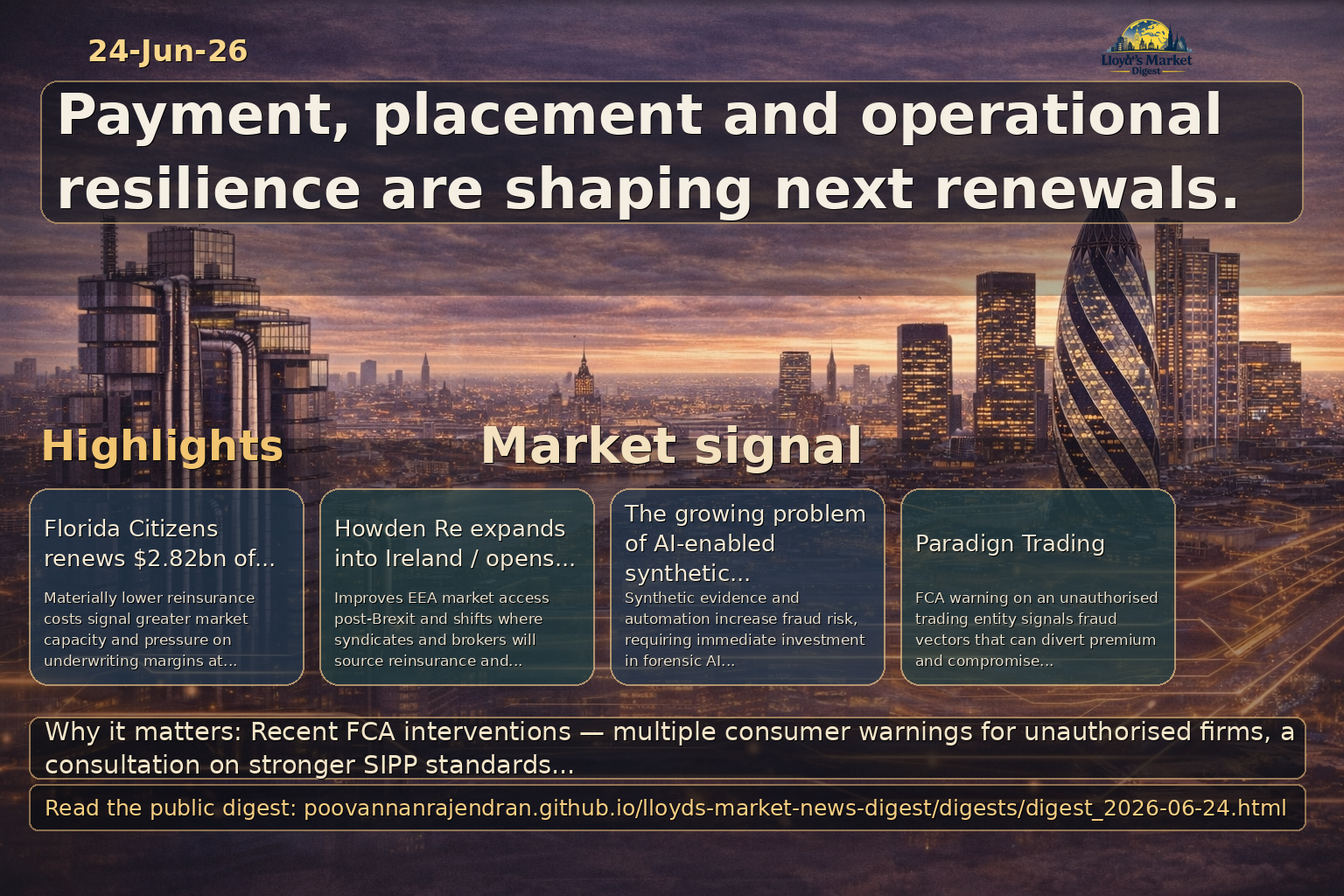
Why it matters: FCA warning on an unauthorised trading entity signals fraud vectors that can divert premium and compromise placement channels used by brokers and platforms; relevant to firms that rely on external payment or intermediary services.
- Validate current and prospective counterparties against FCA Warning List and internal watchlists before routing premiums or policyholder funds.
- Temporarily suspend or add manual controls to any automated payout or collection flows that reference the entity until confirmed clean.
- Communicate the warning to downstream distribution and clients, and review contractual payment routing to ensure funds are sent only to authorised, contracted entities.
Source: fca.org.uk
Why it matters: Pocket Trading EXP appears as an unauthorised operator; brokers and placement platforms should assume these entities are fraud risks that can influence client trust, payment routing and onboarding processes.
- Re‑force KYC/AML checks for intermediary firms and require proof of FCA authorisation for any firm engaging in transactions related to placements or premium financing.
- Review recent payment and premium-finance instructions for indicators of diversion or account changes linked to this name.
- Escalate to compliance/legal to determine if client notifications or remediation actions are required where exposure is detected.
Source: fca.org.uk
Why it matters: Nexusbank Ltd appears on the FCA warning list as unauthorised; any use of similarly named or unverified banking/payment counterparts risks misdirected premiums and broken settlement cycles affecting syndicate cashflows.
- Immediately verify beneficiary banking details in payment instructions against contracted bank account registers and recent confirmations of payee procedures.
- Assess short‑term liquidity implications for syndicates and brokers if premium flows are delayed or reversed due to interactions with unauthorised banking entities.
- Incorporate payee‑verification and out‑of‑band confirmation steps for any high‑value or new‑payee transactions to protect placement settlements.
Source: fca.org.uk
Why it matters: Vossen Capital Management is flagged as unauthorised; placing brokers and platforms must be alert to impersonation and spoofing risks that could target corporate or wholesale clients within specialty lines.
- Mandate two‑factor verification for changes to intermediary or client bank details and require accredited evidence of account ownership.
- Audit recent communications and placement instructions for signs of social engineering that coincide with this name appearing in the market.
- Update incident response playbooks to include steps for rapid tracing and recovery of misdirected premiums when unauthorised entities are involved.
Source: fca.org.uk
Why it matters: Immaculate Ltd (operating as UK Claims) on the warning list raises exposure concerns for claims-handling workflows and intermediaries that may use outsourced claims or salvage vendors; unauthorised vendors can result in data‑privacy and payment diversion risks.
- Suspend onboarding of unverified claims or third‑party service providers and require evidence of FCA registration or established market references for claims vendors.
- Review claims payment processes to ensure funds are disbursed only to authorised suppliers and that client data sharing follows contractual and regulatory standards.
- Communicate with partners and internal claims teams to check for any prior engagements with the named entity and determine remediation if payments or data transfers occurred.
Source: insurancejournal.com
Why it matters: A UK payments firm moving large volumes for high‑risk clients before FCA action highlights systemic AML, transaction monitoring and custody risks for brokers, MGAs and platforms facilitating client funds.
- Strengthen KYC/transaction monitoring and escrow controls for premium flows and commission settlement; reassess correspondent banking and payments relationships.
- Prepare for intensified regulator focus and potential capital or conduct requirements tied to transaction handling across placement platforms.
- Evaluate crime, professional indemnity and regulatory/legal expense coverages for platform operators and consider bespoke endorsements addressing aggregated transaction exposure.
Source: insurancejournal.com
Why it matters: Large governance and compliance litigation against gig-economy platforms increases management liability and casualty aggregation risk, affecting D&O capacity and wordings across specialty markets.
- Syndicates should reassess exposures stemming from platform-based business models and consider tighter exclusions or increased retentions for systemic governance failures.
- Brokers need to map third-party liability chains for platform clients and seek bespoke wording to address driver/worker-related liabilities.
- Placement platforms must flag concentration risks and enable rapid wholesaling to D&O and casualty specialists when systemic risk emerges.
Source: artemis.bm
Why it matters: Swiss Re’s renaming of its ILS investment arm signals deliberate market positioning of ILS capability within a global reinsurer, with implications for distribution, investor clarity and competitive dynamics with independent ILS managers and Lloyd’s-backed strategies.
- Clarifies value proposition for institutional investors — expect improved marketing leverage and potential increases in managed ILS capital that compete with third‑party managers.
- Increases competitive pressure on independent ILS managers and syndicates to articulate differentiated underwriting or distribution advantages.
- Brokers and placement platforms should reassess preferred-manager lists and distribution arrangements to align with an integrated reinsurer‑ILS offering.
Source: artemis.bm
Why it matters: The LM Re and Safehub parametric programme for Mexico demonstrates sovereign appetite for sensor-driven, near-instant pay-outs and reduces traditional indemnity exposure — a model that will affect placement patterns for sovereign and large public-sector risks.
- Sovereign parametric programmes can materially reduce traditional reinsurance demand for specified perils; syndicates should evaluate appetite for providing complementary layers.
- Placement platforms and brokers must develop parametric structuring expertise and data partnerships to originate and place sensor-based solutions effectively.
- Opportunities for Lloyd’s specialty teams to offer hybrid solutions (parametric + indemnity) and to partner on analytics/validation to win sovereign mandates.
Source: artemis.bm
Why it matters: Florida Citizens’ 2026 tower, citing around a 30% YoY price decline, is a clear market indicator of easing reinsurance costs and substantial available capital — a signal with direct consequences for renewals, margin planning and capital deployment across the specialty market.
- Meaningful premium relief for large cedants reduces near-term pricing pressure but compresses underwriting margins for carriers and syndicates.
- Brokers can leverage improved market capacity to restructure towers, increase limit purchased and promote multi-year placements to clients.
- Placement platforms should prepare for larger, more frequent program placements as cedants re‑optimize capital stacks and early redemptions of cat bonds occur.
Source: businessinsurance.com
Why it matters: Howden Re's expansion into Ireland signals strategic repositioning to secure EEA market access and broaden reinsurance placement options for Lloyd's and global specialty clients.
- Enables continuity of service for EEA cedants and supports syndicate access to EU risk flows post-Brexit — review EU-facing distribution strategies and regulatory footprints.
- Creates potential for new reinsurance capacity and partnerships that can be channelled through Lloyd's brokers and placement platforms — evaluate collaboration frameworks.
- Requires targeted talent recruitment and compliance investment in Dublin hubs to support cross-border placements and treaty servicing.
Source: businessinsurance.com
Why it matters: Mexico's nationwide quake/volcano cover represents a material market development in catastrophe risk transfer and a commercial opening for specialty syndicates and brokers.
- Offers syndicates and reinsurers scale opportunities but requires robust exposure aggregation and modelling for seismic/volcanic perils.
- Favours parametric or layered solutions distributed via placement platforms to accelerate payouts and reduce basis risk — assess platform integration and product design.
- Necessitates local partnerships and regulatory navigation; brokers should evaluate balance-sheet appetite and treaty structures to support program rollouts.
Source: businessinsurance.com
Why it matters: Findings that climate risks threaten large portions of data centre capacity highlight concentration and correlation exposures that matter to Lloyd's syndicates and global specialty portfolios.
- Concentration of high-value tech infrastructure in climate-exposed locations increases aggregation risk — enforce tighter risk selection and accumulation controls.
- Require enhanced modelling, site-level resilience underwriting and potential price differentiation by micro-location and climate scenario.
- Placement platforms and brokers should develop specialized placement workflows and policy wordings for correlated business interruption and contingent cyber exposures.
Source: businessinsurance.com
Why it matters: Steadfast's bid and associated network scrutiny underscore regulatory and conflicts-of-interest risks in broker consolidation that affect access to Lloyd's capacity and distribution transparency.
- Increased scrutiny can change broker panel dynamics and referral flows to Lloyd's syndicates — reassess counterparty concentration and dependency risks.
- Regulators may demand clearer disclosure and governance; syndicates and platforms should update compliance checks and KYC for networked broker relationships.
- M&A activity can disrupt local market agreements and MGAs; develop contingency plans for continuity of placement services and servicing standards.
Source: businessinsurance.com
Why it matters: Profile coverage of industry professionals signals ongoing talent mobility and leadership visibility that affect broker-syndicate relationships and placement effectiveness.
- Senior talent movements influence client relationships and distribution strength — prioritise retention incentives and succession planning for key placement roles.
- Profiles provide indicators of emerging skill sets sought by the market (e.g., catastrophe modelling, specialty underwriting) — align recruitment to capability gaps.
- Visibility of leaders can affect brand and market trust; syndicates and platforms should leverage executive engagement in client and broker outreach.
Source: globalreinsurance.com
Why it matters: Howden Re's Dublin launch materially improves its proximity to EU clients and capital markets while adding market credibility through an experienced hire; this will influence how Lloyd's brokers, syndicates and placement platforms source analytics-led advisory and structure capital solutions for global specialty risks.
- Strategic EU access: Establishes a local centre to serve EU-based cedants and intermediaries, easing cross-border placements and aligning with Ireland's expanding captive and reinsurance ecosystem.
- Senior talent and market credibility: Appointment of David Carpenter brings established market relationships and regional know-how, accelerating client engagement and syndicate connectivity in London and Dublin markets.
- Placement and capital advisory uplift: Localised, data-led analytics and capital advisory capabilities strengthen Howden Re's proposition to syndicates, alternative capital providers and placement platforms, increasing competition for mandateed broking and bespoke capital structuring.
Source: insurancejournal.com
Why it matters: State Farm's measured approach to New York auto reform signals carriers will await empirical outcomes before reallocating capital — a reminder for brokers and syndicates to avoid assumption-driven capacity shifts and to price for implementation risk.
- Brokers should collect post-enactment loss-run and frequency data to support placement negotiations and conditional capacity releases.
- Syndicates must model phased legislative impact scenarios into appetite frameworks rather than assuming immediate exposure shifts.
- Placement platforms should enable conditional endorsements and flexible mid-term adjustments to reflect observed claim trends.
Source: insurancejournal.com
Why it matters: Surfside's legacy remains a catalyst for heightened condominium underwriting discipline — reinforcing demand for building-level inspection data, clearer survey protocols and changes to capacity for latent construction/maintenance risks.
- Underwriters and syndicates should mandate standardized structural surveys and incorporate inspection findings into limit and retention setting.
- Brokers must prepare higher-quality submissions with board governance, maintenance histories and remediation plans to unlock syndicate appetite.
- Placement platforms should integrate survey certificates and photo-based evidence to accelerate binding decisions and reduce contingent exposures.
Source: insurancejournal.com
Why it matters: A supply-chain cyber incident exposing major OEM IP highlights aggregation and systemic risk for cyber portfolios — emphasising the need for vendor-level exposure assessment and silent cyber clarity across syndicates.
- Underwriters should demand detailed supply-chain/vendor lists and assess potential for multi-policy aggregation before committing capacity.
- Brokers must stress-test client cyber limits against major vendor compromise scenarios and consider layered placements to manage accumulation.
- Placement platforms should enable cyber aggregation dashboards and support silent cyber declarations/clauses at binding stage.
Source: insurancetimes.co.uk
Why it matters: AI-enabled synthetic claims fraud directly threatens loss ratios, claims adjudication integrity and broker‑insurer trust across specialty portfolios and delegated authorities.
- Fraud sophistication is increasing: synthetic digital evidence and automated content generation shorten time to submission and complicate verification.
- Immediate need to invest in forensic AI detection, cross‑market data sharing and strengthened KYC/claims validation processes.
- Brokers and syndicates must update claims protocols and contractual warranties with MGAs to reduce exploitability of fixed payout caps and automated acceptance rules.
Source: insurancetimes.co.uk
Why it matters: Rising severity for escape-of-water claims and fixed payout caps creates protection gaps that impact product suitability, delegated authority oversight and insurer reputation management.
- Capped cover increasingly inadequate for unoccupied/holiday homes — underwriters must reassess sublimits and aggregation assumptions.
- Brokers should flag suitability risks to clients and consider bespoke placements or endorsements where caps materially underinsure exposures.
- Syndicates and delegated authorities need clearer policy wordings, claims triage protocols and reserve testing aligned to observed cost inflation.
Source: insurancetimes.co.uk
Why it matters: AI data extraction tools on cargo placement platforms materially affect placement efficiency, binding speed and data quality for global specialty marine and logistics risks.
- Automated data capture reduces friction and improves quote turnaround, supporting more frequent and smaller shipments on platform products.
- Dependence on AI increases exposure to extraction errors — carriers and brokers must implement validation gates and audit trails for automated fields.
- Placement platforms and syndicates should pursue API integration and standardised data schemas to unlock better risk analytics and pricing accuracy.
Source: insurancetimes.co.uk
Why it matters: Geopolitical instability in the Middle East has not yet moved travel pricing materially, signalling limited immediate market repricing but highlighting the need for scenario planning in specialty geopolitical coverage.
- Market pricing inertia suggests current underwriting appetite and exclusions remain intact, but continuous monitoring of war/terror exclusions is essential.
- Brokers should re-evaluate advisory language for clients with exposure in higher‑risk regions and ensure clear placement documentation.
- Syndicates should stress‑test catastrophe and travel product portfolios against concentrated geopolitical scenarios to quantify potential tail losses.
Source: insurancetimes.co.uk
Why it matters: Heat‑related claims in specialty pet portfolios illustrate climate-driven frequency and severity shifts that affect underwriting, pricing and policy design for niche lines.
- Heat events are producing meaningful claim upticks and higher average costs — underwriters must update loss assumptions and pricing models.
- Insurers and brokers should consider targeted risk mitigation messaging and seasonal endorsements to reduce preventable claims.
- Reinsurers and syndicates need to assess correlation with other climate perils when modelling aggregate exposures.
Source: newsnow.co.uk
Why it matters: Hiscox coverage is directly relevant as a listed Anglo‑Bermudan insurer with specialty lines activity — its strategic moves inform syndicate competitive positioning, product innovation and distribution tactics.
- Track Hiscox’s product launches and claims reserving updates to benchmark specialty pricing and identify areas of syndicated appetite or retreat.
- Assess Hiscox’s digital distribution and MGA partnerships for implications on placement platform demand and broker‑insurer operating models.
- Use competitor performance signals to inform syndicate capital deployment, treaty negotiations and differential underwriting terms in targeted specialty niches.
Source: reinsurancene.ws
Why it matters: The archive provides historical market context and track record on pricing cycles, catastrophe impacts and broker behaviour — useful for syndicate strategy and long-term placement planning.
- Historical pricing and loss narratives help syndicates calibrate reserve and capital assumptions.
- Broker and client behaviour trends in archives inform distribution and placement timing decisions.
- Reference material supports executive-level post-mortems on past market dislocations and strategy formation.
Source: reinsurancene.ws
Why it matters: Carrick’s successful Part VII transfer of IRB-Brasil UK legacy contracts underscores the ongoing importance of legal mechanisms to effect cross-border run-off and reinsurance business transfers — critical for Lloyd’s syndicates and legacy managers.
- Demonstrates practical use of UK Part VII for cleaning balance sheets and managing capital efficiency.
- Signals demand for specialist lawyers, brokers and run-off reinsurers to structure transfers for syndicates and MGAs.
- Highlights reputational and regulatory considerations for cross-border legacy transfers that syndicates must factor into their exit strategies.
Source: reinsurancene.ws
Why it matters: Moody’s analysis that the protection gap is widening where growth is shifting to emerging markets directly informs capacity strategies for Lloyd’s syndicates and global specialty brokers seeking premium growth.
- Emerging-market protection gaps present opportunity for specialty lines and Lloyd’s syndicates to design affordable, scaled solutions.
- Brokers should prioritise placement mechanisms and local distribution partners to capture underpenetrated demand.
- Underwriting teams must adapt pricing models to low-penetration, high-cat exposure environments and capitalise on reinsurance structuring.
Source: reinsurancene.ws
Why it matters: Improved U.S. P&C performance and a tighter combined ratio affect global reinsurance capacity and pricing dynamics that influence Lloyd’s syndicates and placement platforms.
- A stronger underwriting result in US P&C can reinstate reinsurer risk appetite and tighten retrocession pricing.
- Syndicates and brokers should monitor US catastrophe trends that feed into global capacity allocation and treaty renewals.
- Placement platforms must factor US market capital movements into syndicate capacity offers and layered programme design.
Source: reinsurancene.ws
Why it matters: QBE’s appointment of a Head of P&I Asia signals intensified competition and focus on marine P&I product development in key Lloyd’s trading hubs and Asian maritime markets.
- Strengthens Asia-based underwriting capability relevant to marine-focused syndicates and brokers.
- Impacts broker negotiations around capacity for British Marine and Group P&I placements in Asia.
- Indicates carriers are allocating senior talent to capture regional premium growth and complex marine risks.
Source: artemis.bm
Why it matters: Icosa’s analysis on relative valuations and diversifiers underscores a structural shift: valuation gaps between indemnity and industry-loss bonds are narrowing and secondary perils are more attractive — creating portfolio and placement opportunities.
- Narrowing valuation gaps enable cedants and managers to optimise cost-of-capital by blending indemnity and industry-linked structures.
- Lloyd’s syndicates can exploit demand for diversified peril coverage by offering bespoke triggers or co‑placements with ILS structures.
- Brokers should proactively advise clients on expanded diversification strategies and time placements to capture relative-value opportunities.
Source: artemis.bm
Why it matters: Morningstar DBRS’s view that investor appetite persists despite yield compression confirms resilient demand for catastrophe bonds — an important signal for syndicates, managers and brokers reliant on capital-market retrocession.
- Persistent investor demand supports sustained cat-bond issuance and provides alternative retrocession capacity for syndicates and reinsurers.
- Seasonal risk forecasts (e.g., NOAA) remain short-term pricing catalysts; risk teams must integrate meteorological outlooks into issuance timing and pricing strategies.
- Brokers and placement platforms must maintain investor relationships and transparency on collateralisation and trigger mechanics to preserve access amid yield volatility.
Source: newsnow.co.uk
Why it matters: Local UK regional developments matter for property, flood and SME coverage appetite across Lloyd’s syndicates and broker portfolios; rural/secondary markets influence distribution strategies and catastrophe modelling.
- Reassess flood and property exposure modelling for Welsh coastal/riverine zones; local claims volatility can affect syndicate pricing and capacity allocations.
- Engage regional broker networks to capture SME commercial lines growth and to refine appetite for rural risks and farm portfolios.
- Use granular data from county-level reporting to feed catastrophe accumulation limits and adjust facultative placement strategies.
Source: newsnow.co.uk
Why it matters: Coverage on Michel Barnier and related EU political developments signals potential regulatory and market‑access shifts that affect Lloyd’s EU channels, equivalence assessments and cross‑border distribution strategies.
- Monitor EU regulatory responses that could alter Lloyd’s passporting or third‑country equivalence and force changes to Lloyd’s Brussels/Paris operational footprints.
- Prepare legal and compliance scenarios for changes to reinsurance cedant access and local policy wording requirements in EU member states.
- Advise brokers and carriers on potential need for local placements or increased use of EEA‑licensed partners to maintain continuity of service for European cedants.
Source: newsnow.co.uk
Why it matters: Macro developments in Egypt affect marine, energy and political‑risk exposures — critical for syndicates underwriting Suez‑linked shipping, commodity logistics and MENA infrastructure projects.
- Elevated political or economic instability in Egypt increases demand for political‑risk, trade credit and marine war/emergency coverage tied to Suez Canal throughput.
- Reassess underwriting for energy infrastructure and construction projects given potential for cost overruns, delay claims and changes to host‑state risk appetite.
- Coordinate with brokers to stress‑test marine hull/cargo accumulations and revise voyage route exposures in response to shifting transit patterns.
Source: newsnow.co.uk
Why it matters: Detailed Egypt political reporting informs near‑term sovereign, operational and regulatory risks that affect treaty pricing for political‑risk and credit lines alongside facility underwriting for project finance.
- Monitor legislative and governance changes that could impact foreign investor protections, repatriation rules and insurability of long‑tail infrastructure risks.
- Prepare contingency coverage guidance for clients operating in Egypt (construction and energy) including force majeure and delay‑in‑start‑up policy considerations.
- Adjust political‑risk capacity and reinsurance layers in response to evolving sanctions risk, reputational exposures and AML/Governance reviews.