Source: fca.org.uk
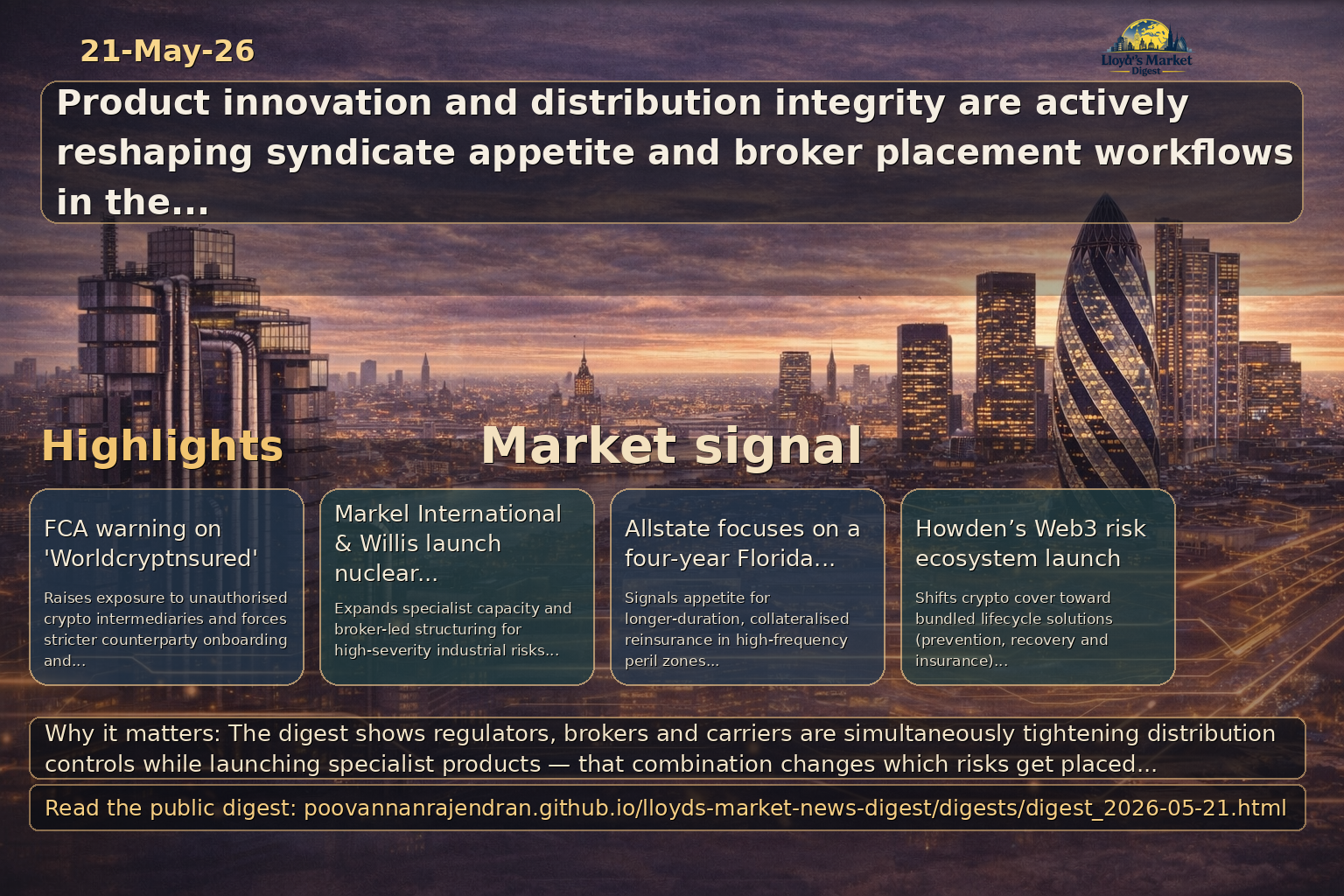
Why it matters: The FCA warning on 'Worldcryptnsured' signals active unauthorised actors targeting clients with crypto-linked financial products. For Lloyd’s market participants this increases exposure to unvetted counterparties, distribution through non‑standard channels, and potential contagion into specialty crypto-insurance placements.
- Immediate: review and augment third‑party and broker onboarding checks to detect unauthorised crypto intermediaries; incorporate FCA warning-list screening into placement platform gates.
- Governance: require explicit counterparty authorisations and traceable proof of regulatory status before accepting crypto-linked risk or collateral into syndicates.
- Strategic: partner selectively with regulated insurtech/crypto custodians; document product-level controls and exclusions to limit unintended exposure to unauthorised crypto distribution.
Source: fca.org.uk
Why it matters: The 'Astro CryptoFX Trade' warning reinforces the trend of fraudulent crypto firms operating without FCA authorisation. This pattern increases market vulnerability to payment fraud, AML breaches and claims disputes arising from policies or warranties sold by unauthorised actors that may reference specialty cover.
- Controls: enforce stricter KYC/AML and source-of-funds verification for crypto-related premium flows across brokers and MGAs, with automated flags for unauthorised entities.
- Platform risk: ensure placement systems block or quarantine submissions referencing unverified crypto counterparties and require manual compliance sign-off for any crypto exposure.
- Reputation and legal: update contractual warranties with brokers/delegated authorities to mandate compliance with UK regulatory status requirements and reserve termination/remediation rights for breaches.
Source: fca.org.uk
Why it matters: FCA research on young drivers and ghost broking—fake insurance sold via social media—exposes distribution-channel weaknesses that can produce large volumes of invalid policies, claims fraud, regulatory complaints and fines. For motor portfolios and delegated distribution, the risk is elevated by rapid social media-based customer acquisition.
- Underwriting: tighten evidence requirements for social-media sourced business and introduce heightened verification for high‑risk cohorts (e.g., young drivers) to reduce post-issue cancellations and fraudulent claims.
- Detection: deploy analytics across placement platforms and brokers to detect anomalous patterns consistent with ghost broking (e.g., rapid policy churn, mismatched payment sources, batch submissions from single intermediaries).
- Market conduct: collaborate with brokers, MGAs and platform providers to implement joint consumer‑protection messaging, takedown procedures and escalation protocols with social platforms and the FCA.
Source: fca.org.uk
Why it matters: The FCA Scale-up Unit opening to solo-regulated firms presents both opportunity and competitive pressure. Insurers, syndicates and placement platforms should engage early to shape scalable, compliant distribution models and to assess insurtech partners for Lloyd’s and global specialty placements.
- Engagement: proactively liaise with the FCA and prospective scale-ups to influence product governance, data standards and secure integration requirements for placement platforms.
- Innovation strategy: evaluate partnerships with regulated scale-ups to gain advantaged access to technology (e.g., real‑time underwriting, fraud detection) while ensuring rigorous change-control and compliance oversight.
- Risk management: adapt vendor/partner due diligence and contractual frameworks to incorporate regulatory milestones, contingency plans and clear remediation obligations for technology and data failures.
Source: insurancetimes.co.uk
Why it matters: The FCA alert on ghost brokers selling fake motor cover highlights distribution integrity threats that can affect insurer loss ratios, broker credibility and platform trust — relevant for all market participants that transact motor or retail lines.
- Enhance platform-level identity verification, document provenance checks and transaction monitoring to detect ghost broker activity early
- Coordinate industry-wide fraud intelligence sharing between insurers, brokers, MGAs and Lloyd’s to disrupt online ghost broking channels
- Educate broker clients and embed fraud warnings and verification steps in digital quoting journeys to reduce exposure and compliance risk
Source: artemis.bm
Why it matters: Allstate’s focus on a four-year Florida tranche underscores demand for multi-year collateralised reinsurance and highlights how sponsors calibrate issuance structure to investor response and portfolio duration needs.
- Shift to a four-year tranche reflects appetite for longer-duration risk transfer in high-frequency peril zones like Florida.
- Dropping the three-year tranche indicates active investor price/size signal management during bookbuilding.
- Brokers should prioritise investor targeting and tranche structuring to balance sponsor collateral needs with market demand.
Source: businessinsurance.com
Why it matters: Creation of a dedicated nuclear insurance facility signals expansion of specialist capacity and the broker-led structuring of complex industrial risks — core to Lloyd's and global specialty strategy.
- Positions market to underwrite higher-severity, long-tail industrial risks with tailored terms and limits
- Highlights broker (Willis) role in packaging difficult-to-place risks and orchestrating syndicate participation
- Increases need for syndicates and placement platforms to offer technical underwriting expertise and streamlined binding workflows for nuclear-class exposures
Source: businessinsurance.com
Why it matters: AIG's acquisition of a Colombian insurer underscores continued geographic expansion by global carriers and implications for distribution, treaty relationships and cross-border capacity sourcing relevant to Lloyd's syndicates and brokers.
- Expands local underwriting footprint and distribution capability in Latin America, altering placement routing and local market relationships
- Creates integration and reinsurance optimisation considerations for cedants and brokers placing regional business
- Signals competitive pressure on global specialty carriers and syndicates to offer coordinated global propositions
Source: businessinsurance.com
Why it matters: Enforcement action in rail construction procurement highlights conduct and contractual risk that can produce significant liability and reputational exposures for contractors and their insurers — a placement and underwriting concern for specialty lines.
- Raises prospect of large liabilities, fines and defence costs under commercial policies and professional liability programmes
- Heightens due-diligence requirements for underwriting contractors, surety and construction-related placements
- May drive stricter policy warranties, enhanced risk engineering clauses and tighter broker submissions to specialty syndicates
Source: businessinsurance.com
Why it matters: A substantial profit uplift at a major reinsurer affects market capacity, retrocession pricing and the capital available to support Lloyd's syndicates and specialty placements.
- Improved reinsurer results can soften treaty pricing or increase available capacity for syndicates and large placements
- May influence Lloyd's syndicates' retrocession strategies and margin expectations across specialty lines
- Signals potential capital rotation into specialty niches, affecting competitive dynamics and rate adequacy assessments
Source: businessinsurance.com
Why it matters: Executive profiles provide early visibility on leadership influence and relationship networks that affect broker-syndicate flows, strategic partnerships and market positioning.
- Leadership visibility indicates potential strategic shifts in placement priorities or product focus
- Senior executives act as focal points for syndicate relationship management and facultative negotiation
- Monitor statements and profile activity for signals on distribution preferences and partnership appetite
Source: globalreinsurance.com
Why it matters: Argenta's appointment of a senior marine reinsurance underwriter signals targeted stewardship of marine treaty portfolios in the London market, reducing transition risk for syndicate placements and informing broker negotiations.
- Succession management: a planned handover to an experienced underwriter mitigates disruption to its marine treaty book and preserves syndicate underwriting continuity for brokers and cedants.
- Placement impact: Saunders’ treaty experience at Swiss Re enhances Argenta’s capability to structure and price marine reinsurance placements, affecting capacity terms offered by syndicates and Lloyd’s brokers.
- Market relationships: strong incumbent relationships with reinsurers and brokers may shift negotiation dynamics and portfolio alignment, requiring brokers and placement platforms to recalibrate engagement strategies.
Source: globalreinsurance.com
Why it matters: NPRe’s appointment of a CEO with distribution experience underscores growth ambitions in specialist cedant segments (MGAs, mutuals, captives) and highlights demand for expert-led underwriting as an alternative to algorithmic approaches relevant to Lloyd’s distribution partners.
- Distribution-led growth: leadership with sales and distribution pedigree is likely to accelerate partnerships with brokers and MGAs that feed Lloyd’s syndicates and placement platforms.
- Underwriting stance: NPRe’s emphasis on expert-led evaluation aligns with specialty brokers seeking bespoke capacity rather than commoditised, model-driven products.
- Strategic partnerships: expanded UK/Europe and Caribbean capabilities create opportunities for collaboration with syndicates and platforms to place tailored reinsurance and retrocession capacity.
Source: globalreinsurance.com
Why it matters: Chedid’s appointment of a regional CEO reflects deliberate expansion of a specialty brokerage footprint across the Middle East and Africa, strengthening local distribution channels that channel business into Lloyd’s and global syndicates.
- Regional distribution: enhanced leadership supports deeper market penetration in MEA, improving access for Lloyd’s syndicates to localized specialty lines and risks.
- Placement capability: a stronger specialty lines portfolio at a regional broker increases the volume and sophistication of placements requiring Lloyd’s and international capacity.
- Market access and partnerships: syndicates and placement platforms should evaluate alliance opportunities with Chedid to secure lead lines and co-insurance arrangements across high-growth markets.
Source: globalreinsurance.com
Why it matters: AIG’s hire of a global head of marine signals a strategic investment in marine leadership that will intensify competition for specialty talent and capacity, with direct implications for Lloyd’s marine syndicates and broker placement dynamics.
- Competitive capacity allocation: AIG’s renewed focus on marine may redirect global capacity and influence pricing dynamics faced by Lloyd’s marine syndicates.
- Talent competition: recruitment of senior marine specialists raises retention pressure on syndicates and placement platforms to maintain underwriting expertise and institutional knowledge.
- Broker negotiation dynamics: brokers can expect enhanced product and service propositions from AIG, prompting syndicates to differentiate through speed-to-market, appetite clarity and specialty solutions.
Source: globalreinsurance.com
Why it matters: Everest’s sale of its Colombia operations to AIG and its strategic pivot toward global reinsurance and specialty underscores a reallocation of capital and distribution, presenting both supply-side openings for syndicates and competitive headwinds for brokers.
- Capital reallocation: Everest’s exit from local retail frees capacity and may redirect cedant demand to Lloyd’s and global specialty syndicates seeking growth opportunities in Latin America.
- Distribution consequences: AIG’s expanded local footprint increases in-market underwriting capability, potentially drawing business away from independent brokers and altering placement flows.
- Opportunity for partnerships: syndicates and placement platforms can pursue collaborations with reinsurers and MGAs to capture cedant business migrating from retail exits and consolidation.
Source: insurancetimes.co.uk
Why it matters: Zurich’s dual five‑star eTrading recognition is a market signal that brokers increasingly reward frictionless, responsive digital interfaces — a core competitive factor for carriers and syndicates seeking retained broker appetite and faster placements.
- Prioritise measurable broker feedback loops and publish eTrading KPIs to demonstrate platform performance to brokers and Lloyd’s market bodies
- Invest in API-first connectivity and standardised messaging to ensure interoperability with broker PAS and placement platforms
- Use digital service excellence as an underwriting distribution differentiator when negotiating capacity and quota shares with syndicates and MGAs
Source: insurancetimes.co.uk
Why it matters: The debate on AI and the price of expertise underscores operational and reputational risk for specialty underwriters and brokers: models can hallucinate, and premiuming for judgement‑led expertise must be explicit in product and quoting workflows.
- Establish governance and validation protocols for AI outputs used in underwriting, claims and legal submissions, including audit trails for model decisions
- Reassess remuneration and pricing frameworks to explicitly value specialist underwriting expertise versus automated processes
- Require firms to document human oversight points in placement platforms to protect against model-induced mispricing or regulatory exposure
Source: insurancetimes.co.uk
Why it matters: Howden’s Web3 risk ecosystem signals a shift from reactive crypto insurance to bundled lifecycle solutions combining preventive cyber controls, recovery services and insurance — attractive to specialty capacity providers seeking de‑risked exposures.
- Syndicates and capital providers should evaluate capacity commitments contingent on pre‑approved vendor panels and resilience controls to limit tail loss
- Brokers should market lifecycle propositions that combine insurance and response services to strengthen placement terms and client retention
- Placement platforms need to support multi‑vendor orchestration and evidence capture (proof-of-control) to enable efficient binding and claims response
Source: insurancetimes.co.uk
Why it matters: Hood Group’s appointment to scale pet insurance reinforces continued retail specialty growth opportunities for brokers and underwriters; pet is a profitable, data-rich line that benefits from operational P&L focus and distribution alignment.
- Underwriters and syndicates should review appetites and capacity for scaled pet programs, leveraging claims data and telehealth partnerships
- Brokers and placement platforms must enable straightforward submission and lifecycle servicing to capture cross‑sell opportunities from existing personal lines relationships
- Consider modular product designs and delegated authority arrangements to accelerate time-to-market and P&L transparency
Source: reinsurancene.ws
Why it matters: Appointment of an experienced CUO at a tech-enabled MGA signals intensified underwriting discipline and scale ambitions among delegated authority players, relevant to syndicates and capacity providers assessing MGA partnerships.
- Reinforce due-diligence frameworks: review delegated authority controls and data access to validate portfolio and pricing alignment.
- Capacity strategy: syndicates and reinsurers should evaluate appetite for quota-share or excess protection with this MGA given its emphasis on portfolio management.
- Platform integration: brokers should prioritise API and data connectivity to capture pricing and placement advantages with a data-powered MGA.
Source: reinsurancene.ws
Why it matters: Aon naming a Japan CEO reflects broker consolidation of senior market relationships in a strategically important jurisdiction — impacting access to Japanese clients for Lloyd’s syndicates and specialty carriers.
- Strengthen local-market distribution: syndicates should reinforce Japan-facing underwriting desks and placement processes to convert increased broker engagement.
- Regulatory and client strategy: expect targeted product pushes (reinsurance, specialty) aligned to Japanese corporate risk appetites and regulatory expectations.
- Coordination with placement platforms: ensure connectivity and support for complex cross-border placements driven from Japan.
Source: reinsurancene.ws
Why it matters: Gallagher’s appointment of a Specialty COO for London Market operations signals brokers’ focus on operational scale and digital transformation to service complex specialty flows.
- Operational resilience: syndicates and placement platforms must ensure compatibility with broker operational changes and SLAs for more automated workflows.
- Tech-led differentiation: expect acceleration in placement tooling, straight-through processing and data analytics to reduce friction on complex placements.
- Talent and retention: brokers’ consolidation of veteran operators increases competition for specialist operations leaders; review talent and vendor partnerships accordingly.
Source: reinsurancene.ws
Why it matters: Price Forbes expanding a construction practice in South Africa creates new origination channels for construction risk placements from Africa — an area of growing interest to global specialty and Lloyd’s capacity.
- Origination opportunity: syndicates and reinsurers should engage early to shape policy form and capacity for Africa-based construction programmes.
- Distribution partnerships: brokers operating globally should align placement strategies to support local client needs and cross-border reinsurance requirements.
- Risk selection & analytics: invest in local exposure modelling and engineering capability to underwrite construction portfolios profitably.
Source: reinsurancene.ws
Why it matters: Zurich’s leadership moves in Singapore, including a regional Head of Energy, indicate insurer commitment to Asia Pacific specialty lines and capacity provision for energy and commercial placements in the region.
- Capacity signals: expect increased insurer-led capacity for Asia Pacific energy and mid-market commercial risks, affecting broker placement strategies.
- Product focus: syndicates should monitor product development and consider co-participation on energy and complex commercial accounts.
- Regulatory and distribution alignment: ensure placement platforms can support jurisdictional requirements and multi-line treaty coordination.
Source: newsnow.co.uk
Why it matters: Broad currency-market moves increase volatility in premium conversions, claims payments and capital ratios — critical for London-centric carriers and international brokers managing multi-currency portfolios.
- Implement FX-hedging strategies for sterling-denominated premiums and reserves to stabilise reported results of syndicates
- Require explicit currency settlement terms on placement platforms to prevent inadvertent FX exposure in facultative and treaty business
- Stress-test capital and liquidity models against FX shock scenarios, particularly for syndicates with sizeable overseas liabilities
Source: newsnow.co.uk
Why it matters: GBP volatility directly affects Lloyd's balance sheets, premium income converted from foreign currencies and the competitiveness of London-originated placements versus international centres.
- Quantify GBP movements’ effect on syndicate solvency metrics and optimise reinsurance and retrocession currency mix
- Advise brokers to price UK-origin risks with explicit FX-adjusted premium mechanics where multi-currency exposures exist
- Leverage placement-platform features to present multi-currency premium options and automated conversion disclosures to clients
Source: artemis.bm
Why it matters: Oak Global’s sponsorship using Arthur Re’s 144A structure is a pivotal example of a Lloyd’s-operating syndicate directly leveraging capital markets to diversify reinsurance capacity and access US institutional investors.
- Demonstrates Lloyd’s syndicate-level use of ILS to manage peak catastrophe exposure for Syndicate 2843.
- Use of an Artex-managed 144A SPI (Arthur Re) provides efficient access to US investors and index-triggered transaction mechanics.
- Signals brokers and placement platforms must integrate capital-markets solutions into syndicate placement strategies.
Source: artemis.bm
Why it matters: PwC’s assessment that ILS will further integrate with rated balance sheets confirms a strategic industry transition toward alignment of incentives, more predictable cycles and deeper structural innovation originating from Bermuda and specialist ILS markets.
- ILS is evolving from a supplemental capacity source to an integrated element of capital strategy, moderating the reinsurance cycle.
- Greater alignment will require enhanced governance, transparency and standardized data for investors and rated carriers.
- Brokers and syndicates must adapt advisory and placement workflows to accommodate hybrid capital structures and investor due diligence.
Source: artemis.bm
Why it matters: Hippo/Spinnaker’s favourable pricing on Mountain Re 2026-1 demonstrates that strong carrier metrics and repeat issuer status can materially improve execution and cost of protection in the ILS market.
- Successful pricing at the low end of guidance evidences investor confidence in robust carrier underwriting and balance-sheet support.
- Repeat issuers gain pricing leverage and expanded market access — a template relevant to Lloyd’s specialty syndicates seeking capital markets solutions.
- Brokers should highlight carrier performance and repeat-issuer track records when marketing transactions to ILS investors.
Source: artemis.bm
Why it matters: The Bermuda Stock Exchange’s surge in Q1 listings and growing market share reaffirms its role as the dominant platform for cat bond and ILS listings, influencing sponsor and arranger choices for domiciliation and investor access.
- BSX listing growth to over $68.5bn in Q1 consolidates its position as the primary venue for global ILS issuance.
- Platform choice affects listing, regulatory clarity and investor familiarity — critical considerations for Lloyd’s syndicates and global specialty insurers.
- Placement platforms, brokers and syndicates should standardise BSX-compatible documentation and timing to maximise market access.
Source: newsnow.co.uk
Why it matters: Developments involving Raul Castro and related US indictments heighten sovereign and political-risk uncertainty for exposures in Cuba and the wider Caribbean — relevant to treaty wording, sanctions screening and contingent business interruption for regional clients.
- Review political-risk and sanctions clauses for Cuba-facing placements; confirm exclusions/coverage scope with reinsurers
- Strengthen sanctions-compliance checks across broker platforms and underwriting teams for counterparties and insureds
- Evaluate contingency plans for claims administration and local partner access if diplomatic tensions reduce on‑the‑ground capabilities
Source: newsnow.co.uk
Why it matters: ICJ activity can alter state liability exposure, set legal precedents and affect treaty interpretations — with direct implications for large sovereign, marine and aviation exposures underwritten by Lloyd's syndicates.
- Track ICJ cases with potential to change state responsibility standards; adjust exclusions and sublimits in political-risk and sovereign indemnities
- Advise clients and cedants on arbitration and choice-of-law language to mitigate adverse case law outcomes
- Coordinate with legal and treaty teams to model potential reserve and claims-frequency shifts from precedent-setting rulings
Source: newsnow.co.uk
Why it matters: GBP/USD pair dynamics are a key driver of cross-border reinsurance costs and affect US reinsurer appetite for UK-origin exposure; movement in this pair can change reinsurance margining and retrocession pricing.
- Monitor GBP/USD trends when negotiating US-dollar reinsurance treaties and retrocession contracts to protect margin and collateral requirements
- Incorporate currency-trigger clauses or indexed premium mechanisms in treaty language to hedge exchange-rate risk
- Coordinate with Treasury to manage collateral posting in contracting currency to avoid forced liquidity events
Source: risk.net
Why it matters: The Energy Risk Asia Awards showcase firms excelling in risk management across commodity and energy markets—information Lloyd's syndicates and brokers can use to refine underwriting criteria, identify partnership targets, and calibrate capacity for volatile sectors such as power, LNG and renewables.
- Reassess underwriting appetite and pricing: Translate award-winning risk management practices into updated exposure models and pricing assumptions for energy portfolios, prioritising products with clear risk-reward profiles (e.g., merchant renewables, LNG volatility covers).
- Strengthen broker-syndicate partnerships: Leverage brokers demonstrating execution excellence as preferred distribution partners and co-develop bespoke structures (parametric triggers, hybrid placements) to win complex, time-sensitive energy risks.
- Invest in data and placement tooling: Accelerate adoption of analytics, forward curve integration and placement-platform APIs to improve slip turnaround, evidence-based adjudication and to capture market share during periods of heightened energy price dislocation.