Source: fca.org.uk
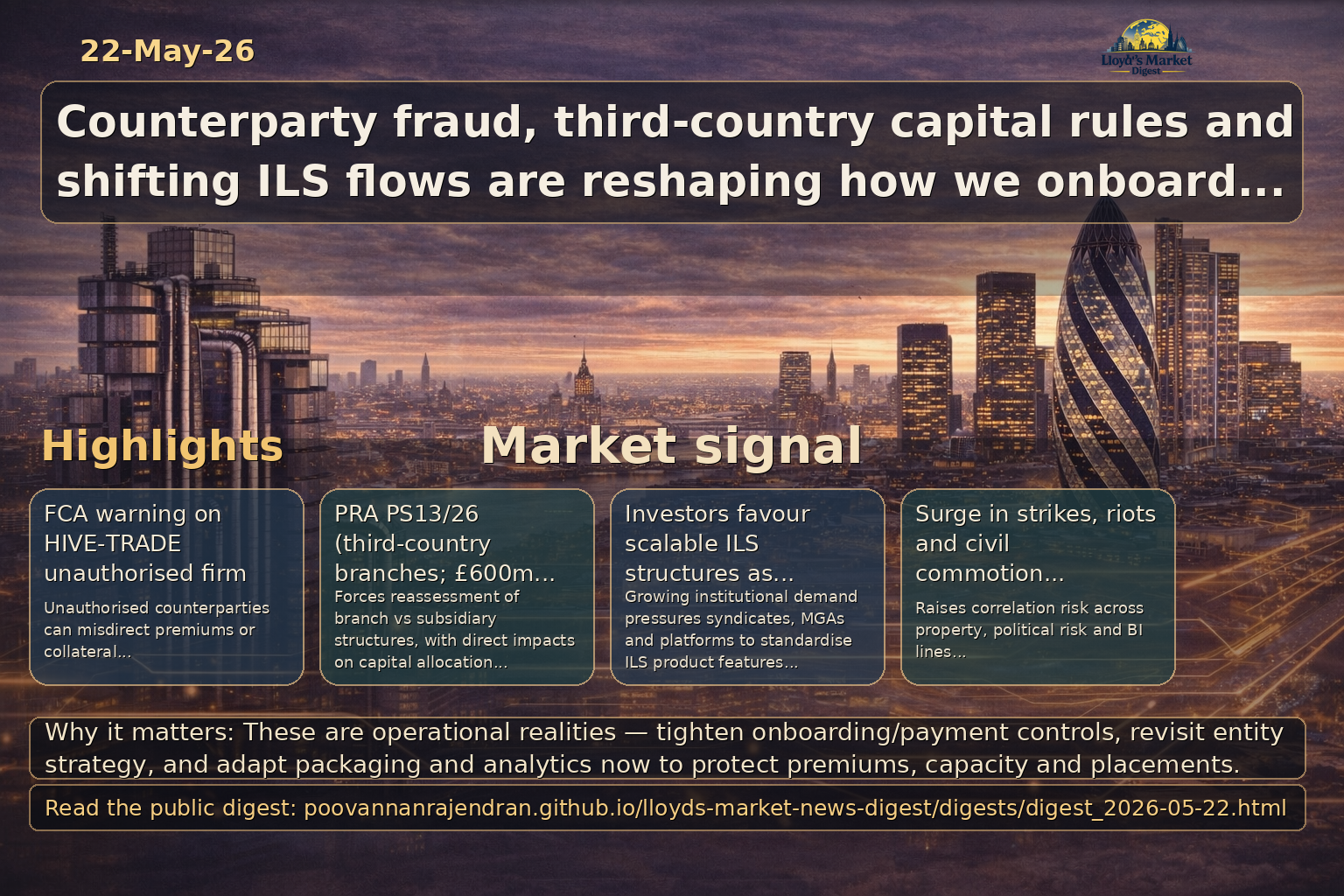
Why it matters: The HIVE-TRADE warning highlights unauthorised entities promoting financial products into the UK. For the specialty and Lloyd's market, unauthorised counterparties can introduce mis-selling, compromise placement integrity and limit recourse (no FOS/FSCS protection) when premiums or collateral are misdirected.
- Refuse engagement with unauthorised firms and require evidence of FCA authorisation or equivalent home-state regulator checks for incoming counterparties.
- Tighten AML/KYC and payment-verification workflows to prevent premium or collateral transfers to unauthorised entities.
- Escalate intelligence to compliance, notify placing brokers and consider market-wide alerts via Lloyd's or trade bodies when unauthorised operators target insurance channels.
Source: fca.org.uk
Why it matters: Hyperliquid (hyperfoundation) represents unauthorised activity possibly connected to digital/crypto channels — a growing source of exposure for specialty lines and alternative collateral arrangements. Such firms can be used to solicit premiums, offer counterfeit cover or introduce novel settlement risks outside regulated rails.
- Treat crypto-linked or alternative-asset counterparties as high-risk: require enhanced due diligence, proof of regulated custody and clear settlement rails before accepting payments or collateral.
- Ensure placement platforms and MGAs prohibit routing funds to unverified wallets/accounts and enforce bank-account-only premium settlement unless exceptions are approved at senior levels.
- Update syndicate and broker policies on accepting digital asset collateral, include forensic traceability requirements and ensure rapid liaison with regulators when suspect activity is detected.
Source: businessinsurance.com
Why it matters: Howden's launch of a US aviation practice signals increased broker competition in a technically demanding specialty — syndicates and established aviation teams should review distribution strategies and partnership opportunities.
- Market share monitoring: track account flows to the new practice to anticipate rate and retention pressure in aviation portfolios.
- Technical capability alignment: ensure underwriting teams maintain technical expertise to compete for complex fleet and aerospace risks.
- Distribution partnerships: explore co‑broker or retrocession arrangements to secure lead positions on multi‑jurisdictional aviation accounts.
Source: bankofengland.co.uk
Why it matters: PS13/26 directly affects decisions on whether to maintain third-country branches or convert to subsidiaries, changes capital and governance expectations, and creates operational demands on brokers and placement platforms handling cross-border business — all material to Lloyd's, global specialty carriers and syndicates managing capital, distribution and regulatory access.
- Entity and capital strategy: The £600m subsidiarisation threshold forces reassessment of group structures, potential subsidiarisation or re-domiciliation, and impacts capital allocation, solvency modelling and group capital management.
- Placement, documentation and platform readiness: Brokers and placement platforms must update due diligence, contractual clauses and onboarding workflows to reflect clarified branch expectations and supervisory requirements to avoid placement delays or compliance gaps.
- Transitional and supervisory engagement: Syndicates and carriers should develop transition plans, stakeholder communication and evidence of governance enhancements to satisfy PRA expectations and minimise disruption to Lloyd's access and cross-border distribution.
Source: businessinsurance.com
Why it matters: Tokio Marine's ability to report rising profit despite Asia‑Pacific losses signals resilient capital management at major global carriers, with direct implications for capacity availability, reinsurance purchasing and competitive pricing for Lloyd's syndicates and brokers active in APAC.
- Reassess APAC appetite: syndicates should stress‑test exposures in politicised and nat‑cat prone APAC markets and adjust capacity allocations.
- Reinsurance strategy: brokers should evaluate treaty attachment points and reinstatement language given disparate regional performance.
- Client advisory: use carrier stability as leverage in negotiations to maintain margins on higher‑loss APAC portfolios.
Source: businessinsurance.com
Why it matters: A surge in strikes, riots and civil commotion (SRCC) claims increases correlation risk across property, political risk and business interruption lines — a focal issue for Lloyd's and global specialty markets that underwrite geo‑political exposures and for brokers managing aggregated client placements.
- Tighten wording and exclusions: brokers must verify SRCC triggers and aggregation clauses across placement platforms to avoid unforeseen exposures.
- Portfolio aggregation monitoring: syndicates should implement real‑time exposure analytics to prevent concentration losses in urban/industrial hubs.
- Claims preparedness: develop rapid response playbooks with claims teams and platforms for high‑frequency SRCC events to limit severity and loss amplification.
Source: businessinsurance.com
Why it matters: Sompo's robust profit performance impacts global capacity dynamics — profitable Japanese carriers can sustain competitive retentions, affect reinsurance demand and alter pricing leverage for brokers negotiating specialty placements across casualty and property lines.
- Monitor capacity shifts: brokers should track Sompo's increased financial capacity as potential counterparty for large placements.
- Competitive pricing pressure: syndicates must evaluate whether Japanese carriers' profitability will depress rates in overlapping product lines.
- Strategic partnerships: explore co‑insurer or fronting arrangements with profitable carriers to optimise capital usage for complex risks.
Source: businessinsurance.com
Why it matters: BYD's labor law issues in Hungary highlight operational and political‑regulatory risk for manufacturers — these events increase employer liability and supply‑chain exposure, relevant to D&O, political risk and trade credit policies underwritten by Lloyd's syndicates and specialty brokers.
- Reprice manufacturing portfolios: underwriters should reassess premiums for clients with cross‑border manufacturing footprints and labour‑intensive operations.
- Policy wording review: brokers should clarify coverage for labour disputes, strikes and regulatory actions in D&O and political risk placements.
- Client risk mitigation: advise insureds on compliance and labour relations strategies to reduce insurable exposures and claims frequency.
Source: globalreinsurance.com
Why it matters: Rising institutional allocations to ILS and scalable structures materially affect how Lloyd's syndicates, global specialty carriers and placement platforms source and package capacity. Demand for transparent, direct-access vehicles pressures the market to standardise product features, enhance reporting and streamline placement channels to capture long-term capital.
- Allocate product development to create scalable, transparent ILS-compatible offerings (sidecars, cat bonds, structured balance-sheet vehicles) that integrate with existing syndicate capital stacks.
- Enhance placement and reporting capabilities on MGAs/managed syndicates and third-party platforms to meet institutional governance, auditing and liquidity expectations, improving attractiveness to large investors.
- Coordinate distribution: brokers and placement platforms must develop investor-facing documentation and standardised deal frameworks to shorten execution timelines and enable repeatable capital deployment.
Source: globalreinsurance.com
Why it matters: The launch of a dedicated reinsurance broking division for credit, political risks and surety highlights growing broker-led specialism and client demand for tailored capacity and treaty solutions. This amplifies opportunities for Lloyd's syndicates and global specialty carriers to provide bespoke capacity, and requires closer collaboration with placement platforms and rating/compliance processes.
- Syndicates and carriers should prioritise nimble paper and appetite definition for credit, political risk and surety lines, enabling faster appetite matching with specialist brokers and improving hit-rates on submissions.
- Brokers expanding into reinsurance broking necessitate deeper technical underwriting partnerships and bespoke contract wordings; carriers must allocate underwriting resources and pricing models for less commoditised lines.
- Placement platforms and Lloyd’s central services need to support differentiated security and contractual features (eg. political risk triggers, surety structures) and accelerate onboarding and actuarial support to capture growing specialist volumes.
Source: insurancejournal.com
Why it matters: Reports of ‘dumb’ and ‘bizarre’ competitor moves signal a rapid loosening of capacity and appetite across the standard and delegated-authority markets, directly affecting syndicate pricing discipline, broker strategy and placement platform workflows.
- Reassess delegated-authority oversight: tighten data submissions, audit cadence and appetite controls for MGAs and MGUs to avoid adverse selection.
- Recalibrate syndicate capacity plans: run scenario stress tests on premium adequacy and reserve impacts if market weakening persists for two quarters.
- Update broker placement playbook: prioritize risk selection, tighten minimum terms and leverage platform capabilities to route business to disciplined capacity providers.
Source: insurancejournal.com
Why it matters: High-profile corporate depositions in coverage litigation raise counterparty risk and testimony exposure that can influence liability reserves, coverage wording disputes and reinsurer recoveries for large institutional placements.
- Stress-test D&O and management liability placements: quantify potential billings and defence costs tied to executive depositions and related discovery.
- Strengthen policy wording clarity: remove ambiguous coverage language around consent, coverage triggers and allocation to reduce litigation vectors.
- Communicate with cedants and reinsurers: establish early-warning protocols for contested coverage claims to protect reinsurance recovery and capital planning.
Source: insurancejournal.com
Why it matters: Projected slowing of P/C growth and rising replacement costs compress premium momentum and heighten the need for underwriting discipline across specialty lines relevant to Lloyd’s syndicates and global brokers.
- Align 2026–27 underwriting plans with loss-cost inflation: reassess rate-on-book targets and embedding of replacement-cost indices into pricing models.
- Prioritize portfolio profitability over top-line growth: deploy tighter UW authority and negotiate terms with delegated partners to protect combined ratios.
- Optimize capital deployment: consider selective capacity retraction or reinsurance layering to protect balance sheets during cyclical weakness.
Source: insurancejournal.com
Why it matters: War supplanting civil unrest as top political-violence concern shifts underwriting focus toward state-backed conflict, supply-chain disruption and trade-risk exclusions that directly affect marine, energy and political-risk offerings placed in London and globally.
- Re-evaluate political-violence wordings and exclusions: ensure clarity on war, sanctions and non-physical damage triggers across marine and trade packages.
- Stress-test trade and supply-chain portfolios: quantify interruption exposure from prolonged maritime chokepoint closures and elevated war risk premiums.
- Coordinate syndicate and broker advisory: provide clients with layered mitigants, including parametric options, political-risk capacity and tailored war endorsements.
Source: insurancejournal.com
Why it matters: Iran-Oman talks on a permanent Hormuz toll raise underwriting and marine war-risk concerns, increasing exposure for hull, cargo, P&I and trade credit lines placed by brokers and managed by syndicates.
- Update marine navigational risk guidance: restrict transit terms for high-risk routes and require enhanced voyage declarations on placement platforms.
- Price premiums to reflect chokepoint risk: incorporate the probability of tolling, interdiction and military escalation into voyage and war rates.
- Engage with clients on risk mitigation: recommend route diversification, convoy protocols and contingency logistics to reduce claim likelihood.
Source: insurancetimes.co.uk
Why it matters: Gallagher’s hire of an ex-London market and BMS operations leader signals prioritisation of operational excellence, technology and market reform to scale specialty placements and improve syndicate engagement.
- Accelerates digital and process reforms across Gallagher Specialty to streamline Lloyd’s and syndicate placements and reduce friction in binding workflows
- Improves broker-side capability to structure complex placements and leverage data/tech for enhanced underwriting submissions
- Increases competitive pressure on other brokers and placement platforms to match operational and client-service standards in specialty lines
Source: insurancetimes.co.uk
Why it matters: Falling shopping and switching rates reshape distribution economics across retail and affinity channels, affecting PCWs, broker retention strategies and pricing dynamics relevant to personal lines placements.
- Lower consumer churn supports retention-focused broker models but compresses underwriting margin visibility and upselling opportunities
- Reduces frequency of wholesale placement turnover for certain personal lines, shifting emphasis to lifetime value and cross-sell via broking platforms
- Signals potential demand softening that underwriters and syndicates must monitor when setting rates and capacity for retail-distributed business
Source: insurancetimes.co.uk
Why it matters: The contrarian examination of nepotism highlights an industry-wide debate on talent sourcing strategies that affects succession, retention and specialist skill continuity in brokerages and smaller syndicate teams.
- Positions experienced insider hires as a pragmatic route to retain specialist institutional knowledge and accelerate placement expertise
- Raises governance and diversity considerations that boards and underwriters must manage to avoid groupthink in underwriting decisions
- Reinforces the need for formal talent development and governance frameworks to balance rapid onboarding with cultural and regulatory expectations
Source: insurancetimes.co.uk
Why it matters: Markel’s appointment of a head of fine art and specie reflects growing risk appetite and demand for specialist capability in high-value asset classes that require bespoke underwriting and placement expertise.
- Signals increasing capacity and competition in fine art, specie, jewellers block and cash-in-transit lines for Lloyd’s and global specialty syndicates
- Requires underwriters, brokers and placement platforms to deepen valuation, recovery and risk-mitigation expertise when structuring policies
- Heightens need for tailored reinsurance and aggregation management given rising asset values and frequency of high-profile losses
Source: insurancetimes.co.uk
Why it matters: Allianz UK expanding into Asda-branded home and motor products exemplifies retailer affinity distribution scaling via insurer underwriting—relevant to brokers and platforms competing for affinity business and retail access.
- Demonstrates growing importance of multi-party distribution models where retailers own customer relationships and insurers provide underwriting and claims capabilities
- Creates competitive pressure on brokers and PCWs for personal lines placement and may shift volumes away from traditional intermediaries
- Highlights need for robust operational integration between underwriting platforms and retailer marketing channels to deliver scale and retention
Source: reinsurancene.ws
Why it matters: Appointment of an experienced CUO at Bishop Street Underwriters impacts underwriting governance across UK operations that interact with Lloyd’s appetite and placement channels; signals disciplined portfolio management and potential expansion of syndicate-facing business.
- Strengthens underwriting governance and portfolio discipline across Avid Insurance and Landmark Underwriting, improving syndicate and broker confidence in placement quality.
- Increases likelihood of targeted growth into Lloyd’s-distributed specialty classes, creating opportunities for syndicates and brokers to collaborate on capacity and appetite alignment.
- Regulatory approval and integration execution are near-term risks; monitor underwriting authority changes and appetite statements for implications to facultative and treaty placements.
Source: reinsurancene.ws
Why it matters: Oliver Wyman’s creation of a Chief AI and Data Officer role (and broader leadership changes) signals acceleration of AI-enabled advisory services that will influence broking models, pricing analytics and placement workflows across the Lloyd’s and global specialty ecosystem.
- Expect advisory-led propositions that embed agentic AI into pricing, portfolio optimisation and submission handling—pressuring brokers and placement platforms to upgrade analytics capabilities.
- Opportunity for syndicates and brokers to partner with advisory firms to pilot AI use-cases in underwriting and claims analytics, shortening decision cycles and improving loss selection.
- Risks include vendor concentration, governance and model assurance; chief executives should insist on robust change management, data governance and explainability standards before wide rollout.
Source: reinsurancene.ws
Why it matters: HIVE Underwriting’s appointment of James Lee as Non‑Executive Director strengthens board-level Lloyd’s market experience for an MGA and Lloyd’s coverholder, reinforcing governance as the firm scales multi-class specialty distribution.
- Elevates board governance and operational expertise, improving appeal to syndicates and delegated authority partners seeking robust control environments.
- Supports HIVE’s multi-class growth strategy and potential expansion of delegated authority placements at Lloyd’s and via global brokers.
- Execution risks include scaling underwriting capacity and matching capital; market participants should watch for changes to delegated authorities and appetite that may create placement opportunities.
Source: reinsurancene.ws
Why it matters: Aon’s appointment of a senior Casualty head for the Nordic Broking Centre strengthens regional casualty broking capability, affecting multinational programme placements and competition for specialty casualty business that could otherwise flow to Lloyd’s syndicates.
- Enhances Aon’s ability to structure and place complex multinational casualty programmes, raising the bar for placement platforms and syndicates competing for Nordic-origin business.
- May intensify broker competition for casualty lines, prompting syndicates to refine appetite and treaty terms to secure distribution through global brokers.
- Watch for accelerated client consolidation and talent-driven market share shifts; syndicates and MGAs should proactively engage to protect placement pipelines.
Source: reinsurancene.ws
Why it matters: Willis’ new growth operations and enablement hires in North America reflect a push to drive pipeline efficiency, RFP adoption and data-driven sales conversion—changes that will alter how brokers present business to syndicates and placement platforms.
- Focus on analytics-driven growth and RFP optimisation will shorten sales cycles and increase conversion, placing a premium on high-quality submissions and disciplined underwriting responses.
- Placement platforms and syndicates must adapt to faster, data-rich broking workflows and demonstrate responsiveness to retain broker-led business.
- Integration and change management pose short-term disruption risks; executives should prioritise interoperability between broker CRM/placement tools and syndicate underwriting systems.
Source: newsnow.co.uk
Why it matters: SpaceX's continuing operational expansion creates large, complex single risks and systemic exposures that materially affect syndicate appetite, capacity allocation and placement mechanics across the Lloyd's and global specialty markets.
- Underwriting & capacity: Demand for higher single-risk limits will push syndicates toward consortium placements, increased reliance on lead underwriters and structured reinsurance/retro solutions to avoid concentration of risk.
- Aggregation & PML management: Satellite constellations and frequent launch activity increase spatial and systemic aggregation; underwriters must refine catastrophe models and scenario testing to quantify correlated failure modes (launch, on-orbit collision, debris).
- Broker and platform implications: Brokers will need to design multi-layered programmes with bespoke wording, telemetry-driven warranties/conditions and coordinated claims protocols; placement platforms must support complex facultative slips and real-time data sharing.
Source: newsnow.co.uk
Why it matters: Starship's scale, reusability ambitions and integration with government programmes (e.g., NASA) raise the magnitude and frequency of exposures, requiring novel policy constructs, parametric triggers and enhanced loss-mitigation clauses within specialty placements.
- Policy innovation: Full-reusability and high-altitude test profiles necessitate new cover modules (test-flight, developmental liability, orbital debris, payload assurance) and bespoke exclusion/aggregation language.
- Capital structuring & reinsurance: The potential for very large losses drives demand for layered solutions — lead syndicates, syndicated consortiums, proportional and non-proportional reinsurance, and capital markets instruments (cat bonds, insurance-linked securities).
- Underwriting data & monitoring: Underwriters will require access to granular telemetry and launch/test data for pricing and risk control; placement platforms and brokers should enable secure data exchange and incorporate telematics/real-time loss-control conditions.
Source: newsnow.co.uk
Why it matters: Broad UK tax developments influence carrier and broker economics, capital returns and the pricing calculus for Lloyd's syndicates and global specialty operations, impacting how capacity is deployed and how products are structured across jurisdictions.
- Premium taxation and pricing: Changes in tax policy or enforcement can alter net premium economics and competitiveness, prompting syndicates to revisit pricing, retention levels and destination of business lines.
- Capital and returns: Higher effective corporate taxation or changes to deductibility can compress after-tax returns for investors in Lloyd's and specialty vehicles, influencing appetite for volatile or long-tail lines.
- Compliance & cross-border placements: HMRC modernisation and evolving reporting requirements increase operational costs and complexity for cross-border placements; brokers and platforms must embed tax compliance into placement workflows.
Source: newsnow.co.uk
Why it matters: VAT developments and rulings directly affect broker fee models, digital placement platform charging structures and the economics of intermediated business, with potential to reshape distribution margins and supplier contracting across the Lloyd's ecosystem.
- Broker fee treatment: Adverse VAT rulings on broking fees or administrative services could reduce net broker income and necessitate re-pricing of client invoices or renegotiation of remuneration models.
- Platform & digital service VAT exposure: Online placement platforms, marketplace fees and ancillary services may be subject to VAT in new ways; platforms must reassess VAT treatment, invoicing and cross-border VAT recovery mechanisms.
- Product packaging & client transparency: Changes in VAT incidence increase complexity in premium presentation to policyholders and may require clearer disclosures, amended MGA/platform contracts and updated compliance controls.