Source: fca.org.uk
Why it matters: Money Helpline appears on the FCA warning list as an unauthorised entity; this presents direct consumer harm and second‑order risks to brokers and syndicates if policies or premium flows are routed outside regulated channels.
- Placement risk: Policies or intermediary introductions made via unauthorised firms create uninsured exposure for cedants and insureds and remove access to FSCS and FOS protections, increasing claims and dispute risk for syndicates.
- Controls: Enforce mandatory verification of counterparties against the FCA register before onboarding, require certified proof of authorisation for intermediaries, and restrict placement channels to approved platforms and counterparties.
- Market action: Issue client advisories, update broker onboarding playbooks, log and report suspicious approaches to the FCA, and review reconciliations for unexpected premium flows or third‑party routing.
Source: fca.org.uk
Why it matters: Kolipfet’s presence on the FCA warnings list signals active unauthorised marketing; for specialty brokers and placement platforms this increases the risk of shadow placements, fraudulently represented coverage and downstream claims disputes.
- Coverage integrity: Accepting business initiated by unauthorised entities risks binding without valid intermediary authority, creating coverage disputes and potential losses for syndicates and lead underwriters.
- Operational mitigations: Strengthen digital identity checks on introducers, implement pre‑placement screening in platform workflows, and require broker attestations confirming source and authority of business.
- Strategic response: Coordinate industry alerts through broker networks and platform governance, maintain audit trails of communications and instructions, and escalate repeat incidents to market associations and the FCA.
Source: fca.org.uk
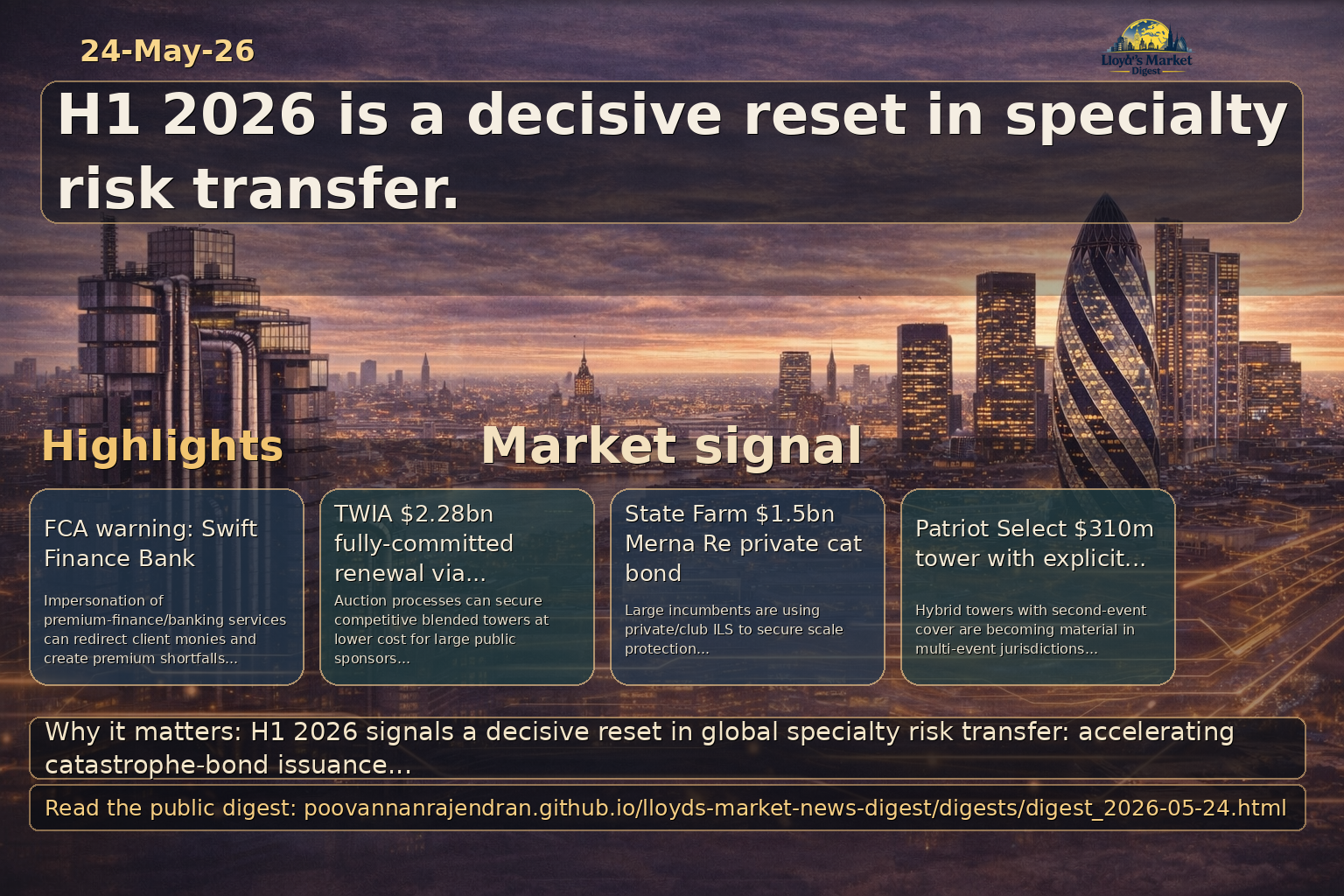
Why it matters: Swift Finance Bank is flagged as unauthorised; impersonation of banking or premium finance services is particularly dangerous for premium collection, trust accounts and settlement flows relied upon by brokers, MGAs and syndicates.
- Payment fraud risk: Fraudulent or unauthorised ‘bank’ entities can redirect premium finance and client monies, creating insolvency exposure for brokers and potential shortfalls for syndicates if premiums are not received into approved accounts.
- Controls and payments hygiene: Require verification of beneficiary bank details through independent channels, use dual‑channel confirmation for payments, restrict changes to bank details without multi‑factor verification and reconciliation against known banking partners.
- Regulatory and counterparty action: Notify treasury and compliance teams to freeze suspicious instructions, update placement platform payment rules to force settlement through validated trust accounts, and report the entity to the FCA and relevant banking partners for investigation.
Source: artemis.bm
Why it matters: TWIA’s fully-committed $2.28bn renewal executed via an auction-like broker process demonstrates how sophisticated broking can secure competitive blended towers and optimise price for large public sponsors amid shifting cat bond maturity profiles.
- Shows efficacy of auction-style broking to procure optimal economics—brokers should highlight competitive execution as a differentiator to public/regulatory clients.
- Illustrates how cat bond redemptions and maturities interact with traditional placement strategy; syndicates need to be proactive on timing and capacity allocation.
- Placement platforms that support multi-round, competitive processes will gain mandate share for large, complex renewals.
Source: artemis.bm
Why it matters: Patriot Select’s tower—combining private market limit, FHCF cover and explicit second-event protection—illustrates hybrid tower design and the growing prevalence of second-event instruments in volatile jurisdictions like Florida.
- Second-event protection is increasingly material for multi-event exposures; brokers should include explicit second-event terms in negotiations.
- Hybrid towers that mix public funds (FHCF) and private/ILS capacity create bespoke capital optimisation opportunities for carriers and can reduce retention needs.
- Placement platforms should support modular tower construction and clear documentation of event sequencing and recoveries.
Source: artemis.bm
Why it matters: Gallagher Securities’ view that ILS/non-traditional capital is a ‘critical extension’ of reinsurance underscores the strategic shift: capital diversification is now core to solvency and growth rather than an optional overlay.
- Syndicates and carriers must integrate ILS into capital planning, scenario testing and product strategy to remain competitive.
- Brokers should package solutions combining traditional reinsurance and ILS to optimise economics and client capital efficiency.
- Placement platforms need to support mixed capital allocations, standardised reporting and scaled investor access to accommodate institutional demand.
Source: artemis.bm
Why it matters: Mangrove’s upsized $111m Buttonwood Re cat bond that priced at tight spreads demonstrates that new market entrants can access attractive ILS funding quickly, intensifying competition for Florida exposure and highlighting investor willingness to back well-structured debut sponsors.
- New entrants accessing ILS rapidly increases supply competition in key geographies—syndicates must compete on service and bespoke cover terms, not only price.
- Brokers should position speed-to-market and certainty of execution as selling points for sponsors evaluating ILS vs traditional towers.
- Placement platforms able to handle debut sponsors and tranche-level pricing guidance will capture mandates from emerging carriers.
Source: artemis.bm
Why it matters: State Farm’s $1.5bn Merna Re Enterprise private cat bond illustrates how large incumbents deploy private/club ILS to secure scale protection while managing investor relationships and distribution, representing a competitive model outside public syndication.
- Large-scale private placements fragment distribution and reduce opportunities for public syndicates—brokers must cultivate direct sponsor relationships and bespoke solutions.
- Private club deals allow sponsors to control investor mix and pricing; placement platforms should offer white-glove, invitation-only workflows to capture similar mandates.
- Syndicates can respond by offering co-invest or bespoke layered solutions that combine underwriting expertise with competitive economics.
Source: businessinsurance.com
Why it matters: A Berkshire Hathaway unit launching Swiss casualty cover signals targeted capacity growth into a regulated European jurisdiction—directly relevant to Lloyd's syndicates and global brokers managing cross-border casualty placements.
- Potential competitive pressure on Lloyd’s syndicates for large Swiss casualty placements; reassess appetite for Swiss risks.
- Implications for brokers: new product available for clients with Swiss exposure, requiring updated placement strategies and comparative terms.
- Regulatory and local-market compliance will affect syndicate deployment models and placement platform connectivity for EU/Swiss binders.
Source: businessinsurance.com
Why it matters: Appointment of a U.K. underwriting chief at Bishop Street is material for distribution and appetite signals in the London market and for brokers placing specialty risks with MGAs and managing agents.
- Leadership change may shift sectoral focus and risk appetite—brokers should re-evaluate submission strategies.
- Opportunity for syndicates and platforms to deepen relationships with Bishop Street for delegated authority placements.
- Indicator of talent flows in the U.K. specialty market; monitor for potential strategic realignment or platform partnerships.
Source: businessinsurance.com
Why it matters: Sava Re’s growth on reinsurance gains reflects capacity dynamics and pricing trends that affect retrocession and primary specialty capacity available to Lloyd’s syndicates and global brokers.
- Stronger reinsurance performance can increase available capacity for higher layers, benefiting syndicates seeking support for large risks.
- Brokers should track reinsurance appetite shifts to advise clients on placement timing and structure.
- Reinsurer profitability metrics influence pricing resets and treaty negotiations; syndicates must align underwriting and capital planning.
Source: businessinsurance.com
Why it matters: Fitch’s observation that European reinsurers’ earnings rose despite revenue declines signals capital resilience and underwriting discipline—key context for Lloyd’s market capacity and specialty pricing strategies.
- Capital resilience supports continued availability of capacity for specialty lines, but selective underwriting will persist.
- May justify incremental tightening of terms and conditions; brokers need to prepare for stronger reinsurer negotiating positions.
- Syndicates should reassess stress scenarios and capital allocation in light of reinsurer profitability and potential rate stabilization.
Source: businessinsurance.com
Why it matters: Workforce crisis coverage implications in healthcare translate into claims frequency and severity exposure for medical malpractice and related casualty portfolios written by Lloyd’s syndicates and specialty carriers.
- Rising workforce strain increases claims volatility and severity—underwriters should revisit exposure modelling and loss means.
- Brokers must flag client risk management gaps and push for preventive contractual terms or risk mitigation endorsements.
- Placement platforms and syndicates should consider tailored products or capacity for high-risk healthcare exposures with enhanced risk engineering.
Source: globalreinsurance.com
Why it matters: M&A insurance's rising role directly affects Lloyd’s syndicates, global specialty brokers and placement platforms by shifting demand toward bespoke transaction covers, faster bind capabilities and partnership models that support private equity and corporate deal timelines.
- Product opportunity for specialty syndicates: scale bespoke reps & warranties, tax and contingent liability programmes with standardized but flexible wordings to mobilise capacity rapidly
- Brokers and placement platforms as deal accelerators: invest in workflow, data integrations and standardised evidence packages to reduce time-to-bind and support auction-driven timetables
- Capital and claims preparedness: syndicates and reinsurers must align capacity, pricing discipline and specialist claims handling protocols to meet private equity expectations for rapid, predictable outcomes
Source: globalreinsurance.com
Why it matters: The nat cat agenda heightens exposure for Lloyd’s and the specialty market — requiring a shift from short-term pricing to resilience, expanded capacity solutions (including ILS/parametrics) and closer cooperation with governments, investors and corporate clients to sustain insurability.
- Expand suite of risk-transfer solutions: develop blended products (parametric triggers, layered ILS placements, resilience-linked terms) to protect capacity and close protection gaps
- Engage in public–private frameworks: syndicates, brokers and Lloyd’s should prioritise structured partnership models with governments and infrastructure investors to share systemic risk and enable coverage continuity
- Embed forward-looking underwriting: adopt climate-forward models, stress scenarios and resilience metrics in placement platforms and broking advice to support credible pricing, risk selection and client advisory on loss mitigation
Source: reinsurancene.ws
Why it matters: Archive item highlights Lloyd's market-structure decisions and market prioritisation (e.g., delaying a Lloyd's index) that influence product innovation, placement mechanics and broker engagement strategies.
- Strategic implication: Delay or re-prioritisation of market-wide initiatives at Lloyd's forces syndicates and brokers to retain flexible go-to-market plans rather than banking on centralised index products.
- Operational action: Placement platforms and managing agents should map alternative distribution workflows and ensure bilateral placement capabilities are robust while market-level products are paused.
- Engagement recommendation: Brokers should proactively engage Lloyd's managing agents and syndicates to surface bespoke solutions and continue investing in direct market access and private placement channels.
Source: reinsurancene.ws
Why it matters: Pro Global's acquisition of GSI Professional Services signals greater professional services and audit capacity entering APAC, supporting MGA and insurer operational resilience and cross-border expansion.
- Market impact: Strengthened audit and advisory capability in Australia improves due diligence and governance support for MGAs, syndicates and global brokers expanding in APAC.
- Capability insight: Brokers and managing agents can leverage local advisory services to accelerate compliance, underwriting file standardisation and post-deal integration for M&A or market entry.
- C-suite action: Syndicates and platform operators should evaluate partnerships with specialist advisory firms to shore up multi-jurisdictional oversight and meet heightened governance expectations.
Source: reinsurancene.ws
Why it matters: Asian Re's strong 2025 results and high solvency illustrate regional reinsurers as credible capacity partners for specialty risks and syndicates targeting Asia-Pacific growth.
- Capacity signal: Robust solvency and profitable underwriting performance make regional reinsurers attractive co-insurers or quota-share partners for Lloyd's syndicates and MGAs expanding in APAC.
- Pricing implication: Competitive regional capacity can temper retrocession costs and influence local treaty negotiations, affecting global reinsurance placement strategies.
- Recommended response: Brokers and managing agents should evaluate strategic reinsurance allocations that include high-rated regional partners to optimise cost of capital and local market access.
Source: reinsurancene.ws
Why it matters: Resilience's Resilience Arc platform connects continuous cyber exposure quantification to insurance decisioning, directly affecting underwriting, aggregation management and placement for multi-entity clients.
- Productisation impact: Continuous, enterprise-level cyber quantification enables underwriters and syndicates to price layered cyber programmes more confidently and structure aggregate attachments.
- Platform integration: Placement platforms and brokers should prioritise integrations with cyber exposure platforms to streamline submission analytics, limit-setting and capacity aggregation across entities.
- Strategic recommendation: Syndicates and MGAs should co-develop cyber wrappers and enterprise-level wordings that map to quantified exposure outputs, reducing basis risk and improving capital allocation.
Source: reinsurancene.ws
Why it matters: Rokstone's $25m cargo stock-only programme demonstrates targeted MGA-led capacity solutions underpinned by proprietary underwriting tech—relevant to brokers, syndicates and platforms servicing inventory-heavy clients.
- Distribution consequence: MGAs with technology-enabled platforms (e.g., ATOMX) can quickly launch niche programmes that capture client demand for stand-alone inventory cover, shifting traditional binder and treaty dynamics.
- Commercial opportunity: Brokers should position specialised stock-only products to retail clients with complex supply chains; syndicates can offer differentiated pricing and wording to win share.
- Operational note: Managing agents and placement platforms must ensure seamless data flows between MGAs, brokers and reinsurers to scale specialty inventory solutions while controlling accumulation risk.
Source: risk.net
Why it matters: The guide's emphasis on enterprise risk, liquidity resilience and connected risk tooling is directly relevant to Lloyd's syndicates and global specialty brokers who must manage market and liquidity shocks while meeting tighter regulatory and capital requirements.
- Enterprise risk: Adopt an ERM framework that consolidates underwriting, market and operational risk across syndicates and managing agents to enable consolidated capital planning and faster escalation in stress scenarios.
- Liquidity and collateral: Implement routine liquidity stress testing and tightened collateral protocols for placements and retrocession to protect syndicate solvency and broker/cedant cash flow under market dislocation.
- Data and placement platforms: Prioritise investment in placement-platform interoperability and real-time data feeds to enable near-instant aggregation of exposures, improved pricing accuracy and audit-ready reporting for regulators and capital providers.
Source: newsnow.co.uk
Why it matters: Heatwaves increase frequency and severity of property, casualty and health claims across portfolios, pressuring retail and wholesale capacity and driving demand for parametric solutions.
- Underwriting: higher attritional and catastrophe loss potential in property and business interruption portfolios requires recalibrated AAL and tightened appetites.
- Reinsurance: increased retrocession pricing and capacity constraints will incentivise greater use of parametric reinsurance and layered strategy design.
- Brokers/Platforms: opportunity to expand parametric products and advisory services; placement platforms must support rapid structuring and live model outputs for buyers and capital providers.
Source: newsnow.co.uk
Why it matters: UK-specific heatwave events create immediate exposure for London market syndicates across urban property, event cancellation and liability lines, with knock-on operational risks for placement and claims handling.
- Urban concentration: elevated loss potential for city-centre portfolios, critical for syndicates with high London exposure and property-heavy accounts.
- Event and sports cover: increased claims for event cancellation and contingency lines raises demand for more granular weather clauses and dynamic pricing.
- Operational resilience: brokers and platforms must ensure contingency in placement workflows and claims triage for heat-related service disruptions.
Source: newsnow.co.uk
Why it matters: Space Tech growth presents a fast-expanding specialty line (satellite, launch, ground segment) requiring tailored capacity, underwriting expertise and new risk-transfer constructs within the Lloyd’s ecosystem.
- Product development: syndicates should accelerate bespoke coverages for launch, on-orbit and supply-chain risks, including cyber-physical exposures.
- Capital attraction: clear, modelled loss metrics will help attract ILS and alternative capital into vintage-specific space pools.
- Brokers/Platforms: placement platforms need enhanced data ingestion (orbital, telemetry, supplier supply-chains) and standardised policy wordings to scale market participation.
Source: newsnow.co.uk
Why it matters: Coal mining incidents and sector volatility highlight operational and environmental liability exposures for energy portfolios, particularly for underwriters with emerging-market and supply-chain concentration.
- Loss severity: mine disasters and operational failures can create high-severity casualty and environmental claims requiring robust aggregate limits management.
- Credit and trade exposure: fluctuating commodity markets increase counterparty credit risk, relevant to specialty credit and political-risk lines.
- Underwriting discipline: syndicates should revisit geographic and operator-level concentration limits and increase on-site risk engineering engagement.
Source: newsnow.co.uk
Why it matters: Shanxi province, as a coal-production hub, is a focal point for industrial concentration risk in China; operational incidents there have potential supply-chain and casualty implications for global underwriters.
- Concentration mapping: Lloyd’s syndicates must map client exposures to Shanxi-centric supply chains and escalate catastrophe-modelling for regional industrial incidents.
- Regulatory & repatriation risk: local regulatory responses to incidents can affect claims settlement timelines and reinsurer recoveries.
- Broker engagement: brokers should collect enhanced loss-prevention documentation and consider local market partners for claims mitigation and recovery.