Source: businessinsurance.com
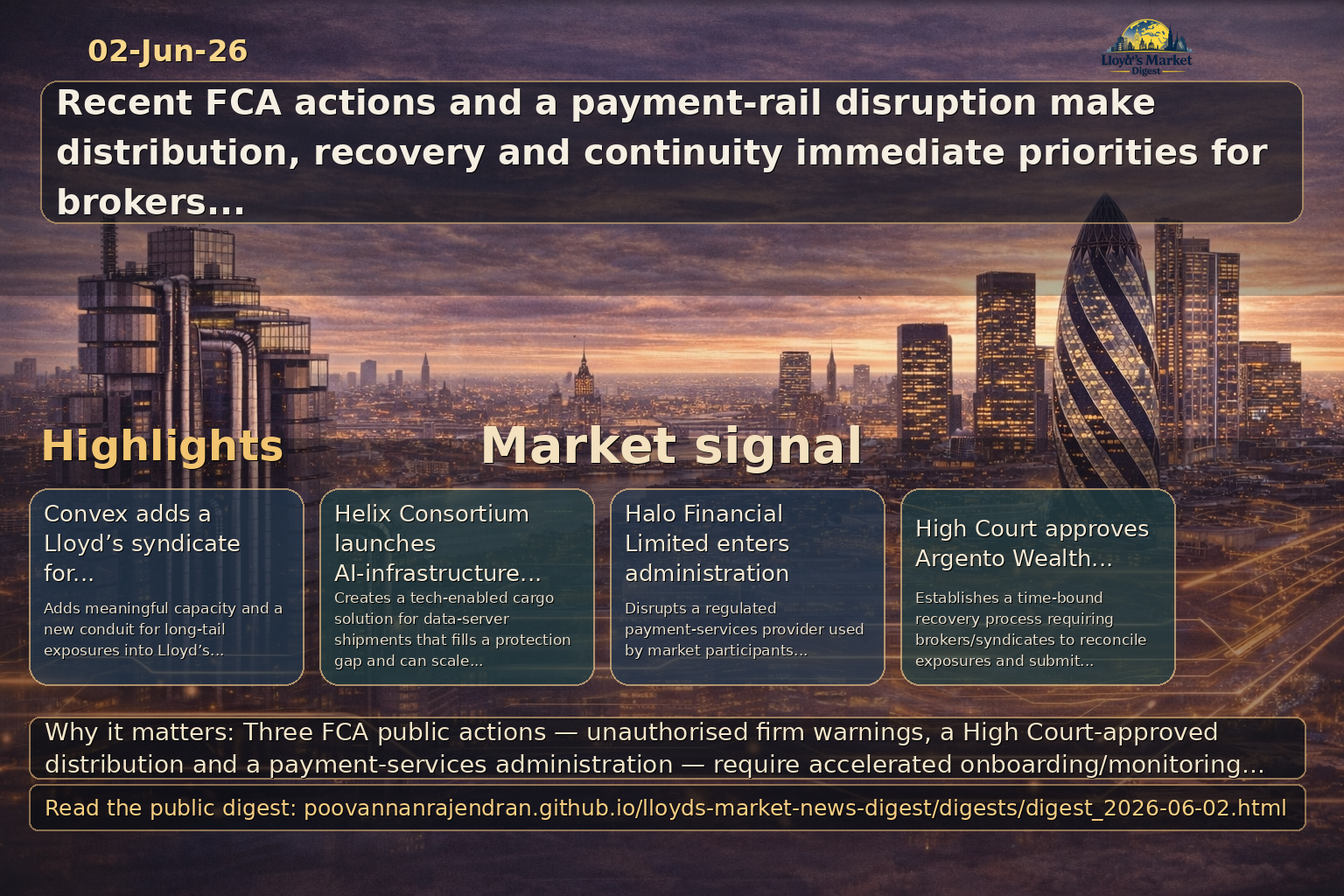
Why it matters: Convex adding a Lloyd’s syndicate for long-tail risks is a direct capacity and structural development in Lloyd’s market, with material consequences for long-tail pricing and placement architecture.
- Adds meaningful capacity and a new conduit for long-tail exposures into Lloyd’s, impacting reinsurance and retrocession demand
- May drive innovation in policy wordings and capital-efficient solutions for latent liability classes
- Brokers and platforms should map Convex’s syndicate appetite to optimise placement routes for long-tail client exposures
Source: globalreinsurance.com
Why it matters: Sam Geddes joining Santam Syndicate 1918 is a material Lloyd’s leadership change with implications for underwriting strategy, capital utilisation and broker-syndicate relationships in London.
- Reinforces Santam’s ambition to scale specialist operations at Lloyd’s and deepen relationships with London brokers
- Geddes’ MS Amlin background suggests potential emphasis on property and portfolio management disciplines within the syndicate
- May prompt recalibration of limits, appetite and third-party distribution to support growth and capital efficiency
Source: globalreinsurance.com
Why it matters: The Helix Consortium — a Lloyd’s-linked cargo solution for AI infrastructure — represents a convergent example of platform-enabled capacity, specialist cover and real-time risk monitoring for technology supply chains.
- Addresses a growing protection gap for data-server shipments, attracting hyperscalers and supply-chain insurers to Lloyd’s capacity
- Combines Overhaul’s real-time risk tech with Pine Walk’s Lloyd’s placement model, exemplifying tech-enabled underwriting and distribution
- Potential to scale quickly through additional syndicate support and bespoke wordings tailored to high-value, time-sensitive cargo
Source: fca.org.uk
Why it matters: FCA warning that Melokoinfx is unauthorised signals potential fraud/scam exposure in distribution channels and placement platforms. For Lloyd’s brokers, syndicates and platforms this raises AML, client‑protection and reputational risks if the entity has been used to solicit investments, receive premium‑related funds or interact with intermediaries.
- Immediate exposure sweep: query broker panels, placement platforms and payment rails for any linkages to Melokoinfx; flag and quarantine related client files and funds.
- Tighten onboarding and monitoring: require documentary FCA authorisation evidence for third‑party promoters; heighten transaction monitoring and source‑of‑fund checks for payments tied to unverified entities.
- Client protection & reporting: notify potentially affected clients and advise on the lack of FSCS/FOS protection; prepare regulatory notification and a remediation playbook to minimise reputational and legal fallout.
Source: fca.org.uk
Why it matters: FCA warning on PrimeWealthExplore reiterates a pattern of unauthorised promoters targeting UK investors and distribution channels. This is material to Lloyd’s market intermediaries and platforms that syndicates rely on for placement and investor access—heightening mis‑selling, conduct and settlement risk.
- Broker and platform review: instruct brokers and platform operators to verify no active engagements with PrimeWealthExplore and to suspend any marketing or client transfers pending investigation.
- Client remediation readiness: run a client contact sweep for referrals or investments routed through the promoter; document remediation steps and preserve evidence for potential claims or regulatory review.
- Governance tightening: update onboarding checklists to mandate FCA registration verification and introduce periodic re‑validation of third‑party promoters and introducers on platforms.
Source: fca.org.uk
Why it matters: High Court approval for distribution of funds recovered from Argento Wealth establishes a time‑bound recovery process. The 1 August 2026 deadline for bank details is critical for investors and any syndicates, brokers or custodians holding client credits or rights to distributions—failure to act could foreclose recoveries.
- Reconcile exposures and submit details: identify client and syndicate positions routed through Argento or EMB; ensure bank details and claim credentials are submitted before 1 August 2026 to capture recoveries.
- Claims and subrogation assessment: involve legal and claims teams to evaluate subrogation, D&O and PI exposures linked to the failure and preserve recovery rights against third parties.
- Client communications & governance: proactively inform affected clients and intermediary partners about deadlines and recovery processes; document steps taken to demonstrate governance and reduce regulatory scrutiny.
Source: fca.org.uk
Why it matters: Halo Financial’s entry into special administration disrupts a regulated payment‑services provider used by market participants. Given Halo’s voluntary undertaking and restricted operations, Lloyd’s brokers, syndicates and placement platforms must address immediate payment continuity, potential client fund recoveries and contractual remedies.
- Map and remediate payment flows: inventory premium collections, escrow accounts and claims payments routed via Halo and enact alternate PSP arrangements or rails to avoid settlement delays.
- Contractual and liquidity response: review service agreements and indemnities with Halo and affected platforms; escalate to treasury and underwriting committees to secure short‑term liquidity and contingency settlement facilities.
- Engage administrators and regulators: coordinate with the special administrators to locate and recover client funds where feasible, update compliance teams on PSRs implications and communicate timelines to brokers and clients.
Source: insurancejournal.com
Why it matters: Senior hires at Beazley and Santam/Syndicate 1918 signal strategic investment in ART, parametrics and Bermuda distribution — influencing where Lloyd’s capacity flows and how brokers source complex specialty solutions.
- Distribution shift: relocation of ART leadership to Bermuda underscores continued flow of specialty talent and capacity to offshore hubs, affecting Lloyd’s broker networks and coverholder strategies.
- Product focus: appointments reflect industry prioritization of ART and parametric solutions — syndicates should mirror with product development and capital allocation.
- Talent pipeline: C-suite should track executive mobility as an indicator of strategic emphasis (e.g., ART, mortgage indemnity, specialty casualty) when planning partnerships.
Source: insurancetimes.co.uk
Why it matters: The departure of Intact UK’s long-standing director of counter fraud and financial crime removes a senior steward of fraud strategy; continuity of fraud controls affects claims outcomes and placed cost of risk for carriers and brokers alike.
- Implication: Leadership turnover can slow or redirect anti-fraud initiatives and technology deployment critical to claims discipline and loss mitigation.
- Action: Insurers and brokers should review counter-fraud governance, technology roadmaps and vendor relationships to maintain momentum and guard detection capability.
- Opportunity/Risk: Transition presents room to modernise fraud approaches but risks temporary dilution of institutional knowledge and programme consistency.
Source: artemis.bm
Why it matters: Jamaica’s $200m World Bank‑facilitated catastrophe bond and planned CCRIF parametric cover expansion underscore sovereign uptake of market solutions—relevant for Lloyd’s syndicates, brokers advising public-sector clients, and placement platforms.
- Sovereign cat bonds broaden market depth and create repeatable transaction pipelines for brokers and syndicates specialising in Caribbean/sovereign risk.
- Parametric expansion requires robust modelling, transparent triggers and advisory capabilities—an opportunity for brokers and Lloyd’s capacity providers to offer tailored solutions.
- Successful sovereign issuance enhances investor confidence in emerging‑market ILS, supporting future private‑public blended structures and resilience financing.
Source: businessinsurance.com
Why it matters: MS&AD appointing a global CRO signals a strategic emphasis on enterprise risk governance across global specialty portfolios — relevant to syndicates, brokers and placement platforms managing cross-border exposures.
- Elevates group-level risk oversight influencing capital allocation and reinsurance purchasing across specialty lines
- Anticipate firmer risk acceptance criteria and stronger scrutiny of facultative/reinsurance placements
- Brokers and platforms should engage the CRO function early to align data, reporting and underwriting metrics for consistent access to capacity
Source: businessinsurance.com
Why it matters: Aspen’s quarterly loss highlights ongoing underwriting and reserving pressure in specialty markets — a cautionary signal for syndicates and placement strategies at Lloyd’s and globally.
- Reinforces need for tighter underwriting discipline on loss-impacted classes and long-tail exposures
- May prompt capacity reallocation and reinsurance programme redesigns among global carriers
- Brokers should reassess pricing defensibility and prepare for more frequent coverage and limit negotiation
Source: businessinsurance.com
Why it matters: Launch of a German specialist broker backed by private equity reflects continued consolidation and platform investment in specialist distribution — material for Lloyd’s market access and European placement channels.
- PE-backed brokers accelerate scale, technology investment and cross-border placement capabilities relevant to Lloyd’s syndicates
- Potential for increased MGA-style appetite and delegated authority agreements with syndicates and carriers
- Placement platforms should monitor partner broker economics and integration risk when routing business to new PE-backed entrants
Source: businessinsurance.com
Why it matters: Report that the P&C market stabilised after prior rate hikes signals a transition to normalized pricing — important for syndicates and broker strategy on capacity deployment and product terms.
- Normalization reduces short-term margin tailwind; emphasis returns to underwriting profitability and expense control
- Syndicates may redeploy capacity selectively, prioritising classes with credible return-on-capital
- Brokers and placement platforms must demonstrate value through risk selection, data analytics and targeted distribution to secure favourable terms
Source: globalreinsurance.com
Why it matters: Gallagher Re's appointment of an experienced cyber lead in Hong Kong underscores brokers' race to scale cyber capabilities in APAC — influencing placement flow between regional clients and Lloyd’s/global carriers.
- Strengthens APAC broking capability and regional placement agility for cyber risks, increasing demand on Lloyd’s cyber capacity
- Brings underwriting and broking experience that can improve terms and portfolio structuring for complex multinational cyber programmes
- Signals brokers’ focus on integrating local market knowledge with global cyber teams to productise cover and accelerate cross-border placements
Source: globalreinsurance.com
Why it matters: QBE’s appointment of a regional corporate underwriter who also leads people risk reflects insurers’ strategic integration of workforce-related exposures into underwriting — relevant to multinational placements and D&O/casualty appetite.
- Local underwriting authority for corporate lines accelerates placement decisions and reduces friction for brokers on regional programmes
- Combined people-risk remit indicates product development for emerging workforce liability exposures (employment practices, social engineering, privacy)
- Alignment with regional CUO and product teams will shape how global capacity, including Lloyd’s, is deployed for multinational clients
Source: globalreinsurance.com
Why it matters: Willis’ D&O survey elevating geopolitical and AI risks is a market signal that underwriters and brokers must re-price, redesign and document D&O coverages to reflect board-level exposure shifts.
- Underwriters will increasingly factor geopolitical and AI oversight risk into pricing, exclusions and risk mitigation requirements
- Brokers and syndicates must develop targeted submission and disclosure frameworks to manage accumulation and avoid coverage disputes
- Opens demand for specialised D&O endorsements and advisory services around AI governance and international sanctions/compliance
Source: insurancejournal.com
Why it matters: June international reinsurance round-up functions as a market barometer: it aggregates geopolitical incidents, climate impacts and emergent specialty products that materially affect Lloyd’s syndicates, brokers and platform strategies.
- Cross-cutting intelligence: consolidated view highlights simultaneous drivers (Middle East escalation, wildfires, food-price inflation) that underwrite portfolio correlation risk for specialty syndicates.
- Distribution signal: people moves and new platform/MGA consortia indicate capacity migration toward Bermuda and digital placement channels — relevant for Lloyd’s brokers and coverholders.
- Product imperative: summary underscores demand for parametric, ART and bespoke cargo solutions; syndicates should prioritize nimble wordings and data partnerships.
Source: insurancejournal.com
Why it matters: Recent vessel attacks in the Strait of Hormuz materially increase war, terrorism and kidnap & ransom exposures for hull, cargo and war-risk layers — driving higher premiums, tightened war clauses and reallocation of capacity.
- Underwriting impact: expect higher war-risk and war-contingent premiums for transits, stricter exclusions and increased use of contingency endorsements by Lloyd’s syndicates.
- Broker action: brokers must secure explicit transit guarantees and negotiate broadened cover or alternative clauses (e.g., rerouting, delay/contingent BI) to protect clients and maintain placements.
- Operational response: placement platforms and MGAs should integrate real‑time AIS/intelligence feeds into quoting workflows to price transit exposures granularly and support rapid binding.
Source: insurancejournal.com
Why it matters: Guy Carpenter’s analysis of Florida renewals signals renewed reinsurer appetite driven by legal reform and resilience measures — a template for disciplined capacity restoration that Lloyd’s syndicates and brokers must incorporate in treaty negotiations.
- Capacity dynamics: rising policyholder surplus and improved combined ratios indicate opportunity for syndicates to deploy capital into U.S. property if terms remain disciplined.
- Pricing and terms: brokers should leverage improved market conditions to secure favorable facultative and treaty structures, while aligning terms with updated catastrophe models and resilience credits.
- Strategic implication: Lloyd’s and specialty reinsurers must monitor state-level reforms and mitigation investments as underwriters reward resilience with capacity and rate moderation.
Source: insurancejournal.com
Why it matters: Escalation of hostilities in Lebanon/Israel raises regional political violence, property and supply-chain interruption exposure; syndicates with Middle East portfolios must reassess aggregation and trigger profiles.
- Aggregation risk: syndicates should re-run regional accumulation models for property, cargo and BI, and consider aggregate collars or aggregate stop‑loss protections with reinsurers.
- Coverage nuance: political violence and war extensions can activate complex exclusions; underwriters must clarify triggers and liaise with brokers on contested claims scenarios.
- Placement strategy: brokers should diversify capacity across markets and secure specialty political violence underwriters for high‑risk Middle East exposures.
Source: insurancetimes.co.uk
Why it matters: The acquisition of Rosling King’s legal team by HF concentrates specialist legal expertise that brokers, syndicates and corporate clients will rely on for complex dispute, insolvency and real estate matters — areas that materially affect underwriting exposures, claims outcomes and placement strategies.
- Implication: Strengthened dispute and insolvency advisory increases capacity for insurers and brokers to manage complex claims and recoveries, reducing loss volatility.
- Action: Syndicates and brokers should evaluate panel counsel relationships and consider pre-emptive legal resourcing agreements to protect contentious lines.
- Opportunity/Risk: Enhanced legal capability supports handling of long-tail casualty claims but may raise expectations for faster, higher-cost legal engagement across portfolios.
Source: insurancetimes.co.uk
Why it matters: Senior appointments and executive moves at major brokers (notably Aon’s naming of a new global commercial risk CEO) signal strategic refocusing toward global commercial and specialty risk — a driver of capacity flow into Lloyd's and specialist placement channels.
- Implication: Leadership changes at global brokers can reallocate distribution emphasis and placement patterns, influencing syndicate access and treaty flows.
- Action: Syndicates and specialty carriers should engage proactively with new broker executives to align product and appetite with anticipated distribution priorities.
- Opportunity/Risk: Consolidated broker leadership can accelerate large-ticket placements but may concentrate negotiation leverage among fewer broker relationships.
Source: insurancetimes.co.uk
Why it matters: DB Insurance’s acquisition of Fortegra, which includes a UK speciality underwriting subsidiary, expands global specialty capacity and provides a multi-jurisdictional platform that could augment Lloyd's and London market placement options and competition for specialty lines.
- Implication: New market entrants backed by balance-sheet strength increase competitive capacity for surety, warranty and specialty P&C lines.
- Action: London syndicates and brokers should map overlap and white-space with DB/Fortegra to identify partnership or displacement risk in target segments.
- Opportunity/Risk: The deal accelerates global distribution for the acquirer but may intensify pricing pressure in niche specialties where capacity pools remain constrained.
Source: insurancetimes.co.uk
Why it matters: Broker consolidation and regional M&A (e.g., Adler Fairways acquiring W B Baxter) and high-profile broker product initiatives highlight continued sector consolidation and targeted regional growth — key distribution trends affecting placement volumes and broker-syndicate relationships.
- Implication: Regional consolidation strengthens broker negotiating power in local markets and reshapes broker-led placement corridors into London and Lloyd's.
- Action: Syndicates should refine regional distribution strategies and ensure delegated authority and appetite are calibrated to broker consolidation patterns.
- Opportunity/Risk: Consolidation offers scale efficiencies and cross-sell opportunities, but may reduce diversity of distribution and heighten counterparty concentration risk.
Source: reinsurancene.ws
Why it matters: Historical items underscore early parametric adoption and Lloyd's strategic pauses — useful context for executives evaluating product innovation timing, marketplace index products and the regulatory/political factors that delay market-wide initiatives.
- Validate timing for launching parametric or index products against historical market response and regulatory sensitivity
- Use archive signals to stress-test platform go-to-market assumptions and broker education plans
- Incorporate lessons on market communication and coalition-building when pursuing Lloyd's-wide initiatives or index launches
Source: reinsurancene.ws
Why it matters: HCI’s 16% increase in aggregate XoL capacity for 2026-27 signals continued demand for layered catastrophe protection and bespoke tower design — relevant to brokers structuring placements and syndicates allocating capacity.
- Brokers should highlight multi-tower designs and attachment strategies to optimise client cost and limit erosion risk
- Placement platforms must ensure market access to both traditional and alternative capital for layered XoL programmes
- Syndicates and investors should monitor pricing adequacy and retro renewal terms to avoid margin compression
Source: reinsurancene.ws
Why it matters: Acrisure Re’s caution on complacency despite a slightly below-average hurricane forecast reinforces underwriting discipline and preparedness imperatives for carriers and brokers managing seasonal exposures.
- Maintain conservative exposure management and scenario testing even with benign seasonal forecasts
- Communicate clear preparedness and claims-readiness plans to broker partners and major cedants
- Use forecast variance as a driver for disciplined pricing and reinsurance purchase timing
Source: reinsurancene.ws
Why it matters: Moody's upgrade of Generali elevates how ratings influence counterparty selection and capacity allocation for underwriting and reinsurance placements, with knock-on effects for syndicates and platforms focusing on credit-sensitive deals.
- Leverage higher-rated counterparties in structured placements to reduce collateral and capital friction
- Reassess retrocession and facultative counterparty appetite in light of rating-driven capacity shifts
- Use rating momentum as a negotiation lever in multi-year capacity agreements
Source: reinsurancene.ws
Why it matters: Vitruvian's planned investment in Africa Specialty Risks, and reference to Syndicate 2454, emphasises investor interest in emerging-market specialty capacity — a strategic opportunity for Lloyd's syndicates and brokers seeking growth in underinsured regions.
- Develop localised product suites and reinsurance support for growth-economy exposures (agriculture, credit, infrastructure)
- Syndicates should explore partnership or quota-share approaches to access local distribution and data
- Placement platforms must support regulatory and FX complexity to facilitate cross-border capital flows
Source: artemis.bm
Why it matters: Guy Carpenter reporting 15–20% risk‑adjusted pricing reductions at Florida June renewals directly affects Lloyd’s syndicates writing US property catastrophe business, broker strategy, and placement dynamics across primary and reinsurance layers.
- Material rate reductions reduce near‑term top‑line for syndicates but improve prospective loss ratios—underwriting discipline and portfolio re‑optimisation required.
- Increased capacity and improved terms create opportunities for syndicates to deploy capital selectively; managing agents should reassess layer tolerances and retro strategies.
- Brokers and placement platforms must capitalise on volume flows, adjust pricing guidance, and offer alternative structures (retro, cat bonds) to lock in efficient capacity.
Source: artemis.bm
Why it matters: Below‑average 2026 Atlantic hurricane forecasts from TSR and the UK Met Office reduce modeled expected losses, influencing pricing, capital allocation and ILS issuance timelines across Lloyd’s, global specialty insurers and brokers.
- Lower seasonal forecasts exert downwards pressure on spot rates and renewals; underwriters should avoid complacency given model and El Niño uncertainty.
- El Niño introduces variability in storm intensification—placement and reinsurance buyers must retain prudent tail protection and stress scenarios in capital planning.
- Timing of ILS and cat bond issuance can be optimised when headline risk reduces, but market participants should balance spread compression against opportunistic capacity locking.
Source: artemis.bm
Why it matters: Plenum’s CAT Bond Dynamic Fund reaching ~$600m AUM signals sustained institutional appetite for catastrophe risk exposure, expanding alternative capacity available to Lloyd’s syndicates and reinsurers seeking retrocession and capital relief.
- Incremental ILS capacity compresses yields and creates pricing competition—syndicates should evaluate cost‑of‑capital arbitrage between traditional reinsurance and ILS structures.
- Growing dedicated funds facilitate more standardized, liquid issuance; managing agents can leverage this to securitise peak layer risk more predictably.
- Brokers and placement platforms need to deepen investor relationships and product innovation (e.g., layered or trigger-optimised structures) to capture demand efficiently.
Source: artemis.bm
Why it matters: Guy Carpenter data showing $3.2bn Florida‑focused cat bonds YTD 2026 and lower pricing highlights continued reliance on capital markets to transfer US property catastrophe risk—implications for syndicates, brokers and placement strategies.
- High issuance confirms capital markets as primary marginal capacity; managing agents can use cat bonds to reduce peak exposure and liberate regulatory capital.
- Pricing compression lowers protection costs for cedants but tightens margins for ILS investors—structuring teams must focus on trigger efficiency and investor alignment.
- Brokers and placement platforms should prioritise speed, documentation standardisation and investor outreach to capitalise on sustained issuance demand.
Source: insurtechnews.com
Why it matters: A July 2026 events calendar highlights concentrated weeks where broker conferences, market meetings and renewal-related activity may compress placement timelines and increase demand on syndicates and digital placement platforms.
- Map calendar dates to Lloyd's renewal and subscription cycles to adjust underwriting timetables, capital allocation and reinsurance placement windows.
- Coordinate broker engagement and syndicate availability ahead of clustered event weeks to optimize lead placement, manage capacity commitments and avoid last-minute terms erosion.
- Pre-position placement-platform resources: validate API integrations, run load and failover tests, and schedule augmented operational support for identified peak dates to ensure seamless transactions and market access.
Source: newsnow.co.uk
Why it matters: El Niño-driven climate anomalies materially increase frequency and severity of weather-related losses across multiple geographies; this directly affects syndicate exposure, reinsurance costs and placement capacity for weather-sensitive lines.
- Reassess geographic exposure: update accumulation controls and cat models in regions prone to El Niño-related storms, floods and droughts.
- Price and capacity strategy: review retrocession and facultative purchases early to hedge elevated tail risk and potential premium hardening.
- Product adaptation: accelerate parametric and hybrid product offerings tied to oceanic/atmospheric indicators to improve speed of pay and reduce claim uncertainty.
Source: newsnow.co.uk
Why it matters: WMO outputs and international meteorological coordination provide authoritative early-warning and seasonal forecasting data that should be embedded into underwriting cycles, model assumptions and catastrophe scenario planning across the Lloyd's market.
- Embed WMO forecasts into underwriting: operationalise seasonal outlooks into risk selection, premium adjustments and renewal discussions.
- Stress testing & capital planning: use WMO scenario sets to validate catastrophe models and inform solvency stress tests at syndicate and managing agent level.
- Market-level collaboration: broker and syndicate alignment on WMO-based parametric triggers to standardise placement language and reduce basis risk.
Source: newsnow.co.uk
Why it matters: IT and platform resilience underpin modern placement ecosystems; outages, third-party failures or insecure integrations amplify operational, cyber and conduct risks for brokers, MGAs and syndicates engaged in digital distribution.
- Infrastructure resilience: enforce higher service-level and cyber-security standards for placement platforms and critical vendors, with clear escalation and continuity plans.
- Data integrity & connectivity: prioritise secure, standardised APIs and encryption to preserve real-time exposure feeds used in risk aggregation and pricing.
- Vendor and third-party risk management: extend due diligence and contractual protections (SLAs, audit rights, cyber clauses) for cloud providers and insurtech partners.
Source: newsnow.co.uk
Why it matters: AI adoption accelerates underwriting efficiency and claims triage but introduces model risk, explainability and compliance challenges that can affect pricing accuracy, regulatory standing and reputational risk across Lloyd's market participants.
- Model governance: implement formal AI validation, monitoring and documentation frameworks to ensure explainability, bias controls and auditability for underwriting and claims models.
- Operational deployment controls: phase AI rollout with human-in-loop oversight for complex lines and establish incident response for erroneous model outputs.
- Regulatory and client transparency: standardise disclosure to brokers and cedants on AI usage in pricing/claims decisions and align with upcoming regulatory expectations.