Source: businessinsurance.com
Why it matters: Santam’s appointment of a new CEO for its Lloyd’s syndicate alters on‑the‑ground leadership at a market entrant; this will affect syndicate underwriting posture, broker relationships and distribution strategy at Lloyd’s.
- Likely near‑term review of underwriting appetite and delegated authority frameworks to align with new leadership priorities
- Brokers should expect re‑engagement on placement terms, capacity allocation and claims handling expectations
- Implications for Santam’s Lloyd’s distribution strategy — potential shifts in product focus (e.g., specialty lines) and partnerships with global brokers
Source: businessinsurance.com
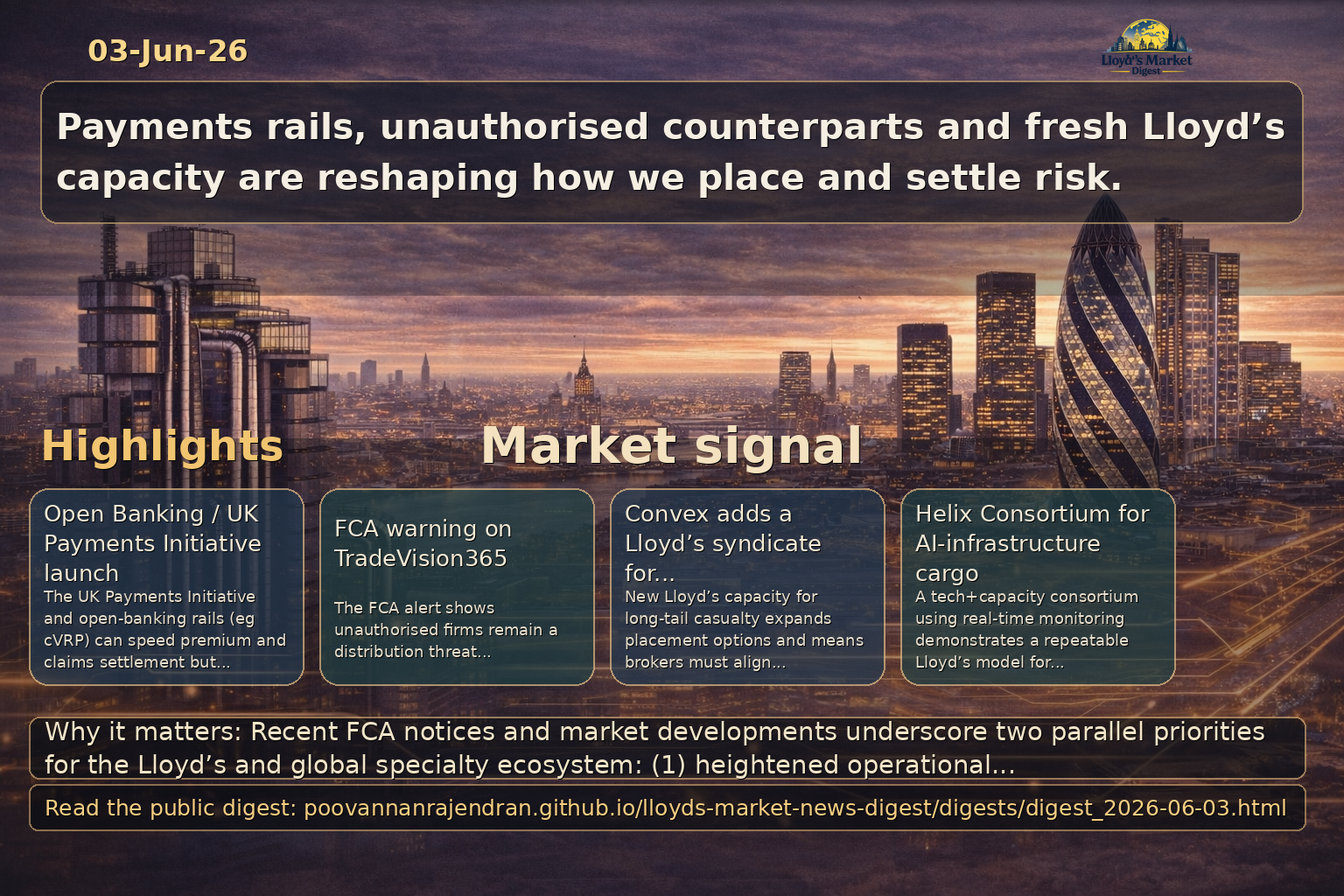
Why it matters: Convex adding a Lloyd's syndicate for long-tail risks is directly material: it expands Lloyd's capacity for casualty and latent exposure lines and alters placement options for brokers and platforms.
- New Lloyd's syndicate capacity for long-tail exposures addresses market demand for admitted-like paper with specialist underwriting expertise.
- Brokers gain an additional partner for complex casualty placements, but must align submission data and placements to the syndicate's underwriting protocol.
- Placement platforms should prioritize connectivity and workflow support for the new syndicate to capture early market share and streamline-bind capabilities.
Source: globalreinsurance.com
Why it matters: Sam Geddes’ appointment as CEO of Santam Syndicate 1918 brings deep Lloyd’s experience to a growing entrant, with implications for underwriting discipline, portfolio management and broker relationships at Lloyd’s.
- Signals Santam’s intent to scale its Lloyd’s proposition with experienced market leadership, likely increasing competition for niche lines and capacity within Lloyd’s.
- Expect renewed emphasis on portfolio and exposure management, which will influence treaty buying, retro strategies and capital deployment for the syndicate.
- Brokers should recalibrate placement conversations to reflect the syndicate’s enhanced underwriting remit and potential appetite shifts across product lines.
Source: globalreinsurance.com
Why it matters: The Helix Consortium at Lloyd's combines Lloyd's cargo capacity with real-time monitoring to insure AI infrastructure shipments, exemplifying how platform-enabled consortia can close niche protection gaps.
- Illustrates a repeatable Lloyd's model: syndicate capacity plus technology partner to underwrite high-value, high-risk verticals with tailored terms.
- Real-time risk monitoring supports dynamic underwriting, potentially reducing loss ratios and enabling more granular pricing for specialised cargo.
- Placement platforms and brokers should pursue similar tech-capacity partnerships to offer differentiated cover for emerging supply-chain and technology assets.
Source: fca.org.uk
Why it matters: Warning on TradeVision365 illustrates the persistent risk of unauthorised entities posing as financial services providers — a direct threat to intermediated distribution chains and premium flows.
- Strengthen KYC and counterparty validation on new brokers, introducers and platforms to detect unauthorised operators before placement.
- Prohibit or require enhanced approvals for marketing partnerships where named counterparties or tech platforms are not FCA‑authorised.
- Review placement platform onboarding to ensure automated checks flag vendors or counterparties appearing on FCA Warning List.
Source: fca.org.uk
Why it matters: The Financial Advisor Dorset warning reinforces the prevalence of unregulated actors targeting UK consumers — a distribution risk for Lloyd’s coverholders, MGA’s and brokers who may inadvertently refer or transact with such firms.
- Reassess referral and lead generation arrangements to ensure third parties are authorised for the services they promote.
- Include contractual warranties and audit rights in broker and lead arrangements to validate regulatory status of introducers.
- Communicate to underwriting teams and claims handlers the need to verify counterparty authorisation before accepting funds or providing client introductions.
Source: fca.org.uk
Why it matters: Greenlee Financial warning signals ongoing threats from firms operating without authorisation — an issue that can expose syndicates and brokers to client loss and operational disruption when such firms enter or exit the market abruptly.
- Implement pre‑placement screenings against FCA Warning List as part of mandatory MIS for all new counterparties and platforms.
- Institute contingency plans for recoveries and client notification where business has been routed via an unauthorised intermediary.
- Coordinate with global broking partners to ensure consistent approach to unauthorised‑firm detection across jurisdictions.
Source: fca.org.uk
Why it matters: The UK Payments Initiative and FCA support for open banking standards represent an inflection point for premium collection, premium finance and ceding/claims payment flows across brokers, syndicates and platforms.
- Evaluate adoption of cVRP and other open banking rails to reduce reliance on card rails and improve reconciliation for premium and claims payments.
- Engage with industry standards bodies and placement platforms to shape governance, operational standards and dispute resolution for open‑banking payments.
- Assess IT, reconciliation and treasury processes to capitalise on faster settlement while safeguarding client money segregation and indemnity arrangements.
Source: fca.org.uk
Why it matters: FCA warning to football clubs about sponsorship from unauthorised firms is a template for reputational risk management: insurers, brokers and syndicates must scrutinise sponsorship and marketing channels to avoid implicit endorsement of unregulated financial services providers.
- Mandate reputational due diligence for sponsorships and high‑visibility partnerships, with FCA status checks and legal sign‑offs.
- Monitor marketing tie‑ups of distribution partners to ensure they do not expose policyholders or brand to crypto/trading scams.
- Incorporate sponsor‑related risk clauses into reinsurance contracts and placement agreements to limit contingent exposure.
Source: businessinsurance.com
Why it matters: EPIC naming James Pierce as natural resources practice chairman reinforces broker focus on energy and resource sectors — an area of significant exposure and opportunity for Lloyd’s syndicates and specialty markets.
- Strengthened natural resources practice will drive demand for tailored energy, marine and environmental liability placements
- Brokers will bundle technical advisory and placement services, increasing need for syndicates to offer flexible limits and bespoke wordings
- Opportunity for placement platforms to support complex programme structuring and data exchange between brokers, cedants and syndicates
Source: artemis.bm
Why it matters: Howden Re's report of accelerated softening and broader coverage terms at renewals highlights a softer pricing environment and expanded underwriting appetites that affect placement strategies and capital allocation across towers and syndicates.
- Significant rate-on-line reductions (up to ~25% reported) create immediate pricing opportunities for cedants but widen the risk-reward gap given elevated underlying hazard exposures.
- Greater appetite for lower layers and broader terms can facilitate laddered placements and investor access to higher frequency, lower severity exposures — useful for ILS and sidecar structuring.
- Brokers should leverage soft-market conditions to renegotiate tower design, secure improved terms, and present structured placements that balance investor-return profiles with cedant capital needs.
Source: artemis.bm
Why it matters: HCMA's hire of an experienced ILS specialist from Verisk strengthens broker-led advisory and modelling capabilities, raising the bar for execution speed and technical depth in structuring capital market transactions and placements.
- Enhanced analytical capability within a broker ILS team accelerates due diligence, improves investor presentations and can shorten time-to-market for cat bond and sidecar deals.
- Competitive pressure increases on other broker teams; syndicates should prefer partners with proven modelling and structuring bench strength to improve execution certainty.
- Placement platforms will need to match upgraded advisory services with operational readiness (data rooms, SPV templates, investor pipelines) to convert demand into completed transactions.
Source: artemis.bm
Why it matters: The SEADRIF–FAO parametric drought pilot in Lao PDR is a concrete example of sovereign demand for anticipatory parametric solutions, presenting a replicable model for insurers, brokers and syndicates to expand into emerging markets.
- Parametric sovereign programmes demonstrate how pre-agreed triggers and rapid payouts can mobilise finance ahead of impact — attractive to multilaterals, donors and sovereign treasuries.
- Lloyd's syndicates and global specialty underwriters can leverage parametric design expertise to capture new sovereign and agricultural risk-transfer mandates.
- Brokers and placement platforms should develop parametric product libraries, standardised triggers and monitoring solutions to scale offerings across similar markets.
Source: artemis.bm
Why it matters: Achmea returning to the cat bond market with a targeted Windmill III Re 2026-1 issuance demonstrates sustained sponsor appetite for capital markets protection, supporting liquidity and investor opportunities in European windstorm risk.
- Repeat sponsor issuances reinforce investor confidence in issuer credit, collateralisation structures and replicable SPV mechanics, supporting market depth.
- Staggering maturities and layering protection indicates sophisticated risk management by insurers and opportunities for tranche-specific investor targeting.
- Brokers and placement platforms should prioritise outreach to investors with appetite for European windstorm and position tranche sizes to align with institutional allocation sizes.
Source: businessinsurance.com
Why it matters: Escalation of conflict involving Iran is driving claims‑cost inflation across marine, energy, aviation and political violence covers — a material underwriting and reinsurance concern for Lloyd’s syndicates and specialty carriers.
- Expect increased war/terror premiums, more restrictive wording and elevated retentions across affected lines
- Potential for claims volatility to trigger reinsurance reinstatements and strain treaty attachment points
- Brokers and placement platforms must revalidate sanctions exposure, war exclusions and loss mitigation clauses for multinational programmes
Source: businessinsurance.com
Why it matters: African Re’s profit decline despite premium growth signals deteriorating loss ratios and capital pressure in regional reinsurance capacity — relevant to Lloyd’s participants writing African business or relying on regional retrocession.
- Reduced regional capacity could push more African risk into Lloyd’s and global specialty markets, creating placement opportunities and price hardening
- Brokers should recheck treaty attachments and collateral requirements as cedants seek predictable capacity
- Syndicates must assess counterparty credit and facultative demand; consider selective appetite adjustments or leveraging alternative capital
Source: globalreinsurance.com
Why it matters: Beazley’s Bermuda office and the Wunderlich ART appointment signal a deliberate strategic build-out in Bermuda to house complex specialty lines and alternative risk transfer capability, reinforcing competition with Lloyd’s for specialty placements.
- Strengthens Bermuda as a strategic hub for ART, parametric and specialty treaty placements, potentially shifting some capacity away from London-led placements.
- Local senior underwriting presence accelerates decision-making and market responsiveness for complex solutions, enhancing opportunities for direct (Bermuda) placements and partnerships with brokers.
- Syndicates and Lloyd's placement platforms should monitor product overlap and respond with differentiated propositions or closer collaboration with Bermuda-based carriers.
Source: globalreinsurance.com
Why it matters: Gallagher Re appoints a senior cyber leader in Hong Kong to scale APAC cyber broking capability, reflecting intensified competition among intermediaries to capture fast-growing cyber demand in the region.
- Improves Gallagher Re’s ability to structure and place complex APAC cyber programmes, increasing pressure on syndicates to provide tailored capacity and wording for regional cyber risks.
- Reinforces the value of hiring cross-functional talent (underwriting and broking experience) to translate product complexity into placeable solutions for insurers and corporate clients.
- Brokers and syndicates should prioritise product development, regional underwriting authority and local insight to win APAC cyber mandates.
Source: globalreinsurance.com
Why it matters: QBE’s appointment of Andy Tsui as Hong Kong and Macau underwriting head and Asia head of people risk formalises a region-wide underwriting and product strategy for workforce-related liabilities.
- Consolidated underwriting authority accelerates placement throughput and consistency for corporate accounts, making QBE a faster counterparty for brokers in the region.
- Elevates 'people risk' as an underwritten product in Asia, creating opportunities for syndicates and MGAs to partner on specialised cover and advisory services.
- Brokers and placement platforms should surface integrated people-risk propositions and data-driven servicing to capture emerging demand from multinational clients.
Source: insurancejournal.com
Why it matters: Illinois legislation expanding insurance department oversight of rate filings signals a broader political and regulatory risk that can constrain pricing flexibility and affect capacity decisions for London market participants writing U.S. homeowners and auto exposures.
- Increased likelihood of state-level pushback on rate increases will force syndicates and reinsurers to justify rate actions with enhanced analytics and defensible models.
- Brokers and placement platforms will face longer negotiation cycles and greater documentation requirements when submitting filings tied to U.S. retail accounts.
- Sustained regulatory pressure could prompt capacity withdrawal or higher terms for U.S. exposures, creating allocation and repricing challenges for Lloyd’s syndicates.
Source: insurancejournal.com
Why it matters: Peer-reviewed research forecasting larger, more damaging hailstorms increases modeled loss volatility for property portfolios, elevating nat-cat aggregation risk that directly affects syndicate capital planning and reinsurance strategy.
- Underwriters will need to recalibrate exposures and attachment points for hail-prone geographies, impacting premium adequacy and capacity deployment.
- Brokers must enhance risk modelling and granular placement language to differentiate site-level mitigation and limit adverse selection.
- Placement platforms and data partners that supply high-resolution hazard analytics will become strategic intermediaries for syndicates managing concentrated hail risk.
Source: insurancejournal.com
Why it matters: Senior leadership moves at Markel International and Gallagher Re reflect continued investment in specialist underwriting capability and program distribution in London, shaping broker access to expertise and competitive dynamics among syndicates and MGAs.
- Appointments that centralize marine, energy and construction expertise improve underwriter scalability and simplify broker routing for complex placements.
- Gallagher Re’s leadership choices signal reinforcement of program and reinsurance solutions, increasing competition for brokered flow business in specialty lines.
- Talent concentration can accelerate product development cycles but also creates relationship risks if key individuals transition between carriers or to brokers.
Source: insurancejournal.com
Why it matters: WTW’s acquisition of Redefind accelerates broker-led platform entry into crypto and digital-asset insurance, presenting both an avenue for new specialty capacity and a challenge for Lloyd’s underwriters to standardize underwriting for tokenized risks.
- Platform-enabled, non-custodial product offerings lower distribution friction and expand addressable demand for digital-asset coverages across institutional clients.
- Syndicates and reinsurers will be asked to underwrite novel exposures (forensics, asset recovery, legal cost) requiring rapid product and wordings development.
- Regulatory uncertainty and valuation volatility in digital assets raise aggregation and claims-modeling challenges that must be managed via disciplined capacity limits and provider selection.
Source: insurancejournal.com
Why it matters: A widening natural-catastrophe protection gap highlights a large market opportunity for specialty insurers and syndicates but also underscores rising accumulation risk and the need for innovative public-private solutions and parametric structures.
- The growing absolute protection gap increases demand for scalable insurance solutions and alternative capital, presenting distribution and capacity opportunities for Lloyd’s market participants.
- Syndicates must balance growth with prudent aggregation controls and reinsurance structures to avoid overconcentration in high-exposure regions.
- Brokers and placement platforms should prioritize client education, tailored coverage options and catastrophe risk transfer mechanisms to close protection shortfalls.
Source: reinsurancene.ws
Why it matters: Archive item provides historical context on market discipline and structural shifts in reinsurance — useful for senior teams calibrating strategic memory against current consolidation and capacity themes.
- Use historical commentary to validate cyclical perspectives when setting syndicate appetite and rate expectations
- Review archived analyses to inform long-term capital allocation and reinsurance purchasing strategies
- Leverage institutional memory in stakeholder communications to explain strategic pivots to brokers and capital providers
Source: reinsurancene.ws
Why it matters: WTW’s acquisition of Redefind signals major broker-led entry into digital-asset insurance distribution — a direct catalyst for new specialty capacity demand and placement platform integration.
- Brokers and syndicates should assess product specs and underwriting standards for digital assets to determine appetite and capacity allocation
- Placement platforms must enable crypto-specific workflows (KYB/KYC, custody proofs, tokenisation data) to support streamlined bindings
- Opportunity for syndicates to partner with brokers on bespoke capacity or co-insurance for tokenised exposures; monitor regulatory and custody risk frameworks
Source: reinsurancene.ws
Why it matters: FutureProof’s AI-driven E&S program highlights how AI underwriting combined with wholesale distribution can scale hard-to-place personal lines in catastrophe zones — relevant to syndicates seeking data-driven appetite expansion.
- Syndicates should evaluate AI models for catastrophe-exposed personal lines to improve pricing accuracy and reduce selection risk
- Wholesale brokers and MGAs present scalable distribution channels; ensure delegated authority controls and data governance are robust
- Placement platforms must support rapid quote-bind workflows and data exchange between AI underwriters, brokers, and carriers for speed-to-market
Source: reinsurancene.ws
Why it matters: Integration of live visual monitoring into flood forecasting enhances real-time risk assessment and claims validation — a capability that materially changes underwriting, loss mitigation and post-event response for property-specialty syndicates.
- Underwriters can incorporate live visual confirmation to refine exposure and vulnerability assessments in flood-prone territories
- Claims teams and platforms can accelerate FNOL verification and reduce adjustment timelines, improving client retention and loss ratios
- Placement platforms and brokers should incorporate real-time sensor/data feeds into submission packets to demonstrate risk controls and command better terms
Source: reinsurancene.ws
Why it matters: ANV’s acquisition of a regional workers’ comp MGA demonstrates continued consolidation of specialty distribution and the strategic value of niche MGAs as feeders of Lloyd’s and global specialty capacity.
- Syndicates should monitor MGA acquisitions as sources of diversified, middle-market premium and potential delegated authority opportunities
- Brokers need to reassess their panel strategies, given MGAs bring targeted underwriting expertise and established distribution relationships
- Placement platforms must support enhanced oversight (portfolio analytics, audit trails) to manage concentration and treaty reinsurance implications
Source: artemis.bm
Why it matters: Leadership transition at Swiss Re's Alternative Capital Partners (ACP) can influence origination cadence and strategic priorities for alternative capital engagements and ILS structuring, with direct implications for partner syndicates and placement channels.
- New leadership often precipitates strategic reassessments of product mix and third-party partnerships — brokers should re-engage ACP to understand any shifts in appetite or distribution strategy.
- Continuity in senior management reduces execution risk for ongoing sidecars and quota-share programmes, but may also present opportunities to renegotiate terms or broaden collaboration.
- Placement platforms and syndicates should monitor ACP messaging and be prepared to align origination workflows to any updated risk-transfer preferences or capital deployment targets.
Source: newsnow.co.uk
Why it matters: Global markets volatility directly affects syndicate investment portfolios, capacity to write new business and the economics of reinsurance and capital market alternatives used by Lloyd’s participants.
- Equity and credit market swings change asset valuations and required capital buffers, influencing capacity deployment for underwriting year planning
- Rising volatility increases the cost of reinsurance and ILS issuance, prompting re‑pricing and tighter attachment strategies
- Placement platforms and brokers must synchronise market intelligence with capital managers to time placements and negotiate terms effectively
Source: risk.net
Why it matters: Nature-related risk requires insurers and brokers in the Lloyd's and global specialty market to incorporate granular geospatial and value-chain data into underwriting, pricing and capital planning (ICAAP), shifting away from climate-only frameworks.
- Underwriting: syndicates must enhance exposure models and wordings to capture ecosystem degradation, contingent supply‑chain loss and emerging liability lines tied to nature loss.
- Data & systems: brokers and placement platforms need to ingest high-resolution geospatial and provenance data to deliver risk-relevant information to underwriters at placement.
- Capital & governance: chief underwriters and capital committees should integrate forward‑looking nature scenarios into ICAAP and stress-testing to quantify potential balance‑sheet impacts.
Source: insurtechnews.com
Why it matters: The URL points to an automated calendar generator returning raw HTML fragments instead of a consumable events API. This is low-value as-is but is strategically important: event schedules drive broker outreach, syndicate planning and placement platform workflows in the Lloyd’s and global specialty ecosystem.
- Immediate remediation: replace or augment the HTML endpoint with a structured feed (iCalendar/JSON/REST) and fix HTML-encoding to ensure downstream systems can ingest events reliably.
- Broker action: integrate canonical event feeds into CRM and deal-tracking tools to automate scheduling for renewals, market briefings and client outreach, reducing manual tracking risk.
- Syndicate/platform action: ensure placement platforms and syndicate BD teams subscribe to validated event feeds to align capacity, underwriter availability and placement timelines; implement monitoring/alerts for feed failures.
Source: newsnow.co.uk
Why it matters: Developments in Indian national politics materially affect regulatory frameworks, fiscal policy and the operating environment for multinational placements, with direct implications for political risk, infrastructure and trade credit underwriting.
- Potential for accelerated regulatory or fiscal reforms that change sovereign and counterparty risk profiles relevant to political risk coverage
- State‑level political shifts can create asymmetric exposures across regions, complicating underwriting appetite and local claims handling
- Increased demand for tailored political risk, trade credit and project‑risk placements; requires closer coordination between syndicates, London and on‑the‑ground brokers
Source: newsnow.co.uk
Why it matters: Frequent urban incidents and cross‑border trade dynamics out of Delhi elevate property, business interruption and supply‑chain disruption exposures that affect both local and multinational insureds handled by London brokers and syndicates.
- Concentrated urban exposures increase severity potential for property and BI claims in metropolitan portfolios
- Cross‑border security and trade relations (eg India–Myanmar) amplify contingent business interruption and political violence considerations for supply‑chain cover
- Brokers should reassess placement terms, local limits and response capabilities; platforms must surface real‑time intelligence to underwriters
Source: newsnow.co.uk
Why it matters: Regional UK developments in coastal counties like Devon inform catastrophe modelling, leisure and property exposure management for UK‑centric portfolios and global syndicates writing retail and commercial lines.
- Coastal and rural property concentrations drive flood and storm exposure that can aggregate across retail and specialist portfolios
- Tourism and holiday‑let markets increase short‑tail volatility and claims seasonality relevant to delegated authority and MGA arrangements
- Underwriters and placement platforms should validate accumulation controls, local underwriting standards and remediation vendor networks
Source: newsnow.co.uk
Why it matters: Royal Navy operations and broader defence activity affect marine traffic patterns, war and terrorism exclusions, and the frequency/severity of marine and energy sector claims written by Lloyd’s syndicates.
- Naval activity near commercial sea lanes can elevate war risk and trigger specialist war‑risk and kidnap & ransom demands
- Defence procurement and operational incidents create contingent supply‑chain risks for marine, energy and defence suppliers
- Syndicates should review war‑risk appetites, clauses and pricing; brokers need clear protocols for underwriting referrals and placement of exclusionary wording
Source: risk.net
Why it matters: Volatility, regulation and AI trends from energy markets signal broader consequences for specialty insurers: model risk, faster price moves and geopolitical shocks will test underwriting agility and placement speed.
- Model & AI governance: syndicates must implement stronger validation, versioning and oversight for AI-used pricing or exposure models to satisfy regulators and limit model-driven losses.
- Platform resilience: placement platforms need deterministic failover, audit logs and latency management to operate during volatile market events and ensure order integrity.
- Product & margining: brokers and underwriters should revisit margin terms, collateral triggers and policy endurance criteria for energy‑linked and other volatility‑sensitive risks.
Source: risk.net
Why it matters: Correlation breaks and hidden exposures in recent market moves expose latent aggregation risk across syndicates and broker placements, calling for more granular position-level surveillance and sharper escalation discipline.
- Aggregation visibility: underwriting and platform teams must reconcile placement-level and portfolio-level exposures to identify latent aggregations and single-point concentrations.
- Stress-testing: syndicates and the market need scenario libraries that include correlation breakdowns and liquidity squeezes to quantify tail losses across lines and distribution channels.
- Escalation & limits: establish stricter intra-day surveillance thresholds, escalation paths and cross-syndicate limits to manage fast-moving contagion events.