Source: businessinsurance.com
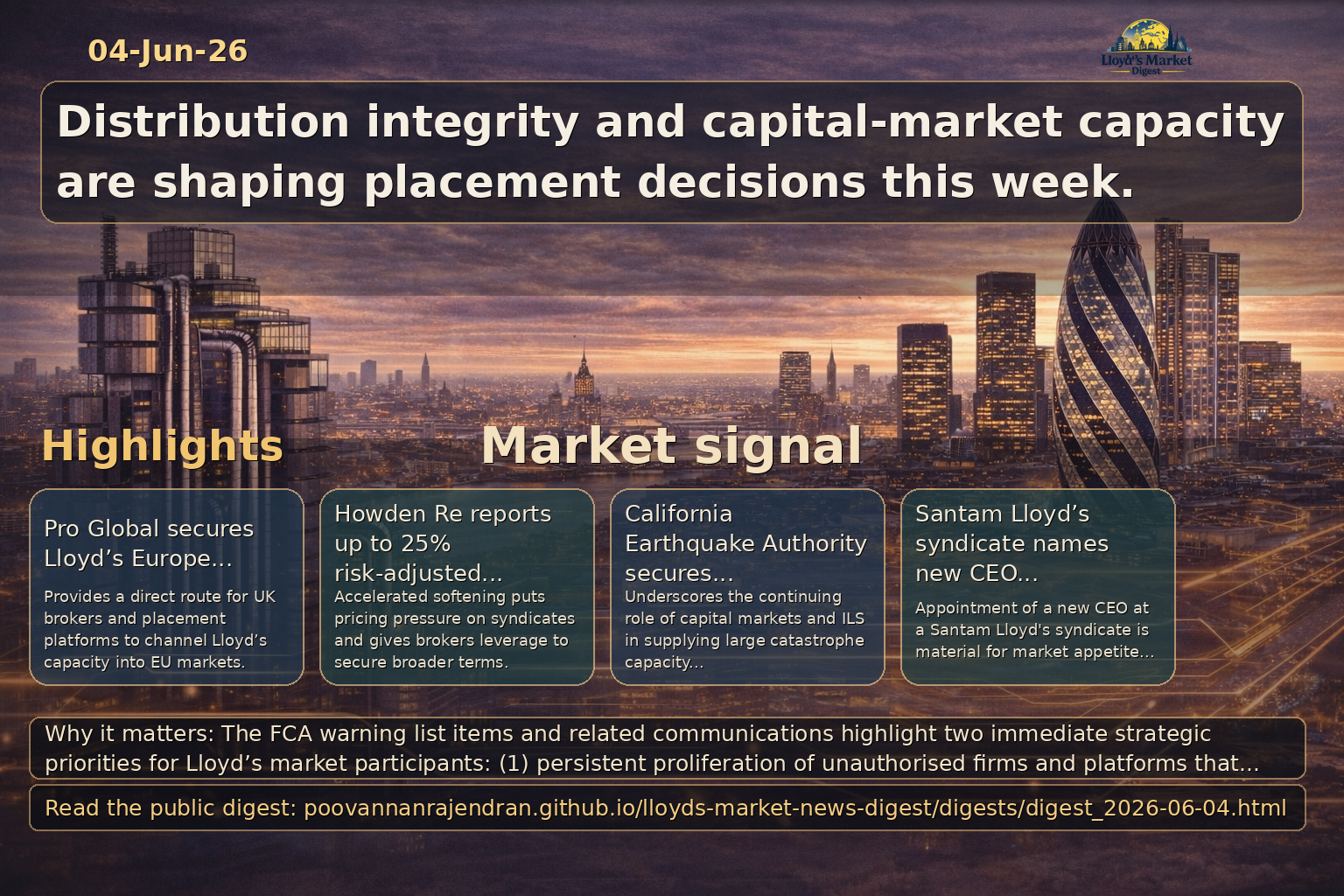
Why it matters: Appointment of a new CEO at a Santam Lloyd's syndicate is material for market appetite, distribution relationships and strategic focus within the Lloyd's ecosystem; brokers and capital providers should monitor for shifts in underwriting strategy.
- Engage early with the syndicate to understand any immediate appetite or appetite-relocation changes and their impact on existing placements.
- Review bilateral relationships and delegated authority arrangements that could be repriced or restructured under new leadership.
- Placement platforms should update syndicate profiles and communicate changes to broking teams to optimize submission routing.
Source: reinsurancene.ws
Why it matters: Pro Global secured Lloyd's Europe accreditation to launch a European broker platform — a direct route for UK brokers and placement platforms to channel Lloyd's capacity into EU markets.
- Brokers should evaluate incubation services to accelerate EU market entry while leveraging Lloyd's distribution credentials
- Syndicates and managing agents should engage early to establish slip/placement workflows and quota‑share arrangements for the new platform
- Placement platforms must ensure regulatory, operational and data integrations to support cross‑border Lloyd's placements and delegated authority placements
Source: fca.org.uk
Why it matters: FCA warning on 'Everest Trust' signals unauthorised firms targeting UK customers; creates client protection, placement and reputational exposure for brokers and syndicates that may be referenced or rely on third‑party distribution.
- Reputational and counterparty risk: brokers and syndicates must ensure no association with unauthorised entities in marketing, referrals or panel listings to avoid client harm and reputational damage.
- Strengthen onboarding: mandate immediate verification checks for new introducers and digital partners against FCA Warning List and automated screening tools.
- Contract and claims exposure review: review distribution agreements and errors & omissions wording to ensure protection if client transactions route through or are influenced by unauthorised intermediaries.
Source: fca.org.uk
Why it matters: 'Best Bond Rates' warning underscores the ongoing use of consumer‑facing marketing channels by unauthorised financial firms — relevant to specialty lines where retail or affinity distribution is used and to syndicates sponsoring consumer‑facing programs.
- Affinity channel vigilance: underwriters and managing agents must require brokers to disclose third‑party affinity partners and conduct enhanced due diligence on co‑brands.
- Marketing governance: implement approval controls for use of syndicate or Lloyd’s branding in any consumer marketing or sponsored content.
- Customer remediation exposure: assess potential downstream consumer complaints risk where business is sourced via unauthorised providers and confirm complaint handling and FSCS coverage messaging in distribution materials.
Source: fca.org.uk
Why it matters: Warning on 'CarFinanceClaim / Black Knight Global Ltd' indicates unauthorised operators in claims/finance advisory niches — a vector for mis‑sold protection products and for bypassing regulated channels relevant to motor and consumer specialty exposures.
- Distribution control for protection products: brokers and MGAs should verify partners involved in claims support or credit products to prevent mis‑selling of insurance add‑ons.
- Data and operational risk: unauthorised intermediaries may process client data outside expected controls — require evidence of data handling, encryption and contractual safeguards before integration.
- Review referral arrangements: suspend or subject to enhanced review any referral or lead‑generation arrangements with entities on the FCA Warning List.
Source: fca.org.uk
Why it matters: 'TradeVision365' is representative of trading platforms and online marketplaces operating without FCA authorisation — a concern for cyber, financial lines and D&O exposures placed in the specialty market and for placement platform fraud vectors.
- Underwrite exposure to platform risk: reinsurers and syndicates should demand clarity on platform governance, segregation of client funds and incident response when underwriting policies for trading‑related exposures.
- Broker onboarding and tech‑connectivity: placement platforms must enforce partner onboarding checks and limit API or data integrations with unauthorised trading sites.
- Escalate cyber due diligence: require evidence of security certifications and penetration testing from platforms and any third‑party that interfaces with client trading or transactional data.
Source: fca.org.uk
Why it matters: The 'Financial Advisor Dorset' warning typifies small or local unauthorised advisers that can create distribution leakage and potential regulatory scrutiny when specialty products are marketed through local advisor networks.
- Distribution network mapping: brokers and managing agents should map and audit local advisor networks to ensure all advisers are FCA authorised where required.
- Training and oversight: require partners to evidence adviser competence, suitability assessment frameworks and complaints handling consistent with regulated standards.
- Mitigate complaint contagion: implement clear escalation and remediation protocols if unauthorised advice has led to product purchase by end customers.
Source: businessinsurance.com
Why it matters: EPIC naming a natural resources practice chair underscores the sector’s underwriting importance and signals targeted distribution efforts for energy and resource risks that intersect with Lloyd’s specialty appetite.
- Sector appetite: Syndicates should review capacity and wording for natural resources exposures, including pollution, commodity disruption and political risk.
- Broker engagement: Brokers should align client outreach to highlight tailored solutions and placement pathways for energy clients across Lloyd’s and wholesale markets.
- Risk management: Emphasize loss control services and joint risk engineering propositions to differentiate coverage on large natural resources accounts.
Source: artemis.bm
Why it matters: S&P stress tests reiterate that reinsurance and retrocession remain essential to manage extreme-event tail risk, reinforcing demand signals for retro markets and coordinated placement via specialist brokers and platforms.
- Risk management: Cedants and syndicates should reassess retro and quota-share programmes as stress-test mitigation tools.
- Broker advisory: brokers must integrate stress-test outcomes into client renewal strategies and structure retro placements accordingly.
- Capital strategy: placement platforms and ILS managers should position retro-capacity offerings to meet demand for layered tail protection.
Source: artemis.bm
Why it matters: The California Earthquake Authority’s $425m Sutter Re 2026-1 upsized issuance underscores the ongoing role of capital markets for large-scale natural catastrophe programmes, raising the bar for earthquake capacity and municipal market engagement.
- Public-sector market: brokers and placement platforms should proactively target regional public entities and utilities that favour fully-collateralized cat bond structures.
- Syndicate competition: Lloyd’s and global reinsurers face increased ILS competition for earthquake risk — consider tailored co-investment or placement partnerships.
- Structuring expertise: transaction teams must refine parametric/per-occurrence triggers and collateral mechanics for sovereign and quasi‑sovereign sponsors.
Source: artemis.bm
Why it matters: Howden Re’s report of up to 25% risk‑adjusted rate‑on‑line reductions at the June 1 renewals highlights accelerated softening and broader coverage wins for buyers, directly affecting syndicate returns and broker negotiation dynamics.
- Pricing pressure: Lloyd’s syndicates must reassess target ROE and underwriting appetite in light of accelerated rate declines.
- Broker opportunity: brokers can leverage market softening to secure broader terms and expanded limits for clients, while capturing incremental placement volume.
- Risk selection: underwriting teams should enhance portfolio controls and limit concentration as premium rates soften.
Source: artemis.bm
Why it matters: HCMA’s hire of Adil Imani from Verisk strengthens a broker-led ILS advisory capability, reflecting heightened competition among brokers to offer advanced modelling and structuring expertise to cedants and investors.
- Capability build: brokers and managing agents should consider similar talent acquisitions to bolster structuring and model-driven advisory services.
- Client benefit: enhanced modelling expertise supports more sophisticated deal origination and improved investor communication.
- Competitive landscape: placement platforms must differentiate through proprietary analytics and deep modelling resources.
Source: artemis.bm
Why it matters: The SEADRIF–FAO parametric drought pilot in Lao PDR marks expansion of parametric sovereign solutions in Southeast Asia, signalling new revenue opportunities for brokers, placement platforms and syndicates willing to underwrite innovative, early‑warning instruments.
- Product expansion: brokers and Lloyd’s syndicates should develop parametric templates and monitoring arrangements to capture emerging-market sovereign mandates.
- Placement readiness: platforms must integrate environmental indices and payout automation capabilities for rapid execution.
- Market development: successful pilots can create replicable sovereign and donor-funded programmes across the region.
Source: businessinsurance.com
Why it matters: Allied World’s expansion in the UAE signals direct market competition and distribution growth in MENA — a strategic area for Lloyd’s syndicates and global brokers seeking premium diversification and local placement relationships.
- Brokers should reassess regional distribution strategies and partner networks to capture inbound mid-market and corporate flow.
- Syndicates must evaluate appetite and capital allocation for MENA-exposed risks, considering local regulatory and collateral requirements.
- Placement platforms and coverholders will need to support local licensing, data capture and delegated authority frameworks to accelerate underwriting.
Source: businessinsurance.com
Why it matters: The growing share of ILS and cat bonds in reinsurance capital alters capacity composition and pricing signals for Lloyd’s syndicates and brokers — creating both competitive pressure and partnership opportunities with capital markets.
- Syndicates should model ILS-driven capacity impacts on pricing and corridor exposure to avoid margin erosion in peak peril programs.
- Brokers can incorporate ILS tranches into multi-layer placements to enhance program efficiency and investor diversification.
- Placement platforms need to support structuring, reporting and investor due diligence workflows to facilitate hybrid reinsurance placements.
Source: businessinsurance.com
Why it matters: Achmea’s targeted €87M windstorm cat bond highlights continued appetite from insurers to transfer peak peril risk to capital markets — a relevant benchmark for syndicates, brokers and placement specialists working on European wind storm exposures.
- Syndicates should use the placement as a pricing and structure reference when underwriting windstorm layers amid evolving model outputs.
- Brokers can present cat bond alternatives to clients as part of layered solutions, improving cost-of-capacity options on large programmes.
- Placement platforms must ensure analytics and investor-ready documentation to compete when primary carriers access capital market solutions.
Source: globalreinsurance.com
Why it matters: MAPFRE Re’s appointment to lead its India branch and establishment in GIFT City signals increased onshore reinsurance presence and a commitment to accessing Indian cedant flows — relevant to global specialty placement and broker sourcing strategies.
- Enhances local capacity and placement capability in India, improving direct treaty and facultative access for cedants.
- Increases relevance of GIFT City as a regional regulatory/placement hub; Lloyd’s brokers should reassess routing strategies for India-origin business.
- Action: Syndicates and global brokers should engage MAPFRE Re early on India propositions and evaluate product and treaty collaboration given regulatory approval risks and local market nuances.
Source: globalreinsurance.com
Why it matters: Permanent CEO appointment at HDI Global UK & Ireland provides leadership stability across cyber, A&H, credit and energy lines — a factor affecting capacity availability and competitive positioning in the London market and broker panels.
- Signals continuity in underwriting appetite and execution, supporting stable capacity for core specialty lines across UK & Ireland.
- Creates a predictable counterparty for brokers and placement platforms courting UK-origin specialty business.
- Action: Brokers and Lloyd’s syndicates should monitor HDI’s product and pricing posture for partnership or competitive responses; align placement timing to capitalize on consistent underwriting leadership.
Source: globalreinsurance.com
Why it matters: Convex’s launch of a technology-enabled, FCA-authorised MGA (Kinetic) reinforces the trend toward platform-based distribution and niche underwriting units backed by balance-sheet capacity — a structural development for specialty placements and broker workflows.
- Creates a faster, underwriting-led channel for niche specialty risks that can undercut or supplement broker-led placements.
- Backed by Convex and third-party capacity, Kinetic offers alternate capacity lines for Lloyd’s syndicates and placement platforms to consider or compete against.
- Action: Placement platforms and syndicates should evaluate partnership/referral models, invest in comparable tech-enabled processes, and review appetite for delegated authority placements.
Source: globalreinsurance.com
Why it matters: Acrisure’s partnership with Monopoli Sigorta extends a major broker platform into Turkey, widening distribution reach and creating a conduit for regional premium flows into international specialty markets.
- Expands Acrisure’s international platform and provides a direct routing mechanism for Turkish corporate and retail business to global capacity providers.
- Increases the probability of cross-border placements into London, Bermuda and other specialty markets as local business seeks international capacity and solutions.
- Action: Syndicates and placement platforms should proactively engage Acrisure’s Turkish operation to secure distribution alignment and assess regulatory/tax implications for structured placements.
Source: globalreinsurance.com
Why it matters: Beazley’s Bermuda office opening and appointment of a head of alternative risk transfer highlights Bermuda’s growing role as a strategic hub for ART, parametric and complex specialty solutions — directly relevant to the competition for alternative capital and treaty appetite.
- Strengthens Bermuda as a centre for ART, parametric and treaty solutions, increasing competitive pressure on Lloyd’s and other centres for those product lines.
- Signals an explicit push to align underwriting footprint with alternative capital sources and geographically diversified reinsurance solutions.
- Action: Lloyd’s syndicates and placement platforms should clarify product differentiation, consider Bermuda partnerships or presence, and reassess ART/parametric product offerings to retain market share.
Source: insurancejournal.com
Why it matters: Political intervention halting offshore wind projects alters long-term renewable energy placement pipelines and creates reputational and regulatory risk for capacity providers and brokers active in energy transition lines.
- Reduced renewables project pipeline compresses near-term demand for specialized construction and operational renewable risk capacity — syndicates should re-evaluate appetite and pipeline assumptions.
- Increases political risk and litigation exposure for insurers and brokers advising renewable sponsors; placement platforms must enhance political-risk and contingent liability checks.
- Opportunity for specialty markets to design transition-focused coverages (e.g., stranded-asset, political-event endorsements) and engage in structured solutions with clarity on jurisdictional risk.
Source: insurancejournal.com
Why it matters: Acrisure’s litigation with former principals highlights integration, non‑compete enforcement and client‑retention risks inherent in broker roll‑ups — implications for capacity decisions and broker counterparty assessment.
- Syndicates and carriers should intensify counterparty due diligence on broker consolidation activity and client‑transfer risks when underwriting through aggregators.
- Placement platforms need contractual clarity on client ownership, data access and claims cooperation to limit disruption from post‑deal disputes.
- Brokers and in‑house risk teams should document client consent and transition plans to reduce litigation exposure and preserve placement certainty.
Source: insurancejournal.com
Why it matters: Swiss Re’s analysis of a US$424bn protection gap underscores a persistent global demand-supply imbalance for catastrophe capacity and a strategic opening for Lloyd’s and specialty markets to fill product and distribution voids.
- Syndicates should prioritize scalable catastrophe capacity and expand parametric, micro‑insurance and layered reinsurance solutions to address underserved segments.
- Brokers can capitalize by structuring blended public‑private programs and resilience‑linked products to close national protection gaps.
- Placement platforms must support rapid catastrophe quoting, model integration and multi‑trigger placements to expedite execution during peak demand.
Source: insurancejournal.com
Why it matters: Ships stuck in the Strait of Hormuz amplify hull, cargo and war‑risk exposures, raising premiums, restricting capacity and complicating claims and crew welfare — immediate concern for marine underwriters and brokers.
- Expect elevated war and war‑adjacent premiums and restricted AMV/coverage options; syndicates should review geographic exclusions and contagion limits.
- Brokers must advise clients on alternative routing, increased transit clauses, and contingency logistics; placement platforms should enable rapid war‑risk quoting and endorsement layering.
- Insurers and P&I clubs need enhanced crisis claims protocols and crew support mechanisms; reassessment of accumulation and contagion modelling is essential.
Source: insurancejournal.com
Why it matters: Arch Capital’s consolidation of the president role signals potential strategic simplification and allocation of capacity across re/insurance lines — a marker for capacity shifts and relationship re-prioritization in the London market.
- Syndicates and brokers should monitor capacity reallocation across Arch’s product lines, as leadership consolidation may reprioritize underwriting appetite.
- Strategic shifts could alter reinsurance retrocession demand and partnership frameworks; placement platforms should track product availability changes.
- Market participants should engage senior contacts to understand distribution strategies and anticipated portfolio focus to anticipate placement impacts.
Source: reinsurancene.ws
Why it matters: Historical archive content provides precedent on portfolio sales, catastrophe loss impacts and earlier strategic moves by major reinsurers — useful for trend analysis though of limited direct operational relevance today.
- Use as reference for precedent in large portfolio sales and pension‑fund style buyers when evaluating contemporary runoff or admin‑reinsurance opportunities
- Inform post‑loss pricing and capital cycle analysis by comparing prior catastrophe loss years with current market exposures
- Limit reliance on archival data for current decision‑making; corroborate with up‑to‑date filings and recent M&A activity
Source: reinsurancene.ws
Why it matters: Acrisure's entry into Turkey via partnership expands a global broker platform into a strategically significant growth market — implications for distribution of specialty and Lloyd's capacity in the region.
- Global brokers' local partnerships increase competition for specialty placements; syndicates should clarify appetite and terms for Turkish‑origin business
- Syndicates and MGAs should assess regulatory and tax implications when underwriting through partnered brokers in Turkey
- Placement platforms should build connectivity to local broker systems and compliance checks to streamline cross‑border placements
Source: reinsurancene.ws
Why it matters: TD Cowen's update showing E&S growth slowing amid softer property pricing directly affects specialty capacity allocation and rate adequacy conversations at Lloyd's and across global syndicates.
- Syndicates must reassess property rate adequacy and exposure concentrations in volatile states (CA, FL, TX) to avoid underwriting erosion
- Brokers can leverage increased competition to negotiate improved terms for clients but should monitor carrier solvency and attachment dynamics
- Placement platforms should incorporate real‑time filing and rate data into analytics to support dynamic pricing and layering decisions
Source: reinsurancene.ws
Why it matters: Mereo's underwriting of ESL's excess casualty energy portfolio following a renewal‑rights transaction demonstrates active portfolio transfer activity and the need for continuity in specialty energy coverage.
- Portfolio acquisitions are a viable route to scale specialty lines; syndicates should develop playbooks for integrating acquired portfolios and underwriting teams
- Brokers must seek contractual clarity on claims handling and continuity of terms during ownership and system transitions
- Placement platforms need to support data migration, legacy policy continuity and automated workflows to prevent placement disruption during transfers
Source: newsnow.co.uk
Why it matters: CMA activity signals heightened UK competition and consumer protection scrutiny that can reshape obligations on platforms, brokers and insurers — including rules on search, transparency, and opt‑out rights. Outcomes will influence market structure and distribution economics in Lloyd’s and global specialty placements.
- Prepare for potential CMA-imposed obligations on platform transparency, data portability or publisher opt-out rights that could alter placement platform economics and referral flows.
- Factor increased regulatory scrutiny into M&A, partnership and go-to-market strategies; incorporate regulatory risk into valuation and integration plans.
- Engage proactively with regulators and industry groups, contribute to consultations and model anticipated compliance costs and operational changes.
Source: newsnow.co.uk
Why it matters: Escalation in North Korea’s nuclear and missile activity materially increases political violence, war and sanction-related exposures relevant to Lloyd’s market syndicates, reinsurers and brokers. This elevates underwriting risk, claims volatility and compliance complexity across international placements.
- Review and tighten political violence/war exclusion and coverage terms; reassess appetite and capacity for exposures in affected geographies and value chains.
- Enhance sanctions screening and KYC processes across broker, MGA and syndicate workflows to prevent prohibited exposures and ensure sanctions compliance.
- Stress-test portfolios and reinsurance programmes for scenario-driven losses, supply-chain disruption and premium adequacy; update contingency plans for rapid claims spikes.
Source: newsnow.co.uk
Why it matters: News flow around Google — especially AI search and platform changes — affects digital distribution, lead generation and data interoperability that brokers, placement platforms and insurtechs rely upon. Regulatory and product impacts could change referral flows and underwriting data models.
- Monitor platform algorithm and product changes for impacts on referral volumes and customer acquisition; diversify digital distribution channels to reduce single‑platform dependency.
- Re-evaluate data partnerships and privacy controls; ensure AI models used in underwriting and pricing meet governance, explainability and compliance standards.
- Identify insurtech opportunities from AI advancements while establishing model risk frameworks and operational controls to manage deployment and vendor dependency.
Source: newsnow.co.uk
Why it matters: Activity from consumer advocacy bodies such as Citizens Advice drives scrutiny on product fairness, claims handling and transparency. For brokers, syndicates and placement platforms this raises conduct risk, potential regulatory intervention and reputational exposure.
- Strengthen complaint handling, disclosure and claims processes to reduce escalation risk and align with evolving consumer expectations and regulatory guidance.
- Review product design and pricing frameworks for fairness and clarity; document affordability and vulnerability assessments where relevant.
- Develop proactive stakeholder engagement and consumer‑facing communications to mitigate reputational risk and demonstrate good conduct practices.