Source: fca.org.uk
Why it matters: FCA warning on an unauthorised entity signals a fraud/impersonation vector that can affect broker-led placements, client introductions and placement-platform onboarding. Name similarity or marketing to UK clients may result in misdirected premiums, bogus claims or data leakage affecting Lloyd’s syndicates.
- Enforce automated checks against FCA Warning List in broker/insurer onboarding and pre-bind workflows
- Alert distribution networks to the specific name and require written confirmation of counterparty authorisation before sharing client data or accepting funds
- Add the entity to internal blocklists in placement platforms and update client-facing guidance to prevent misdirected payments
Source: fca.org.uk
Why it matters: Globeinchain appears on the FCA Warning List as unauthorised. Such entities can be used to solicit risks or to pose as brokers/insurers, creating lead contamination and potential fraudulent placement attempts that reach syndicates via intermediaries or digital platforms.
- Mandate provenance checks for new broker/introducer relationships, including evidence of FCA authorisation or equivalent home-state licences
- Require placement platforms to flag and quarantine any requests referencing the warned name pending manual verification
- Issue a targeted advisory to distribution partners advising zero transfer of client funds or policy documentation to the named entity
Source: fca.org.uk
Why it matters: Ultrabrokers’ listing as unauthorised indicates a broker impersonation risk. Where digital placement channels accept submissions from third parties, an unauthorised intermediary can attempt to create or alter bind/claims instructions affecting syndicate exposures and client funds.
- Validate all introducer credentials before allowing API or portal access; revoke access where authorisation cannot be proven
- Train placement desk and syndicate operations to treat unsolicited documentation from unverified intermediaries as high-risk
- Incorporate contractual indemnities and audit rights in broker/syndicate agreements to address losses from interactions with unauthorised parties
Source: fca.org.uk
Why it matters: FCA enforcement investigation into Consultation Claims Limited for alleged forged signatures and improper customer onboarding in motor finance claims is materially relevant to carriers and syndicates underwriting motor credit/minibus portfolios and to brokers who refer claims. This raises potential for mass complaints, adverse reserve movement and regulatory scrutiny of distribution chains.
- Initiate a rapid review of any placements, referrals or sub-broking arrangements that passed motor finance claims to CCL or similar CMCs during the cited period
- Perform a claims-file integrity audit focusing on signature provenance, recorded customer consent and third-party handling; notify claims reserves and legal teams to quantify potential exposures
- Coordinate with UK brokers and platform partners to identify affected clients, prepare customer remediation templates and engage proactively with the FCA where appropriate
Source: fca.org.uk
Why it matters: Everest Trust appearing as unauthorised poses client trust and fund routing risks. For syndicates and MGA networks, trust-style names can be used to harvest sensitive policyholder information or intercept premium flows, impacting regulatory responsibility and claims integrity.
- Prohibit transfers of client monies or sensitive KYC data to any entity on the FCA Warning List until provenance is confirmed
- Update custody and trustee onboarding checks within delegated authority frameworks to include explicit verification of trust structures and regulatory status
- Communicate with broker partners to ensure no substitution of authorised counterparties with similarly named entities occurs during placement
Source: globalreinsurance.com
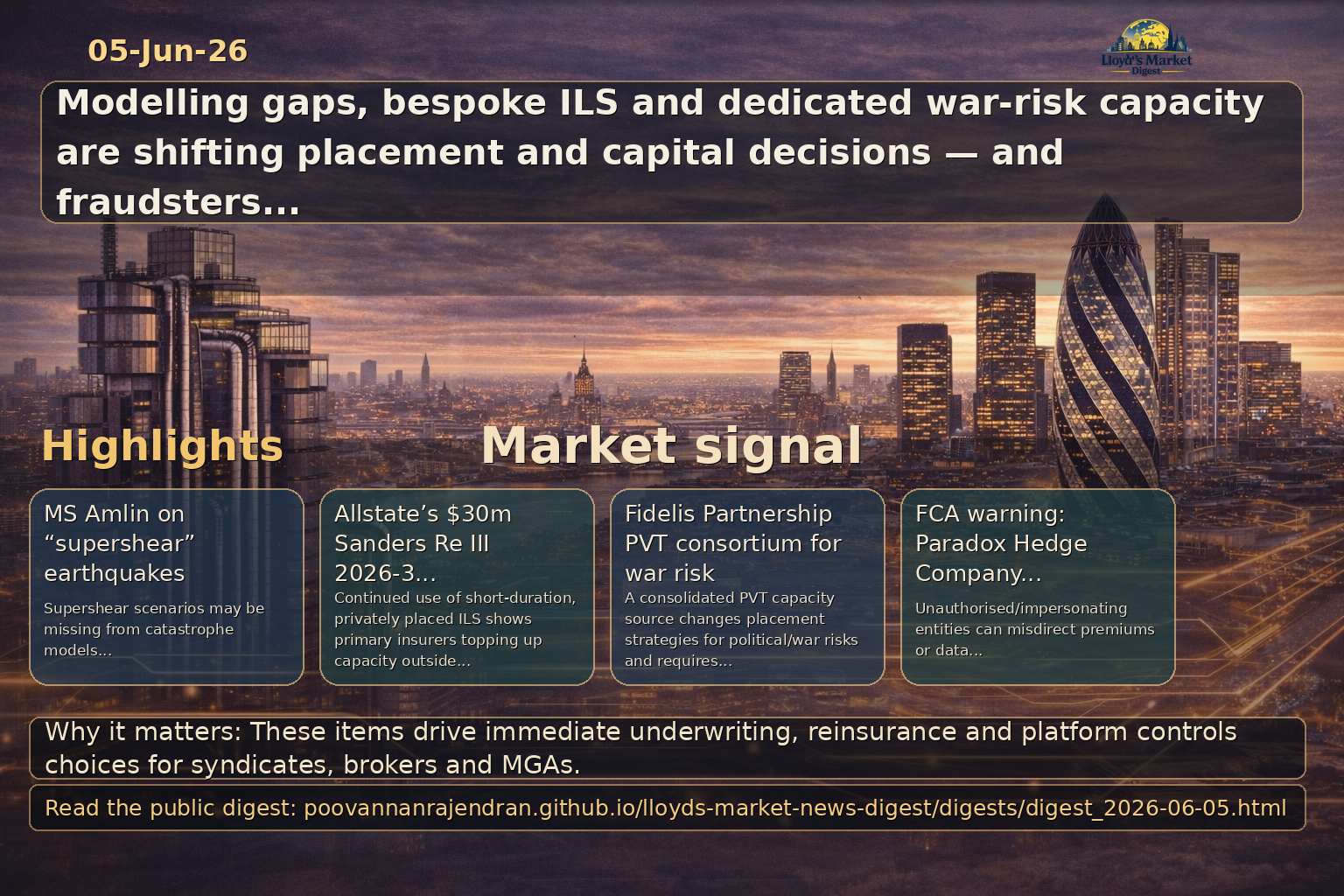
Why it matters: MS Amlin’s research on supershear earthquakes exposes a material modelling blind spot that could understate insured losses and capital needs for seismic portfolios — a strategic concern for Lloyd’s syndicates and global specialty insurers.
- Immediate action: reassess seismic exposures and stresses in catastrophe models; engage model vendors and academic partners to quantify supershear scenarios.
- Underwriting response: reprice, tighten terms or limit accumulation in regions where supershear risk materially increases tail loss estimates.
- Capital & reinsurance: review capital allocation and retrocession programmes to ensure solvency metrics account for higher-loss supershear scenarios.
Source: reinsurancene.ws
Why it matters: MS Amlin’s research on supershear earthquakes exposes a material blindspot in cat models with potential for significant underestimation of earthquake losses.
- Demand model vendor updates and incorporate supershear scenarios in enterprise stress testing and capital planning.
- Initiate portfolio-level sensitivity analysis and reprice exposures in major earthquake zones where supershear risk is credible.
- Coordinate with catastrophe model providers, brokers and regulators to validate model enhancements and capital adequacy metrics.
Source: artemis.bm
Why it matters: Allstate's privately placed Sanders Re III cat bond demonstrates continued use of one-year, privately arranged ILS to supplement reinsurance capacity, a pattern relevant to brokers and placement platforms.
- Repeat mid-year private cat bond placements show primary insurers using targeted ILS transactions to top-up capacity outside traditional treaty renewals
- Private placements shift negotiations toward bespoke terms and collateral structures, requiring brokers and platforms to support customized execution
- Sustained issuer demand for short-duration ILS affects the flow of capital and competitive dynamics between ILS and traditional reinsurers
Source: artemis.bm
Why it matters: Swiss Re Institute analysis that insurance cover is growing broadly in line with catastrophe exposure informs strategic underwriting, capital planning and product development across Lloyd's and global specialty markets.
- A sizable protection gap remains (~$424bn), but parallel growth in insurance cover requires syndicates to target underserved segments and tailor solutions
- Strong benefit-cost ratios for adaptation projects create opportunities for insurers and syndicates to partner on resilience financing and parametric products
- Underwriters must factor asset-value growth and adaptation investments into exposure management and reinsurance purchase decisions
Source: businessinsurance.com
Why it matters: Senior executives launching new carriers alters the specialty landscape—affecting capacity allocation, distribution relationships and placement workflows across Lloyd’s, syndicates and wholesale brokers.
- Capacity reallocation: New entrants can siphon specialist capacity and mandate share from established syndicates, requiring underwriters to re-evaluate portfolio concentration and quota-share strategies.
- Distributor and platform impact: Brokers and placement platforms must update panels, appetite matrices and connectivity to onboard new carriers quickly while preserving placement efficiency and data integrity.
- Counterparty and regulatory diligence: Underwriters and brokers should strengthen due diligence (financial, governance, LIC status) and align contract terms to manage onboarding risks and solvency/authorization variances.
Source: businessinsurance.com
Why it matters: Acrisure’s expansion into Turkey underscores continued broker consolidation and rapid distribution growth in EMEA growth markets—implications for local capacity needs, placement routing and platform localization.
- Distribution footprint and flow-through: Global brokers expanding locally change broker-of-record dynamics; syndicates and MGAs should refine regional appetite and delegated authority frameworks to capture or defend flow.
- Placement platform adjustments: Placement and binding platforms must support multi-jurisdictional compliance, local language/terms and integrations with emerging-market carriers to avoid placement friction.
- Capacity and margin pressure: Increased competition for retail and wholesale commissions in new markets may pressure margins—syndicates should reassess pricing, facultative panels and reinsurance structures for regional exposures.
Source: businessinsurance.com
Why it matters: A $340M Russian aircraft claim decision highlights concentration and geopolitical exposure in aviation portfolios—critical for syndicates and reinsurers that underwrite war, sanctions and complex hull/liability risks.
- Sanctions and war-risk clarity: Underwriters must re-evaluate wording around war, seizure and sanctions exclusions, and test placement flows against evolving sanction regimes and jurisdictional enforcement risk.
- Reinsurance and facultative strategy: Large aviation losses drive demand for targeted facultative and excess-of-loss protection; syndicates should stress-test treaty attachment points and claims escalation protocols.
- Broker engagement and documentation: Brokers must ensure robust pre-placement disclosures and post-loss coordination (evidence, salvage, jurisdictional counsel) to limit dispute risk and expedite recoveries.
Source: businessinsurance.com
Why it matters: Typhoon-driven disruption to rail and air travel evidences persistent catastrophe and transport loss volatility—relevant to travel, aviation liability, cargo and business-interruption exposures across specialty portfolios.
- Exposure aggregation and modelling: Syndicates should refresh catastrophe models and exposure aggregation for transport corridors and allied BI exposures to avoid unintended accumulation.
- Policy wordings and contingent BI: Underwriters and brokers need to scrutinize trigger definitions, ingress/egress clauses and contingent BI cover layers for clarity after weather-driven disruption.
- Operational readiness for surge claims: Placement platforms and brokers should coordinate claims-routing protocols and carrier communication plans to manage high-volume property, cargo and travel claims efficiently.
Source: businessinsurance.com
Why it matters: A gubernatorial task force on undue claim delays signals intensifying regulatory and political focus on claims timeliness—material for Lloyd’s managing agents, syndicates, carriers and brokers handling complex specialty claims.
- Claims governance and SLAs: Syndicates and delegated authorities must audit claims workflows, enforce SLAs and invest in triage automation to reduce time-to-pay and regulatory exposure.
- Transparency and reporting: Brokers and carriers should prepare for enhanced reporting requirements and public scrutiny—improve documentation, customer communications and escalation records.
- Technology and vendor oversight: Placement platforms and claims technology vendors must be validated for end-to-end claims support; insurers should ensure vendor SLAs and compliance controls mitigate delay risks.
Source: globalreinsurance.com
Why it matters: Aon’s appointment of an EMEA chief claims officer signals elevated claims capability and advocacy which materially affects insurer relationships, claims outcomes and placement certainty for brokers and syndicates across complex and large-scale losses.
- Brokers should engage early with Aon’s EMEA claims leadership to align claims protocols and expectations when placing complex risks.
- Syndicates and carriers must anticipate stronger claims advocacy influencing settlement dynamics and reserve requirements on large losses.
- Recommendation: codify claims response playbooks with major brokers and leverage the appointment to test joint crisis/claims escalation procedures.
Source: globalreinsurance.com
Why it matters: The Fidelis Partnership PVT consortium demonstrates Lloyd’s syndicates assembling dedicated, sizable capacity for war, terror and political violence in response to market dislocation — a template for rapid capacity deployment via collaborative placement.
- Brokers gain a consolidated capacity source for PVT placements; update placement strategies to leverage the consortium for Middle East and global risks.
- Syndicates should evaluate co-participation and capital exposure limits to diversify PVT risk while preserving margin and trauma protections.
- Operational: align wordings, limits and claims protocols across consortium participants to ensure efficient issuance and claims handling in high-frequency geopolitical environments.
Source: globalreinsurance.com
Why it matters: The Russell Group’s endorsement of corporate wargaming highlights a proactive approach to scenario testing that can surface hidden assumptions in underwriting, placement strategy and balance-sheet planning for insurers and brokers.
- Incorporate wargaming into capital planning cycles to test extreme but plausible geopolitical and systemic scenarios impacting placements and liquidity.
- Underwriting teams should use wargaming to stress-test product wordings, accumulation controls and reinsurance arrangements before crises unfold.
- Brokers and syndicates should run joint wargames to synchronise contingency plans, communications and claims response for complex multi-jurisdictional events.
Source: globalreinsurance.com
Why it matters: MAPFRE Re’s appointment of a head for its India branch based in GIFT City signals intensifying reinsurance competition and capacity availability in a high-growth Asian market, affecting placement strategies for global specialty insurers and Lloyd’s syndicates seeking regional diversification.
- Expect increased local capacity and tailored product offerings; brokers should deepen engagement with MAPFRE Re on India-centric treaty and facultative placements.
- Syndicates should reassess appetite for India risk flows and potential co-insurance or retrocession partnerships to capture growth while controlling accumulation.
- Monitor regulatory approval timelines and GIFT City developments to identify placement efficiencies, tax and operational advantages for regional operations.
Source: insurancejournal.com
Why it matters: Maritime insecurity in the Strait of Hormuz raises war/political violence exposure for hull, cargo and energy liabilities, and drives demand for specialty marine and political-risk capacity across the London Market and global brokers.
- Immediate impact on war/strikes and political violence covers — potential for short‑term spikes in quotes and risk‑adjusted premiums from syndicates.
- Rerouting and alternate transit options change per‑voyage exposure profiles, complicating placement and requiring underwriters to reassess voyage and accumulation risk.
- Heightened coordination between brokers, Lloyd’s syndicates and reinsurers will be needed for capacity allocation and to manage potential aggregation across energy and marine portfolios.
Source: insurancejournal.com
Why it matters: Regulatory scrutiny of insurers’ private credit allocations affects balance‑sheet strength and capital available for underwriting specialty risks — a focal point for syndicates and wholesale brokers managing investment‑linked capacity.
- Syndicates and managing agents must strengthen credit risk frameworks and reporting to address regulator expectations and market criticism of illiquid allocations.
- Changes in asset valuation or capital charges could reduce deployable capacity for specialty lines, prompting pricing and attachment adjustments.
- Brokers and placement platforms should integrate asset‑liability considerations into client advice and consider alternative structures (e.g., sidecars, collateralised facilities) to preserve capacity.
Source: insurancejournal.com
Why it matters: WTW’s DFSA license in DIFC signals accelerated broker-led regionalization, enabling locally regulated investment and advisory services that reshape placement channels and client engagement across EMEA and the Middle East.
- Local licensing permits brokers to originate and service sophisticated insurance‑and‑capital solutions from a regional hub, increasing cross‑border placement flow into London Market capacity.
- Syndicates and managing agents should review feeder relationships and appetite for DIFC-originated business, and consider partnership or data‑sharing arrangements with regional brokers and platforms.
- Placement platforms will face pressure to support compliant cross‑jurisdictional workflows, KYC/AML and regulatory reporting to capture growth from locally anchored broker operations.
Source: insurancejournal.com
Why it matters: Senior hires at specialty insurers and MGAs can materially shift underwriting strategies, distribution focus and relationship dynamics with Lloyd’s brokers and wholesale distribution partners.
- New leadership often signals recalibration of underwriting appetite, capacity deployment and product focus — brokers should proactively reassess terms and target markets.
- Appointments from global carriers (e.g., Chubb executive joining Hamilton) indicate intensified competition in private client and high‑net‑worth niches, with implications for appetite and rates.
- Syndicates and placement platforms should monitor talent flows to identify partnership opportunities and to anticipate shifts in delegated authority and distribution relationships.
Source: insurancejournal.com
Why it matters: Ongoing EU‑US trade‑policy dynamics and tariff threats introduce volatility to supply chains and trade credit exposures, creating demand for political‑risk, credit and contingent business interruption solutions from specialty markets.
- Tariff uncertainty can prompt clients to seek trade‑credit and contingent BI covers, requiring underwriters to reprice and model heightened counterparty and supply‑chain concentrations.
- Syndicates should evaluate treaty and facultative reinsurance arrangements covering political risk and trade exposures to avoid unanticipated accumulations.
- Brokers and placement platforms must be prepared to structure multi‑jurisdictional placements and bespoke political‑risk products for corporates with complex cross‑border supply chains.
Source: insurancetimes.co.uk
Why it matters: Platform supporting UK brokers expanding into Europe directly affects placement strategies, compliance frameworks and capacity access for brokers working with Lloyd's and global specialty carriers.
- Facilitates rapid market entry while providing governance and local regulatory controls required by capacity providers and Lloyd’s stakeholders.
- Reduces friction for brokers seeking cross-border panels, increasing competition for syndicates that supply capacity to those brokers.
- Demonstrates demand for placement platforms that can evidence effective control and carrier oversight — a key requirement for underwriting delegations.
Source: insurancetimes.co.uk
Why it matters: Rising e-cigarette fire incidents escalate claims frequency and severity for property and casualty portfolios, impacting underwriting, reserving and loss prevention priorities among specialty underwriters and brokers.
- Increases underwriting loss volatility for household and small commercial portfolios, prompting tightened terms, exclusions or rating actions by syndicates.
- Elevates claims volume and potential for contentious liability exposures, requiring enhanced claims handling protocols and capacity for large or complex claims.
- Creates an opportunity for brokers and placement platforms to offer targeted risk engineering, policy wordings and loss-control services to differentiate carriers and protect capacity appetite.
Source: insurancetimes.co.uk
Why it matters: Alps expanding its GAP range highlights product innovation in motor finance protection — relevant to brokers, syndicate appetite for motor-related credit-shortfall exposures and embedded motor propositions.
- Broadens intermediary product set, enabling brokers to bundle finance shortfall cover and drive distribution opportunities that syndicates or delegated platforms can underwrite.
- Deposit protection feature raises questions on claims inflation and reserve modeling for syndicates underwriting GAP products.
- Signals continued investor and carrier interest in niche motor-related products that can be integrated into OEM or dealer embedded journeys via placement platforms.
Source: insurancetimes.co.uk
Why it matters: SSP's AI product platform accelerates MGA product deployment and has direct implications for syndicate/MGA relationships, binding authorities and placement platform interoperability.
- Agentic AI reducing product cycle from months to days will pressure traditional underwriting and compliance sign-off processes used by Lloyd’s and global carriers.
- Faster configuration increases velocity of capacity utilisation but raises governance risks — syndicates and brokers will demand auditability and explainability for AI-generated product rules.
- Platforms that integrate AI product tooling will become strategic for brokers and MGAs seeking to scale, altering where and how syndicates deploy capital.
Source: insurancetimes.co.uk
Why it matters: Appointments to the Insurance Fraud Bureau board underscore market-wide focus on fraud mitigation — a material concern for underwriting performance and placement decisions across syndicates and brokers.
- Enhanced cross-market collaboration on fraud detection protects underwriting results and reduces strike-risk for capacity providers across Lloyd’s and global specialty markets.
- Board hires signal insurers and intermediaries will face greater expectations for data-sharing and evidence-based anti-fraud controls during placement negotiations.
- Brokers will need to demonstrate control environments and anti-fraud processes when seeking binding authorities or delegated limits from syndicates.
Source: reinsurancene.ws
Why it matters: Historical Lloyd's programme decisions and delays (e.g., index launch pauses) remain relevant for executive risk planning and timing of product innovation.
- Treat historic governance and regulatory triggers as precedent when sequencing new product launches and market initiatives.
- Embed geopolitical and regulatory scenario planning into product rollout timelines (Brexit-style impacts).
- Ensure executive communications and market stakeholder engagement plans anticipate strategic pauses to preserve market credibility.
Source: reinsurancene.ws
Why it matters: OAK Global's upsized Quercian Re cat bond illustrates Lloyd's syndicates leveraging ILS for multi-year, fully collateralised retrocession capacity.
- Consider multi-year, collateralised ILS structures to diversify retrocession and reduce counterparty risk on syndicate portfolios.
- Assess investor appetite and structure triggers (annual aggregate/industry loss) to align with syndicate risk profiles.
- Coordinate accounting, capital and collateral mechanics early between syndicate, managing agent and ILS vehicle for efficient placement.
Source: reinsurancene.ws
Why it matters: Gallagher Re’s use of Arthur Re underscores broker-facilitated platforms that reduce time-to-market and cost for index catastrophe bond issuance.
- Evaluate placement-platform partners (e.g., Arthur Re) to accelerate ILS issuance and lower structuring costs for Lloyd's syndicates.
- Leverage broker advisory capabilities to optimise trigger design, collateralisation and investor targeting.
- Require clear platform governance, segregated account structures and service-level expectations in engagement terms.
Source: reinsurancene.ws
Why it matters: Aon’s appointment and deployment of a claims platform highlights claims leadership and analytics as competitive differentiators for brokers and syndicates.
- Prioritise integration of claims analytics and digital tools (e.g., Claims Copilot) across placement and post-loss workflows to improve loss outcomes.
- Ensure claims leadership has direct lines into underwriting and product teams to close the feedback loop on pricing and reserving.
- Negotiate data-sharing and platform access with brokers to enable consistent, insight-led claims management across syndicates.
Source: artemis.bm
Why it matters: Guy Carpenter highlights continued growth of alternative capital, signaling structural shifts in capacity sources that affect Lloyd's syndicates, brokers and placement strategies.
- Alternative capital approaching ~20% of global reinsurance capital and poised to grow, increasing competitive pressure on traditional reinsurers and syndicates
- Brokers must refine placement strategies to balance investor-driven ILS capacity with treaty reinsurance, leveraging data and relationship management
- Market structure changes may compress pricing cycles and require syndicates to differentiate through underwriting discipline and product innovation
Source: artemis.bm
Why it matters: RenaissanceRe Capital Partners' AUM increase signals continued investor appetite for reinsurance and ILS strategies, reinforcing alternative capacity available to the market and competitive implications for syndicates.
- ~7% year-on-year growth in third-party AUM to $8.46bn shows persistent investor allocations to reinsurance-linked strategies
- Reinsurer-affiliated capital pools can compete with Lloyd's syndicates for direct placements and influence market pricing
- Brokers and placement platforms should map reinsurer-managed capital as a distinct source when structuring deals and advising clients
Source: risk.net
Why it matters: The Markets briefing signals shifts in market structure and product liquidity that materially affect how Lloyd’s syndicates, brokers and placement platforms price risk, manage asset portfolios and structure collateral/settlement. Changes in platform architecture and new asset classes require operational alignment and updated risk frameworks to protect capital, maintain distribution efficiency and ensure accurate hedging.
- Platform convergence: Expect demand from brokers and clients for integrated, end-to-end placement and execution workflows. Syndicates and placement platforms should prioritise API-based connectivity, standardised data models and STP to reduce placement friction, speed limits on capacity and lower reconciliation costs.
- Digital assets and tokenisation: Growth of stablecoins and tokenised instruments introduces new custody, valuation and regulatory considerations for syndicate investments and collateral. Insurance executives should evaluate custody partners, mark-to-market processes, and policy wording related to crypto exposures and collateral acceptance.
- Clearing, liquidity and modelling: New clearing mandates and evolving benchmarks (post-Libor) change liquidity profiles and hedging effectiveness for fixed-income and derivatives positions held by syndicates. Update valuation models, stress scenarios and counterparty exposure limits to reflect tighter clearing requirements and potential market dislocations.
Source: artemis.bm
Why it matters: Verisk's updated US tropical cyclone model on a cloud-native Synergy Studio changes underwriting and portfolio analytics for syndicates, brokers and placement platforms by delivering a near-present climate view and faster model integration.
- Near-present climate view and revised vulnerability modelling will require syndicates and brokers to revisit pricing and concentration metrics for US hurricane exposure
- Synergy Studio's cloud-native delivery enables quicker model updates and easier integration into broker analytics and placement platforms for real-time portfolio assessment
- Impacts reinsurance buying cycles and capital allocation as more realistic peril assumptions affect expected losses and limit utilisation