Source: fca.org.uk
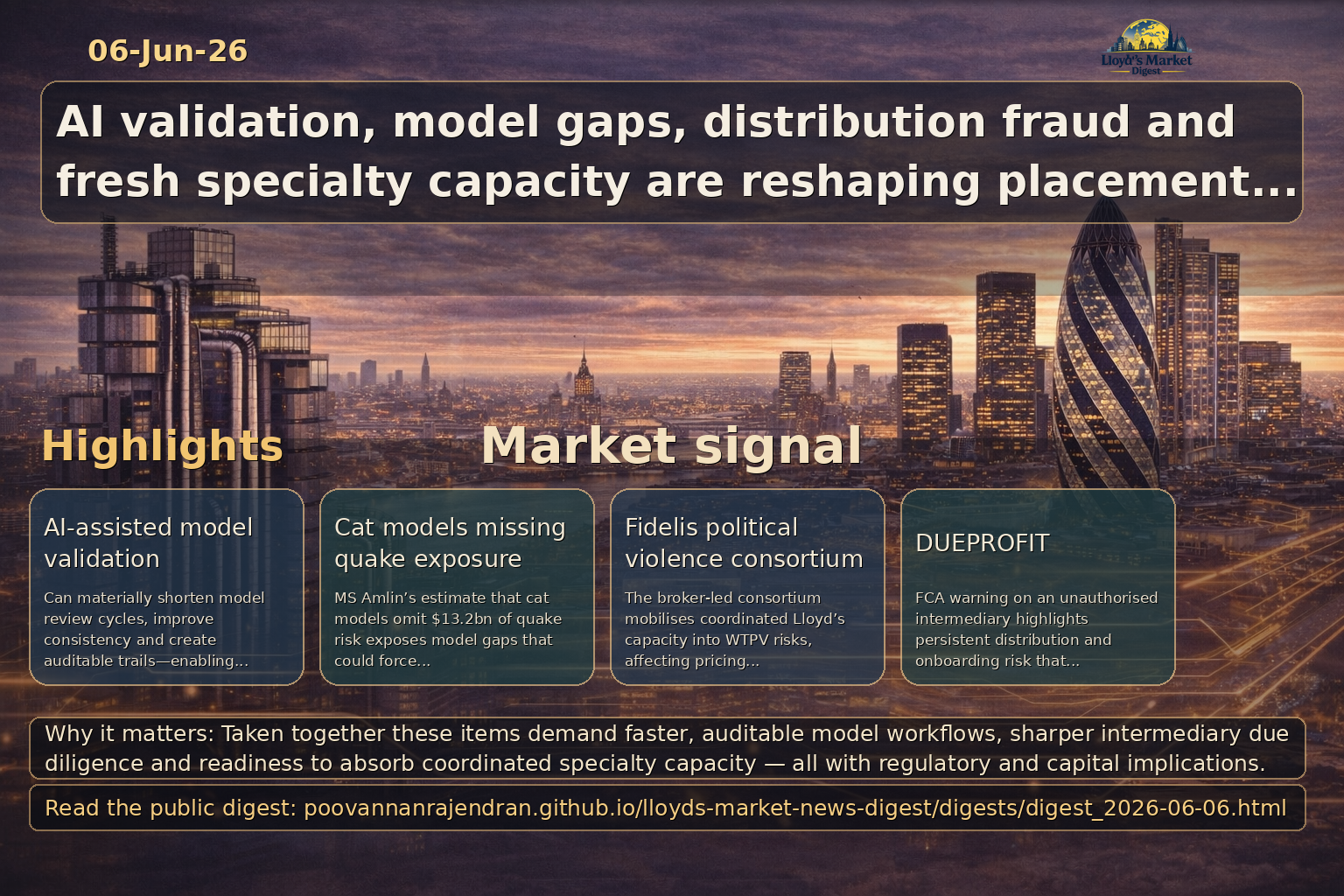
Why it matters: FCA warning on an unauthorised intermediary highlights persistent distribution and onboarding risk that can expose brokers, syndicates and placement platforms to fraud, mis‑selling and post‑placement complaints.
- Implement mandatory authorisation checks in broker/introducer onboarding and embed FCA Warning List screening into CRM and placement workflows.
- Require indemnities and audit rights in intermediary agreements to limit syndicate exposure to unauthorised distribution.
- Communicate escalation and remediation protocols to underwriting teams when suspected unauthorised placements are identified.
Source: fca.org.uk
Why it matters: Warning relating to a site marketing private market access signals targeted scams leveraging specialist investment language that could mislead cedants, private clients and smaller brokers.
- Treat offers referencing ‘private market’ access as high‑risk and subject them to senior compliance review before any engagement.
- Enhance client education materials and broker due diligence checklists to flag likely unauthorised private‑market solicitations.
- Coordinate with compliance/legal to block or flag such domains on corporate platforms and internal communications.
Source: fca.org.uk
Why it matters: FCA warning about a firm trading under a non‑financial brand underlines risk of non‑insurance businesses presenting regulated products, creating exposure through referral or cross‑sell channels.
- Expand onboarding checks to include non‑insurance partners and referral sources; require written proof of FCA permissions where regulated activity is implied.
- Embed contractual safeguards and passthrough liability terms when placing business via non‑traditional channels.
- Audit referral pipelines quarterly to identify and delist any unauthorised third parties.
Source: fca.org.uk
Why it matters: FCA proposals to simplify climate reporting (TCFD‑aligned) could reduce reporting costs but require insurers, asset managers and syndicates to reassess product disclosures and governance for investment and underwriting portfolios.
- Assess product‑level reporting frameworks now to identify savings and compliance gaps if FCA implements simpler, targeted disclosures.
- Align syndicate and managing agent investment reporting with any revised FCA expectations while preserving board oversight of climate‑related risk appetite.
- Engage with asset managers and placement platforms to ensure consistency of climate risk information provided to brokers and retail intermediaries.
Source: fca.org.uk
Why it matters: The Bank of England–FCA MoU review confirms ongoing coordinated supervision of financial market infrastructure; for Lloyd’s market this reinforces expectations around oversight of trading venues, clearing, and placement platforms.
- Proactively engage FMIs and platform operators used in placements to validate governance, incident response and data‑sharing arrangements aligned to regulator expectations.
- Incorporate MoU outcomes into business continuity planning and regulatory horizon‑scanning for platform resiliency requirements.
- Ensure contracts with third‑party platforms permit rapid cooperation with regulators and support audit/inspection requests.
Source: businessinsurance.com
Why it matters: MS Amlin’s observation that cat models miss material quake exposure highlights model risk which directly affects syndicate capital allocation, reinsurance purchasing and broker placement strategies.
- Underscores need for Lloyd’s syndicates to validate and supplement vendor models with exposure analytics.
- May drive higher risk margins, expanded retro/reinsurance programs and cautious capacity deployment.
- Elevates broker advisory role in communicating model uncertainty to clients and structuring alternative covers or risk transfer.
Source: reinsurancene.ws
Why it matters: EPIC’s appointment of a natural resources practice chair demonstrates broker consolidation of energy expertise — important for syndicates underwriting energy and project risk.
- Concentration of senior energy expertise enhances brokerage capability for complex upstream, midstream and renewables placements.
- Syndicates should ensure specialist underwriting resources and tailored policy forms to capture energy mandates.
- Placement platforms should accommodate project‑level data, contract assurance and financing linkages for natural resources programmes.
Source: businessinsurance.com
Why it matters: Launch of a political violence consortium signals broker-led pooling of specialty capacity and bespoke product development that will affect Lloyd’s syndicates and global specialty appetite.
- Creates an avenue for distributed capacity that brokers can place through syndicates or platforms.
- Raises demand for tailored wording, aggregation controls and specific PML assessments.
- Increases broker-led coordination opportunities and potential for MGAs/consortia to compete with traditional Lloyd’s capacity.
Source: businessinsurance.com
Why it matters: Gothaer’s search for substantial German flood cover demonstrates rising corporate demand for large-capacity flood solutions and the importance of cross-border capacity sourcing by brokers and syndicates.
- Signals appetite for packaged flood placements that may require layered solutions across reinsurers and Lloyd’s syndicates.
- Highlights need for standardized modeling assumptions and clarity on aggregation and flood definitions.
- Creates opportunities for placement platforms to streamline multi-jurisdictional tower construction and treaty coordination.
Source: businessinsurance.com
Why it matters: Zurich’s expansion of data center cover to Europe and Brazil confirms data center risk as a growth specialty line and a target for syndicates and capacity providers.
- Data center wording complexity increases demand for technical underwriting expertise from specialty syndicates.
- Brokers must coordinate property, BI, cyber and contingent business interruption exposures across markets.
- Opportunity for Lloyd’s syndicates to offer differentiated capacity and specialized policy forms via placement platforms.
Source: businessinsurance.com
Why it matters: Profile of an industry executive is a reminder that senior leadership and distribution relationships shape broker-syndicate interactions and placement outcomes.
- Executive leadership influences strategic broker partnerships with syndicates and platform selection.
- Key hires can reallocate client flows and specialist capabilities across the market.
- Monitoring senior profiles helps syndicates and carriers anticipate shifts in client coverage demand and distribution.
Source: insurancejournal.com
Why it matters: Howard Hughes' $2.1bn acquisition of Bermuda-based Vantage signals non-insurance conglomerates deploying permanent capital into specialty re/insurance, reshaping competitive dynamics for Lloyd's syndicates and global brokers.
- Competitive capacity: Additional consolidated capital can compress pricing in select specialty lines; syndicates should reassess appetite and differentiate via underwriting expertise.
- Distribution implications: Brokers must evaluate incumbency and placement strategies as new owner leverages direct access to capital and analytics to pursue scaled relationships.
- Operational synergies: HHH's investment in analytics and infrastructure could accelerate product innovation; syndicates and platforms should benchmark technological and data capabilities when negotiating partnerships.
Source: insurancejournal.com
Why it matters: Advanced talks for Allianz to acquire Portugal's Caravela reflect continued European consolidation that will influence regional distribution, treaty flows and captive opportunities for Lloyd's and global specialty players.
- Regional footprint: Acquisition would strengthen insurer-led distribution in Iberia, creating localized competition for Lloyd's and international brokers seeking market access.
- Reinsurance demand: M&A can alter cedant profiles and treaty structures; reinsurers and syndicates should model shifting loss portfolios and treaty attachment points.
- Deal risk and valuation: Private equity and multi-stakeholder shareholder exits drive pricing; acquirers and brokers must factor regulatory approvals and integration costs into transaction planning.
Source: insurancejournal.com
Why it matters: The Fidelis Partnership PVT consortium, placed by Guy Carpenter and including leading Lloyd's syndicates, represents a coordinated capacity response into the war, terror and political violence (WTPV) segment amid heightened global demand.
- Capacity mobilisation: Assembled Lloyd's capacity relieves immediate supply shortages and stabilises placement continuity for large brokers handling complex WTPV exposures.
- Pricing and terms: Coordinated capital injections will influence market pricing dynamics and attachment structures; brokers should leverage consortium clarity when negotiating client renewals.
- Placement platform role: The transaction underscores the strategic value of wholesale brokers and placement platforms to aggregate disparate syndicate capacity quickly and transparently.
Source: insurancejournal.com
Why it matters: Senior claims appointments at Aon and Canopius signal intensified competition among brokers and carriers to strengthen claims advocacy and integrated client service, a critical differentiator in specialty markets.
- Client retention and advocacy: Elevated claims leadership enhances post-loss client outcomes and can be a decisive factor in broker selection by Marshalled enterprise clients.
- Talent competition: Movement of senior claims executives between major brokers and specialist carriers tightens the market for experienced claims leaders; succession planning is essential for syndicates and platforms.
- Product positioning: Strong claims capabilities allow brokers and carriers to justify higher premiums for value-added placement and to negotiate improved reinsurance support.
Source: insurancejournal.com
Why it matters: WTW's AI Workforce Transformation product highlights a practical, data-driven approach to prioritising AI deployment across jobs and processes — a strategic lever for brokers, syndicates and placement platforms to capture productivity gains.
- Prioritise high-impact pilots: Use role and process diagnostics to target AI applications that accelerate placement cycles, underwriting throughput and claims handling.
- Vendor selection and data advantage: Advisory firms with proprietary job and skills data gain an edge; assess partnerships for data governance, model explainability and regulatory compliance.
- Change management risk: Effective adoption demands board-level oversight, measurable KPIs and workforce reskilling plans to realise ROI while managing operational and compliance exposures.
Source: reinsurancene.ws
Why it matters: Archive material provides historical context on capital moves and market cycles — useful for strategic planning of capacity, capital recycling and syndicate positioning.
- Review of past transactions offers benchmarks for capital management and timing of disposals or acquisitions.
- Historical loss and pricing cycles inform stress scenarios for syndicate business planning and reinsurance buying.
- Brokers can use retrospective data to advise clients on renewal strategies and to calibrate appetite across hard and soft cycles.
Source: reinsurancene.ws
Why it matters: Zurich’s global roll‑out of data‑centre construction cover highlights a fast‑growing specialty opportunity requiring coordinated global capacity, engineering expertise and tailored wordings — a direct addressable market for Lloyd's and specialty syndicates.
- Global demand for data‑centre cover creates scalable syndicate opportunities requiring unified global terms and consistent risk engineering.
- Brokers should standardise placement documentation and build specialist placement pathways to coordinate multi‑jurisdictional capacity.
- Placement platforms must enable ingestion of technical data, construction milestones and parametric components to facilitate efficient bindings.
Source: reinsurancene.ws
Why it matters: Fortegra’s senior appointment signals continued emphasis on distribution relationships and underwriting leadership within global specialty niches relevant to brokers and delegated authority placements.
- Senior leadership with deep distribution ties accelerates market access and strategic partnership formation with brokers and MGAs.
- Syndicates and reinsurers should monitor how this affects capacity allocation and broker servicing expectations in niche segments.
- Placement platforms can capitalise by streamlining binding authority workflows and improving integration with carrier underwriting systems.
Source: reinsurancene.ws
Why it matters: A dedicated Africa‑focused inclusive insurance fund represents targeted capital flow into insurtech and distribution models — an entry vector for Lloyd's syndicates seeking diversification and for brokers building emerging‑market pipelines.
- Early‑stage funding expands the universe of distribution partners and product innovators for micro and SME risk transfer.
- Syndicates can partner via capacity lines or coinvestments to secure first‑mover advantage in underpenetrated markets.
- Brokers and placement platforms should track portfolio companies for strategic alliances, white‑label solutions and regional MGAs.
Source: risk.net
Why it matters: Demonstrates how AI assistants are being used to scale and accelerate credit‑model validation under regulatory pressure — a blueprint for underwriting, catastrophe and reserving model validation at Lloyd’s syndicates, global specialty carriers and brokers.
- Pilot AI‑assisted validation on a narrow but high‑value model set (cat, pricing, reserving) to quantify time savings and error reduction before broader rollout.
- Design mandatory audit trails and version control so AI outputs are reproducible and admissible in regulatory/external audit reviews (critical for Lloyd’s and PRA expectations).
- Ensure cross‑function integration so validation outputs feed placement and underwriting platforms — reducing back‑and‑forth between brokers, syndicates and capital providers.
Source: risk.net
Why it matters: Coverage of markets and platform evolution highlights trends in electronic trading, cross‑asset platforms and tech‑driven client solutions — directly relevant to placement platforms, ILS distribution and broker technology strategy.
- Accelerate integration between broking/placement platforms and electronic market infrastructure to enable real‑time pricing, improved contract certainty and wider distribution of specialty risks.
- Leverage platform capabilities to access capital markets and ILS liquidity with greater transparency and speed; ensure connectivity supports settlement, collateral and reporting needs.
- Invest in data architecture and standardized interfaces so syndicates and brokers can consume market pricing, model outputs and validation artifacts within a single workflow.
Source: newsnow.co.uk
Why it matters: The Black Sea is materially relevant to Lloyd's market interests: elevated geopolitical tension affects war-risk premiums, energy exposures, shipping routes and sanctions, all of which influence syndicate appetite, reinsurance programmes and broker placement strategy.
- Underwriting impact: expect higher war/strikes/terrorism premiums for hull, cargo and P&I lines; review policy wordings for war-risk triggers and territorial definitions to avoid dispute at placement.
- Sanctions & compliance: intensified screening and real‑time updates required for transactions involving Russian/Ukraine-linked counterparties, energy projects and shipping entities; placement platforms must integrate sanctions lists and provenance checks.
- Strategic broker actions: re-route risk to alternative tonnage/capacity where possible, secure capacity for energy upstream/downstream exposures, and brief clients on contract certainty and enhanced claims protocols given disruption risk.
Source: newsnow.co.uk
Why it matters: The feed returned no substantive content for the 'Fishing boat' query — this is an information-quality signal rather than a market event. For Lloyd's specialty participants, small craft content is typically low materiality, but can indicate localized marine claims or regulatory changes worth occasional monitoring.
- Operational note: treat this as a data-hygiene flag for placement platforms and brokers; validate search feeds and source indexing to avoid missed marine intelligence.
- Underwriting relevance: small-vessel losses can aggregate in coastal perils and pollution events; ensure reinsurance and aggregate limits account for localized fleet exposures where clients underwrite leisure or small commercial craft.
- Placement recommendation: maintain standard war/terror/exclusion language for small-craft policies and confirm salvage/pollution sub-limits where coastal concentrations exist; no immediate market action from this empty search result.
Source: newsnow.co.uk
Why it matters: The 'Anthony Head' query produced no results. As with other celebrity-name returns, absent direct news of production, liability or regulatory events, this is not actionable for mainstream Lloyd's underwriting — only of niche interest to entertainment/cast insurers if tied to specific productions or claims.
- Data assurance: mark this as a null signal and avoid using it for underwriting judgement; ensure automated alerts suppress non-results to reduce noise for syndicate analysts.
- Niche exposure: if tied to an insured production, actor-related claims (cancellation, non-appearance) are material to cast/production lines — brokers should confirm event-level detail before placement.
- Process: instruct broking teams to escalate only verified entertainment claims/news to specialty underwriters; do not trigger programme or capacity changes on an unverified celebrity search.
Source: newsnow.co.uk
Why it matters: The Sarah Michelle Gellar item contains general celebrity and business-profile content. For Lloyd's market players this is peripheral unless linked to a named production, endorsement, product liability claim (e.g., Foodstirs) or D&O exposure for a celebrity-founded company — in which case it becomes relevant to specialty lines and placement decisions.
- Underwriting considerations: celebrity involvement in productions creates potential cast/production insurance triggers (cancellation, key-person loss) and can produce reputational or product liability exposures if tied to consumer brands.
- Broker guidance: verify whether the celebrity is connected to an insurable event (film/TV production, endorsement, consumer product launch) before engaging specialty capacity; obtain full schedules and contractual clauses for placement.
- Platform/placement ops: ensure ingestion rules flag substantive entertainment or product liability news and suppress generic celebrity profiles to reduce analyst distraction; escalate only when event-linked coverage is required.