Source: fca.org.uk
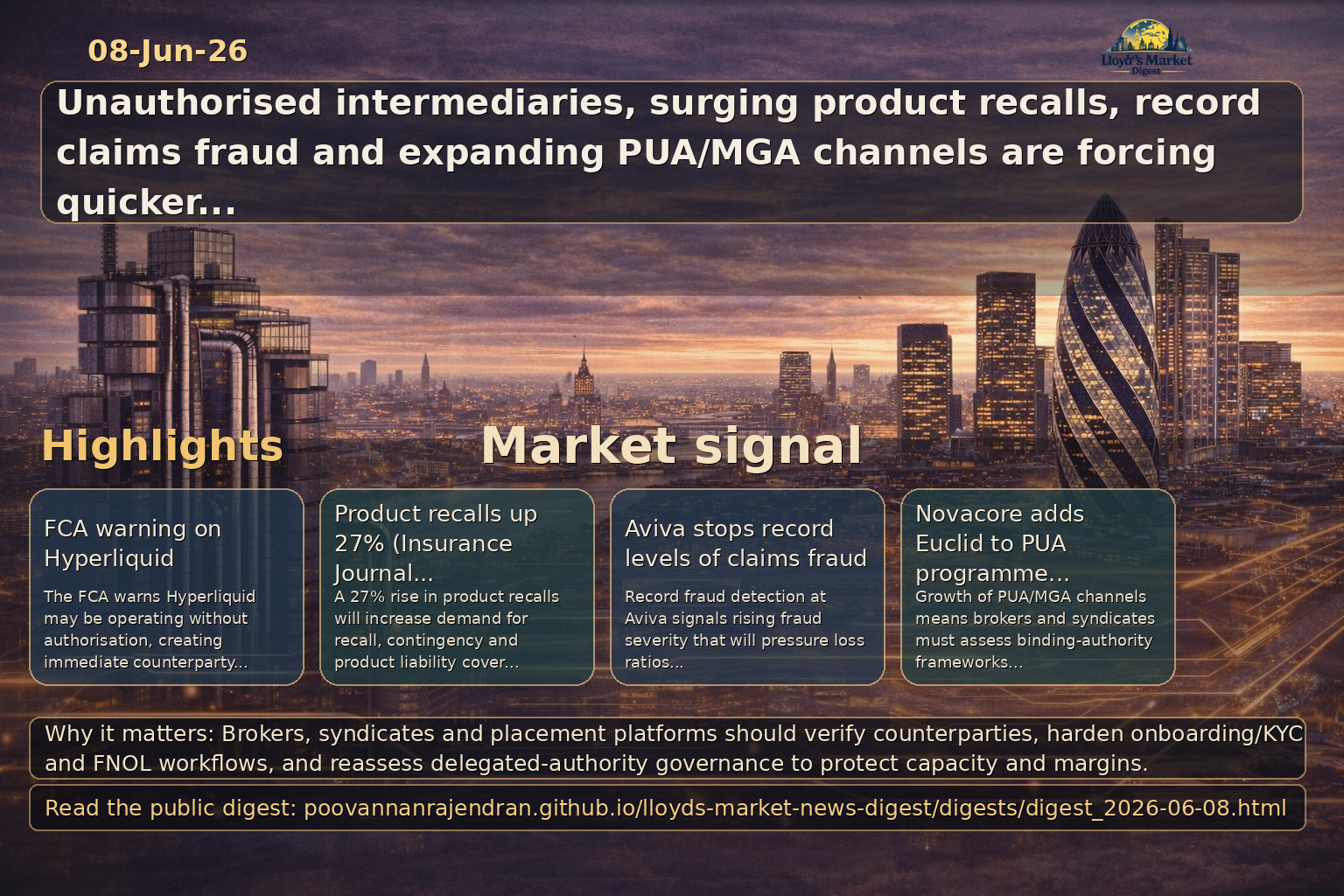
Why it matters: An FCA warning that Hyperliquid may be operating without authorisation poses direct risks to Lloyd's distribution chains: unauthorised intermediaries can misplace premium flows, expose syndicates and brokers to fraud claims, undermine placement platform credibility and create regulatory and reputational exposure for market participants.
- Immediate exposure assessment: verify whether any broker, MGA, syndicate or placement platform has transacted with or received documentation from Hyperliquid; suspend further dealings, trace recent payments and flag affected files to compliance and legal teams.
- Tighten counterparty controls: mandate FCA register checks and documentary proof of authorisation for all counterparties on placement platforms and in broking workflows; apply enhanced KYC/AML and digital identity verification for new or unusual intermediaries.
- Market coordination and reporting: circulate the FCA warning across underwriting and broking desks, notify placement platforms and Lloyd’s market services as appropriate, report suspected fraud to the FCA and law enforcement, and update incident response and client‑communications templates.
Source: insurancejournal.com
Why it matters: The Insurance Journal Research issue aggregates signals—Program Directory prominence, geopolitical risk elevation, and a notable increase in product recalls—that directly affect specialty capacity, program placements and syndicate underwriting strategy.
- Program Directory focus: Indicates continued growth in delegated authority and program business. Strategic implication — brokers and syndicates should prioritise selective MGA/coverholder partnerships and streamline onboarding via compliant placement platforms to capture margin and control loss selection.
- Geopolitical shift to ‘war’ as top political violence exposure: Underwriters and capital providers must re-evaluate war/strikes/PV appetite, tighten treaty terms and pricing, and ensure sanctions/compliance checks are embedded in placement workflows.
- 27% rise in product recalls + supply-chain volatility: Expect increased demand for recall, contingency and product liability solutions. Syndicates and reinsurers should refine underwriting data inputs, consider capacity segmentation for recall-prone sectors, and update claims reserving assumptions.
Source: insurancejournal.com
Why it matters: The Insurance Journal West edition flags regional regulatory actions (California AI executive order, IMR reversals, fines) and program-directory activity in a major market — all of which impact underwriting, distribution and compliance practices for Lloyd’s and global specialty players operating in or writing US-exposed risks.
- California AI executive order: Signals regulatory intervention on enterprise AI risk and workforce disruption. Brokers and syndicates should assess product suites for emerging tech E&O, regulatory liability and change controls; placement platforms must integrate AI-compliance due diligence for large commercial placements.
- IMR reversals and fines in workers’ compensation: Demonstrates state-level claims and regulatory volatility that can materially affect accident-year loss pick and pricing. Reinsurers and capacity providers should stress-test treaties and consider jurisdiction-specific loss creep when negotiating facultative/reinsurance terms.
- Program growth in West / regional market dynamics: Western US program expansion—especially in tech, entertainment and gig-economy exposures—creates targeted opportunities for Lloyd’s syndicates and brokers to deploy delegated authority via digital platforms, but requires strengthened oversight, data-sharing and audit capability.
Source: insurancetimes.co.uk
Why it matters: Aviva’s record fraud detection highlights material operational and underwriting risk that will affect capacity, loss ratios and placement practices across Lloyd’s and global specialty markets — particularly where motor and casualty lines intersect with brokered placements and digital platforms.
- Underwriting and capital: Rising and evolving fraud increases claim severity volatility, driving re‑pricing, tighter terms, higher reserves and potential reallocation of capacity away from exposed classes.
- Broker and placement controls: Brokers must strengthen first‑notice‑of‑loss processes, enhanced due diligence on repair/credit hire networks, and embed fraud clauses and data verification into terms before syndicate placement.
- Platform and syndicate response: Placement platforms, syndicates and managing agents should prioritise shared claims analytics, real‑time fraud scoring, API integrations with repair/credit markets and coordinated intelligence with reinsurers to reduce leakage and protect underwriting margins.
Source: reinsurancene.ws
Why it matters: Historical reinsurance and catastrophe reporting highlights precedent for capital repositioning and pricing cycle impacts that inform current Lloyd's and syndicate capital strategies.
- Use historical nat-cat loss data to validate catastrophe models and stress tests for syndicate portfolios and retro reinsurance programmes.
- Anticipate periods of capital reallocation or divestment by global reinsurers and plan contingent capacity sourcing with brokers and platforms.
- Leverage lessons from past pricing cycles in renewal negotiation strategies and in setting risk appetites for property and catastrophe-exposed specialty lines.
Source: reinsurancene.ws
Why it matters: Addition of a specialist A&E underwriting team into a PUA demonstrates the growth of MGA/PUA channels that broaden distribution for niche professional liability products relevant to Lloyd's and specialty markets.
- Underwriters and syndicates should assess binding authority frameworks and appetite alignment before allocating capacity to MGAs/PUAs.
- Brokers must adapt placement strategies to leverage PUA distribution for design professional E&O while preserving margin and data transparency.
- Placement platforms should prioritise straight-through processing and delegated authority controls to accelerate access to niche A&E exposures.
Source: reinsurancene.ws
Why it matters: The ICA–ICNZ MOU formalises regional cooperation on disaster resilience, with direct implications for pricing, regulatory expectations and reinsurance programme design for exposures in Australia and New Zealand.
- Monitor evolving regulatory guidance and public-private resilience programmes that may alter coverage terms, claims expectations and pricing in the ANZ market.
- Reinsurers and syndicates should recalibrate catastrophe accumulation and retro strategies to reflect coordinated regional mitigation efforts and changing model inputs.
- Brokers and placement platforms need to standardise data capture and reporting for ANZ risks to support faster renewals and resilience-linked product structures.
Source: reinsurancene.ws
Why it matters: Appointment of a CFO at a scaling specialty platform signals heightened focus on financial control, reporting maturity and potential capital transactions—key considerations for partners, syndicates and brokers.
- Evaluate potential partners’ finance leadership and reporting capabilities as indicators of readiness for syndicate launches, capital raises or rating agency engagement.
- Expect accelerated investment in finance systems, KPIs and governance that improve counterparty transparency for brokers and placing platforms.
- Use CFO-driven strategic planning as a trigger to revisit reinsurance buying, capital allocation and product profitability assumptions.
Source: reinsurancene.ws
Why it matters: Atrium’s creation of a standalone Product Recall class and senior hire highlights product recall as an emerging specialty line within the Lloyd's ecosystem, requiring specific underwriting, claims and supply-chain expertise.
- Syndicates should evaluate product recall capacity as a complement to casualty portfolios and consider cross-selling opportunities with manufacturing clients.
- Brokers must develop data-rich submissions (supply-chain, recall history, containment plans) to secure appropriate capacity and pricing for recall programmes.
- Placement platforms need capabilities for rapid claims notifications, supply-chain analytics and integration with third-party recall response services to support these policies.
Source: newsnow.co.uk
Why it matters: Continuous headlines from Armenia indicate heightened regional attention and potential volatility; for Lloyd’s market participants this feeds directly into political violence, state-backed risk assessments, and sanctions/compliance exposure for energy, trade credit and property accounts.
- Underwriting: Reassess political violence and conflict exclusions for regional property, energy and D&O accounts; stress-test accumulated exposure in the Caucasus corridor.
- Brokers: Heighten client due diligence and advise on tailored wording for political risk and sanctions clauses; consider alternative placement strategies where capacity is constrained.
- Platforms/Syndicates: Monitor sanctions lists and compliance workflows on placement platforms; ensure real-time alerts and capacity reallocation tools are in place to respond to rapid risk shifts.
Source: newsnow.co.uk
Why it matters: Armenian political news (election outcomes and party control) alters sovereign risk profiles and political stability assessments that are material to treaty and facultative placements across credit, political risk and trade lines.
- Underwriting: Update country risk ratings and scenario models to reflect electoral outcomes and potential policy shifts impacting state guarantees and sovereign obligations.
- Brokers: Re-evaluate client exposures to government contracts and supply-chain counterparties; present contingency placement options to corporates with Armenia-linked operations.
- Platforms/Syndicates: Ensure syndicate country exposure dashboards and treaty aggregations incorporate updated political-risk factors to manage accumulation limits.
Source: newsnow.co.uk
Why it matters: Coverage of Prime Minister Nikol Pashinyan and associated political developments is a proxy for foreign policy direction and potential friction with regional powers—key for war, terrorism and political violence underwriting as well as multinational brokered placements.
- Underwriting: Incorporate directional policy risk—e.g., westward alignment or regional tensions—into pricing and exclusions for kidnap & ransom, political violence and trade credit lines.
- Brokers: Counsel multinational clients on continuity and supply-chain risk in the region; prepare tailored policy options including layered war and political-risk programmes.
- Platforms/Syndicates: Activate rapid re-underwriting protocols for placements touching Armenia-related exposures; coordinate with reinsurers on treaty protection for sudden escalations.
Source: newsnow.co.uk
Why it matters: Local reporting on Somerset and surrounding English counties highlights micro-level flood and weather events that cumulatively impact residential and commercial property portfolios and inform UK-centric catastrophe frequency models used by syndicates.
- Underwriting: Recalibrate flood risk models and property underwriting guidelines for exposed postal sectors and coastal/riverine locations; reassess flood mitigation crediting.
- Brokers: Use hyper-local intelligence to advise corporate and SME clients on coverage gaps (flood, business interruption) and to source parametric options where appropriate.
- Platforms/Syndicates: Integrate local event feeds into exposure management tools to detect accumulation concentration and to trigger post-event claims readiness and capacity reallocation.
Source: newsnow.co.uk
Why it matters: Bath and regional UK municipal news can signal shifts in local planning, infrastructure investment and property valuations that affect municipal liability, construction and property portfolios underwritten by specialty syndicates and MGAs.
- Underwriting: Monitor local planning decisions and infrastructure projects for emerging latent risks in construction and excess liability portfolios.
- Brokers: Engage local clients on compliance, indemnity and construction-period covers; leverage municipal insight to tailor extended reporting and risk control services.
- Platforms/Syndicates: Capture municipal-level data within placement platforms to refine risk selection and to price latent accumulation in urban portfolios.