Source: businessinsurance.com
Why it matters: Severe storm impacts in Tokyo raise nat‑cat accumulation, placement speed and reinsurance considerations for Lloyd’s syndicates and global specialty markets.
- Increased short‑term claims and potential aggregate losses require syndicates to reassess exposure concentrations and retrocession programs to protect capital.
- Brokers and electronic placement platforms must expedite coastal property capacity matching and catastrophe modelling data to meet rapid slip demands.
- Higher demand for parametric and non‑traditional products; syndicates should coordinate underwriting limits and attachment strategies to preserve capacity across correlated exposures.
Source: businessinsurance.com
Why it matters: A potential $1bn AML fine for a major bank elevates regulatory and operational risk that will influence financial lines underwriting, compliance due‑diligence and broker risk advisory services.
- Underwriters of D&O, PI and crime/fidelity lines must tighten underwriting questionnaires and stress test insureds’ AML controls, increasing demand for enhanced risk assessment services.
- Brokers will see heightened client advisory needs on regulatory change, potentially increasing placement complexity and the use of bespoke policy terms and warranties.
- Syndicates and placement platforms should review client onboarding/KYC integration and consider collaboration with RegTech vendors to reduce operational and reputational risk.
Source: businessinsurance.com
Why it matters: Large litigation against a tech platform signals rising media/technology liability and antitrust exposure relevant to specialty lines and tech‑focused syndicates.
- Media liability and technology E&O underwriters should reassess exposure aggregation for large‑scale platform litigation and potential systemic damages.
- Brokers need to map emerging judicial precedents into policy wordings, limits and aggregation clauses for clients operating in digital advertising and content distribution.
- Placement platforms may be asked to support tailored towers, multi‑jurisdictional placements and contingency protections for clients facing protracted high‑value litigation.
Source: businessinsurance.com
Why it matters: Allianz’s bid for a Portuguese insurer underscores ongoing consolidation that will reshape distribution channels, capacity allocation and strategic partnerships for Lloyd’s and specialty markets.
- M&A activity can reallocate capacity and change appetite profiles — syndicates should monitor potential shifts in treaty placements and quota share arrangements.
- Brokers must evaluate counterparty strength and distribution continuity as consolidation may alter broker panels and preferred aggregator relationships.
- Placement platforms should prepare for integration requests and due‑diligence workflows to support faster, compliant transfers of business across merging entities.
Source: businessinsurance.com
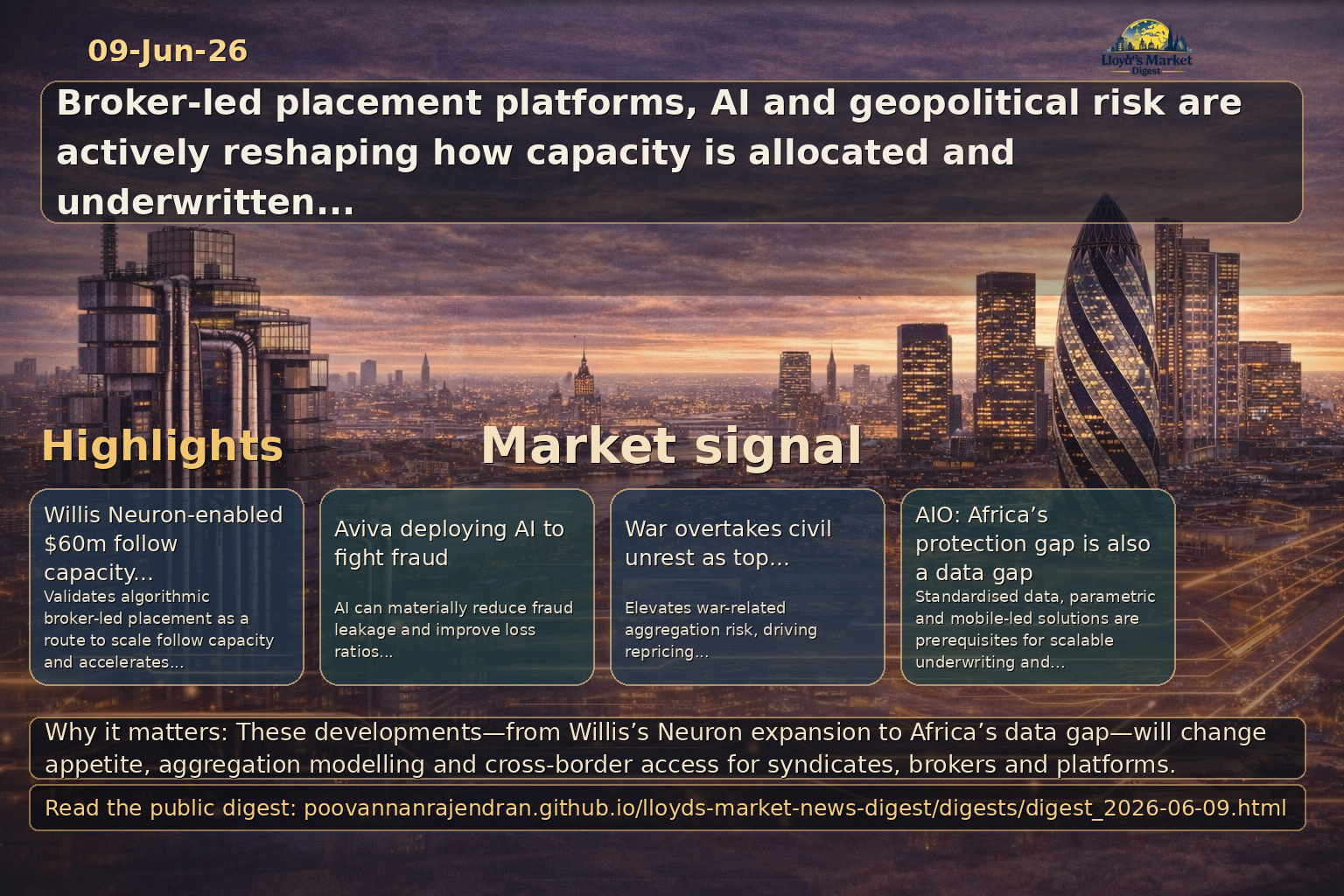
Why it matters: Aviva’s deployment of AI to combat fraud highlights the technology’s role in claims integrity, underwriting efficiency and third‑party vendor risk across specialty lines.
- Adoption of AI tools can materially reduce fraud leakage and improve loss ratios, incentivizing syndicates to invest in analytics and partner with verified vendors.
- Brokers and placement platforms should ensure transparency of AI models used in underwriting/claims to satisfy auditability and regulatory expectations.
- Insurers must balance efficiency gains with model governance, data privacy and operational resilience — creating a market for underwriting warranties around AI vendor performance.
Source: globalreinsurance.com
Why it matters: Willis’s Neuron-enabled expansion signals a step-change in broker-led platform capability to aggregate follow capacity and extend Lloyd’s syndicates’ lead panel reach across international property placements.
- Validates algorithmic placement platforms as a route to scale follow capacity and accelerate transaction speed — syndicates should evaluate inbound dealflow and pro rata allocation models.
- Broadens Lloyd’s syndicates’ international footprint across primary and excess layers; monitor appetite shifts for airports, hospitality, industrial and infrastructure portfolios.
- Competitive imperative for brokers and placement platforms to deepen tech integration and curated lead panels to maintain distribution advantage.
Source: globalreinsurance.com
Why it matters: The appointment of Aegon CEO Lard Friese as Geneva Association chair signals continuity and potential recalibration of industry research priorities that will influence regulatory engagement and strategic risk dialogue.
- Elevates insurer-led research influence on topics likely to affect capital and reserving practices (climate, longevity, systemic risk) — syndicates should track research outputs for strategic planning.
- Strengthens a forum that can shape regulatory and public-policy narratives important to cross-border capacity and specialty lines.
- Brokers and placement platforms should engage proactively to help frame research questions and ensure market implementation considerations are reflected.
Source: globalreinsurance.com
Why it matters: IGI’s approval to operate in GIFT City is a material development for specialty re/insurers and brokers seeking structured access to India via an IFSCA-regulated hub.
- Creates an onshore conduit for treaty and facultative business in India, reducing friction for cross-border placements and attracting capacity-constrained syndicates.
- Syndicates and brokers should anticipate increased competition for regional paper and consider strategic partnerships or quota-share arrangements to retain corridor share.
- Placement platforms and Lloyd’s market participants should evaluate operational and compliance models to optimise participation in GIFT City-originated flows.
Source: globalreinsurance.com
Why it matters: Framing Africa’s protection gap as a data gap highlights a market opportunity for Lloyd’s syndicates, brokers and placement platforms to invest in data, standards and mobile-led distribution to enable scalable underwriting.
- Standardised data sets and insurtech-enabled risk scoring will be prerequisite to responsible scaling — first movers can secure advantaged underwriting margins.
- Mobile-led ecosystems and parametric/index solutions present a pragmatic route to reduce basis risk and reach underserved retail and SME segments.
- Collaborative pilots with local regulators, reinsurers and distribution partners are essential to prove loss models, accelerate acceptance and de-risk capital deployment.
Source: globalreinsurance.com
Why it matters: The IUAI survey elevating geopolitics as aviation’s top threat highlights a broader re-underwriting across specialty lines where systemic and geopolitical stress is reshaping capacity, exclusions and pricing.
- Expect hardened terms and selective capacity withdrawal in geopolitical hotspots; syndicates must reassess limit-setting, war clauses and aggregation modelling.
- Brokers should diversify placement strategies, enhance geopolitical scenario modelling and use dynamic layering to protect clients’ continuity of cover.
- Placement platforms should enable rapid repricing, clause updates and delegated authority adjustments to respond to fast-moving geopolitical events.
Source: insurancejournal.com
Why it matters: War overtaking civil unrest elevates political violence and war exposures material to Lloyd's syndicates, specialty brokers and placement platforms — driving reassessment of underwriting appetite, premium adequacy and war exclusions across global portfolios.
- Reprice and tighten war-risk, kidnap & ransom and contingent BI coverages; allocate explicit capacity for non-proliferation and sovereign-related exposures.
- Integrate real-time geopolitical intelligence into platform pricing engines and binder automation to accelerate placement and avoid adverse selection.
- Coordinate with reinsurers and ILS investors on treaty terms and collateral triggers to ensure capacity resilience amid correlated war losses.
Source: insurancejournal.com
Why it matters: NCCI workers' comp combined-ratio dynamics inform US specialty carriers and Lloyd's syndicates on pricing adequacy, reserving pressure and the potential for capital redeployment; useful for brokers advising clients on loss control and premium optimisation.
- Review state and industry mix exposures in global portfolios; adjust US workers' comp appetite where accident-year loss trends exceed target ratios.
- Engage actuaries to stress-test reserving assumptions and retrocession needs given prior-year reserve development.
- Advise corporate clients on risk control programmes to reduce frequency and leverage deductible structures to improve carrier economics.
Source: insurancejournal.com
Why it matters: A six-figure dog-bite settlement highlights personal injury liability and household liability exposures that affect carriers writing UK/US household and personal lines, umbrella/excess programs and MGAs placing high-frequency liability risks.
- Reassess household and personal liability rate adequacy where frequency-driven small-to-medium claims erode profitability.
- Promote loss-prevention and underwriting controls through brokers — e.g., owner history, animal control disclosures and enhanced policy conditions.
- Consider targeted endorsements and limits management for high-risk animal breeds and host liability exposures placed via specialty MGAs and retail brokers.
Source: insurancejournal.com
Why it matters: Oklahoma's shift to file-and-wait rate approvals signals regulatory trends that could propagate nationally; Lloyd's syndicates and brokers should anticipate increased actuarial scrutiny and longer implementation timelines for rate changes affecting US-exposed business.
- Build regulatory-insight workflows into pricing platforms and extend lead times for US rate-change placements with client notifications.
- Increase documentation and actuarial support for filings to reduce regulatory pushback and potential premium compression.
- Monitor other state legislatures for similar reforms and prepare standardized filing packs for syndicates and MGAs.
Source: insurancejournal.com
Why it matters: Diesel price shocks affecting US agriculture illustrate commodity-price driven operational exposures relevant to parametric products, crop & farm insurers, and syndicates underwriting agriculture and supply-chain contingent business interruption risk.
- Evaluate parametric and index-based product structures to help clients manage fuel-price volatility and yield-correlated exposures.
- Stress-test agricultural portfolio CAT models for combined commodity-price and war-driven supply disruptions.
- Advise brokers to offer combined packages (crop, fuel price hedging advisory, and BI) to reduce basis risk and retain clients.
Source: insurancetimes.co.uk
Why it matters: High-profile global events such as World Cup 2026 concentrate operational and cyber exposures across complex supply chains and broadcast ecosystems, creating single-point-of-failure scenarios that can produce rapid aggregation losses and reputational fallout for capacity providers and brokers.
- Assess aggregation modelling gaps: re-evaluate silent cyber and event concentration in portfolio-level stress tests across syndicates and Lloyd’s underwriting portfolios.
- Strengthen placement clauses and exclusions: work with brokers and placement platforms to clarify coverage triggers, sub-limits and aggregation language for event-related cyber exposures.
- Enhance partner resilience requirements: require demonstrable cyber controls and incident response plans from insureds, venues, broadcasters and key supply-chain counterparties as part of binding authority and facultative underwriting.
Source: insurancetimes.co.uk
Why it matters: CFO transition at a major broker group signals potential shifts in capital allocation, acquisitive strategy and financial governance that affect capacity providers, reinsurance arrangements and strategic partnerships within the Lloyd’s and global specialty distribution ecosystem.
- Reassess counterparty credit and integration risk: syndicates and platforms should monitor changes to broker balance-sheet strategy and integration plans that may affect premium flows and security.
- Engage on financial reporting and capital plans: request clarity on the new CFO’s priorities for investment in technology, MGA funding and M&A to anticipate changes in placement volumes.
- Scenario-test continuity of service commitments: ensure service-level and delegated authority arrangements include continuity protections during executive transition.
Source: insurancetimes.co.uk
Why it matters: Appointment of a head of commercial strategy at a broker focused on commercial lines underscores intensified competition for distribution and the need for differentiated propositions that interface with syndicates, MGAs and placement platforms.
- Align product development with placement partners: brokers should coordinate with syndicates and platforms early in proposition design to ensure capacity and competitive terms.
- Prioritise digital placement integration: accelerate API and data-driven workflows between brokers and platforms to improve speed-to-market for new commercial offerings.
- Monitor broker-led distribution strategies: syndicates should track brokers’ strategic hires as indicators of shifting appetite and potential new business pipelines.
Source: insurancetimes.co.uk
Why it matters: Departure of a senior risk executive amid allegations of non-financial misconduct raises governance and conduct risk issues that are particularly sensitive in the Lloyd’s market and for specialty carriers where reputation and regulatory scrutiny are elevated.
- Reinforce executive vetting and disclosure: syndicates, managing agents and broker partners should tighten background checks and clarify disclosure expectations for senior hires.
- Review conduct frameworks and escalation protocols: update policies across underwriting and placement teams to ensure rapid, proportionate responses to misconduct allegations.
- Communicate with stakeholders and regulators proactively: prepare clear governance narratives to preserve market confidence and meet any regulatory inquiries.
Source: insurancetimes.co.uk
Why it matters: An MGA doubling cyber limits to £10m and internalising claims handling is a material product and operational shift that affects capacity sizing, aggregation risk, claims outcomes and the role of MGA-led distribution in the cyber market.
- Re-evaluate capacity provisioning and aggregation models: capacity providers must run updated aggregation scenarios to reflect higher single-risk cyber limits and related tail risk.
- Coordinate claims governance with capacity providers: ensure claims in‑house models meet syndicate standards for reserving, reporting and reinsurance notification.
- Assess pricing, underwriting and risk mitigation: brokers and underwriters should demand enhanced cyber risk controls and premium adequacy given higher limits and broader access for mid-market insureds.
Source: reinsurancene.ws
Why it matters: Historic Reinsurance News archive provides context on past pricing cycles and broker commentary that informs cyclicality, reserve behaviours and strategic placement decisions relevant to syndicates and brokers evaluating market timing.
- Reference point for pricing-cycle signals and historical loss impacts that underpin current renewal strategies
- Useful archive to validate hypotheses on when reinsurance becomes the cheapest form of capital and implications for Lloyd’s capacity planning
- Brokers and placement platforms can mine archives to enhance predictive models and client advisory material on timing and capital solutions
Source: reinsurancene.ws
Why it matters: CyberCube’s DACH partnership with an Austrian broker signals expanding demand for modelled cyber analytics at the broker level — important for Lloyd’s syndicates and placement platforms offering cyber capacity or ecosystem services.
- Broker access to sophisticated cyber models accelerates risk selection and supports larger-limit placements for syndicates
- Placement platforms should integrate analytics outputs to standardise cyber submissions and speed decisions
- Syndicates can leverage broker-analytics partnerships to underwrite differentiated cyber programmes and refine reinsurance buying
Source: reinsurancene.ws
Why it matters: AIO’s assessment of data scarcity in Africa highlights a structural barrier to scaling specialty and Lloyd’s-led solutions in emerging markets — strategic for syndicates, brokers and platforms aiming to grow exposure responsibly.
- Investment opportunity for Lloyd’s and capacity providers to fund data infrastructure and parametric pilots to close protection gaps
- Brokers should prioritise standardised data collection and partner with local players to improve pricing accuracy and portfolio diversification
- Placement platforms and MGAs can differentiate by offering analytics and data-cleaning services to support underwriting in under-served markets
Source: reinsurancene.ws
Why it matters: Liberty Specialty Markets’ bespoke retail proposition demonstrates productisation and regional hub models that syndicates and brokers should monitor as distribution expectations shift toward localised, value-added underwriting.
- Regional hubs enable faster decisioning for mid-market retail risks and create replication opportunities for syndicates seeking scale
- Brokers should align client presentation and placement strategies to hub capabilities (underwriting, claims, engineering)
- Placement platforms need to support differentiated regional products and streamline handoffs between London, Manchester, Bristol and Dublin workflows
Source: reinsurancene.ws
Why it matters: AM Best’s note on shrinking US D&O underwriting margins warns of emerging strain in a previously profitable line — a signal to syndicates, reinsurers and brokers to reassess pricing, reserves and facultative support.
- Increased scrutiny on reserve adequacy and accident-year development should inform syndicate capital and reinsurance programme design
- Brokers will need to balance client expectations with market discipline; potential resurgence in attachment points or retentions
- Placement platforms should surface D&O loss-development analytics to support underwriting and reinsurance placement decisions
Source: artemis.bm
Why it matters: Weekly top-read items highlight continuing market momentum for sponsor-driven cat bonds and ILS solutions for regional perils, providing a near-term roadmap for capacity formation, pricing signals and distribution strategies relevant to Lloyd’s syndicates, capital partners and wholesale brokers.
- Market signal: Debut and targeted cat bond transactions (eg. German flood sponsorship) indicate growing appetite for territorially-specific ILS solutions — syndicates and capital managers should evaluate underwriting appetite and modelling investments for onshore European perils.
- Distribution imperative: Brokers and placement platforms must prepare for an uptick in sponsor-led transactions by developing streamlined documentation, bespoke structuring workflows and relationships with domiciles/structured vehicles (DACs) to capture mandate flow.
- Capital & governance: The entry of alternative-capital hires and teams (eg. senior appointments at major reinsurers) underscores the need to align governance, reporting and investor engagement practices to attract diversified capital into Lloyd’s and specialty placements.
Source: artemis.bm
Why it matters: Aon’s analysis emphasises structural coverage gaps created by concentrated, capital-intensive digital infrastructure — a commercial imperative for Lloyd’s market participants and brokers to accelerate ART and ILS productisation for long-dated, correlated exposures.
- Product innovation: Digital infrastructure requires bespoke ART structures (parametric elements, multi-year covers, ILS wrappers) — syndicates and capital managers should prioritise adaptable wordings and longevity in capacity commitments.
- Underwriting & modelling: Concentration, interdependency and long-tail demand for data-centre exposures necessitate enhanced peril modelling, scenario testing and aggregation controls to satisfy investors and rating/regulatory expectations.
- Placement & client advisory: Brokers and platforms must develop end-to-end advisory capabilities (risk engineering, portfolio solutions, capital placement across ILS and traditional reinsurance) to bridge insurer/owner needs where conventional market capacity is constrained.