Source: insurancetimes.co.uk
Why it matters: Protest at Lloyd's over Coral Triangle LNG projects highlights escalating ESG and reputational scrutiny for syndicates underwriting fossil fuel developments.
- Reputational and litigation risk for syndicates underwriting LNG projects in biodiverse regions — increased stakeholder and client scrutiny at placement stage.
- Recommended action: underwriters and platforms should enhance ESG due diligence, scenario analysis and disclosure for energy accounts, and prepare targeted communications for brokers and clients.
- Brokers must flag potential non-renewals or tightened capacity from carriers sensitive to activism; consider alternative placement strategies and carve-outs where necessary.
Source: insurancejournal.com
Why it matters: Large-scale compensation programs and potential mass complaints in motor finance create reserve and operational burdens for carriers and distributors in UK and global markets.
- Quantify contingent exposure from consumer redress programs across portfolios and stress test reserves and capital allocations accordingly.
- Engage proactively with regulators and industry bodies to influence remediation frameworks that limit run-on operational costs for carriers and intermediaries.
- Ensure placement platforms capture historical motor-finance warranty data to enable faster triage of potentially affected accounts and automate complaint routing.
Source: reinsurancene.ws
Why it matters: Saudi Re's GIFT City branch signals a broader trend of regulated onshore reinsurance presence in India, changing how brokers, Lloyd's syndicates and placement platforms source capacity and comply with local requirements.
- Implication: Increased onshore capacity reduces reliance on cross-border placements and may alter terms for Lloyd's/syndicate participation in APAC risks.
- Opportunity: Brokers and placement platforms can capture placement fees by facilitating compliant onshore placements and hybrid structures.
- Action: Syndicates should map distribution partners in GIFT City, update placement workflows for local capacity and consider local quota-share or fronting partnerships.
Source: businessinsurance.com
Why it matters: A leadership/profile entry with limited operational content; useful as an indicator of talent movement that can affect broking distribution and client access.
- Talent moves can alter RFP outcomes and broker panel dynamics important to syndicates
- Track senior staff for potential formation of new MGAs or specialised distribution channels
- Profiles provide context for relationship mapping and business-development targeting
Source: artemis.bm
Why it matters: Hamilton’s casualty sidecar demonstrates a scalable route to deploy investor capital into casualty lines, creating a structural substitute for traditional reinsurance capacity.
- Provides multi-year, programmatic capacity that can support underwriting growth without diluting insurer balance sheets — relevant to AUM-backed capital strategies at Lloyd’s and global specialty carriers.
- Signals investor willingness to take casualty risk, increasing competition and potentially exerting downward pressure on casualty rates over time.
- Requires brokers and placement platforms to integrate sidecar economics, investor mandates and investment governance into conventional placement workflows.
Source: artemis.bm
Why it matters: Evidence of room for CalPERS to increase ILS allocations signals a meaningful potential supply of institutional capital into reinsurance and cat bonds, influencing market supply-demand dynamics.
- Large institutional commitments can materially expand the alternative capital pool, pressuring reinsurance rates and improving liquidity for issuers seeking public ILS execution.
- Creates commercial opportunities for brokers to design bespoke vehicle structures and co-investment solutions aligned with institutional mandates.
- Places a premium on transparency, standardisation and reporting from syndicates and placement platforms to attract and retain large-scale institutional allocations.
Source: businessinsurance.com
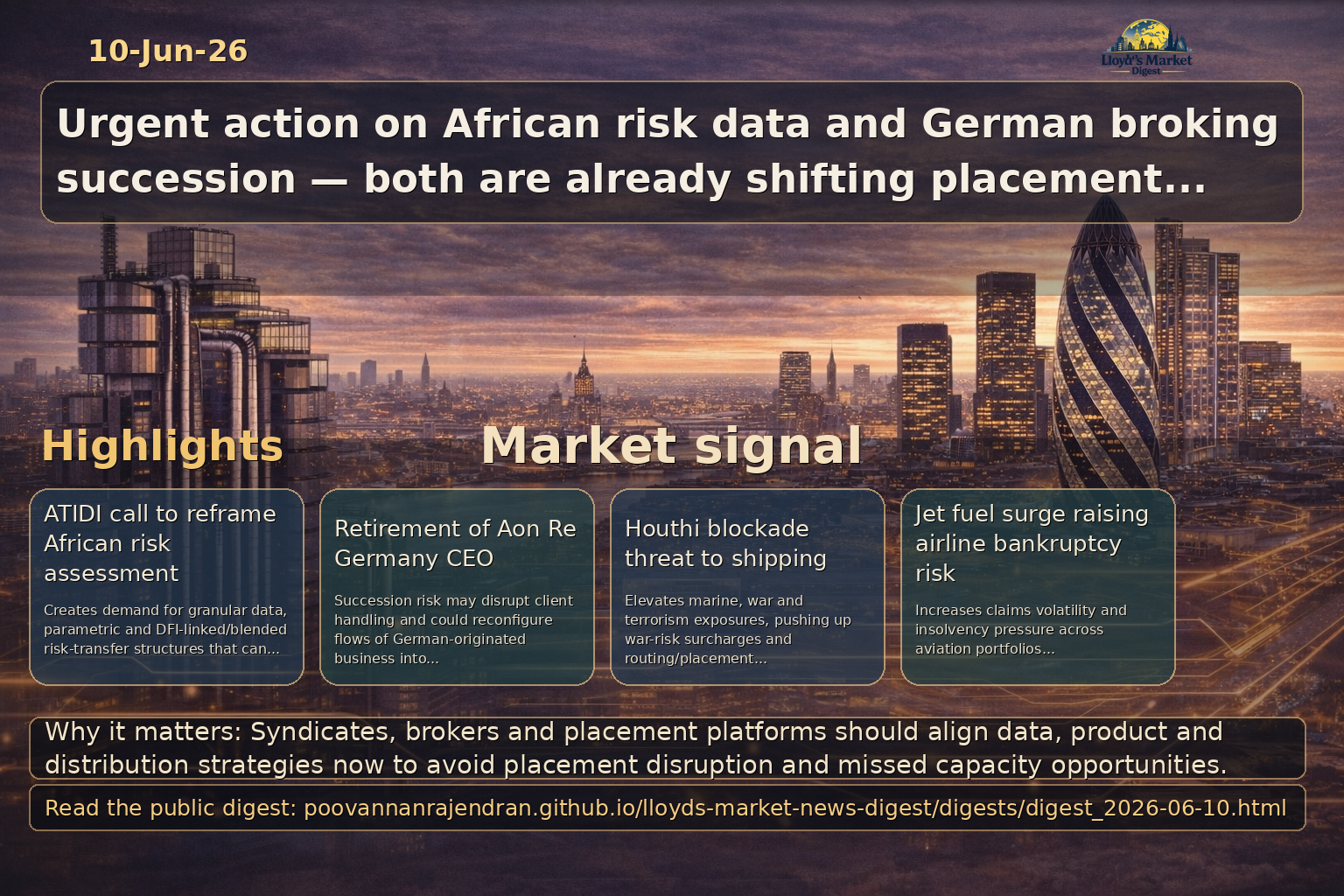
Why it matters: Houthi blockade risk elevates marine, war and terrorism exposures, directly affecting Lloyd's marine underwriters, brokers arranging global hull/cargo placements, and war-risk facilities.
- Immediate pressure on war-risk premium pricing and demand for explicit war/terrorism exclusions or surcharges; syndicates should reassess appetite and reinsurer participation
- Placement complexity rises — brokers must manage routing, premium financing, and war-risk declarations across platforms and delegated authorities
- Opportunity for London market to lead bespoke hull/cargo war-risk solutions and war-risk mutualisation via Lloyd's or specialist facilities
Source: businessinsurance.com
Why it matters: Data deficits in Africa drive mispriced risk and adverse selection — a strategic imperative for syndicates, brokers and placement platforms to invest in granular data, parametrics and local partnerships.
- Persistent underwriting blind spots create capital inefficiency and limit scalable capacity; Lloyd's syndicates can differentiate through data-led underwriting models
- Brokers and MGAs should prioritise partnerships with analytics firms and local insurers to source loss history and exposure data for accurate pricing
- Placement platforms and Lloyd's digital initiatives can standardise data capture and enable index/parametric products to expand capacity into underserved African risks
Source: businessinsurance.com
Why it matters: International General Insurance's expansion into GIFT City represents a distribution and domiciliation shift with implications for cross-border capacity, regulatory arbitrage and placement routing for specialty risks into India and the region.
- GIFT City can become a regional hub for capacity and reinsurance flows; Lloyd's and syndicates should assess domiciled structures or coverholder relationships
- Brokers need to map placement workflows, tax/regulatory impacts and documentation for cross-border bindings and delegated authority
- Placement platforms must enable connectivity to new domiciles and support local licensing, policy wordings and regulatory reporting
Source: businessinsurance.com
Why it matters: Jet fuel price surge increases airline insolvency and consolidation risk, elevating claims volatility and underwriting losses for aviation portfolios held by specialty syndicates and global brokers.
- Underwriters must re-assess attritional and large-loss frequency expectations and incorporate fuel-driven credit stress into pricing and terms
- Brokers should proactively restructure cover, consider contingent BI/credit protection layers and engage reinsurers on capacity terms
- Placement platforms need to support more dynamic exposure monitoring and rapid re-pricing workflows for aviation account renewals
Source: globalreinsurance.com
Why it matters: ATIDI’s call to reframe risk assessment in Africa is directly material to Lloyd’s and global specialty players: improved data and mitigation tools expand investable risk pools, require new underwriting approaches and create demand for bespoke reinsurance and placement solutions that syndicates and brokers can supply.
- Enhances underwriting opportunity: better risk models enable syndicates to price long-term infrastructure, energy and trade exposures in Africa with greater confidence.
- Drives product innovation: demand for parametric covers, blended finance structures and DFI-linked risk instruments that brokers and placement platforms can structure and distribute.
- Strengthens partnerships: opportunities for Lloyd’s syndicates and specialty brokers to collaborate with DFIs and local markets to provide capacity, technical advisory and risk-mitigation solutions.
Source: globalreinsurance.com
Why it matters: The planned retirement of Aon Reinsurance Germany’s CEO is a strategic event for market distribution. As a major reinsurance broker, leadership transition may shift client relationships, placement dynamics and the flow of German-originated business into Lloyd’s syndicates and specialist capacity providers.
- Distribution continuity risk: succession may create short-term disruption in client handling and placement workflows that placement platforms and syndicates should proactively manage.
- Competitive opportunity: leadership change can prompt clients and carriers to re-evaluate broker panels, opening business development windows for competing global specialty brokers and Lloyd’s managing agents.
- Talent and strategic realignment: succession offers a trigger for internal strategic shifts at Aon Germany—monitor for changes in product focus, client segmentation and partnerships that affect treaty and facultative placement demand.
Source: insurancejournal.com
Why it matters: High prevalence of uninsured or underinsured motorists increases tail loss and sub-limit exposure for motor portfolios and highlights advisory opportunities for brokers and syndicates writing motor and casualty lines.
- Reassess motor portfolio aggregation and policy limits exposure; consider offering higher UM/UIM advisory products to corporate clients.
- Embed uninsured-motor exposure analytics in placement platforms to flag concentration and tail-risk to underwriters during bind.
- Work with brokers to design client education and endorsement options that convert uninsured risk into retained or reinsured capacity where appropriate.
Source: insurancejournal.com
Why it matters: Winners and losers emerging from the hard market create counterparty selection risk for brokers and syndicates; underperforming carriers can threaten security and distribution relationships.
- Institute a formal carrier performance and solvency review for panel and platform inclusion, focusing on underwriting metrics and executive stability.
- Prepare contingency plans for client and account migration, including pre-agreed capacity alternatives and syndicate access routes.
- Exploit market dislocation by selectively poaching key talent and niche portfolios, while defending against competitor poaching via retention programs.
Source: insurancejournal.com
Why it matters: C-suite focus on resilience elevates demand for advisory-led risk transfer and new product solutions from brokers and specialty carriers in Lloyd's and global markets.
- Position resilience advisory as a core distribution offering, linking insurance placement with continuity and recovery services.
- Develop modular products that combine risk transfer with resilience spending (e.g., parametrics plus loss-prevention services) to differentiate specialist syndicates.
- Use resilience metrics in underwriting scorecards and placement platforms to price and allocate capital to clients demonstrating proactive risk management.
Source: insurancejournal.com
Why it matters: Organised cargo identity fraud and theft materially raises marine cargo loss frequency and claims severity, affecting pricing, exclusions and insurer controls across international specialty markets.
- Strengthen supply-chain clause requirements and documentary controls in marine cargo placements; require verified chain-of-custody protocols.
- Work with logistics partners to mandate identity verification technology and GPS/telematics as condition precedents for coverage or reduced deductibles.
- Adjust facultative and treaty terms to reflect increased fraud risk, including tighter sub-limits, exclusions for unsecured transfers and enhanced fraud investigation clauses.
Source: insurancetimes.co.uk
Why it matters: COO departure at Sedgwick affects claims operations and loss-adjusting capacity relied on by brokers, syndicates and placement platforms.
- Operational continuity risk for brokers and carriers relying on Sedgwick-managed UK commercial claims workflows — potential for slower settlements and service variance.
- Boardroom and succession focus: sponsors and major clients should request transition plans and SLAs to protect claims outcomes during leadership change.
- Placement implication: brokers should reassess service-level clauses and consider alternative adjuster relationships where concentration risk is material.
Source: insurancetimes.co.uk
Why it matters: MGA NBS Underwriting's PI capacity expansion to £10m via AmTrust partnership materially increases placement efficiency for larger PI programmes.
- Consolidated multi-layer capacity through a single underwriting contact reduces fragmentation and referral delays for high-limit PI placements.
- Brokers gain a simpler placement pathway for clients requiring up to £10m limits — opportunity to market cleaner program structures and faster bind times.
- Placement platforms should highlight this combined facility when matching PI appetite to demand; underwriters should monitor accumulation and aggregation risk across existing placements.
Source: insurancetimes.co.uk
Why it matters: Ripe, a digital MGA, appointed a COO to lead operations and integrations — critical as MGAs scale and integrate with brokers and platforms.
- Operational leadership hire signals acceleration of back-office integration, straight-through processing and broker API roll-outs — expect tighter SLAs.
- C-suite action: ensure MAPs and distribution partners align on integration timelines and data governance to protect underwriting discipline during scale-up.
- Placement platforms should anticipate increased submission volumes from digitally-enabled MGAs and validate capacity routing and referral thresholds accordingly.
Source: insurancetimes.co.uk
Why it matters: Addept's partnership with Howden-owned Protect My Let expands landlord pet-damage coverage — example of broker-MGA collaboration filling product gaps post-regulatory change.
- Product innovation driven by tenant-rights changes creates a new distribution opportunity for brokers and managing agents focused on rental portfolios.
- Brokers and platforms should assess appetite for add-on niche products and ensure underwriting definitions and exclusions align with broader landlord policies.
- Placement impact: such targeted covers can reduce uninsured exposure for landlords and may shift renewals toward providers offering integrated solutions.
Source: reinsurancene.ws
Why it matters: Integration of Property Guardian wildfire intelligence into EigenRisk’s EigenPrism directly enhances underwriters’ ability to assess and price wildfire exposure — a material capability for syndicates, Lloyd’s managing agents and placement platforms focused on commercial property.
- Enables finer risk selection and portfolio stratification for wildfire‑exposed accounts, reducing concentration risk at syndicate level.
- Supports more granular pricing and terms negotiations with brokers, improving loss cost allocation for specialty lines.
- Creates a use case for placement platforms to embed hazard analytics into submission workflows, accelerating decisioning and response.
Source: reinsurancene.ws
Why it matters: Historic archive signals precedent on market consolidation and asset sales (e.g., Swiss Re Admin Re discussions) that remain instructive for current capacity management and strategic capital moves among reinsurers, syndicates and brokers.
- Provides comparable transactions to inform syndicate exit/entry and capital recycling decisions in the current volatile macro environment.
- Historic loss and pricing cycles serve as benchmarks for underwriting cycle planning and long‑term rate assumptions.
- Useful research input for investor relations and boards when modelling the impact of strategic disposals or acquisitions on capacity and balance sheets.
Source: reinsurancene.ws
Why it matters: ANV’s acquisition of ASIA expands a wholesale workers’ compensation platform, illustrating continued consolidation of distribution and the growing role of MGAs/binders — a structural development relevant to Lloyd’s distribution and specialty placement strategies.
- Increases broker/MGA scale to access niche US workers’ comp risk pools, creating more efficient origination channels for syndicates.
- Offers opportunities for capacity deployment via bespoke binding authority and delegated underwriting agreements.
- Integration and cross‑sell risk: managing agents should pre‑empt operational and portfolio aggregation challenges arising from rapid platform consolidation.
Source: reinsurancene.ws
Why it matters: Fitch’s neutral outlook underscores restrained volume growth, claims inflation pressures and commercial lines margin risk — signals that require Lloyd’s syndicates and brokers to tighten underwriting discipline and capital planning.
- Expect constrained appetite in softening commercial lines; syndicates should recalibrate aggregate exposures and strengthen pricing actions where warranted.
- Impacts capital allocation decisions and reinsurance purchasing; managing agents should stress‑test liquidity under elevated claims inflation scenarios.
- Investor communications and rating agency engagement must reflect assumed pricing trajectories and loss cost inflation in business plans.
Source: artemis.bm
Why it matters: Ark’s view underscores a clear market bifurcation: property rate adequacy remains, but casualty is attracting a surge of investor interest with implications for pricing and risk selection.
- Lloyd’s syndicates with casualty portfolios should prepare for heightened capital competition and potential margin compression driven by ILS and asset-manager capital.
- Brokers will need to sharpen negotiating levers — terms, exclusions and pricing — to preserve underwriting economics as investor capital targets longer-tailed liabilities.
- Greater investor interest reinforces the need for rigorous reserving, forensic claims analytics and advanced modelling for casualty exposures.
Source: artemis.bm
Why it matters: Stable positive returns in UCITS cat bond funds validate investor appetite and provide a sustained source of alternative capacity that competes with traditional reinsurance capital.
- Supports continued inflows to ILS vehicles, increasing available capacity for catastrophe risk transfer and retrocession.
- Raises the bar for capital efficiency — brokers should present ILS as a competitive placement alternative alongside syndicates and reinsurers.
- Placement platforms and syndicates must monitor UCITS liquidity and yield curves when pricing risk and structuring multi-tranche solutions.
Source: artemis.bm
Why it matters: Lowered price guidance for MPIUA’s cat bond highlights issuer sensitivity to market conditions and signals potential compression in execution for some offerings despite broader ILS strength.
- Indicates deal-by-deal variability — brokers should recalibrate expectations on spreads and tranche sizing during syndication.
- May increase time-to-market or drive reliance on alternative capital (sidecars, retro) if public ILS terms weaken.
- Placement platforms need flexible structuring and market access to bridge pricing gaps and preserve issuer access to capacity.