Source: insurancetimes.co.uk
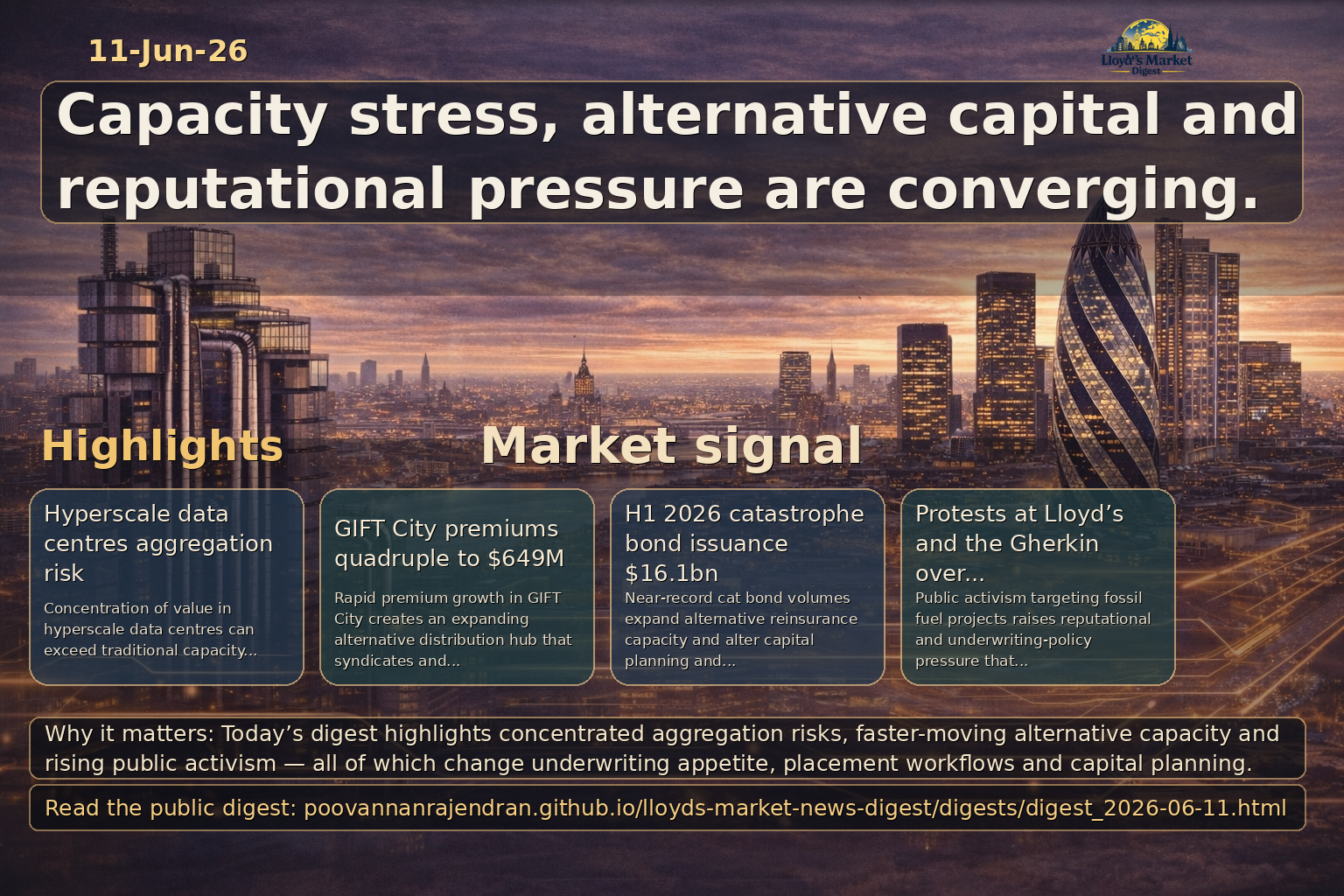
Why it matters: Protests outside Lloyd’s over Coral Triangle LNG projects are a direct reputational and policy signal for the Lloyd’s market; sustained activism can influence syndicate underwriting guidance and broker placement advice on fossil fuel risks.
- Underwriting policy risk: Persistent activism increases pressure for syndicates to re-evaluate LNG and upstream exposure limits and disclosure practices.
- Broker advising: Brokers must proactively address client and carrier ESG expectations in placement documentation and risk presentations.
- Governance response: Syndicates should review ESG escalation procedures and prepare public communications to manage stakeholder scrutiny.
Source: reinsurancene.ws
Why it matters: Gallagher’s strengthening of its PEMA practice in Italy and EMEA reflects growing demand for insurance‑backed transactional risk solutions tied to private equity and M&A activity — an area where Lloyd’s capacity and bespoke wording can be highly competitive.
- Scale transactional capacity: insurers and syndicates should consider expanding dedicated capacity and bespoke policy wordings for M&A/PE transactional risks.
- Broking capability matters: brokers with integrated legal, forensic and claims resolution services will capture higher value mandates — placement platforms should support complex, deal‑specific submissions.
- Cross‑border coordination: deal flows require coordinated global capacity; syndicates should streamline cross‑jurisdiction placement processes and expedite treaty approvals.
Source: artemis.bm
Why it matters: NJM’s target of a $250m Lower Ferry Re 2026-1 cat bond highlights sponsor appetite for material capital market protection for northeast US named-storm exposure and presents direct origination opportunities for brokers and placement platforms.
- Larger-sized issuance by a regional carrier signals willingness of sponsors to pursue capital market solutions for concentrated coastal storm risk.
- Tranche sizing strategy opens opportunities for layered investor participation and bespoke structuring to meet insurer capital targets.
- Brokers and platforms should coordinate investor segmentation and marketing to optimize pricing and placement speed.
Source: businessinsurance.com
Why it matters: Airspace closures after a volcanic eruption create immediate loss potential and business interruption exposures for hull, cargo and liability lines, testing syndicate contingency response and broker crisis placement capabilities.
- Immediate exposure spike for aviation hull, passenger liability and cargo — syndicates must assess catastrophe accumulation and rollback limits for affected sectors.
- Brokers and placement platforms need rapid coordination to source emergency capacity and handle client claims and contingency programs.
- Insurers should review wording for volcanic ash exclusions, BI triggers and supply-chain knock-on effects to avoid coverage disputes.
Source: businessinsurance.com
Why it matters: GIFT City’s premium growth signals an expanding alternative distribution and capacity hub in India that specialty carriers, Lloyd’s syndicates and platforms must monitor for market access and regulatory arbitrage opportunities.
- Rapid premium expansion offers syndicates and MGAs an alternative route to Indian risk, but requires careful navigation of local regulation and capital controls.
- Placement platforms and brokers should evaluate integration with GIFT City operations to maintain competitive distribution and client servicing.
- Underwriters must adjust pricing models and treaty support for lines migrating to the domicile to avoid adverse selection and reserve surprises.
Source: businessinsurance.com
Why it matters: Removal of sanctioned vessels from the Indian registry reduces legal and underwriter compliance risk but highlights ongoing sanctions-driven volatility for marine and energy portfolios placed through global brokers and syndicates.
- Registry actions reduce sanctioned exposure but increase demand for robust KYC/sanctions screening across broker placement platforms and Lloyd’s carriers.
- Underwriters need enhanced voyage-level vetting and re-evaluation of P&I and hull exposures to prevent inadvertent cover for sanctioned entities.
- Claims and recovery teams should prepare for disputes tied to prior-period coverages and potential coverage gaps as vessels reflag or change ownership.
Source: businessinsurance.com
Why it matters: Concentration of value in hyperscale data centers presents aggregation and capacity challenges for property, cyber and business interruption insurers — a systemic test for Lloyd’s syndicates and global specialty markets.
- Aggregation risk from clustered sites can exceed traditional capacity; syndicates should reassess per-location limits, aggregation modelling and reinsurance structures.
- Brokers must source layered solutions, consider parametric or hybrid products, and demand enhanced engineering risk surveys and cyber resilience data.
- Placement platforms should enable granular risk mapping and real-time exposure dashboards to support underwriters and cedants in capacity allocation decisions.
Source: businessinsurance.com
Why it matters: Executive profiles such as Florence Levy provide signals on experienced leadership and board composition trends relevant to broker governance and specialty business strategy.
- Senior appointments and profiles are indicators of succession planning and governance robustness at broker and carrier firms operating in Lloyd’s and global specialty markets.
- C-suite and boards should track such moves to anticipate shifts in distribution strategy, client relationships and product priorities.
- Talent visibility supports stakeholder confidence — firms must communicate continuity plans and role mandates to mitigate disruption risk.
Source: insurancejournal.com
Why it matters: State-backed support for a member-owned captive demonstrates growing appetite for captive solutions to control cost and capacity for niche exposures — a model syndicates and brokers should monitor for client retention and alternative capacity development.
- Brokers and Lloyd’s syndicates should evaluate partnership opportunities with captives as a route to retain profitable accounts and reduce placement friction for affordable housing risks.
- Consider development of tailored reinsurance and facultative capacity lines to support housing captives and to limit accumulation on primary books.
- Placement platforms must ensure capability to place and service captive-originated business, including policy admin, data feeds and capital modelling integration.
Source: insurancejournal.com
Why it matters: High-profile wildfire litigation and arson prosecutions amplify claims uncertainty and can influence underwriting appetites and wildfire mitigation underwriting requirements globally, including syndicate exposures writing US CAT and homeowners business.
- Syndicates should review wildfire exposure modelling and underwriting thresholds in high-risk California-adjacent corridors, including underwriting on rebuilt areas and POI triggers.
- Brokers must emphasise enhanced risk mitigation evidence (defensible space, materials) when negotiating terms and pricing for residential portfolios.
- Underwriters and platforms should anticipate increased defence and litigation costs driving higher loss-adjustment expenses and incorporate into loss picks and reinsurance planning.
Source: insurancejournal.com
Why it matters: FTC enforcement against a DEI consultancy underscores growing regulatory scrutiny of third-party supplier practices; broker and syndicate procurement and certification programmes need stronger compliance oversight to avoid reputational and legal contagion.
- Placement platforms and brokers should audit vendor DEI programmes and contract language to ensure compliance with evolving anti-discrimination and procurement laws.
- Risk committees must factor supplier governance as an operational risk, integrating contractual covenants and termination rights for non-compliant providers.
- Syndicates should brief distribution partners on acceptable third-party practices and incorporate reputational due-diligence into panel and MGA onboarding.
Source: insurancejournal.com
Why it matters: A forecast reduction in Atlantic named storms driven by El Niño modestly reduces near-term peak hurricane accumulation risk but does not materially change longer-term catastrophe planning for syndicates and reinsurers.
- Syndicates and brokers should not materially relax catastrophe protections; maintain disciplined aggregation management and reinsure per established return-period metrics.
- Capital planners can use the reduced seasonal stress to opportunistically optimise reinsurance tower purchases and timing of capital raises or long-term retrocession placement.
- Underwriting teams should recalibrate regional exposure concentrations but continue investment in modelling and scenario analysis for tail events and secondary perils.
Source: insurancejournal.com
Why it matters: Changing UK garden practices that increase surface runoff exacerbate flood risk modelling and could drive higher Flood Re use, influencing pricing and capacity for flood-exposed portfolios across commercial and personal lines underwritten by London market participants.
- Lloyd’s syndicates and brokers should update risk appetite and pricing on UK household and small commercial flood-exposed classes to reflect increased urban runoff and micro-flood drivers.
- Underwriters need location-level granular exposure data and underwriting guidance for non-permeable surface indicators to avoid adverse selection.
- Placement platforms and MGAs should build questions and evidence requirements into submission workflows to capture garden and drainage characteristics for accurate premium and capacity allocation.
Source: insurancetimes.co.uk
Why it matters: Student protests at the Gherkin targeting Swiss Re's stance on Coral Triangle gas projects highlight escalating public and talent-market scrutiny on re/insurers' fossil fuel exposures — a reputational and underwriting-policy risk for Lloyd’s-facing reinsurers and syndicates.
- Reputational risk: Activism amplifies stakeholder scrutiny, potentially prompting stricter underwriting/decline lists for LNG and upstream energy risks.
- Talent and distribution risk: Emerging workforce pledges to boycott firms backing fossil fuel projects can disrupt broker relationships and talent pipelines into specialty teams.
- Recommended action: Review and articulate clear ESG underwriting positions, client communication strategies and placement protocols to manage activist engagement.
Source: insurancetimes.co.uk
Why it matters: Allianz Commercial’s distribution leadership focus underscores the strategic importance of broker engagement and data-driven insurer differentiation — a model relevant to syndicates and platform carriers seeking 'edge through insight' in competitive specialty placement markets.
- Distribution priority: Syndicates and carriers should invest in analytics and broker-facing insight to earn placement share rather than relying on price alone.
- Claims and outcomes integration: Combining claims, complaints and underwriting performance data will be a competitive differentiator for platforms and delegated authority partners.
- Operational implication: Enhance broker roadshows and strategic account programs to translate insight into sustainable premium growth across specialty lines.
Source: insurancetimes.co.uk
Why it matters: The Amwins–Dragoneer approach to acquiring Steadfast signals continued strategic consolidation between wholesale/retail brokers and capacity providers, with direct implications for London market distribution, MGA partnerships and placement workflows.
- Distribution consolidation: A combined ownership model could reconfigure broker-syndicate access to wholesale placement and delegated authority in London and global specialty hubs.
- Strategic alignment: Splitting retail broker and underwriting agency ownership suggests targeted optimisation of capital deployment and go-to-market strategies.
- Action for platforms: Reassess relationships and pipeline exposure to larger broker groups; anticipate renegotiation of delegated authority and data-sharing terms.
Source: insurancetimes.co.uk
Why it matters: Oxbow’s forecast of motor market profitability despite premium decreases highlights claims performance and pricing dynamics that matter to capacity providers and MGAs exposed to motor lines; offers a lens on market-wide combined ratio trends relevant to capital allocation.
- Profitability signal: A forecasted combined ratio under 100% suggests capacity providers can sustainably support motor lines, influencing placement capacity decisions.
- Claims inflation risk: Low claims inflation in 2025 may reverse with geopolitical or economic shifts; syndicates should stress-test motor portfolios for inflation sensitivity.
- Placement implication: Brokers and MGAs should emphasise claims performance and portfolio segmentation when negotiating motor capacity terms.
Source: reinsurancene.ws
Why it matters: Appointment of a COO at a digital MGA underscores the market priority on operational scale, M&A integration capability and customer‑facing platform reliability — key factors for syndicates and placement platforms when underwriting or providing delegated authority.
- Accelerates M&A integration: expect faster onboarding of acquired portfolios and standardised operating procedures — syndicates should require clear integration KPIs in delegated authority agreements.
- Enhances platform scalability: improved customer operations increase appetite from distribution partners to place flows through the MGA; evaluate capacity allocation and profit share mechanics.
- Signals competition for Lloyd’s MGAs: syndicates and platforms should proactively offer differentiated support (data, API connectivity, capacity) to secure preferred distribution relationships.
Source: reinsurancene.ws
Why it matters: Investment in business development for AUGold — Atrium’s end‑to‑end quote, bind and policy issuance platform — highlights how carriers and syndicates are leveraging placement automation to accelerate binding efficiency and scale specialist risk appetite.
- Increases placement efficiency: expanded adoption of AUGold can materially reduce binding cycle times — underwriters should reassess delegation thresholds and automated rulesets.
- Integration opportunity for brokers/placements: evaluate API and workflow integration to ensure capacity is visible and pricing is dynamically usable in platform flows.
- Disintermediation risk for low‑complexity risks: brokers should identify high‑value advisory roles and seek platform partnerships to retain placement economics on automated volumes.
Source: reinsurancene.ws
Why it matters: Board appointment of a seasoned insurance executive with claims and operational transformation experience signals increased emphasis on claims performance, governance and data‑driven risk oversight — implications for reinsurers, brokers and Lloyd’s syndicates on reporting and product design.
- Heightened governance and oversight: expect stronger demand for claims analytics and outcome reporting from cedants — brokers should prepare enhanced MI packages for underwriting and reinsurance discussions.
- Claims transformation focus: opportunities for reinsurers and MGAs to propose loss mitigation, parametric or claims‑acceleration solutions aligned to improved claims KPIs.
- Strategic vendor selection: carriers and syndicates may prioritise partners with proven claims‑tech and operational integration capabilities when negotiating capacity and delegated authority.
Source: reinsurancene.ws
Why it matters: Senior hire to lead first‑party lines in Africa demonstrates escalating commitment by MGUs to write property, engineering and energy business in the region — a critical signal for Lloyd’s syndicates and placement platforms to refine regional underwriting strategies and retrocession structures.
- Expanded regional capacity needs: syndicates should evaluate tailored reinsurance and retrocession solutions to support increased first‑party writing in Africa.
- Local authority and distribution: placement platforms and brokers must develop local underwriting authority frameworks and partnerships to capture growth with appropriate governance.
- Product and pricing focus: anticipate emphasis on energy, engineering and property risk engineering — underwriters should prioritize granular exposure management and catastrophe modelling.
Source: artemis.bm
Why it matters: Artemis London 2026 signals London’s continued role as a convening centre for ILS and catastrophe bond dialogue, important for Lloyd’s syndicates, brokers and placement platforms seeking to deepen investor relationships and introduce hybrid solutions into syndicate and treaty programmes.
- Conference provides a platform for brokers and syndicates to pre-position primary deals and engage institutional investors ahead of H2 issuance windows.
- Agenda focus on catastrophe bond/ILS mechanics facilitates cross-functional dialogue (underwriting, structuring, legal) needed for hybrid placements.
- Attendance supports placement platform market intelligence and direct investor access, improving execution and pricing outcomes for sponsors.
Source: artemis.bm
Why it matters: The Bermuda ILS Executive Roundtable underscores Bermuda’s strategic importance as a domiciliation, structuring and placement hub for ILS — reinforcing relationships among sponsors, fund managers, legal advisors and rating agencies that influence deal velocity and structure.
- Reaffirms Bermuda’s central role for structuring, legal and regulatory support, which is critical for syndicates and brokers using offshore special purpose vehicles.
- Roundtable findings highlight market momentum and investor sentiment that underpins capacity for near-term issuance.
- Facilitates collaboration between placement platforms, law firms and rating agencies to streamline deal execution and compliance.
Source: artemis.bm
Why it matters: H1 2026 cat bond issuance reaching $16.1bn (with 144A at $15.8bn) demonstrates sustained investor appetite and material alternative reinsurance capacity; this alters capital planning and hedging strategies for primary insurers and Lloyd’s syndicates.
- High issuance volumes expand capacity for transferring peak catastrophe exposures from syndicates and primary carriers to capital markets.
- Projected near-record H1 levels suggest continuing compression in spreads and improved execution for sponsors seeking market-based reinsurance.
- Brokers and placement platforms must scale origination, investor outreach and transaction execution capabilities to capture increased deal flow.
Source: artemis.bm
Why it matters: Icosa’s appointment of an experienced ILS specialist to lead institutional expansion signals accelerating professionalisation and competition in the ILS asset management space, with implications for mandates, product complexity and capital allocation decisions.
- Talent movement toward institutional ILS management indicates growing investor sophistication and demand for large-scale, bespoke cat bond mandates.
- Heightened competition among asset managers can increase capital availability and drive innovation in structuring and risk transfer solutions for syndicates.
- Placement platforms and brokers should anticipate demand for larger, multi-tranche structures and coordinate on investor-ready documentation and analytics.
Source: newsnow.co.uk
Why it matters: Canadian political developments drive shifts in regulatory policy, infrastructure spending and energy transition timelines — all of which affect underwriting assumptions for political risk, environmental liability, construction and public-sector placements relevant to Lloyd’s syndicates and brokers.
- Regulatory and climate policy changes can alter insured exposures and loss frequency for energy, infrastructure and environmental liabilities — syndicates should reassess underwriting criteria and pricing.
- Increased government-led programs and procurement create opportunities for political risk, surety and public-sector liability placements; brokers should package multi-line solutions for insurers.
- Market participants must monitor indigenous reconciliation and provincial policy changes for contingent liability and reputational risk; placement platforms should support rapid policy wordings and endorsement tracking.
Source: newsnow.co.uk
Why it matters: The 2026 FIFA World Cup presents concentrated, time‑bound exposure across multiple jurisdictions (USA, Canada, Mexico) — a high-priority aggregation, contingent business interruption and event liability challenge for global specialty insurers, reinsurers and broking platforms.
- Event cancellation, non-appearance, and contingent BI exposures require coordinated multi-jurisdictional covers and bespoke capacity; syndicates should pre-allocate limits and structure layered reinsurance.
- Aggregation modelling and catastrophe/terrorism scenario analysis are essential to quantify peak accumulation across venues, travel chains and hospitality portfolios — placement platforms must surface real-time aggregation to underwriters.
- Cyber, ticketing fraud and physical security risks increase demand for packaged event liability, cyber and kidnap/contingency products; brokers can lead bundled placements and risk engineering services.
Source: newsnow.co.uk
Why it matters: New York business news signals ongoing economic concentration, large corporate exposures and evolving operational risks (AI adoption, litigation, financial services stress) — a core market for Lloyd’s-originated specialty placements (D&O, cyber, financial lines).
- Concentration of financial institutions and large corporates sustains demand for D&O, financial institutions and cyber capacity — syndicates should calibrate appetite and attachment strategies for high-severity accounts.
- Emerging operational risks (AI disruption, cyber) increase limits and aggregation risk requirements; brokers must integrate incident response and cyber-capacity layering into placements.
- Local regulatory and litigation dynamics in New York influence claim frequency and severity for US-exposed multinational clients; placement platforms should ensure jurisdiction-specific wordings and compliance checks.
Source: newsnow.co.uk
Why it matters: Broad New York state developments matter for exposure concentration (commercial real estate, infrastructure, catastrophe and municipal risk) that can affect portfolio accumulation and capacity deployment from Lloyd’s syndicates and reinsurers.
- State-level infrastructure and real estate trends influence property and casualty exposure concentrations — underwriting teams must stress-test portfolios for storm, flood and urban hazard scenarios.
- Municipal and public-sector activity creates demand for political risk, municipal bond, and surety solutions; brokers should position syndicates for tailored public‑sector offerings.
- Inter-state regulatory and tax developments can shift risk domicile and claims patterns; placement platforms should support flexible jurisdictional placement and endorsement management.