Source: reinsurancene.ws
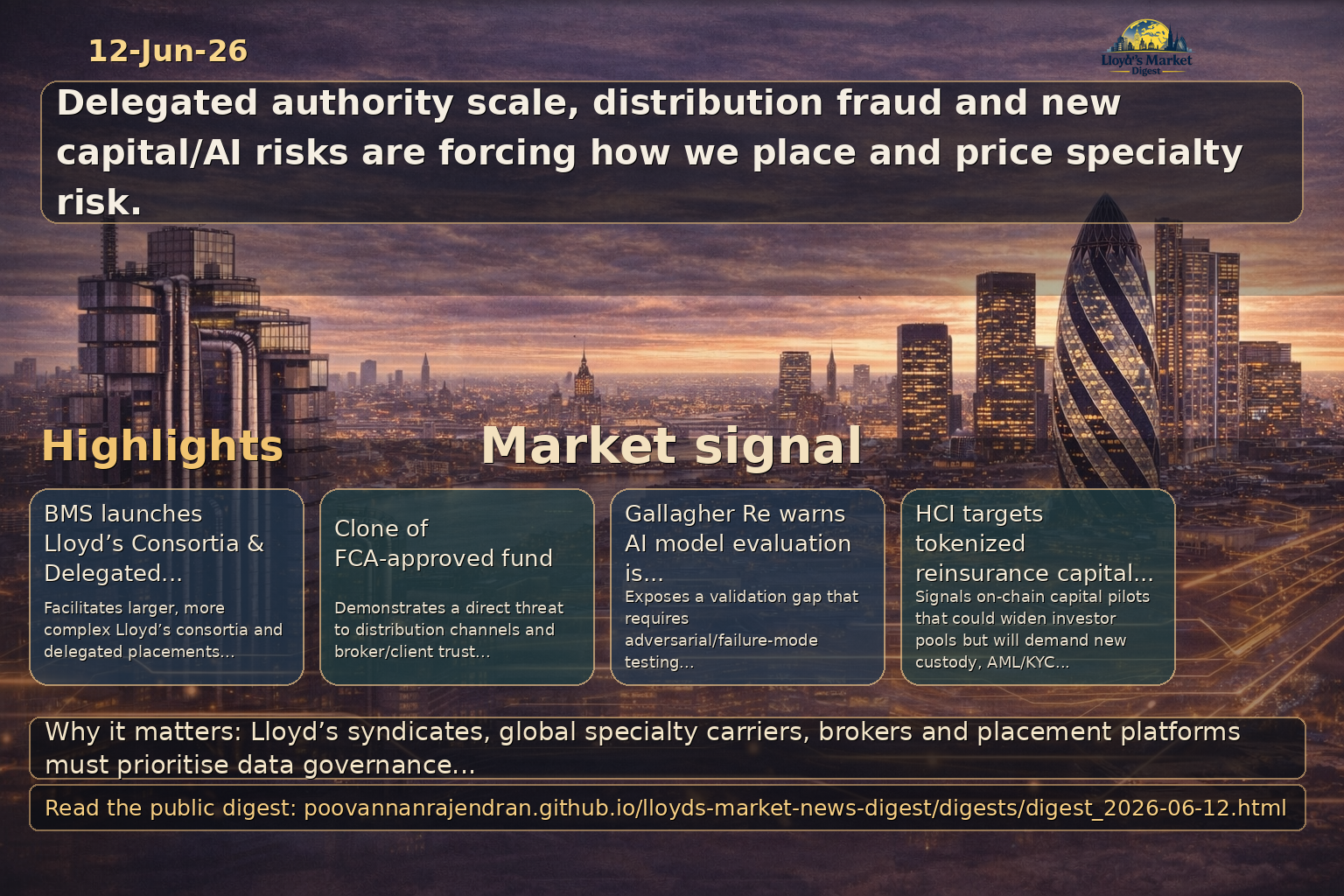
Why it matters: BMS’s launch of a Lloyd’s Consortia & Delegated Authority team directly targets growth areas in the Lloyd’s market — delegated authority, consortia placements and coverholder scale are centerpieces for syndicates and placing brokers.
- Centralizing consortia and delegated authority expertise will facilitate larger and more complex Lloyd’s consortia placements, attracting carrier appetite for scaled facilities.
- Carriers can deploy capacity more efficiently via BMS‑managed consortia; syndicates should reassess appetite for delegated volumes and risk transfer terms.
- Successful execution requires integration with placement platforms, standardized data reporting and reinforced compliance controls to manage delegated authority risks.
Source: fca.org.uk
Why it matters: Clone of an FCA-approved fund demonstrates direct threat to distribution channels and broker/client trust; such clones can impersonate regulated counterparties to extract premiums or sensitive information, damaging placement platforms and syndicate reputation.
- Immediate review of broker and platform onboarding to ensure URL/email verification and signed proof of counterparty regulatory status before any premium flows.
- Implement automated checks for known clone indicators (domain similarity, unofficial email addresses) and require confirmation of FCA firm reference number via FCA public register.
- Communicate an alert to brokers and syndicates with instructions to refuse engagement until direct verification, and update placement platform fraud detection and blocker lists.
Source: fca.org.uk
Why it matters: Unauthorised firm warning (SovereignFX) highlights payment-facilitation and money-laundering vectors that can affect premium flows and client onboarding across global specialty distribution networks.
- Prohibit payments to or through entities not present on the FCA register; require proof of regulated status for any new payment beneficiary before funds are released.
- Tighten AML and source-of-funds verification for clients, intermediaries and introducers, with escalation to compliance for any retail-facing or FX-related counterparties.
- Coordinate with banks and payment partners to implement block lists for suspicious unauthorised entities and to trace any redirected premium payments for recovery.
Source: fca.org.uk
Why it matters: FCA decision to fine a CEO for disclosure failures signals heightened scrutiny of senior manager declarations and fitness and propriety—directly relevant to syndicate leaders, managing agents and platform executives under SMCR.
- Enhance senior manager vetting: mandate deeper regulatory and disciplinary history searches (including overseas regulators) and require periodic re-declarations tied to role changes and significant transactions.
- Strengthen governance attestations for boards and delegated authority holders; require disclosure of investigations, sanctions or regulatory inquiries as a condition of placement and reinsurer acceptance.
- Introduce a remediation and escalation protocol for any undisclosed adverse information discovered post-appointment, including communication templates for regulators, reinsurers and major brokers.
Source: fca.org.uk
Why it matters: Administration of Amplifi Capital (an authorised firm) demonstrates contagion and operational disruption risk for counterparties providing loans, credit broker services and customer finance—relevant to premium finance providers and platforms that rely on third‑party credit arrangers.
- Map and quantify exposure to third‑party lenders and credit brokers used across the syndicate and broker network; prioritize contingencies for premium finance arrangements.
- Require counterparty continuity plans and proof of client money segregation for any credit or loan partner integrated into placement platforms.
- Review contractual terms with premium finance providers to confirm fallbacks for loan servicing, collections and data access in insolvency scenarios.
Source: fca.org.uk
Why it matters: Court‑appointed special administrators for Euro Exchange Securities (EES) and frozen funds highlight settlement, custody and liquidity risk—material for syndicates and brokers reliant on timely securities settlement, collateral transfers and client money protections.
- Validate custody and settlement arrangements for all counterparties and trading venues; confirm who holds client assets and the legal segregation model in place.
- Stress‑test settlement and collateral workflows on placement platforms for delays or freezes; establish fallback settlement corridors and notification procedures for brokers and syndicates.
- Require proof of client money treatment and reconciliation cadence from trading counterparties; insist on rapid access to transaction and client records to support recovery and client communications.
Source: reinsurancene.ws
Why it matters: Aon’s hire of a seasoned casualty placement leader strengthens its middle‑market broking capability and enhances access to syndicates and specialty capacity for casualty placements.
- Strengthens Aon’s middle‑market casualty placement credentials — expect deeper relationships with Lloyd’s syndicates and global specialty carriers.
- Opportunity to standardize placement workflows and leverage delegated authority/coverholder solutions for mid‑market clients to improve hit ratios.
- Competitive signal to other brokers: retain senior placement talent and enhance casualty product teams to protect market share and placement leverage.
Source: artemis.bm
Why it matters: Fitch’s assessment that the Florida reinsurance market is better positioned for 2026 hurricanes — combined with improved market conditions for buyers — affects underwriting, pricing and capacity deployment for firms with concentration in U.S. coastal risks, including Lloyd’s syndicates and specialty writers.
- Strategic implication: Reduced near‑term tail risk for Florida exposures may exert downward pressure on renewal pricing and uplift demand for alternative capital to replace traditional layers.
- Operational consideration: Carriers should validate modelled exposures and capital buffers given state‑level concentration and regulatory scrutiny in Florida.
- Recommended action: Brokers and syndicates must revisit term structures, collateral requirements and placement timing to optimize renewals in a firmer buyer market.
Source: artemis.bm
Why it matters: HCI’s move to issue tokenized reinsurance support via Oxbridge Re and SurancePlus signals progressing market experimentation with on‑chain capital, potentially widening investor pools and altering distribution and settlement mechanics for reinsurance capital.
- Strategic implication: Tokenized capital can reduce friction and open non‑traditional investors, but introduces custody, AML/KYC and regulatory complexity for carriers and brokers.
- Operational consideration: Implementing tokenized instruments requires new operating workflows, legal wrappers, and platform integration between traditional brokers, domiciles and on‑chain providers.
- Recommended action: Pursue controlled pilots with experienced technology and legal partners, coordinate with domiciles and regulators, and evaluate platform partners that can bridge institutional investors and on‑chain settlement.
Source: businessinsurance.com
Why it matters: A five-year capacity deal between a global insurer and a partner signals multi-year capacity commitments that change placement dynamics for specialty risks and influence syndicate capital allocation and broker negotiation strategies.
- Reassesses Lloyd’s syndicate competitive positioning where long-term bilateral capacity deals reduce spot market opportunities.
- Brokers should evaluate leverage and placement sequencing when counterparties lock in multiyear capacity to avoid surprise capacity shortfalls.
- Placement platforms must ensure systems and reporting can reflect long-term capacity commitments to maintain transparency for syndicates and cedants.
Source: businessinsurance.com
Why it matters: A.M. Best’s assessment that a quake will result in limited insured losses is a near-term indicator for catastrophe modelling, reserve adequacy and pricing outlooks for property-exposed syndicates and reinsurers.
- May temper upward reinsurance renewal momentum for seismic-exposed portfolios, creating price relief opportunities at upcoming renewals.
- Syndicates should reconcile model outputs with confirmation from ratings agencies to validate capital and reserve assumptions.
- Brokers ought to communicate these loss signals to clients and use them in timing and structuring of facultative/reinsurance placements.
Source: businessinsurance.com
Why it matters: Gallagher’s majority stake in a Saudi broker reflects accelerated broker consolidation and market access plays in MENA — strategically important for syndicates seeking distribution and local placement solutions.
- Enhances broker-led access to Saudi capacity and regulated distribution channels important for Lloyd’s syndicates considering Gulf exposures.
- Syndicates and MGAs should review local binding authority, compliance and product localisation when engaging with enlarged broker platforms.
- Placement platforms and reinsurers must account for concentrated broker power when structuring commissions, information flows and governance.
Source: businessinsurance.com
Why it matters: Mexico doubling parametric catastrophe cover underscores a rising appetite from sovereigns for fast-pay, index-based solutions — a key growth vector for specialty and Lloyd’s market capacity providers.
- Creates scalable business opportunities for syndicates and MGAs that can underwrite parametric layers with standardized indices.
- Requires underwriters to invest in index validation, basis risk analysis and payout governance to protect syndicate capital and reputation.
- Placement platforms should support parametric workflows and data exchange to facilitate rapid issuance and payout triggers for sovereign and corporate buyers.
Source: businessinsurance.com
Why it matters: Profile pieces on industry figures offer signals about leadership priorities and talent bench strength across brokers, reinsurers and specialty carriers that can affect distribution relationships and strategic initiatives.
- Executives should monitor leadership profiles to anticipate shifts in broker underwriting appetite and strategic focus relevant to Lloyd’s syndicates.
- Succession or role emphasis identified in profiles can indicate future distribution or product strategy changes requiring early syndicate engagement.
- Placement platforms can leverage knowledge of key executives to prioritise integrations and relationship management for high-value broker partners.
Source: globalreinsurance.com
Why it matters: Gallagher Re’s critique of current AI model evaluation highlights a material gap between capability benchmarking and underwriting-relevant failure modes. For Lloyd’s syndicates, specialty reinsurers and brokers this represents an emerging non-modelled aggregate risk that will require new validation, disclosure and pricing approaches.
- Establish model-failure testing standards: underwriters and brokers should demand adversarial and failure-mode test results from model owners; update submission checklists to include provenance, training data characteristics and stress scenarios.
- Product and wordings review: legal and claims teams must design cover language and endorsements addressing ambiguous AI behaviour, systemic failure cascades and third‑party model dependencies; consider capacity loading and explicit exclusions where uncertainty is highest.
- Market collaboration: brokers and placement platforms should convene reinsurers, syndicates and tech firms to define standardized validation protocols and data-sharing agreements to restore insurer confidence and enable scalable capacity deployment.
Source: globalreinsurance.com
Why it matters: Lancashire US’s addition of financial lines, inland marine and environmental liability signals incumbent specialty capacity providers enlarging US footholds. This diversification alters competition dynamics for Lloyd’s syndicates and brokers seeking placement partners in the North American specialty market.
- Reassess capacity allocation: syndicates and reinsurers should review appetite and capital deployment for these lines in the US, adjusting retrocession and aggregate limit strategies to reflect new entrants.
- Platform and underwriting readiness: placement platforms and MGA partners must ensure class-specific intake, rating engines and data sources for marine, environmental and financial lines are in place to capture flow efficiently.
- Distribution and partnership opportunities: brokers should explore DA/MGU collaborations and tailored distribution strategies to place niche US specialty risks where traditional Lloyd’s paper may be less competitive.
Source: globalreinsurance.com
Why it matters: BMS’s creation of a delegated authority and consortia team demonstrates market focus on end-to-end servicing of Lloyd’s consortia and DA business. Centralising operational capability addresses insurer demand for efficient servicing but elevates expectations around governance and performance monitoring.
- Conduct DA governance review: carriers and MGAs should tighten delegated authority KPIs, audit schedules and data transparency requirements before scaling consortia placements.
- Outsource opportunity for syndicates: syndicates can evaluate partnering with specialist brokers like BMS to offload operational servicing while retaining underwriting control and oversight.
- Platform integration imperative: placement platforms should prioritise DA workflows, automated bordereau ingestion and consortium-level reporting to attract delegated authority flow and reduce operational friction.
Source: globalreinsurance.com
Why it matters: Appointing an experienced executive to lead Willis Re’s Bermuda operation underscores Bermuda’s continued strategic role for reinsurance and retrocession capacity. Leadership continuity and market relationships are critical for syndicates and brokers accessing Bermuda capital pools.
- Leverage Bermuda connectivity: brokers and Lloyd’s syndicates should engage Bermuda platforms proactively to secure capacity and structure retrocession that aligns with evolving specialty exposures.
- Regulatory and operational readiness: placement platforms must ensure Bermuda-specific compliance, tax and reporting capabilities to facilitate efficient cross-jurisdiction placements.
- Monitor competitive repositioning: expect accelerated activity from Bermuda-capitalised brokers and reinsurers—review pricing, treaty terms and service models to maintain market competitiveness.
Source: globalreinsurance.com
Why it matters: Aon’s appointment of a chief broking officer for its Global Broking Center signals intensified competition to marry broking, analytics and capital solutions in the London wholesale and specialty market. This raises the bar for other brokers and placement platforms on integrated service propositions.
- Accelerate analytics-capital integration: brokers and syndicates must embed predictive analytics and capital advisory into the broking value chain to preserve client advisory differentiation.
- Strengthen direct market relationships: syndicates should offer differentiated data-driven insights to brokers and clients to remain preferred partners as broking firms broaden product and capital solutions.
- Platform capability enhancement: placement platforms need to deliver seamless interoperability with brokers’ analytics and capital structures to maintain flow and reduce execution latency.
Source: insurancejournal.com
Why it matters: Travelers' findings on longer recovery times for older employees and high injury rates among first‑year workers drive claims severity and frequency dynamics for casualty and workers' compensation portfolios — a direct input to Lloyd's syndicates' reserving, pricing and risk engineering conversations with large employer clients.
- Underwriting: Recalibrate pricing models and loss reserves to reflect age-related severity and extended recovery profiles; consider age-based exposure segmentation and sublimits for high-severity injury classes.
- Brokers: Develop advisory services and loss-control packages (ergonomics, fall-prevention, targeted training for new hires) to reduce claims and justify capacity placement with syndicates.
- Placement platforms: Enhance data ingestion (employee age cohorts, tenure, incident types) and analytics to support binding authority decisions and differentiated appetite across casualty classes.
Source: insurancejournal.com
Why it matters: Texas' recommended regulatory framework for data centers reallocates infrastructure and grid responsibilities to operators — changing the risk profile for property, business interruption and contingent business interruption products and influencing coverage triggers and exposure aggregation for specialty markets.
- Underwriting: Syndicates must reassess exposures tied to power-generation obligations, interconnection liabilities and water usage clauses; introduce specific endorsements addressing operator responsibility for grid upgrades and interconnection costs.
- Brokers: Negotiate policy terms that reflect contractual allocation of utility and infrastructure costs and secure clearer definitions for civil authority and utility failure BI triggers.
- Placement platforms: Incorporate infrastructure-level data (grid interconnects, on-site generation, water system design) into risk models and aggregator views to manage accumulation across tech clusters.
Source: insurancejournal.com
Why it matters: The suspected strike on an Indian‑crewed tanker off Oman underscores escalating maritime and Gulf region war exposures, with immediate implications for hull, cargo, P&I and war/terror covers — a high-priority concern for marine underwriters, syndicates and brokers operating in London and Bermuda markets.
- Underwriting: Re-evaluate war/terror territory definitions, surcharge levels and aggregation limits for the Gulf; consider temporary suspension or tightening of terms for transits via high‑risk corridors.
- Brokers: Expedite placement of additional war risk capacity, coordinate security clauses and evacuation/crew safety endorsements, and advise clients on routing alternatives and contingency logistics.
- Placement platforms: Enable rapid re-rating and notification workflows for brokers and syndicates, and integrate live maritime intelligence to support conditional binding authority and pro-rata premium adjustments.
Source: insurancejournal.com
Why it matters: The Evergrande liquidation and resulting partner-level risk at PwC affiliates highlights contagion concerns for professional indemnity and D&O exposures, especially where auditor conduct and client insolvency interact — relevant to syndicates underwriting PI, audit liability, and related financial lines.
- Underwriting: Increase scrutiny on audit firm clients, tighten capacity and aggregate limits for audit/assurance PI books, and demand enhanced disclosures on engagement concentrations and systemic client exposures.
- Brokers: Advise corporate and financial institution clients on audit‑related contractual protections, insurance-to-value and potential carve‑outs; pursue extended reporting period and run-off cover options where audit risk is material.
- Placement platforms: Implement concentration monitoring for exposures to large developer groups or systemic counterparties and add workflow flags for auditor-related engagements that may trigger elevated PI/D&O scrutiny.
Source: insurancejournal.com
Why it matters: Statements and actions indicating further strikes on Iran elevate political and military risk across energy, maritime and regional property exposures — prompting immediate review of war exclusions, sanctions compliance and accumulation scenarios by specialty carriers and brokers.
- Underwriting: Reassess appetite for energy infrastructure and associated contingent BI exposures; update war risk clauses, sublimits and explicit named-peril coverages for Middle East exposures.
- Brokers: Ensure sanctions screening is current, advise clients on contract continuity, and seek temporary capacity with specialized war risk underwriters where traditional markets withdraw.
- Placement platforms: Provide swift scenario modelling for regional accumulations, automate sanctions checks and enable emergency battlestations for rapid slip redistribution among syndicates.
Source: reinsurancene.ws
Why it matters: Historical archive highlights prolonged margin pressure and the cyclical nature of reinsurance pricing—important context for strategic underwriting and capital planning in syndicates and broker advisory.
- Reinforces that underwriting margin attrition is a multi-year dynamic requiring disciplined portfolio management by syndicates and carriers.
- Provides a benchmark for senior executives when assessing current pricing normalisation and rate adequacy across specialty lines.
- Valuable research input for placement platforms and brokers modelling long-tail exposures and cyclical capital allocation.
Source: reinsurancene.ws
Why it matters: Record-competitive DB buy-in pricing demonstrates abundant insurer capacity and pricing compression—an indicator for carriers and reinsurers on capital deployment and product profitability.
- High insurer capacity and new market entrants are intensifying competition, pressuring margins for transaction-focused business lines.
- Impacts capital allocation decisions for specialty insurers and syndicates that may be asked to provide longevity/reinsurance solutions.
- Brokers should leverage timing and competitive dynamics to optimise placement outcomes and negotiate terms for clients.
Source: reinsurancene.ws
Why it matters: Tokenised reinsurance securities on blockchain signal a material shift in how reinsurance risk and investor access can be structured—relevant to placement platforms, alternative capital strategies, and syndicate distribution models.
- Tokenisation can streamline issuance, ownership transfer and settlement, creating potential efficiencies for syndicates and platform providers.
- Offers new channels for qualified investors to gain structured exposure to reinsurance risk, diversifying capital sources beyond traditional retrocession and ILS.
- Regulatory, custody and investor accreditation considerations will shape adoption timelines; brokers and Lloyd’s participants must assess operational and compliance implications.
Source: risk.net
Why it matters: Hong Kong’s expanding biotech product ecosystem signals underwriting and capital deployment opportunities for specialty writers and Lloyd’s syndicates seeking diversified biotech exposure.
- Reassess biotech underwriting appetites: expanded product suites and derivatives create new exposures and hedging instruments for specialty lines.
- Enhance technical capabilities and data sources for biotech risk assessment (trial outcomes, licensing trends, regulatory shifts in China/HK).
- Work with brokers to develop tailored placement structures and reinsurance solutions that reflect faster licensing cycles and concentrated counterparty risk.
Source: risk.net
Why it matters: Actionable private markets intelligence supports investment strategy for syndicates and provides underwriting insight for exposures tied to private companies and alternative assets.
- Integrate private company datasets into syndicate asset-liability modelling to better align investment risk with underwriting liabilities.
- Require enriched entity mapping and provenance for private assets used as collateral or part of capital allocation decisions.
- Deploy dashboarding that links private market signals to underwriting watchlists and broker placement recommendations.
Source: artemis.bm
Why it matters: Everest’s simultaneous two‑series Kilimanjaro III retro approach underscores large reinsurers’ continued reliance on the cat bond market for multi‑year retrocession capacity — a direct signal to brokers, syndicates and placement platforms about sustained ILS demand for layered and longer‑tenor risk transfer.
- Strategic implication: Confirms competitive demand for retro capacity from capital markets, pressuring traditional retro pricing and capacity allocation.
- Operational consideration: Multi‑series, multi‑tenor executions require coordinated structuring, legal and investor communication across platforms and lead brokers.
- Recommended action: Syndicates and brokers should proactively prepare multi‑year placement propositions and strengthen ILS origination capabilities to capture recurring retro flows.
Source: artemis.bm
Why it matters: Artex’s view that the ILS market is broader and more resilient but more complex highlights the market shift into casualty, specialty and cyber — a development that increases modelling, legal and investor‑communication complexity for syndicates, brokers and placement platforms.
- Strategic implication: Diversification into non‑traditional peril classes expands capital sources but challenges standard risk models and investor appetites.
- Operational consideration: Structuring hybrid and casualty deals requires enhanced actuarial models, bespoke contract terms and investor education to bridge information asymmetries.
- Recommended action: Invest in cross‑disciplinary modelling capability, upgrade placement platforms for bespoke documentation, and develop investor outreach programs to support novel structures.
Source: artemis.bm
Why it matters: CSU’s downward revision to the 2026 Atlantic hurricane forecast and reduced landfall probabilities should temper loss expectations for North America‑focused portfolios, influencing pricing, retention strategies and appetite for catastrophe protection at upcoming renewals.
- Strategic implication: Lower forecasted activity creates potential near‑term pricing relief but does not eliminate tail risk or model uncertainty tied to ENSO dynamics.
- Operational consideration: Risk teams must avoid complacency — maintain scenario testing for extreme events and assess concentration in coastal syndicates and specialty portfolios.
- Recommended action: Use revised forecasts to negotiate better terms for buyers where appropriate, while retaining optionality via multi‑year or parametric placements for residual tail.
Source: newsnow.co.uk
Why it matters: China–Philippines tensions increase regional political risk, marine and energy exposure, and supply-chain volatility — areas where Lloyd's syndicates and specialty brokers provide targeted capacity and political violence covers.
- Elevated political violence and maritime incident exposure — review and tighten political violence and war exclusion/inclusion language for marine, energy and offshore portfolios.
- Supply-chain and trade credit disruption risk — engage with brokers to stress-test cargo/contingent business interruption and consider parametric triggers for trade corridors.
- Regulatory and market access uncertainty — assess need for local underwriting capacity, reinsurance protection and delegated authority adjustments across Asia platforms.
Source: newsnow.co.uk
Why it matters: Mexico City represents concentrated urban risk: high seismic vulnerability, dense insured values and evolving litigation/social inflation trends relevant to property, casualty and municipal programmes.
- Seismic and secondary perils exposure — quantify aggregated peak zone accumulation and revisit pricing, limits and retrocession for earthquake and flood scenarios.
- Social inflation and liability trends — adjust casualty reserving assumptions and policy wordings; consider specialist legal expense and reputational risk products for corporate clients.
- Broker and syndicate placement strategy — prioritise facultative and treaty capacity that reflects urban concentration, and ensure placement platforms capture granular exposure data for real-time aggregation.
Source: newsnow.co.uk
Why it matters: High-profile political developments in Thailand can affect travel, tourism and P&I exposures, and create reputational or regulatory considerations for multinational corporate accounts underwritten by specialty carriers.
- Political stability and event-driven risk — monitor protest and state response dynamics; ensure political violence and riot covers are consistent across regional treaties.
- Tourism and BI exposure — assess business interruption and travel insurance portfolios tied to Thai market disruptions, with focus on guest liability for hospitality insurers.
- Regulatory and reputational impact — coordinate with brokers to map local regulatory responses and heightened scrutiny on claims handling; adjust delegated authority oversight where necessary.
Source: newsnow.co.uk
Why it matters: The 2026 FIFA World Cup is a large-scale, multi-jurisdictional event that generates concentrated short-duration demand for event cancellation, terrorism, cyber, travel and liability covers — an opportunity and stress-test for syndicates, MGAs and placement platforms.
- Mass-event and terrorism exposure — scale facultative and treaty capacity for public liability, event cancellation and political violence; prioritise integrated terrorism and NBCR scenario planning.
- Cyber and ticketing platforms vulnerability — implement cyber and contingent business interruption products for organisers and ticketing platforms; emphasise incident response and crisis management capacity in placements.
- Placement workflow and timing — leverage broker platforms for rapid, auditable allocation of short-term capacity, parametric structures for cancellation, and standardised wording to reduce negotiation friction.
Source: risk.net
Why it matters: Guide on fund data excellence translates to placement platforms and broker distribution: stronger provenance and onboarding discipline reduce operational friction and speed placement while lowering conduct and regulatory risk.
- Prioritise end-to-end data provenance on placement platforms to reduce manual queries and accelerate syndicate binding decisions.
- Design onboarding SLAs and automated validation rules so brokers and syndicates can scale product launches without sacrificing underwriting quality.
- Invest in a single source of truth for product and client data to improve portfolio analytics, compliance reporting and reinsurer transparency.
Source: risk.net
Why it matters: Commodity market shocks are becoming more frequent; syndicates and managing agents must revisit risk frameworks, hedging assumptions and capital models accordingly.
- Update scenario libraries and stress tests to reflect persistent commodity-tail volatility and locational/timing mismatch risks.
- Review hedging and collateral arrangements embedded in placements and retrocession contracts for effectiveness under elevated spreads.
- Coordinate with brokers to capture granular exposure data (physical locations, logistics, supply-chain dependencies) to feed revised underwriting models.