Source: fca.org.uk
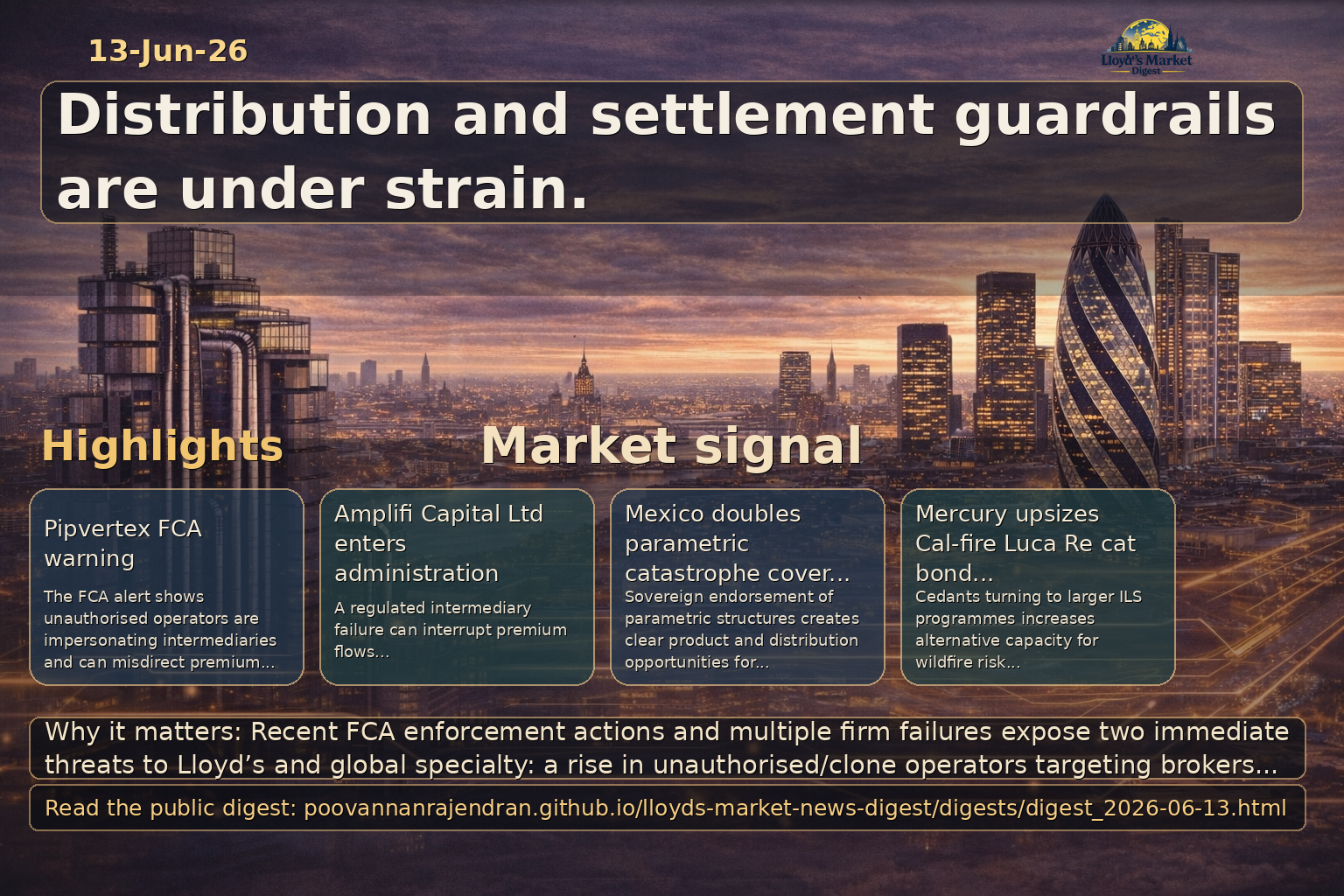
Why it matters: FCA warning on Pipvertex signals active unauthorised operators that may impersonate legitimate intermediaries or offer fraudulent financial services; direct risk to brokers, placement platforms and syndicate premium flows and reputations.
- Validate counterparties against the FCA register and maintain an approved counterparty list on placement platforms.
- Communicate warnings to brokers and clients with clear instructions to verify payment instructions and domain authenticity.
- Implement technical controls: blocklisted domains/IPs, phishing detection, and mandatory verification of new payment beneficiaries.
Source: fca.org.uk
Why it matters: Clone of an FCA‑approved fund demonstrates fraudsters copying authorised firm details to deceive intermediaries and clients; creates risk that premiums or investor funds are misdirected, undermining trust in distribution channels and affecting capacity available to syndicates.
- Require multi‑factor verification of any fund or counterparty identity (FCA firm reference number, telephone verification via published numbers).
- Alert brokers and placement teams to the specific cloned domains and email addresses; mandate confirmation of payee details by a secondary channel.
- Review contractual terms with distributors to ensure liability allocations and remediation steps for clone‑related losses.
Source: fca.org.uk
Why it matters: SovereignFX warning highlights unauthorised FX/payment providers operating in the market; premium payment rails are an attractive vector for fraud that can compromise settlement integrity for brokers and syndicates.
- Mandate use of pre‑approved, regulated payment processors for premium remittances and confirm beneficiary account details before settlement.
- Introduce mandatory reconciliation of premium receipts against bordereaux and placement records on a shortened cadence.
- Enhance onboarding KYC for payment counterparties and require segregation of client monies when third‑party payment providers are used.
Source: fca.org.uk
Why it matters: FCA decision to fine a CEO for disclosure failures underscores governance and fit‑and‑proper risks at senior management level; material for managing agents, syndicate leadership and brokers who rely on counterparties’ disclosures and regulatory standing.
- Review and strengthen senior manager vetting, disclosure and ongoing monitoring policies across managing agents and key brokerages.
- Require enhanced background checks and escalation triggers for regulatory investigations or sanctions against senior executives of counterparties.
- Integrate disclosure breach scenarios into business‑continuity and reputational risk plans, with pre‑defined communication protocols to stakeholders.
Source: fca.org.uk
Why it matters: Amplifi Capital entering administration evidences contagion risk from regulated intermediaries failing; distribution interruptions and potential losses to broker receivables, client lending arrangements and platform partners are material to syndicates underwriting credit‑linked business or relying on intermediary origination channels.
- Perform counterparty exposure mapping to quantify direct and indirect financial links to Amplifi (receivables, commission flows, credit lines).
- Assess contractual continuity clauses and contingency plans for distribution and loan servicing arrangements tied to the failed firm.
- Proactively communicate with affected clients and reassign business where possible to preserve premium flow and policy continuity.
Source: reinsurancene.ws
Why it matters: Oliver Wyman’s appointment of a General Counsel & Chief Compliance Officer signals continued demand for advisory expertise on regulatory, M&A and compliance matters affecting insurers, brokers and placement platforms in the Lloyd’s ecosystem.
- Consulting firms with strengthened legal/compliance leadership will play a larger role in structuring cross-jurisdictional transactions and regulatory programmes for syndicates and brokers.
- Underwriters and placement platforms should anticipate advisory-led improvements in governance, regulatory reporting and deal execution capabilities.
- Engage advisory partners early on complex capital restructurings, platform implementations or regulatory change programmes to reduce execution risk.
Source: reinsurancene.ws
Why it matters: MS Amlin’s appointments of a CRO and CIO reflect a Lloyd’s market trend prioritising risk management and technology — critical for syndicates and platforms modernising underwriting, analytics and distribution.
- Strengthening CRO and CIO roles signals investment in enterprise risk frameworks, data and digital placement capabilities — areas syndicates must prioritise to stay competitive.
- Expect increased focus on data-driven underwriting, platform integration and cyber resilience that will affect broker placement workflows.
- Syndicates should align underwriting tech roadmaps and risk governance to capture workflow efficiencies and demonstrate robust controls to capital partners.
Source: artemis.bm
Why it matters: Mexico’s doubling of parametric catastrophe cover is a high‑profile sovereign endorsement of parametric and capital‑markets solutions, creating precedent and product templates that Lloyd’s syndicates and brokers can adapt for sovereigns, corporates and subnational placements.
- Reinforces sovereign appetite for fast‑paying parametric structures that reduce basis and settlement friction compared with indemnity reinsurance
- Creates structuring and distribution opportunities for Lloyd’s syndicates and specialist brokers to develop bespoke parametric triggers and placement platforms
- Signals potential for greater public‑sector demand that can be layered with traditional reinsurance and ILS instruments, affecting capacity allocation and pricing dynamics
Source: artemis.bm
Why it matters: Mercury’s decision to upsize its wildfire cat bond target underlines cedants’ reliance on ILS to secure California fire capacity and the willingness of issuers to seek lower pricing and greater limits — a dynamic that affects syndicate appetite and broker placement strategies.
- Demonstrates cedant willingness to transfer concentrated wildfire exposure to capital markets, reducing sole dependence on traditional Lloyd’s capacity
- Upsizing pursuit and price sensitivity indicate issuer leverage and improving investor comfort, pressuring syndicates on rate and attachment terms
- Requires brokers and placement platforms to present integrated syndicate+ILS solutions and to manage investor relations for wildfire-related structures
Source: artemis.bm
Why it matters: NJM’s successful upsized $250m Lower Ferry Re cat bond and pricing below guidance demonstrates strong investor demand for northeast US named storm risk, directly competing with Lloyd’s syndicates and reshaping placement options for regional exposure.
- Provides meaningful alternative capacity for named‑storm exposures that historically relied on Lloyd’s and global reinsurers, pressuring syndicate pricing and terms
- Sub‑guidance pricing signals broad investor appetite, shortening execution timelines for issuers and increasing ILS share of available capacity
- Mandates brokers to present balanced placement mixes combining syndicate capacity and ILS to optimise cost and certainty for cedants
Source: businessinsurance.com
Why it matters: Amwins’ expansion of an occupational accident program for contractors underscores the ongoing growth of specialty product distribution through wholesale brokers and MGAs — channels that intersect with Lloyd’s capacity and syndicate appetite.
- Distribution leverage: strengthens wholesale/MGA channels that can accelerate placement volumes for specialty underwriters and Lloyd’s syndicates.
- Product tailoring: contractor-focused occupational accident cover signals demand for niche, high-frequency liability products requiring disciplined pricing and attachment strategies.
- Platform implications: increased appetite from brokers for delegated authority and placement platform integration to speed placement and claims handling.
Source: businessinsurance.com
Why it matters: The five-year capacity deal between Zurich and Jensten highlights a strategic, multi-year approach to capacity provision which affects market stability and long-tail planning for specialty placements.
- Capacity stability: long-dated arrangements reduce volatility at renewal and offer syndicates predictable deployment paths for capital.
- Competitive pricing: multi-year deals can compress near-term rate movements and influence market-wide pricing benchmarks for similar lines.
- Placement strategy: brokers and platforms should prioritise counterparties with secured capacity to improve placement certainty for clients.
Source: businessinsurance.com
Why it matters: Gallagher’s majority stake in a Saudi broker is a clear example of broker consolidation and strategic regional expansion, opening distribution pathways into MENA for global specialty insurers and Lloyd’s syndicates.
- Market access: enhances direct distribution capability into Saudi Arabia — a high-growth market under public sector reform and insurance market development.
- Regulatory and capital considerations: increases need for local compliance and capacity solutions, including reinsurance and Lloyd’s syndicate participation.
- Syndicate opportunity: global syndicates can leverage enlarged broker networks to scale specialised products and tap regional premium pools.
Source: businessinsurance.com
Why it matters: Mexico doubling its parametric catastrophe cover signals sovereign appetite for rapid, model-driven payouts and expanded use of alternative risk transfer — a growth area for specialty markets and placement platforms.
- Product innovation: parametric structures shift focus from indemnity to trigger design and basis risk management — attractive to capital markets and syndicates seeking collateralised capacity.
- Speed and transparency: parametric payouts require robust modelling and data feeds, favouring placement platforms that can handle parametric structuring and settlement.
- Sovereign gateway: successful sovereign programmes create templates for other emerging markets, presenting repeatable opportunities for Lloyd’s and global specialty insurers.
Source: businessinsurance.com
Why it matters: Colorado State’s softer hurricane forecast moderates immediate catastrophe pricing pressure but does not remove model and accumulation risk considerations that remain central to syndicate underwriting and reinsurance strategy.
- Pricing dynamics: a below‑normal seasonal outlook can reduce short-term upward rate pressure but underwriters must avoid over-allocating capacity based on a single forecast.
- Accumulation management: syndicates and brokers should continue to stress-test portfolios against adverse scenarios given model dispersion and geographic concentration risks.
- Renewal strategy: reinsurers and placement platforms may use the forecast as a tactical input, but long-term protection buying should still reflect tail risk and capital planning.
Source: globalreinsurance.com
Why it matters: Willis Re’s appointments to lead non-marine specialties and Bermuda treaty reinsurance strengthen the broker’s specialty underwriting and Bermuda placement capability, shaping competitive dynamics for Lloyd’s-focused distribution and reinsurer relationships.
- Reinforces Willis Re’s ability to originate and place complex specialty risks — syndicates and carriers should reassess appetite and delegated authority partnerships to capture redistributed flow.
- Signals increased broker-led portfolio management in Bermuda — placement platforms must ensure strong connectivity and documentation to support cross-jurisdictional placements.
- Heightens competition for talent and mandate leadership in specialty lines — carriers should prioritise retention of distribution relationships and consider co-development of product suites with lead brokers.
Source: globalreinsurance.com
Why it matters: Gallagher Re’s analysis that current AI model evaluations focus on capability rather than failure modes highlights a substantive gap for insurers and syndicates seeking to underwrite and price AI-related exposures across specialty and technology lines.
- Underwriters must adopt scenario and failure-mode testing, beyond benchmark performance, to quantify tail exposures for AI-centric risks and inform capacity allocation.
- There is an urgent need for standardized AI underwriting frameworks and policy wordings; Lloyd’s and market bodies can lead on model-evaluation guidance to restore insurer confidence.
- Reinsurers and capital providers should consider bespoke capacity or parametric structures for AI risk while new metrics and stress-testing practices are developed.
Source: globalreinsurance.com
Why it matters: Lancashire US’s expansion into financial lines, inland marine and environmental liability materially broadens specialty capacity in the US market, affecting distribution options for brokers and syndicates seeking diversified exposures.
- Expands US placement capacity for brokers — Lloyd’s syndicates and placement platforms should map overlap and identify niches for collaborative underwriting or appetite differentiation.
- Encourages brokers to bundle cross-class solutions for multinational clients; syndicates may need faster underwriting approvals for multi-line exposures.
- Carriers and placement platforms should update underwriting criteria, binding authorities and data collection to integrate new product flows efficiently.
Source: globalreinsurance.com
Why it matters: BMS’s dedicated delegated authority and consortia team targets broking and servicing of Lloyd’s consortia, underscoring the market shift toward scalable delegated structures and the operational demands on placement platforms.
- Anticipate growth in Lloyd’s consortia business; syndicates should assess operational readiness and back-office integration for delegated authority volumes.
- Placement platforms must enhance workflows for consortium placements, reporting and claims handling to meet carrier governance and audit requirements.
- Carriers should review delegated authority governance, data standards and oversight mechanisms to control aggregation risk while enabling distribution growth.
Source: globalreinsurance.com
Why it matters: Appointing an experienced Bermuda CEO positions Willis Re to expand its Bermuda footprint and relationships with local reinsurers and collateral providers—critical for retrocession, capacity sourcing and Lloyd’s-related placements.
- Signals intent to scale Bermuda-originated reinsurance flow; Lloyd’s syndicates and global carriers should evaluate Bermuda connectivity and counterparty arrangements.
- May accelerate local product innovation and increased use of Bermuda domiciled capital — placement platforms need to support Bermuda-specific compliance and settlement processes.
- Encourages strategic alignment between Bermuda operations and London broking desks to optimise cross-jurisdictional distribution and capital deployment.
Source: insurancetimes.co.uk
Why it matters: Senior leadership focused on private client growth materially affects distribution flows into specialty and Lloyd's markets, improving prospects for syndicates and placement platforms to secure higher-value, tailor-made capacity.
- Strengthens broker capability to aggregate and retain private client portfolios, creating a more consistent feed of high-net-worth risks that are attractive to Lloyd's syndicates and specialty carriers.
- Enhances opportunities for bespoke placement solutions: syndicates and global specialty brokers can propose tailored capacity and terms when a broker demonstrates integrated regional leadership and scalable growth plans.
- Increases the strategic value of placement platforms and technology: integrating acquired firms and standardising submission processes will make it easier for underwriters and platforms to access, quote and bind private client business efficiently.
Source: reinsurancene.ws
Why it matters: Historic market archives provide precedent on loss events, pricing cycles and capacity responses useful to syndicate underwriters and placement strategists when modelling catastrophe and underwriting behaviour.
- Use archival articles to validate catastrophe frequency/pricing assumptions and to back-test underwriting responses across cycles.
- Extract historical precedent for structuring large programme placements and catastrophe bond comparatives for syndicate analytics.
- Caveat: older material requires contextualisation against current exposures, climate trends and modern placement mechanics.
Source: reinsurancene.ws
Why it matters: The Descartes–Nextpower parametric SLW solution demonstrates how parametric structures can cover renewable-energy physical perils at scale — a direct opportunity for Lloyd's syndicates and specialty brokers to expand into renewable asset protection.
- Parametric triggers using site-level meteorological data reduce claims friction and speed liquidity for solar operators — attractive to capital providers seeking predictable loss profiles.
- Syndicates and platforms should evaluate integration of similar parametric products into placement flows, particularly for renewable-focused delegations and MGAs.
- Brokers must develop standardized wording and data-origination partnerships; syndicates should stress-test basis risk and accumulation exposure.
Source: reinsurancene.ws
Why it matters: S&P’s analysis of growing private-market links highlights rising direct exposures between insurers, banks and alternative asset managers — a material consideration for syndicate investment committees and capacity providers.
- Private-debt and private-equity allocations increase balance-sheet correlation and counterparty concentration risk for reinsurers and Lloyd's carriers.
- Syndicates and boards should enhance disclosure and stress-testing of private-market exposures and review liquidity contingencies for large-scale loss events.
- Brokers and placement platforms should anticipate demand for reinsurance structures that accommodate insurers’ alternative asset strategies and deliver capital relief.
Source: risk.net
Why it matters: Hong Kong's expanding biotech product ecosystem signals broader avenues for specialty underwriting, structured products and reinsurance that syndicates and brokers should monitor. New derivatives and product liquidity alter capital allocation, policy wordings and claims dynamics for life sciences and clinical trial exposures.
- Assess underwriting competence and capacity for biotech exposures: map existing appetite, identify capability gaps and partner with specialist MGAs or external scientific advisers for complex risks.
- Innovate coverage and placement solutions tied to derivative liquidity: consider hybrid products linking policy triggers to market instruments and develop clear contractual interfaces for claims and settlement.
- Monitor market liquidity and regulatory shifts in APAC: align distribution strategies and capital deployment to evolving listing venues and licensing activity that influence loss frequency and severity profiles.
Source: artemis.bm
Why it matters: Willis Re’s appointment of John Fletcher to lead its Bermuda platform is material to market positioning: it strengthens broker capability in a core reinsurance hub, intensifies rivalry among major brokers and affects access to retrocession and treaty panels used by Lloyd’s syndicates.
- Adds seasoned Bermuda leadership that enhances client access to capital and retrocession markets, benefitting complex treaty placements and large account servicing
- Increases competitive pressure on rival broker platforms (notably Guy Carpenter) for talent, mandates and placement flow into Lloyd’s and Bermuda syndicates
- Supports Willis Re’s ability to originate bespoke solutions and mobilise placement technology, influencing how syndicates engage on multi‑jurisdictional programs
Source: artemis.bm
Why it matters: Willis Re’s hires of Jonathan Ogilvie (Non‑Marine Specialties) and Chris Dart (Treaty, Bermuda) signal deliberate expansion into specialty lines and treaty capabilities — a development that reshapes distribution patterns for complex specialty risks placed into Lloyd’s and Bermuda.
- Strengthens broker product teams that originate non‑marine specialty business attractive to Lloyd’s syndicates, supporting tailored underwriting appetite
- Enhances treaty placement capability in Bermuda, providing capacity and structuring options for syndicates seeking retrocession or quota share relationships
- Indicates strategic investment in senior underwriting and distribution talent by brokers, accelerating platform competition and market consolidation
Source: risk.net
Why it matters: A practical guide on accelerating fund onboarding without compromising data quality is directly relevant to placement platforms, brokers and syndicates that rely on timely, accurate asset and fund data for pricing, collateral assessment and product distribution. For Lloyd's and global specialty players, data excellence reduces friction in multi-jurisdiction placements and supports richer exposure analytics.
- Upgrade platform ingestion and provenance controls: implement standardized taxonomies, automated validation and audit trails to reduce manual broker effort and speed syndicate acceptance decisions.
- Embed data quality KPIs into distributor and broker SLAs: tie speed-to-bind and placement success metrics to data completeness and consistency to align commercial incentives.
- Invest in modular data infrastructure: prioritize scalable APIs and middleware that enable rapid onboarding of new fund/product types while preserving regulatory and actuarial auditability.
Source: risk.net
Why it matters: Elevated commodity volatility changes the baseline for what counts as tail risk, with direct implications for energy, marine, trade credit and political risk exposures placed by brokers into Lloyd's and specialty markets. Syndicates must revisit hedging assumptions, margining, and scenario-based solvency modelling to remain resilient.
- Recalibrate risk frameworks and stress tests: update scenarios to reflect more frequent, persistent commodity shocks and model locational/timing mismatches that erode traditional hedges.
- Refine placement and hedging advice: brokers should present multi-scenario hedging packages and alternative risk transfer structures (eg. parametrics, collars) to protect syndicate balance sheets.
- Review collateral, margin and capital buffers: adjust appetite and terms for energy/commodity-linked risks, and ensure placement platforms surface real-time exposures to underwriters for intra-day decisioning.