Source: insurancejournal.com
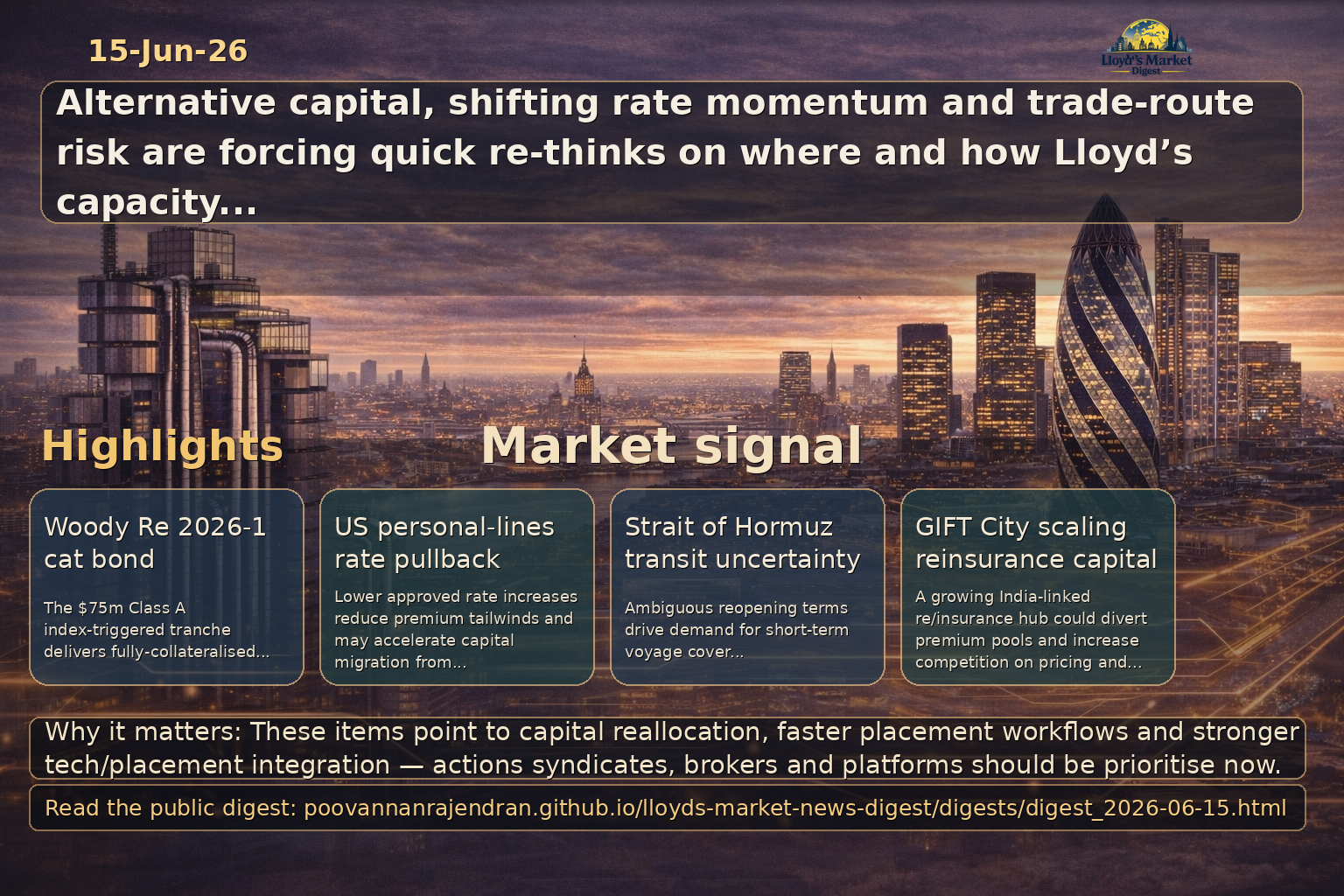
Why it matters: A pullback in US personal-lines rate momentum alters return expectations on commoditised retail business, prompting Lloyd's syndicates and global specialty brokers to reassess where to deploy capacity. Lower approved rate increases reduce premium tailwinds, influence reinsurance demand and may accelerate capital migration to specialty classes where underwriting margins remain more attractive.
- Syndicates should reassess portfolio mix and consider reallocating capital from commoditised US personal lines into higher-margin specialty and international niches to preserve ROE.
- Brokers must update renewal pricing assumptions and stress tests, proactively seeking alternative capacity or bespoke wording where marginal pricing no longer supports risk appetite.
- Placement platforms and MGAs will face margin compression and should prioritise underwriting automation, improved risk selection models and tighter attachment/reinstatement strategies to protect profitability.
Source: insurancejournal.com
Why it matters: Uncertainty around Strait of Hormuz transit arrangements directly impacts marine hull, cargo, P&I and energy war-risk exposures—areas where Lloyd's syndicates and specialty brokers are heavily involved. Ambiguous reopening terms will drive demand for short-term voyage cover, war exclusions adjustments and rapid re-underwriting of exposed portfolios, while placement platforms must support high-velocity binding and data-led route analysis.
- Syndicates should immediately model stressed loss scenarios for hull, cargo and energy portfolios, adjust war-risk appetite and be ready to price conditional/surge premiums for transits until persistence of safer conditions is confirmed.
- Brokers need contingency playbooks with pre-agreed cover structures, rapid facultative reinstatement options and clear negotiation strategies for war/terrorism clause usage to minimise transit delays for clients.
- Placement platforms must enable fast electronic binding, integrate AIS and route intelligence for real‑time exposure management, and support layered/parametric offerings to facilitate rapid, scalable placement during transit volatility.
Source: reinsurancene.ws
Why it matters: GIFT City’s rapid scale-up of re/insurance volumes creates an emergent centre for India-linked risk and global reinsurance capital that will affect Lloyd’s market access, broker routing and capacity strategies.
- Distribution impact: Global and regional brokers will increasingly route India-originated specialty and treaty business via GIFT City, requiring Lloyd’s syndicates to reassess placement strategies and broker relationships to maintain access to that premium pool.
- Alternative capacity and competition: New capital domiciled in IFSC structures can provide reinsurance and retro capacity that competes with London, pressuring pricing and terms for specialty lines.
- Regulatory and operational considerations: Syndicates, delegated underwriters and placement platforms must evaluate regulatory, tax and operational implications of writing business via GIFT City, including implications for binding authority, claims handling and data flows.
Source: reinsurancene.ws
Why it matters: The appointment of an experienced sales leader at a major insurance SaaS vendor signals intensified vendor-led push into the Americas with AI-enabled offerings that will influence broker and syndicate tech stacks and go-to-market execution.
- Acceleration of platform adoption: A stronger sales presence for SaaS/AI solutions increases pace of migration away from legacy systems among brokers, MGAs and syndicates, improving straight-through processing for specialty placements.
- Competitive differentiation for syndicates: Early adoption of AI-enabled underwriting and analytics from scaled vendors can shorten quote-to-bind cycles and improve risk selection — a strategic advantage in competitive global specialty markets.
- Integration imperative for placement platforms: Brokers and Lloyd’s platforms must prioritise API/connectivity and vendor partnerships so that new SaaS capabilities plug into existing placement workflows and delegated authority arrangements.
Source: reinsurancene.ws
Why it matters: Sustained, sizeable insurtech investment creates a pipeline of digital capabilities and distribution models that will reshape how brokers, syndicates and placement platforms interact and source capacity.
- Scale and partnership potential: Large later-stage funding rounds produce vendors capable of enterprise-grade solutions that syndicates and global brokers can partner with to modernise placement, underwriting and claims processes.
- Distribution disintermediation risk: Continued capital to digital distribution models (MGAs, platforms) raises the risk of insurer-broker disintermediation unless brokers and Lloyd’s embrace platform integration and value-added services.
- Global innovation footprint: Investment across multiple jurisdictions expands sourcing options for specialty solutions; Lloyd’s and its brokers should proactively engage with international insurtechs to secure strategic alliances and access to new distribution channels.
Source: artemis.bm
Why it matters: The Woody Re 2026-1 issuance is material because it is the first catastrophe bond to explicitly benefit a Lloyd's syndicate launched in 2024 (Syndicate 3123), using Gallagher Re's Arthur Re platform to deliver cost-efficient, index-triggered retrocession capacity — a template likely to be replicated across Lloyd's and global specialty markets.
- Direct capital relief for Syndicate 3123: Provides fully‑collateralized, multi‑year retrocession that supports underwriting capacity and capital management for a newly established Lloyd's syndicate.
- Platform-driven efficiency: Arthur Re (Gallagher Re) demonstrates lower-cost, faster issuance of index-trigger cat bonds — a model that can broaden access to capital markets for other syndicates and specialty lines.
- Broker and placement implications: Reinforces opportunity for brokers and placement platforms to package and distribute alternative capital solutions, changing how retrocession is sourced and negotiated in the Lloyd's ecosystem