Source: reinsurancene.ws
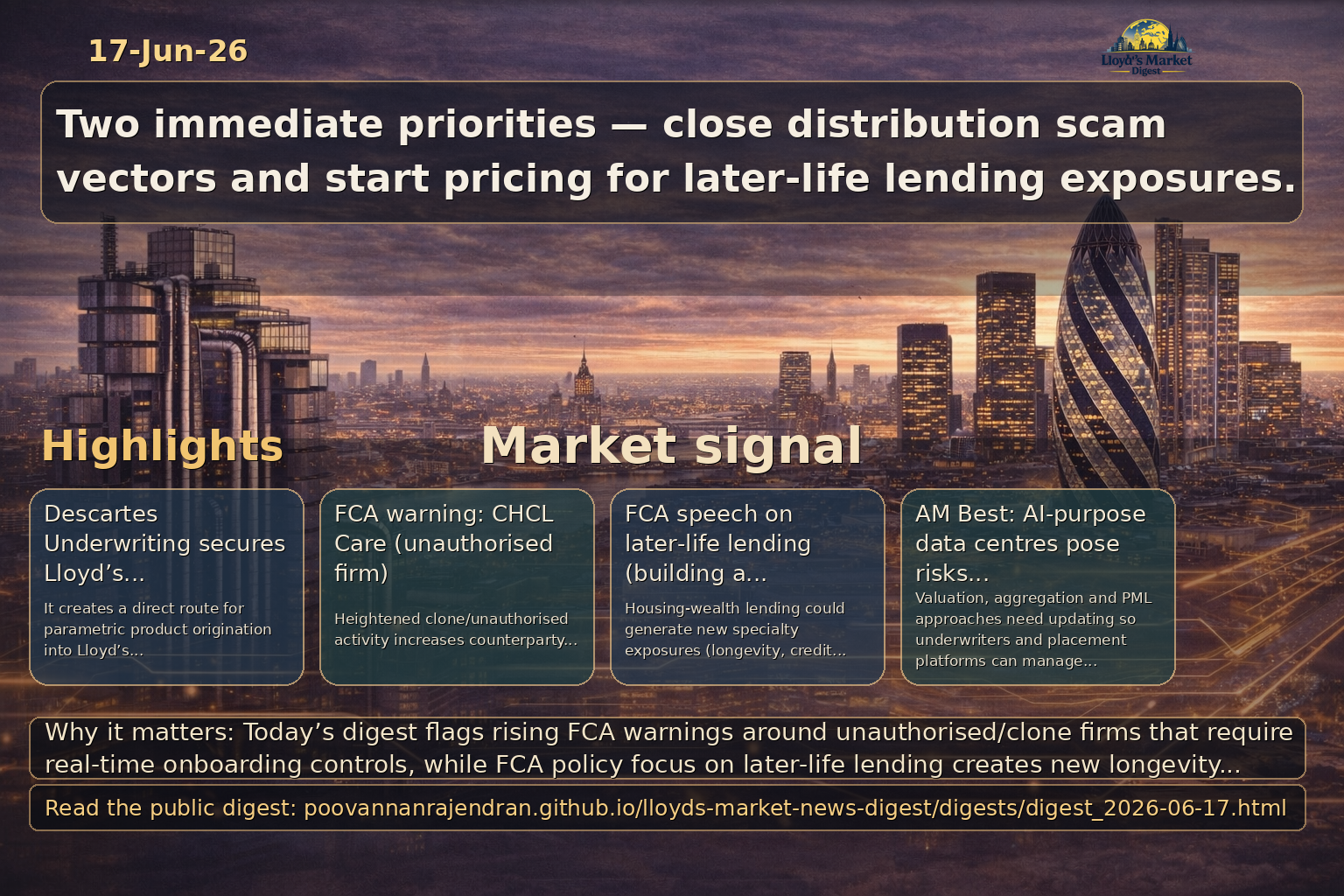
Why it matters: Descartes Underwriting securing Lloyd’s coverholder status through OAK Global provides a direct route for parametric product origination into Syndicate 2843, accelerating distribution of parametric solutions via the London market.
- Creates a streamlined pathway for parametric products to access Lloyd's capacity, enhancing speed-to-market for insurers and brokers seeking indemnity-alternative solutions.
- Reinforces Lloyd's position as a platform for innovative product distribution; syndicates should evaluate appetite for parametric lines and delegated authority partnerships.
- Placement platforms and brokers will need to adapt processes for parametric binding and claims mechanics while leveraging Lloyd's security and distribution reach.
Source: fca.org.uk
Why it matters: FCA warning about an unauthorised firm (CHCL Care) signals heightened fraud targeting of UK clients and distribution channels; this increases counterparty, reputational and contingent liability risk for brokers, platforms and syndicates using third-party introducers.
- Immediate action: integrate FCA Warning List API checks into new business and renewal workflows to block transactions from flagged entities.
- Contract and onboarding: require evidence of FCA authorisation or equivalent for introducers and partners; add indemnities for business routed via unauthorised third parties.
- Operational monitoring: escalate transaction and referral anomalies to compliance and syndicate underwriting teams; run targeted audits of recent placements that originated through non‑standard channels.
Source: fca.org.uk
Why it matters: Theclaimsgroup.co.uk warning demonstrates persistent use of consumer-facing branding to impersonate legitimate claims or distribution services; brokers and placement platforms face elevated risk of misdirected premiums, chargebacks and client losses that can impair capacity allocation and syndicate trust.
- Client protection: enforce segmented escrow or trust-account requirements for new intermediated premium flows until third-party legitimacy is verified.
- Platform controls: implement domain and brand-monitoring tools to detect look‑alike websites and block onboarding of counterparties using suspicious domains.
- Market communication: notify impacted wholesale brokers and coverholders of identified scams; coordinate with syndicates to freeze contested exposures pending verification.
Source: fca.org.uk
Why it matters: Profitinvest warning underscores cross-sector impersonation by entities offering financial products; for Lloyd’s and specialty markets this heightens the need for enhanced digital due diligence on non-traditional originators, aggregators and fintech partners.
- Vendor due diligence: expand AML and tech‑security assessments for fintech onboarding, including penetration test evidence and ownership transparency.
- Data governance: require audit trails for referrals and electronic signatures to trace origination and validate client consent in cases of suspected fraud.
- Claims readiness: update fraud response playbooks with roles for syndicate claims, platform operators and lead brokers to limit contagion and cost exposure.
Source: fca.org.uk
Why it matters: FCA speech on later-life lending signals regulatory focus and market opportunity: housing wealth and reverse‑mortgage style products could create new specialty exposures (longevity, credit, title risk) and distribution complexity for advisers and placement platforms.
- Product strategy: syndicates should model longevity and tail‑risk scenarios tied to later‑life lending products and secondary-market securitisations affecting asset values.
- Distribution governance: require clarity on advice chains and consumer outcomes where specialty capacity supports lending-linked insurance; ensure propositions align with FCA outcome expectations.
- Collaboration: engage advisers, mortgage lenders and platforms to define standard risk disclosures, underwriting data requirements and reinsurance structures suitable for later‑life products.
Source: fca.org.uk
Why it matters: Clone firm alert for desirewealthmanagement variants highlights targeted deception using names of authorised firms; this is directly material to brokers and platforms that rely on brand trust and authorised principal relationships for placement and delegation.
- Authorised-entity verification: mandate live confirmation with FCA Register for any firm claiming authorisation and require proof of registration numbers, firm reference numbers and authorised representative lists.
- Commercial safeguards: update delegation agreements and coverholder audits to include explicit clauses addressing losses arising from dealings with clone or impersonating entities.
- Industry defence: participate in cross-market information sharing on clone incidents and support rapid takedown requests with regulators and domain registrars to protect client channels.
Source: businessinsurance.com
Why it matters: Suncorp's exit from retail tobacco insurance signals selective underwriting withdrawals and reputational sensitivity that can create coverage gaps and pricing dislocation in specialty and Lloyd's markets.
- Market opportunity: specialty syndicates and MGAs can offer tailored products to fill gaps, subject to reputational risk appetite.
- Broker action: proactively review clients’ tobacco and related exposures and present alternative placement options or risk-mitigation structures.
- Risk note: exits can precipitate rapid premium increases and coverage breaches; assess client concentration and continuity plans.
Source: businessinsurance.com
Why it matters: A $400M World Bank resilience programme creates opportunities for layered risk-transfer solutions, public–private partnerships and parametric programmes that specialty markets and placement platforms can help structure and distribute.
- Product development: design parametric and index-based products that can be blended with concessional funding.
- Strategic action: brokers and syndicates should pursue PPP engagements and position placement platforms as transaction enablers.
- Commercial risk: ensure pricing models account for basis risk and donor reporting/contractual requirements.
Source: businessinsurance.com
Why it matters: DEVK's steady reinsurance growth is a signal that reinsurer capacity and appetite are expanding in certain regional markets, affecting global capacity balances relevant to Lloyd's and specialty players.
- Capacity implications: increased reinsurer supply may compress rates for some classes—reassess retention and facultative strategies.
- Broker leverage: use diversified reinsurer appetite to negotiate improved terms for complex placements.
- Watchpoint: monitor retrocession spreads and loss creep that could erode apparent capacity gains.
Source: businessinsurance.com
Why it matters: India’s intent to divest 5% of GIC alters the regional reinsurance competitive landscape, with implications for capacity, pricing and partnership opportunities for Lloyd's syndicates and global reinsurers.
- Market entry: potential strategic opening for international reinsurers and syndicates seeking greater India presence.
- Broker strategy: reassess treaty placements and retrocession corridors tied to Indian risks.
- Regulatory risk: political timing and regulatory oversight could create volatility—maintain flexible capital allocation.
Source: businessinsurance.com
Why it matters: Executive profiles such as Brad Livingston provide insight into decision-makers whose strategic priorities influence placement flows, appetite and distribution relationships in specialty markets.
- Relationship mapping: track senior appointments to identify shifting underwriting or distribution priorities.
- Business development: target new leaders for strategic commercial discussions and collaborative pilots.
- Governance: anticipate change-led reprioritisations that may affect delegated authorities or preferred broker panels.
Source: globalreinsurance.com
Why it matters: Syndicates and market underwriters must recognise that conventional political violence/terrorism models understate probable maximum loss for data centres; an engineering-based PML approach is required to quantify internal structural and systems damage and to set appropriate underwriting limits and placement requirements.
- Commission engineering-focused PML studies for material digital infrastructure exposures to capture internal blast and systems failure modes.
- Revise accumulation management, attachment points and facultative triggers to reflect concentrated values and higher tail severity.
- Update broker submission standards and placement platform data fields to require engineering outputs and resilient design information for underwriting and syndicate aggregation control.
Source: globalreinsurance.com
Why it matters: Price Forbes’ senior facultative hires in Dubai signal expansion of MEA facultative distribution capability; this affects Lloyd's syndicates and global specialty carriers seeking scalable regional placement pipelines and local market expertise for complex treaty gaps.
- Engage new facultative leaders early to secure regional capacity lines and coordinate co-syndicate opportunities for high-severity risks.
- Review facultative appetite and delegated authority frameworks in MEA to capitalise on growing placement throughput while managing portfolio concentration.
- Integrate these broker relationships into placement-platform connectivity and submission routing to reduce friction and speed facultative placements for syndicates.
Source: globalreinsurance.com
Why it matters: Willis’ claims analysis indicates cyber insurance delivers substantial indemnity for the majority of breach events; for underwriters and brokers this validates product utility but necessitates active management of aggregation, wordings and reinsurance recoveries given ransomware severity trends.
- Reassess cyber accumulation models and catastrophe scenarios given high frequency of data breaches and concentrated ransomware severity.
- Standardise policy wordings, sub-limits and exclusion language informed by claims analytics to reduce coverage disputes and improve reinsurance recoverability.
- Use broker claims datasets as input to underwriting guidelines, pricing actions and retrocession buying decisions to ensure sustainable capacity deployment.
Source: globalreinsurance.com
Why it matters: Bermuda’s strategic push into insurtech, digital assets, cyber and shipping underlines its continued relevance as a source of capacity, innovation and domiciliary flexibility for specialty business — a development syndicates and brokers should monitor for new structuring and partnership options.
- Track Bermuda regulatory and tax initiatives that enable new SPV, sidecar and insurtech formations attractive to alternative capital providers.
- Evaluate domicile and platform partnerships in Bermuda for rapid deployment of specialty lines or to host technology-enabled MGAs and digital distribution vehicles.
- Engage Bermuda-based business development teams to source capacity and collaborate on innovation pilots (cyber, digital assets, shipping) that complement Lloyd’s syndicate offerings.
Source: globalreinsurance.com
Why it matters: Aon’s Contract AI demonstrates practical application of large-scale contract analytics to identify exclusions, clause trends and coverage divergence across reinsurance portfolios — a capability that can materially reduce placement friction, accelerate negotiations and lower post-event disputes for brokers and syndicates.
- Pilot contract analytics within placement workflows to accelerate clause validation, reduce manual review time and standardise coverage interpretation across syndicates.
- Feed contract-insight outputs into placement platforms and underwriting systems to highlight market trends, common exclusion creep and negotiation levers in real time.
- Leverage aggregated analytics to inform reinsurance purchasing strategy, dispute mitigation processes and to harmonise wordings across treaty and facultative placements.
Source: insurancejournal.com
Why it matters: AM Best highlights that the scale and complexity of AI-purpose data centers exceed traditional P/C exposures, creating a specialty underwriting and accumulation challenge for syndicates and global reinsurers.
- Underwriting: Lloyd's syndicates and specialty teams must revisit valuation methodologies, sub-limits and wording for builder’s risk, operational interruption and contingent business interruption tied to AI data centers.
- Aggregation: Placement platforms and brokers need improved site-level exposure mapping and aggregate-loss scenarios to quantify concentration across regions and tenants.
- Capacity & Reinsurance: Syndicates should engage reinsurance partners early to structure layered capacity and consider bespoke parametric or hybrid covers to manage tail accumulation.
Source: insurancejournal.com
Why it matters: The Key Bridge litigation underscores evolving marine liability exposures and defenses that will drive claims strategies, wordings and allocation of risk among hull, cargo and third-party liability markets.
- Coverage disputes: Syndicates and brokers must anticipate contested economic loss theories and ensure clear definitions of insured interests to limit exposure to non-proprietary economic loss claims.
- Risk placement: Brokers should structure multi-line placements (hull, cargo, liability) with aligned limits and defense control provisions to avoid gaps or overlapping indemnities.
- Claims playbook: Market legal teams need to codify defense strategies for bridge and infrastructure casualty claims, including early engagement with P&I and hull markets to coordinate indemnity positions.
Source: insurancejournal.com
Why it matters: An interim US–Iran agreement and the prospect of reopening the Strait of Hormuz materially affect marine war-risk exposure, premium adequacy and the reinstatement timeline for vessels and cargo transits.
- War-risk repricing: Syndicates and MGAs must re-assess regional war premiums, deductibles and policy triggers as transit risk evolves from active hostilities to fragile ceasefire conditions.
- Operational readiness: Brokers and shipowners will require rapid clarity on insurer security requirements, convoy/escorts and reroute consequences for coverage applicability.
- Reinstatement timing: Placement platforms should prepare for phased demand as shipowners delay transits until underwriters confirm acceptable risk mitigation and wordings.
Source: insurancejournal.com
Why it matters: The backlog of fertilizer shipments, even after Hormuz reopens, highlights persistent operational and accumulation risks for marine insurers and cargo underwriters.
- Concentration risk: Delayed voyages create clustering of exposures at ports and in transits, increasing potential aggregate losses that syndicates must model and limit.
- Logistics clauses: Brokers should negotiate clear laytime, demurrage and storage clauses to manage exposures arising from congestion and extended onshore storage.
- Commodity price and credit: Syndicates must monitor counterparty credit and commodity price volatility as protracted delays can trigger contingent claims and cargo liabilities.
Source: insurancejournal.com
Why it matters: Publication of the US–Iran draft MOU crystallizes potential scenario outcomes that specialty markets must incorporate into stress testing, policy wordings and capacity planning.
- Scenario planning: Lloyd's syndicates should re-run war-risk and political violence accumulation scenarios against the MOU’s potential timeline and conditional clauses.
- Policy clarity: Brokers must seek endorsements that address cessation of hostilities, retroactive coverage triggers and residual exclusions linked to prior acts of war.
- Reinsurance alignment: Placement teams should synchronize treaty and facultative cover terms with anticipated shifts in primary market exposure.
Source: insurancetimes.co.uk
Why it matters: Appointment signals AR network scaling and distributor-led growth that matters to syndicates and placement platforms seeking delegated authority and feeder channels into Lloyd’s and global specialty markets.
- Reinforces value of AR networks for sourcing SME and niche specialty lines; syndicates should review appetite for AR-originated classes.
- Opportunity to strengthen onboarding, compliance and data flows between ARs and managing agents to protect underwriting quality.
- Consider partnership pilots for product distribution or delegated authority that leverage Gauntlet’s broker development model.
Source: insurancetimes.co.uk
Why it matters: Projected subsidence exposure growth is a material underwriting concern for property portfolios in Lloyd’s and specialty markets; it affects pricing, accumulation and reinsurance strategies across homeowners and commercial property lines.
- Immediate need to stress‑test portfolios against updated subsidence scenarios and integrate BGS findings into catastrophe and accumulation modelling.
- Review policy wordings and excess structures to mitigate moral hazard and manage claim frequency; consider targeted underwriting restrictions in high‑risk geographies.
- Engage with reinsurers and retrocession partners on pricing and capacity adjustments; explore engineering and risk‑mitigation services as bundled propositions.
Source: insurancetimes.co.uk
Why it matters: Evidence that consumers reduce cover without monthly payment options highlights premium finance as critical to retention and distribution for personal lines business placed through brokers and platforms.
- Assess reliance on premium finance for retention metrics; distributors and carriers should secure stable finance partnerships to avoid lapse-driven exposures.
- Placement platforms should integrate flexible payment rails as a core product feature to protect volumes and conversion rates.
- Regulatory and affordability reviews required for underwriting assumptions where payment frequency materially affects cover levels.
Source: insurancetimes.co.uk
Why it matters: Marsh’s off-the-shelf captive solution expands the addressable market for cell captives and signals growing demand for balance-sheet engineering in employee benefits — a trend affecting premium flows and retention strategies for global specialty carriers.
- Brokers and managing agents should quantify premium diversion risk as multinational clients adopt captives over market placements.
- Syndicates can respond with alternative risk transfer offers or co‑sponsored captive programmes to retain strategic client relationships.
- Placement platforms and MGAs should develop advisory capabilities around captive feasibility, regulatory setup and portfolio aggregation.
Source: insurancetimes.co.uk
Why it matters: Expansion of technology-enabled loss adjusting pathways increases surge capacity and reduces handling times — a competitive lever for carriers and third‑party administrators servicing Lloyd’s syndicates and global placements.
- Evaluate partnerships with loss adjusters offering advanced video triage and digital workflows to improve surge readiness and cost efficiency.
- Incorporate digital evidence capture standards into placement terms to reduce friction across borders and jurisdictions.
- Ensure vendor contracts maintain consistent quality controls and data security for syndicate claims handling.
Source: reinsurancene.ws
Why it matters: Price Forbes’ senior facultative hires in Dubai materially enhance facultative placement capability for MEA, increasing broker-led access to reinsurance capacity in a growth region.
- Strengthens local facultative origination and placement expertise, improving broker leverage with syndicates and global reinsurers for stand-alone and layered placements.
- Signals heightened competition among wholesale brokers in MEA — syndicates and Lloyd's brokers should anticipate increased flow of facultative risk requiring nimble capacity deployment.
- Encourages reinsurers and placement platforms to deepen regional connectivity and product flexibility (e.g., treaty–fac split, tailored wordings) to capture growing facultative volumes.
Source: reinsurancene.ws
Why it matters: Lockton’s appointment of a Canada CEO reflects strategic investment in Canadian retail distribution, with implications for multinational placements and cross-border specialty flows into Lloyd's and global markets.
- Anticipate increased demand from Canadian corporates for coordinated cross-border programmes, driving requirement for integrated Lloyd's/syndicate capacity and broker-led placement orchestration.
- Multinational clients may shift or expand broker relationships, prompting syndicates and specialty carriers to refine product and service propositions for Canadian-led placements.
- Placement platforms and lead markets should prepare for larger treaty and facultative interests tied to Canadian commercial lines, including risk aggregation and capital optimisation needs.
Source: reinsurancene.ws
Why it matters: Defne Turkes’ elevation at Liberty International Insurance underscores emphasis on international commercial P&C growth, reinforcing a carrier-driven approach that will influence syndicate competition and corporate placements.
- Liberty's strategic leadership change may accelerate appetite for complex, multinational programmes, increasing competition for Lloyd's syndicates on large commercial risks.
- Expect renewed focus on operational platforms and multi-jurisdiction underwriting that can simplify placements for brokers managing global accounts.
- Syndicates and placement platforms should monitor Liberty's product and capacity strategies for collaboration or differentiation opportunities in specialist lines.
Source: reinsurancene.ws
Why it matters: Guy Carpenter’s hire into Global Structured Solutions signals sustained importance of legacy transactions, sidecars and structured reinsurance solutions, reinforcing broker-led access to alternative capital for syndicates and carriers.
- Enhances intermediary capability to engineer bespoke capital solutions that link traditional capacity with ILS and sidecar vehicles — material for syndicates seeking non-traditional funding.
- Will likely increase structured transaction activity (legacy transfers, sidecars), driving demand for legal, modelling and placement platform support across Lloyd's and global markets.
- Syndicates and MGAs should evaluate how structured solutions can optimise balance sheets, especially for complex legacy exposures and cat aggregation management.
Source: newsnow.co.uk
Why it matters: Empty search results for “Indo‑Pacific Command” indicate no immediate open-source signal but highlight the need to monitor military activity in the Indo‑Pacific for potential marine, political violence and kidnap/terror exposures.
- Validate and enrich platform feeds: instruct placement platforms and brokers to integrate authoritative defence and maritime intelligence feeds to avoid missed indicators or false negatives.
- Review policy exclusions and wording: legal/uW teams should confirm clarity on military operations, maritime incidental operations and war/terrorism clauses for regional exposures in Asia‑Pacific.
- Proactive capacity planning: syndicates with marine, energy and political‑risk lines should maintain rapid response workflows to reprice or withdraw capacity if credible military mobilization intelligence emerges.
Source: newsnow.co.uk
Why it matters: No open‑source hits for “US Pacific Command” similar to the Indo‑Pacific result; absence of noise is useful but requires confirmation via vetted intelligence to inform underwriting and maritime disruption scenarios.
- Cross‑check with premium intelligence: brokers and syndicates should corroborate platform alerts with defence and commercial maritime SIGINT/OSINT providers before changing placement advice.
- Stress test supply‑chain and marine war covers: run scenario tests for trans‑Pacific shipping disruption and military escalation to quantify potential exposure and retrocession needs.
- Communicate to clients: advise corporate clients with Asia‑Pacific operations to prepare contingency plans; offer placement options for contingent business interruption and political violence coverage.
Source: newsnow.co.uk
Why it matters: Haiti’s ongoing gang violence, prison breaks and political breakdown present immediate homeland security, political violence and crisis management exposures for specialty lines and corporate clients operating in the Caribbean.
- Immediate underwriting guidance: syndicates should restrict new lines susceptible to political violence in high‑risk zones, apply war/terror endorsements and consider premium uplift or sublimits for Haiti exposures.
- Claims & contingency readiness: brokers and carriers must preposition catastrophe response teams, confirm on‑island adjuster access alternatives, and fast‑track evacuation and repatriation cover protocols for insured personnel.
- Reinsurance and retrocession dialogue: market leaders should engage reinsurers to confirm treaty terms for political violence aggregation, and model scenarios to determine capital implications and potential reinstatement of aggregate limits.
Source: newsnow.co.uk
Why it matters: Algeria developments are material for energy, national oil company concentration risk and regional security exposures relevant to Lloyd’s energy and political‑risk syndicates.
- Reassess energy portfolios: underwriters should re-evaluate concentration in Algerian upstream and midstream risks, factoring in export disruption and force majeure likelihoods affecting European gas supply chains.
- Political‑risk coverage review: consider tightening local political‑risk terms, updating sanctions screening and pricing for sovereign‑related exposures tied to Sonatrach and state contracts.
- Engage brokers on business continuity: encourage placement platforms to surface alternative risk transfer (ART) and parametric solutions for clients with Algeria supply dependence.
Source: newsnow.co.uk
Why it matters: Empty search results for “River City” suggest low signal relevance; maintain watch for localised incidents that could affect regional entertainment or municipal liabilities but no current underwriting action required.
- Reduce noise in client alerts: placement platforms should implement relevance filters to avoid surfacing empty or low‑value search hits to brokers and underwriters.
- Monitor niche exposures selectively: specialty underwriters for municipal liability or small‑market entertainment should retain watchlist status but not reallocate capacity absent concrete incidents.
- Feedback loop to tech teams: instruct data/product teams to refine queries and source lists to minimise time wasted on empty search returns.
Source: risk.net
Why it matters: Hong Kong's maturation into a multi-asset biotech ecosystem expands the pool of insured risks and cross-border placements relevant to Lloyd's syndicates and brokerage platforms, requiring tailored specialty capacity and placement workflows.
- Underwriting impact: Growth in listings and structured biotech products increases demand for clinical trials, product liability, IP protection, biotech M&A and D&O covers—syndicates must scale specialist underwriting and scientific advisory resources.
- Placement and regulatory complexity: Cross-border capital flows and HK–China linkages require coordinated broker strategies, bespoke wordings and attention to local regulatory licensing when placing coverage across jurisdictions or via platforms.
- Commercial actions: Brokers and placement platforms should develop sector-focused distribution corridors, enhance medical/scientific data ingestion for risk selection, and propose modular wordings that address trial-stage, IP and lifecycle transfer events.
Source: risk.net
Why it matters: Banks expanding commodity and energy coverage into Europe and Asia change counterparty exposure and hedging patterns relevant to energy, trade credit and political risk insurers operating in the Lloyd's specialty market.
- Counterparty and credit risk: Increased bank-led commodity activity shifts concentration and collateral dynamics—insurers must reassess limits on trader/merchant counterparties, review margining triggers and strengthen credit monitoring.
- Product implications: Growth in regional energy flows and hedging creates demand for tailored energy liability, cargo, storage and trade credit products; syndicates should align underwriting terms with evolving commodity supply chains and regulatory regimes.
- Distribution and data actions: Brokers should map shifting trading hubs to placement strategies, leverage placement platforms for faster response to market moves, and push for standardized data exchange to underwrite commodity-related exposures accurately.