Source: insurancejournal.com
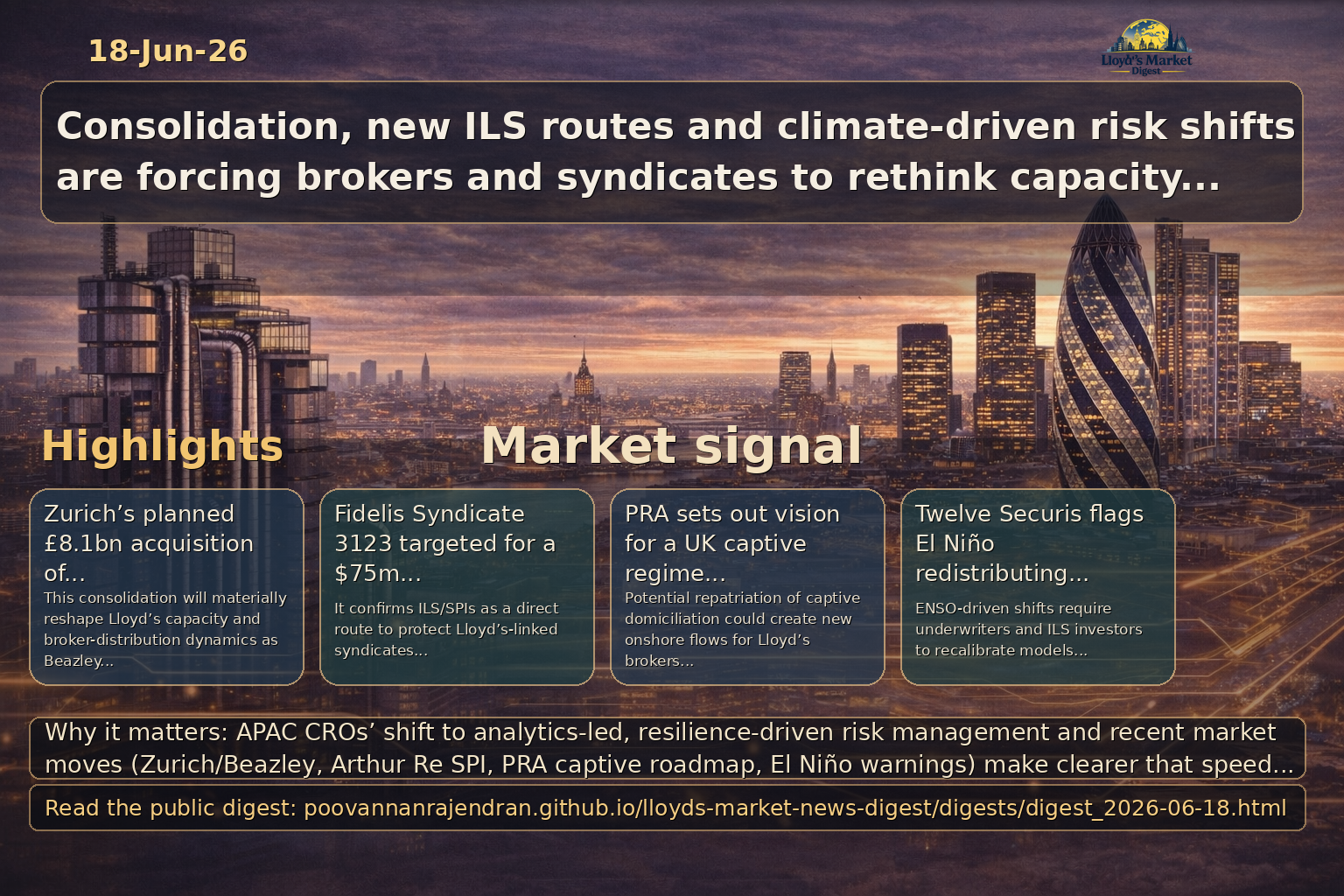
Why it matters: ACCC approval of Zurich's proposed acquisition of Beazley materially affects Lloyd's market dynamics — consolidation of a major specialty player will influence capacity, distribution relationships and competitive underwriting appetite.
- Capacity management: anticipate reallocation of lines and potential concentration risks across syndicates; update portfolio diversification plans.
- Broker relationships: expect renegotiation of agency and placement terms as Beazley capabilities integrate with Zurich's global platform.
- Regulatory watch: maintain active monitoring of remaining approvals (UK, Lloyd's, FINMA, EU) and prepare contingency sourcing if conditions are imposed.
Source: insurancetimes.co.uk
Why it matters: Tide's mobile-first Compass platform signals increasing digitalisation of niche marine distribution and certificate management — a direct efficiency and compliance play for yacht business that brokers and syndicates should monitor for integration and competitive positioning.
- Syndicates and Lloyd's managing agents should evaluate API and document-exchange compatibility to enable straight-through certificate issuance and reduce manual placement friction.
- Brokers handling marine or yacht portfolios can reduce administrative costs and compliance exposure by partnering with mobile MGAs; assess potential margin and service impacts.
- Placement platforms should consider rapid onboarding of niche MGAs to capture niche yacht flows and to offer real-time policy and claims access to captains/managers.
Source: businessinsurance.com
Why it matters: A broker launching a dedicated transportation practice signals concentrated distribution and product opportunities in marine, logistics and transportation liability for specialty capacity providers.
- Position targeted marine and transportation products with appropriate war/political risk and cargo wordings
- Leverage placement platforms to streamline binding authority and accelerate quote-to-bind cycles
- Cultivate strategic broker relationships to secure flow business and improve loss selection data
Source: insurancetimes.co.uk
Why it matters: The PRA's roadmap for a UK captive regime ahead of consultation signals a strategic opportunity to repatriate captive domiciliation and create new onshore flows for Lloyd's brokers, reinsurers and specialist advisers.
- Lloyd's syndicates and brokers should prepare advisory and product offerings to capture expected captive formations and related reinsurance placements.
- Risk managers and advisory firms must engage with the consultation to shape a commercially viable and proportionate regime that supports specialty lines.
- Placement platforms and managing agents should assess operational and regulatory frameworks needed to service captives, including tax, governance and capital modelling.
Source: artemis.bm
Why it matters: First cat bond to directly protect a Lloyd's-linked syndicate via Gallagher Re's Arthur Re SPI demonstrates expanding route-to-market for syndicates and confirms placement platforms as a strategic alternative to traditional reinsurance.
- Syndicates should evaluate ILS-native capital as a complementary, potentially lower-cost source of capacity and update collateral and capital stack policies.
- Brokers must develop structuring expertise for SPI-driven industry-loss triggers and manage investor allocation strategies for multi-cedant platforms.
- Placement platforms and Lloyd's oversight teams should validate operational, legal and collateral governance of Arthur Re-type SPIs to ensure timely settlement and reputational control.
Source: artemis.bm
Why it matters: Twelve Securis flags El Niño as a major redistributor of catastrophe risk, likely to alter demand and pricing across re/insurance and ILS markets for 2026–27 — a material input to underwriting and capital allocation.
- Underwriters and syndicates must stress-test portfolios against ENSO-driven scenario sets and consider selective tightening or repricing in exposed geographies.
- ILS managers and investors should recalibrate exposure limits and hedging strategies to reflect seasonal probability shifts and tail correlations.
- Brokers should proactively coordinate model updates and renewals messaging to capture or hedge changing capacity flows while protecting client placements.
Source: businessinsurance.com
Why it matters: Novo Nordisk cyberattack highlights systemic cyber exposure for large corporates and the consequent demands on cyber capacity, underwriting granularity and incident response features.
- Accelerates scrutiny by Lloyd’s cyber syndicates on aggregation and silent cyber exposure across portfolios
- Brokers must prioritize incident response add-ons, forensic expense limits and aggregation modelling in client renewals
- Placement platforms need rapid quoting capability and standardized cyber data collection to place capacity efficiently during elevated loss activity
Source: businessinsurance.com
Why it matters: Maersk maintaining shipping restrictions despite a ceasefire underscores persistent marine war risk uncertainty affecting cargo insurers, hull underwriters and global supply-chain placements.
- Sustained restrictions keep upward pressure on marine war and cargo premiums, challenging syndicate appetite and treaty reinsurance design
- Brokers will need to negotiate explicit war-risk language and explore alternative transit solutions for clients
- Placement platforms should surface war-risk capacity and war-exclusion clauses quickly to avoid placement delays and ensure compliant coverage
Source: businessinsurance.com
Why it matters: Insurers forecasting double-digit premium hikes signals a continued hard market across specialty lines with direct implications for Lloyd’s syndicate rate plans and broker renewal strategies.
- Syndicates must demonstrate rate adequacy and tightened terms by line to protect combined ratios and reinsurance effectiveness
- Brokers should prepare clients for material renewals, emphasizing risk mitigation to retain capacity and limit price shock
- Placement platforms and analytics teams will be critical to justify pricing moves and to enable rapid multi-syndicate placements
Source: businessinsurance.com
Why it matters: Everest’s $600M casualty sidecar represents targeted alternative capital entering casualty markets to relieve capacity constraints and support large-limit placements.
- Provides incremental capacity for casualty-exposed syndicates and can lower pressure on primary limits within Lloyd’s placements
- Brokers can structure multi-source tower solutions using sidecar capital to meet client limit demands
- Signals continued investor appetite for insurance-linked structures, affecting syndicate capital strategies and reinsurance purchasing
Source: globalreinsurance.com
Why it matters: The appointment is material for Lloyd’s and global specialty markets because AXA XL is a major capacity provider; a renewed underwriting mandate from its CUO will influence capacity deployment, pricing dynamics and broker negotiation strategies, while the parallel focus on risk advisory expands opportunities for placement collaboration and value-added services.
- Underwriting posture: Expect firmer risk selection and clearer appetite statements—syndicates and brokers should re-evaluate exposures and submission quality to align with AXA XL’s tightened underwriting disciplines.
- Placement and distribution: Brokers and placement platforms must anticipate higher requirements for data, analytics and pre-bind risk engineering as AXA XL pairs underwriting with enhanced advisory services.
- Market signalling and capacity: Syndicates and competitors will monitor AXA XL’s portfolio repositioning for pricing and capacity cues; strategic partners should prepare for shifts in capacity allocation and co-insurance structures.
Source: insurancejournal.com
Why it matters: Pennsylvania Supreme Court ruling narrows anti-referral scope, raising workers' compensation pharmacy exposure and potential upward pressure on medical costs — a relevance to specialty WC underwriters, brokers managing networks and syndicates writing US-focused medical-cost risk.
- Underwriting: reassess WC medical-cost assumptions and pharmacy benefit management controls where affiliated pharmacy referrals are possible.
- Brokers: renegotiate provider network terms and audit rights; advise clients on PBM selection and cost-containment clauses.
- Placement platforms: flag jurisdictional legal changes in data feeds and update loss-cost models to reflect potential claim inflation.
Source: insurancejournal.com
Why it matters: Federal judge sending Bayer's Roundup settlement back to state court sustains the path to a large multi-jurisdictional resolution — significant for reinsurers, legacy claim reserves and D&O liability exposures within the specialty market.
- Reserving: expect pressure on casualty reserves and potential reinsurance attachment/retro allocation disputes; review IBNR and commutation risk.
- Brokers and syndicates: prepare for increased demand for settlement-funding solutions and negotiation support for insureds.
- Placement platforms: ensure systems track jurisdictional procedural shifts that affect global mass-tort exposures and reinsurance recoveries.
Source: insurancejournal.com
Why it matters: High-profile corporate jet crash underscores sustained aviation liability and hull risk for private-charter operators and insured executive travel programmes — relevant to aviation syndicates, brokers placing corporate aviation and affiliates such as NetJets.
- Underwriters: reassess operator risk profiles, maintenance oversight and pilot standards for corporate jet capacity decisions.
- Brokers: advise C-suite clients on risk-transfer, contingency travel provisions and crisis response clauses.
- Claims and crisis: prepare communication protocols and reputational-risk guidance for insureds and syndicates following high-visibility losses.
Source: insurancejournal.com
Why it matters: Interpol's report of rising cybercrime across Asia signals accelerating frequency and potential accumulation risk for cyber insurers and syndicates, affecting appetite, pricing and pre-placement underwriting requirements.
- Capacity and pricing: anticipate hardening cyber rates in affected jurisdictions and tighter sub-limits for aggregation-prone exposures.
- Risk engineering: increase reliance on pre-bind security controls and remediation conditions; pair coverage with vendor-led mitigation services.
- Brokers and platforms: enhance portfolio-aggregation analytics to identify and limit single-event cyber accumulations across clients and regions.
Source: insurancetimes.co.uk
Why it matters: TBIG's increased stake in a regional broker underscores ongoing consolidation dynamics in the broking market and highlights the strategic value of scale, while reinforcing the need for retention strategies and clear governance as ownership structures evolve.
- Lloyd's-focused brokers and syndicates should monitor regional consolidation for distribution concentration risks and potential changes in submission patterns.
- Acquirers and targets must prioritise retention clauses for key executives and client continuity planning to protect specialty lines and binding authorities.
- Advisory teams should revisit valuation and earn‑out structures in deals given sustained investor appetite for broker cashflow and GWP.
Source: insurancetimes.co.uk
Why it matters: Braven's platform processing c.$800m of premium and its London launch highlight growing infrastructure solutions for delegated authority and specialty underwriting — directly relevant to syndicates and placement platforms seeking scalable binding authority operations.
- Syndicates should pilot or integrate with such platforms to improve oversight, reporting and controls over delegated authorities and APU (authority performance underwriting).
- Placement platforms and managing agents must assess competitive differentiation by offering seamless onboarding, analytics and compliance modules to MGAs.
- Brokers advising capacity providers should stress-test operational resilience and regulatory compliance of third-party platforms before widening distribution reliance.
Source: insurancetimes.co.uk
Why it matters: Ifed's intensified focus on travel fraud raises enforcement and claims-examination expectations for insurers and brokers handling travel and related specialty lines — with direct implications for Lloyd's syndicates that underwrite travel-risk exposures.
- Underwriters and claims teams should tighten data-sharing protocols with enforcement bodies and adopt forensic claims triage to reduce fraud leakage.
- Brokers must enhance submission transparency and claims cooperation clauses to protect capacity and demonstrate robust anti-fraud controls.
- Placement platforms should prioritise transactional audit trails and identity-validation integrations to minimise carriage of fraudulent business.
Source: artemis.bm
Why it matters: The World Bank’s Morocco Climate & Risk Finance Program signals increased use of cat bonds and parametric solutions in sovereign risk transfer, creating a scalable template for MDB-backed transactions that can mobilise private capital.
- Syndicates and specialty carriers can position to design sovereign and sub-sovereign parametric products, expanding premium pools and public-sector relationships.
- Brokers should cultivate MDB and government advisory capabilities to act as arranger and structurer for blended finance placements.
- Placement platforms and ILS investors must assess sovereign trigger design, basis risk and credit exposure to determine suitability and pricing for these mandates.
Source: artemis.bm
Why it matters: Everest’s Annapurna Re casualty sidecar, targeting $600m and anchored by Stone Point, marks significant third-party capital entry into long-tail casualty — a structural shift with implications for Lloyd’s and global specialty casualty capacity.
- Carriers and syndicates should evaluate sidecar templates to deploy or access capital against long-tail liabilities while preserving balance-sheet flexibility.
- Investors need long-duration modelling, reserving transparency and governance frameworks specific to casualty risk to support durable allocations.
- Brokers must adapt placement strategies to account for collateralised casualty capital, due diligence requirements and potential accelerated capacity availability.
Source: artemis.bm
Why it matters: An early Atlantic storm (Tropical Storm Arthur) highlights the need for immediate operational readiness and may influence short-term claims, reserve dynamics and investor sentiment ahead of renewals.
- Claims and underwriting teams should confirm surge capacity, cat plans and pre-positioning of adjusters to limit response lags and loss amplification.
- Syndicates and brokers ought to reassess exposures in affected US Gulf locations and review model outputs for near-term reserve and pricing implications.
- ILS investors and placement platforms should communicate event impact assessments promptly to maintain trust and manage allocation or collateral actions.
Source: risk.net
Why it matters: Although APAC-focused, the article highlights trends that directly affect Lloyd's market participants: APAC CROs' move toward analytics-led, strategic risk management changes demand signals, capital allocation and distribution models. Syndicates, brokers and placement platforms should view this as a mandate to accelerate data, product and platform capabilities to retain access to APAC risk flows and to support clients needing more integrated risk solutions.
- Analytics and GenAI: Syndicates and platforms must integrate advanced analytics into underwriting engines and placement workflows to meet APAC CRO expectations for predictive risk insight and scenario testing.
- Product and distribution adaptation: Brokers and carriers should co-develop APAC-tailored products (political risk, supply-chain, cyber, parametrics) and streamline placement terms to reflect regional risk drivers and faster decision cycles.
- Resilience, governance and capital: Syndicates and carriers need stronger stress-testing, capital allocation frameworks and regulatory engagement to demonstrate the resilience APAC CROs now require when transferring risk to global specialty markets.