Source: insurancetimes.co.uk
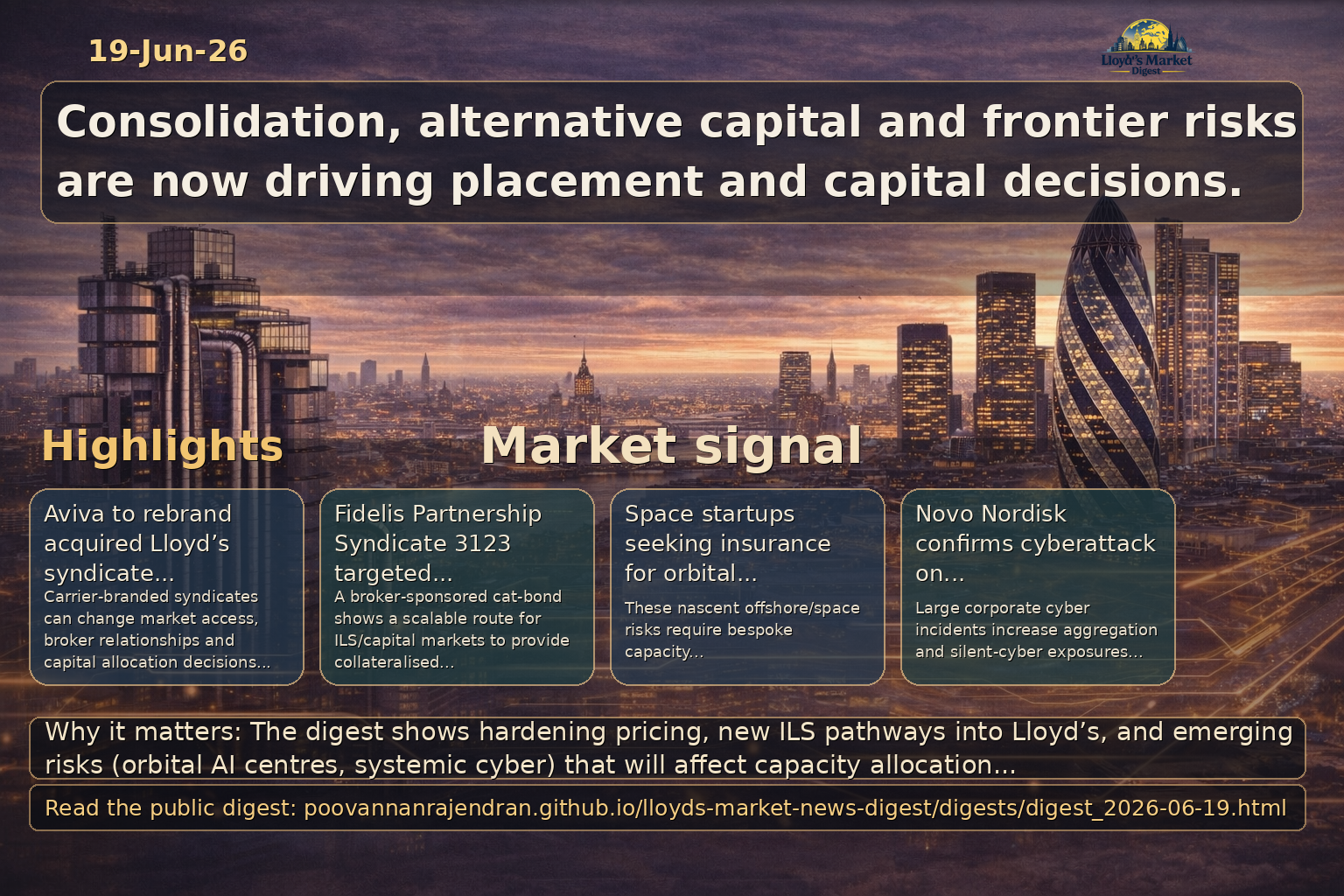
Why it matters: Aviva's planned rebrand of Probitas 1492 to Aviva Syndicates signals continued consolidation of Lloyd’s capacity under carrier-branded platforms, with implications for market access, broker relationships and capital allocation.
- Branding the syndicate will streamline client and broker recognition but requires careful comms to preserve existing coverholder and broker flows
- Integration suggests operational harmonisation and potential economies of scale — review systems, reporting and placement workflows to capture synergies
- Syndicate rebranding can shift negotiation dynamics with brokers and co-insurers; reassess panel terms, appetite and capital deployment plans
Source: reinsurancene.ws
Why it matters: Lloyds Bank survey highlighting insurers' prioritisation of liquidity strength signals continued capital conservatism across the industry — directly relevant for syndicates, managing agents and brokers when negotiating capacity, collateral and treaty terms.
- Reinforces likelihood of disciplined capacity deployment and cautious pricing — syndicates may favour liquid balance-sheet carriers for partnership.
- Brokers should anticipate increased scrutiny on counterparty liquidity and structuring of collateralised placements.
- Liquidity focus could accelerate demand for capital-efficient platforms and alternative capital solutions in the Lloyd's ecosystem.
Source: fca.org.uk
Why it matters: FCA warning on Doxfundchain highlights ongoing risk from unauthorised entities marketing financial services; this can expose brokers, placement platforms and syndicates to diverted premiums, client losses and regulatory scrutiny if they fail to detect or prevent engagement with such firms.
- Immediate verify: cross-check counterparties and introducers against FCA Warning List and incorporate automated screening into onboarding workflows.
- Segregate client funds and require proof of authorisation/contractual standing before accepting business introduced through unfamiliar digital channels.
- Issue targeted client/broker communications and train front-office teams to recognise and escalate suspected unauthorised firm approaches.
Source: fca.org.uk
Why it matters: Denosetrades warning reinforces pattern of scam operators that may approach insureds, cedants or smaller brokers; failure to detect such actors can create downstream claims, recovery gaps and supervisory inquiries for market participants.
- Enforce enhanced due diligence for new trading counterparties, especially those originating from digital solicitations or outside established broker networks.
- Incorporate warning-list checks into placement platform APIs and deny transactions until counterparty legitimacy is confirmed.
- Maintain auditable decision logs and client advisories to demonstrate proportionate controls in the event of FCA follow-up.
Source: fca.org.uk
Why it matters: The asadministration.uk warnings illustrate persistent use of domain-based or impersonation tactics; for Lloyd's and global specialty markets, platform-level authentication and contractual validation are critical to prevent exploitation of digital placement channels.
- Strengthen domain and credential verification for counterparties and intermediaries; require corporate email domains and authenticated digital signatures for placement confirmations.
- Apply multi-factor verification and verified introducer lists on electronic placement platforms to reduce impersonation and fraud.
- Review contractual language to limit payment routing changes and require secondary confirmation for any beneficiary or account changes.
Source: fca.org.uk
Why it matters: Therese Chambers' speech signals the FCA's escalation toward earlier intervention using supervision, oversight and enforcement — a clear prompt for Lloyd's market players to accelerate AML, transaction monitoring and cross-border controls tailored to fast, complex financial crime threats.
- Elevate transaction monitoring rules and anomaly detection specific to specialty placements, including rapid multi-party flows and novel product structures.
- Conduct targeted readiness reviews and scenario testing of financial crime controls across brokers, syndicates and platform providers.
- Enhance regulatory engagement: pre-emptive disclosure of remediation plans and quicker escalation protocols to demonstrate proactive risk management.
Source: fca.org.uk
Why it matters: The FCA closure of the Drax investigation demonstrates the regulator's capacity for deep, document-heavy inquiries into disclosures and market information. For underwriters, brokers and platforms, accurate record-keeping and transparent disclosure practices are essential to avoid protracted reviews.
- Ensure underwriting and syndicate disclosure practices are documented and supported by third‑party due diligence, particularly for ESG and sustainability-related risks.
- Strengthen controls around marketing materials and statements to avoid inadvertent misrepresentation; maintain contemporaneous audit trails for decision-making.
- Prepare dossiers that evidence reasoned commercial judgements and compliance checks to shorten resolution time if subject to regulatory review.
Source: insurancejournal.com
Why it matters: Regulatory approval in Australia for Zurich's proposed acquisition of Beazley is material to Lloyd's distribution and global specialty capacity, signaling potential consolidation and strategic repositioning of syndicate-linked capacity.
- Brokers should prepare for product and underwriting harmonisation risks, potential changes to Lloyd's broker panels and shifts in specialty appetite as controls consolidate.
- Syndicates and managing agents must assess competitive impacts on capacity, treaties and retrocession arrangements, and prepare for stakeholder engagement with Lloyd's and regulators.
- Placement platforms should evaluate integration scenarios for shared tech, data and distribution capabilities that could alter speed to market and policywording standardisation.
Source: insurancetimes.co.uk
Why it matters: Tide’s Compass mobile platform exemplifies how MGAs and specialty insurers are using consumer‑facing digital tools to simplify niche product servicing and reduce broker administration overheads in marine/yacht lines.
- Mobile-first servicing reduces friction for yacht owners and compliance document delivery — syndicates should evaluate API and certificate exchange integration
- Brokers can use such platforms to reduce placement friction; underwriting teams should consider partnering for enhanced data capture and risk management
- Digital servicing capability may become a differentiator for MGAs and capacity providers when negotiating distribution agreements
Source: reinsurancene.ws
Why it matters: MS Amlin's 2026 hurricane landfall analysis (reduced but still material risk) affects catastrophe modelling, capital allocation and pricing strategies for London market syndicates and reinsurers offering US property reinsurance and retrocession.
- A one-in-four chance of a major US hurricane landfall translates to sustained demand for disciplined catastrophe capacity and calibrated pricing from syndicates.
- Placement platforms and brokers should prepare for volatility in reinsurance renewals and potential capacity tightening for US exposure.
- Sustained warm Atlantic waters combined with El Niño variability require ongoing investment in modelling and accumulation controls by managing agents.
Source: insurancetimes.co.uk
Why it matters: The PRA's articulation of a simpler, proportionate and commercially viable UK captive regime will influence where multinational clients house retained risk and how brokers, Lloyd's syndicates and placement platforms design and distribute solutions.
- Repatriation opportunity: A commercially viable UK captive regime can attract multinational captives back to the UK, increasing premium retention and creating cross-sell opportunities for brokers and Lloyd's syndicates.
- Placement and platform implications: Simplicity and proportionality favour faster onboarding and lower operational friction, requiring placement platforms to adapt workflows, data integration and captive-native product capabilities.
- Regulatory and capital planning: Syndicates and brokers should anticipate changes to reinsurance demand and captive capital strategies and prepare compliance, product and go-to-market plans ahead of formal consultation outcomes
Source: artemis.bm
Why it matters: The Woody Re 2026‑1 issuance via Arthur Re targeting Syndicate 3123 is a notable precedent: a broker‑sponsored platform delivering direct cat‑bond protection to a Lloyd’s syndicate, signalling a scalable route for syndicate access to ILS capacity.
- Demonstrates Arthur Re and broker platforms can directly connect ILS capital to Lloyd’s syndicates — a template for other syndicates seeking cost‑efficient, collateralised cover
- Promotes competitive pressure on traditional reinsurance markets for US multi‑peril placements; syndicates should evaluate capital economics versus traditional treaties
- Placement platforms and brokers will need robust validation, documentation and data exchange standards to accelerate similar multi‑cedant transactions
Source: artemis.bm
Why it matters: A strong El Niño forecast is re‑shaping geographic risk appetites across reinsurance and ILS markets, prompting redistribution of risk that affects Lloyd’s underwriting mix and broker placement strategies for H2 2026 and early 2027.
- Expected regional shifts in peril frequency/severity will influence where syndicates deploy capacity — underwriters should revise line‑plan exposures and pricing
- Brokers and placement platforms must adapt structuring to capture investor demand in less correlated perils and regions
- ILS managers and sponsors should recalibrate portfolio tilt and attachment decisions to reflect altered loss probabilities
Source: businessinsurance.com
Why it matters: Space startups seeking insurance for orbital AI data centres represent a nascent specialty line that sits squarely within Lloyd’s appetite for frontier risks, requiring bespoke capacity, engineering expertise and novel placement structures.
- Market implication: Lloyd’s syndicates and specialty brokers can capture first-mover advantage by developing tailored modules combining physical damage, third-party liability and launch/space debris coverage.
- Underwriting action: Invest in technical underwriting teams and partner with aerospace engineers for risk modelling, telemetry data access and credible exposure aggregation controls.
- Placement/platform note: Digital placement platforms and delegated authority models must adapt policy wordings and data ingestion to underwrite telemetry-driven loss triggers and cross-jurisdictional liability exposures.
Source: businessinsurance.com
Why it matters: IMA’s lawsuit against Howden over an alleged Pacific Northwest team raid underscores elevated counterparty, continuity and reputational risks tied to broker mobility — a structural distribution risk for Lloyd’s and global specialty markets.
- Distribution risk: Syndicates and chief underwriters must strengthen broker-vetting, continuity clauses and non-solicitation covenants where appropriate to preserve placement flows.
- Commercial response: Encourage stronger service-level agreements and data access commitments from lead brokers to mitigate sudden book migration and client churn.
- Governance & platform impact: Placement platforms should enhance audit trails and credentialing to provide syndicates transparency on broker teams, origin of submissions and material client relationships.
Source: businessinsurance.com
Why it matters: A confirmed cyberattack on a major corporate (Novo Nordisk) reinforces that large-scale operational cyber losses are migrating into the specialty commercial cyber market, posing aggregation and silent cyber concerns for syndicates and brokers.
- Aggregation exposure: Syndicates must update cyber accumulation modelling, consider systemic scenarios and reinsurance protection for correlated enterprise cyber losses.
- Product evolution: Brokers should push for modular cyber offerings with clear affirmative wording on AI/ML usage, supply chain disruptions and regulatory fines to limit silent cyber ambiguity.
- Operational readiness: Placement platforms need capabilities for rapid incident notification, claims triage workflows and integrated forensic vendor lists to support insureds and underwriters.
Source: businessinsurance.com
Why it matters: Maersk maintaining shipping restrictions despite a ceasefire points to ongoing marine and cargo war/terrorism exposures that keep demand for specialist marine war and political violence coverage elevated for Lloyd’s syndicates and global brokers.
- Underwriting stance: Syndicates should maintain disciplined pricing and explicit war exclusions or enhanced terms for transits through high-risk lanes, aligning with reinsurance appetite.
- Broker strategy: Brokers must provide granular voyage-level risk intelligence and contingency logistics planning to support insureds and justify premium/retention adjustments.
- Placement implications: Digital marine placements and e-bind platforms should integrate dynamic geopolitical risk feeds and cargo routing tools to better price and place short-duration risks.
Source: businessinsurance.com
Why it matters: Insurers forecasting double-digit premium hikes signals continued hard market dynamics across commercial lines, reinforcing opportunities for Lloyd’s syndicates to rebuild margins but also elevating client retention and distribution friction for brokers.
- Capital & margin: Syndicates should prioritize profitable growth, re-calibrating appetite and deployment of capital via selective capacity and structured reinsurance/sidecar solutions.
- Client management: Brokers need to prepare retention programmes, enhanced risk engineering offerings and clear client communication to manage sticker shock and churn risks.
- Platform effect: Placement platforms must support comparative quoting, binding speed and documentation to preserve intermediated flows as buyers shop across markets.
Source: globalreinsurance.com
Why it matters: Senior underwriting leadership change at a global specialty carrier with attendant elevation of risk advisory capabilities will materially influence market behaviour — from appetite and pricing to placement mechanics and broker engagement — and will be watched closely across Lloyd's and global specialty hubs.
- Market signalling and appetite: Expect clearer, more centralised underwriting guidance from AXA XL that may tighten discipline in areas of elevated volatility while creating differentiated appetite statements for brokers to calibrate submissions and placement strategies.
- Distribution and platform impact: Brokers and electronic placement platforms should anticipate updated submission standards and enhanced demand for technical data and loss-prevention evidence as underwriting and risk advisory functions align; this will affect time-to-bind and documentation requirements.
- Strategic competitive dynamics: The split elevating a dedicated Risk Advisory CEO creates cross-sell and product innovation opportunities (prevention, parametric solutions, engineering services) that syndicates and competitors will need to match or counter through their own advisory capabilities or tighter underwriting partnerships.
Source: insurancejournal.com
Why it matters: Zurich signalling the need for data center securitization is a direct signal to Lloyd's syndicates and specialty brokers that concentrated infrastructure exposures will demand new capital solutions and placement structures.
- Underwriters and syndicates should model accumulation across cloud providers and hyperscale projects to quantify securitization suitability and tranche sizing.
- Brokers and placement platforms must develop investor-grade documentation and standardised risk data to attract capital markets investors for infrastructure risk pools.
- Consider collaboration between reinsurers, MGAs and capital markets to pilot securitized structures for large construction and operational value-at-risk on data center portfolios.
Source: insurancejournal.com
Why it matters: Pennsylvania Supreme Court ruling on self-referral exclusions affects claims handling, pharmacy arrangements and indemnity medical cost management relevant to insurers offering workers' compensation and disability products.
- Insurers and brokers should review provider networks and pharmacy benefit arrangements to ensure compliance and anticipate challenges to care management programs.
- Syndicates and reinsurers must re-evaluate reserving and medical cost trend assumptions where pharmacy steering or captive arrangements are in place.
- Placement teams should advise clients on contractual protections and disclosure requirements for provider financial interests to limit regulatory and litigation exposure.
Source: insurancejournal.com
Why it matters: Federal court remanding of Bayer's Roundup settlement into state court highlights persistence of large-scale mass torts that drive reallocations of reinsurance, legacy reserves and capital at Lloyd's and specialty carriers.
- Underwriters should re-examine aggregation clauses, pollution and product liability exhaustion points and retroactive reinsurance exposures tied to mass tort outcomes.
- Brokers need to flag clients with potential product liability exposures to syndicates and structure long-tail capacity solutions, including finite and loss portfolio transfers.
- Risk and capital officers should stress-test balance sheets for adverse settlement distributions and evaluate buy-in to pooled industry solutions for legacy liabilities.
Source: insurancejournal.com
Why it matters: The fatal business jet crash underscores continued exposure in corporate aviation, charter and fractional ownership lines that are specialty staples for Lloyd's syndicates and aviation brokers.
- Aviation underwriters should reassess underwriting on fractional operators, operator risk management protocols and OEM maintenance provenance for business jets.
- Brokers should verify operational data, pilot vetting and third-party operator oversight when placing hull plus liability programs for high-net-worth and corporate accounts.
- Placement platforms can differentiate by incorporating telematics and flight-data risk analytics to support dynamic pricing and loss prevention engagement.
Source: insurancetimes.co.uk
Why it matters: TBIG’s majority acquisition of a specialist independent broker highlights ongoing consolidation in retail distribution that will reshape GWP flows to carriers and affect broker-syndicate relationships in specialty segments.
- Consolidator ownership can change broker panel dynamics and decision rights — underwriters should review appetite, placement terms and communication protocols
- Retention of existing leadership mitigates disruption; carriers must monitor continuity of service and portfolio quality post-acquisition
- Strategic M&A by consolidators creates counterparty concentration risk for syndicates and carriers — reassess broker diversification and credit exposure
Source: insurancetimes.co.uk
Why it matters: Braven’s funding round and London launch indicates growth in infrastructure providers targeting delegated authority and specialty flows — relevant to syndicates, brokers and platforms seeking scalable placement technology.
- High volumes already flowing through the platform suggest material market utility; consider pilots to access new delegated authority distribution channels
- London presence accelerates platform‑to‑Lloyd’s connectivity opportunities — review integration roadmaps and third‑party risk governance
- Talent and hiring plans point to competition for platform and underwriting talent; factor in recruitment and partnership opportunities in market strategy
Source: reinsurancene.ws
Why it matters: A landmark reinsurance treaty for Cancer Precision Medicine between Malaysian Re and China Re Life signals product innovation in life/health reinsurance and cross-border capacity collaboration relevant to Lloyd's syndicates and London market brokers seeking to support advanced medical and longevity risks in growth markets.
- Demonstrates insurer-to-reinsurer collaboration on complex life/health covers (CAR-T, targeted therapies) — a template for specialty underwriting and syndicate appetite in emerging markets.
- Creates distribution and placement opportunities for London brokers to structure cross-border reinsurance and facultative support for local carriers.
- Highlights need for tailored underwriting, data-sharing and capital modelling to absorb high-severity, low-frequency medical treatments.
Source: reinsurancene.ws
Why it matters: Africa Specialty Risks' senior underwriting hires reflect the strategic emphasis on regional expertise within global specialty markets and the ongoing importance of experienced underwriters for Lloyd's and broker-led capacity into developing markets.
- Strengthens underwriting capability for marine and property lines in Africa — improving risk selection and capacity deployment from syndicates and reinsurers.
- Signals broker and capacity providers’ focus on local market knowledge to write complex portfolios and manage accumulation.
- Reinforces competitive positioning of specialist groups in London as conduits for pan-African placements and treaty structures.
Source: reinsurancene.ws
Why it matters: Accenture's finding that AI will influence consumer renewals for home and motor underscores the growing role of AI in distribution channels — a trend that will reshape broker-client interactions, placement platforms and customer-retention strategies used by specialty lines and syndicates.
- AI-enabled comparison and advisory tools may compress distribution margins and require brokers to differentiate via specialist advice and placement services.
- Placement platforms and syndicates should invest in AI-driven client engagement and underwriting triage to retain intermediary relationships.
- Regulatory and model-governance implications will be material as AI influences policy wording, pricing and renewal decisions across retail-fed specialty lines.
Source: artemis.bm
Why it matters: The World Bank’s Morocco Climate & Risk Finance Program and potential cat‑bond role illustrate sovereign issuance growth and an expanded addressable market for syndicates, brokers and placement platforms in parametric and indemnity sovereign risk transfer.
- Sovereign ILS issuance creates new opportunities for Lloyd’s syndicates and specialty capacity providers to participate in structured risk programs
- Brokers and platforms that can navigate multi‑stakeholder public‑private deals will capture advisory and placement fees
- Syndicates should consider developing or partnering on parametric products and advisory capabilities to support sovereign and development finance sponsors
Source: bankofengland.co.uk
Why it matters: CP9/26 proposes tighter constraints and methodological changes to IMA for market risk that will directly affect how Lloyd’s syndicates and global specialty portfolios calculate market-risk capital. Syndicates that trade or hold market-sensitive instruments (including investment portfolios, derivatives, and insurance-linked securities) may face capital increases, longer model approval cycles and higher compliance costs. Brokers and placement platforms will need to adapt pricing conversations, structuring options, and distribution workflows as capital costs and capacity shift, while managing client communication and intermediary margins.
- Capital and pricing pressure: Expect upward pressure on market-risk capital for IMA-approved desks and investment portfolios, forcing syndicates to reprice risk, limit capacity in capital-intensive lines, or shift exposures to standardized approaches or reinsurable structures.
- Model, governance and operational readiness: The consultation raises the bar on model validation, backtesting, stress scenarios and data lineage. Managing agents must inventory IMA exposures, accelerate model audits, and resource validation teams to avoid protracted PRA review and potential capital add-ons.
- Placement and strategic response: Brokers and placement platforms should prepare for constrained capacity and pricing volatility by expanding reinsurance and alternative capital solutions, reconfiguring placement workflows to accommodate faster risk-transfer, and coordinating market responses with syndicate capital managers and third-party capital providers.
Source: artemis.bm
Why it matters: Allstate’s April–May catastrophe drawdowns are material to placement strategy and aggregate trigger exhaustion for cedants linked to annual aggregate programmes, with direct implications for reinsurance and cat‑bond attachment expectations that Lloyd’s syndicates and brokers must account for.
- Aggregate erosion impacts availability/price of annual aggregate reinsurance and cat bond triggers — syndicates and brokers must re‑price or re‑structure placements accordingly
- Placement platforms should assess counterparty trigger overlap to avoid unintended concentration across Lloyd’s and ILS towers
- Underwriters must update accumulation models and communicate expected exhaustion scenarios to facultative brokers and treaty partners
Source: artemis.bm
Why it matters: US severe convective storm losses exceeding $22bn year‑to‑date drive sustained demand for specialty reinsurance and ILS capacity that directly affects Lloyd’s property portfolios, broking strategy and regional pricing dynamics.
- Persistent SCS losses compress available short‑tail capacity, elevating reinsurance pricing for US property and personal lines — critical for syndicates with Gulf/Northeast exposure
- Brokers should calibrate placement mixes between traditional retro and ILS to secure competitive pricing while managing accumulation
- Syndicates and placement platforms must factor convective storm volatility into catastrophe models and limit frameworks for H2 renewals
Source: newsnow.co.uk
Why it matters: Manhattan remains a high-concentration exposure for Lloyd's syndicates through D&O, cyber, financial institutions and real-estate portfolios; careful aggregation management and tailored US placement strategies are essential.
- Assess aggregate exposure across brokers to Wall Street and Manhattan real-estate risks; implement concentration limits and stress tests.
- Prioritise specialist D&O and cyber capacity with lead-follow clarity for complex multinational accounts.
- Enhance US placement workflows and US counsel engagement to address state-level regulatory nuances and claim behaviours.
Source: newsnow.co.uk
Why it matters: A null search result for a high-profile term highlights gaps in real-time media and market intelligence that impair timely reputational and social-risk underwriting decisions for brokers and syndicates.
- Upgrade media-monitoring and alternative-data feeds for early detection of campaigns and reputational spikes affecting insureds.
- Integrate platform alerts into underwriting authority workflows so underwriters receive material intelligence ahead of placement.
- Formalise escalation protocols between brokers and syndicates when intelligence gaps could materially change risk appetite or terms.
Source: newsnow.co.uk
Why it matters: Aberdeen's economy is energy-centric; strikes, supply-chain disruption and transition risk affect underwriting appetite for upstream/downstream energy portfolios and local liability exposures.
- Re-evaluate coverage and pricing for North Sea energy assets given labour actions and transition timelines.
- Promote specialist liability and environmental coverages for decommissioning and renewables conversion projects.
- Coordinate with brokers to monitor local political and labour developments as underwriting triggers for mid-term adjustments.
Source: newsnow.co.uk
Why it matters: The South Pacific presents acute climate and sovereign resilience risks for specialty insurers—sea-level rise, cyclones and limited local capacity create demand for bespoke insurance and layered reinsurance structures.
- Develop parametric and index-based products tailored to island nation exposures to reduce claims friction and speed pay-outs.
- Structure multi-year placement solutions with regional partners to address affordability and retention challenges.
- Consider public-private programmes and catastrophe bonds to extend capacity where traditional reinsurance is constrained.
Source: newsnow.co.uk
Why it matters: Australia is a structurally important specialty market with frequent severe nat-cat events and evolving regulatory expectations—opportunities exist for Lloyd's syndicates to expand calibrated capacity and digital distribution.
- Reprice and tighten nat-cat and property portfolios using updated modelling informed by recent loss experience.
- Deepen broker partnerships and placement-platform integrations to accelerate access to Australian retail and wholesale clients.
- Monitor APRA and ASIC guidance for capital, conduct and disclosure changes that affect cross-border capacity deployment.
Source: risk.net
Why it matters: The article documents APAC CROs adopting resilience, agility and AI-driven analysis—dynamics that directly affect how risks are underwritten, priced and placed for Lloyd’s syndicates and global specialty brokers active in the region.
- Embed CRO-led analytics into placement workflows: Require syndicates and brokers to incorporate APAC CRO scenarios and AI outputs in pre-placement diligence to improve pricing accuracy and reduce tail exposure.
- Upgrade data and AI capabilities for specialty lines: Invest in platform integrations that deliver clean APAC risk data and GenAI-derived insights to underwriters and binding authorities, enabling faster, more consistent decisions across syndicates.
- Reassess appetite and capital allocation: Use CRO-driven stress tests and geopolitical scenario analysis to recalibrate syndicate limits, facultative capacity and product structures for APAC risks, and align broker strategies with evolving regional regulation and security dynamics.