Source: insurancejournal.com
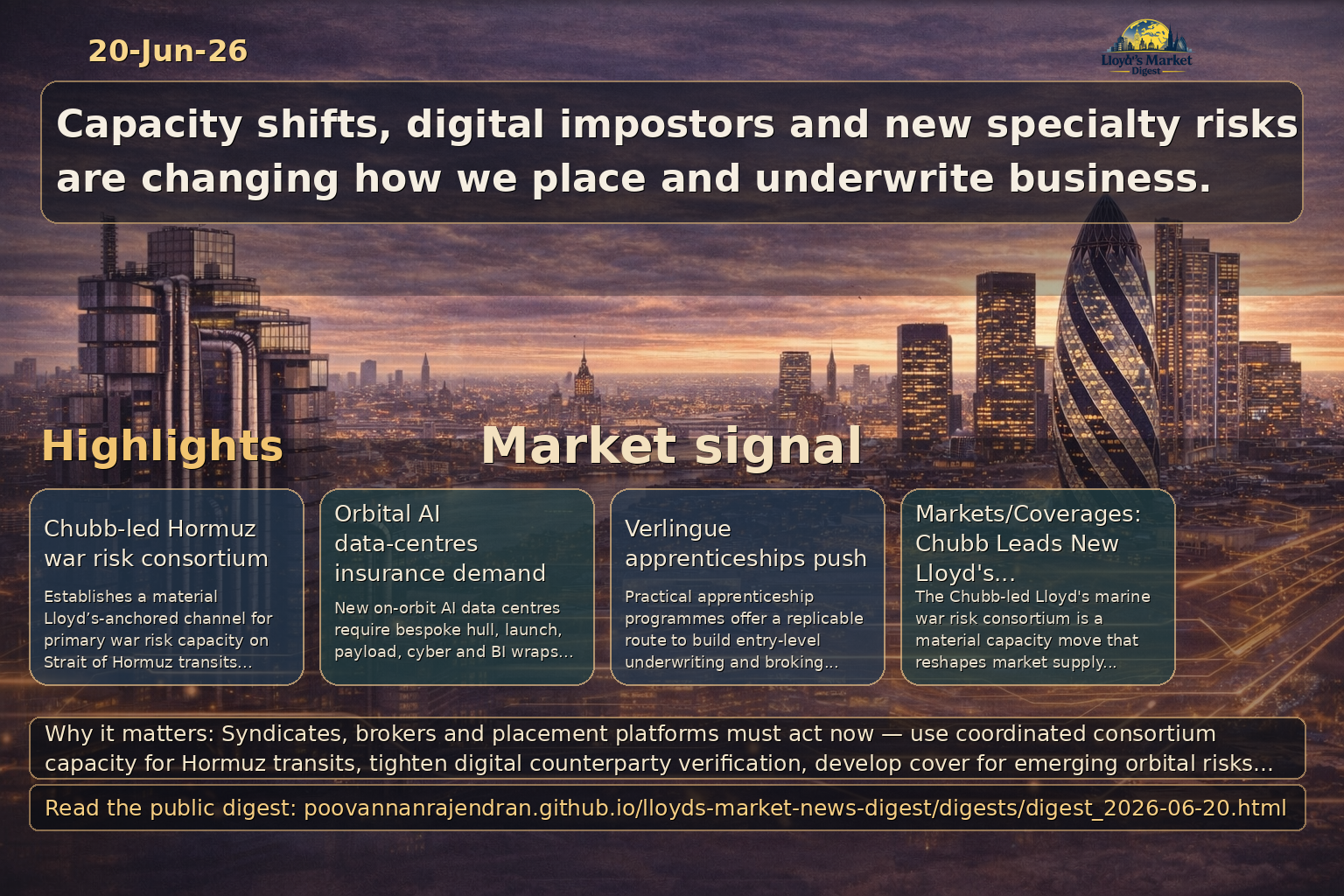
Why it matters: The Chubb‑led Lloyd's marine war risk consortium is a material capacity move that reshapes market supply for Hormuz transits; it establishes a channel for primary placements and signals collaborative syndicate responses to acute geo‑risk.
- Brokers: leverage the consortium for consolidated capacity but conduct parallel market checks on sublimits, claim handling protocols and bilateral slip wordings to secure best client terms.
- Syndicates/Leads: coordinate on standardized policy wordings, clear aggregation reporting and transparent pro rata allocations to speed multi‑party placements and reduce placement friction.
- Placement platforms: onboard consortium slip templates and automated consent workflows, enabling faster binding and visibility of shared capacity across Lloyd's and company markets.
Source: reinsurancene.ws
Why it matters: Lloyd's-led, Chubb-anchored war risk facility for the Strait of Hormuz is a material market response to a regionally concentrated marine risk — demonstrating Lloyd's capacity leadership and the importance of coordinated consortium underwriting for complex perils.
- The facility provides a clear placement route for brokers requiring significant war risk capacity and reinforces Lloyd's role in convening market-led solutions for geopolitical hotspots.
- Syndicates should evaluate participation strategic fit, underwriting criteria and sanctions compliance before joining to ensure alignment with appetite and capital efficiency.
- Placement platforms must ensure rapid referral and clear documentation paths for marine accounts transiting the corridor to capitalize on the market facility.
Source: fca.org.uk
Why it matters: The FCA warning for Forexobot highlights unauthorised entities using online presence to offer financial services. For Lloyd's and global specialty markets this signals a heightened risk that cyber-enabled operators could impersonate brokers or platforms to solicit premiums or place business without proper authority, resulting in client loss and regulatory consequences.
- Immediate: instruct syndicates, fronting carriers and delegated authority teams to block and report any submissions originating from or referencing the Forexobot domain; require brokers to confirm authorised intermediary status in writing.
- Control: require placement platforms and brokers to implement automated domain and WHOIS checks during onboarding, and flag transactions from unverified domains for manual review.
- Client protection: publish an advisory to retail and wholesale intermediaries clarifying that business placed via unauthorised entities will not be accepted and reminding clients they lack FSCS/Ombudsman protections.
Source: fca.org.uk
Why it matters: capital-trustblank.online is an example of a generic-sounding domain used to promote financial services without FCA authorisation. In the specialty insurance ecosystem such actors can target vulnerable or sophisticated clients alike, creating exposures through bogus placements, false premium collection, or misuse of Lloyd's branding.
- Verification: enforce KYC and firm-authorisation checks for every intermediary and platform counterparty; require FCA firm reference numbers and validate against the FCA register before proceeding with placement.
- Operational: update broker agreements and marketplace terms to include audit rights and invoice reconciliation clauses to detect premium diversion from rogue domains.
- Escalation: centralise reporting of suspected unauthorised operators to a single market-facing team and coordinate disclosure with the FCA and market associations to mitigate reputational risk.
Source: fca.org.uk
Why it matters: PCP Refunds 4U Ltd demonstrates how consumer-facing services may be unauthorised yet attract UK-based clients. For brokers, MGAs and syndicates, such firms increase the risk of misdirected claims, contested recoveries and client complaints, especially where delegated authorities or digital intermediaries are involved.
- Due diligence: require evidence of regulatory status and claims-handling credentials for any referral partner or intermediary handling client funds or claims; suspend engagements lacking verification.
- Controls: implement transaction monitoring to detect anomalous premium flows and reconcile payments against binding authorities and policy ledgers to prevent fund diversion.
- Communications: brief wholesale brokers and binding authorities to warn clients about unauthorised refund/claims services and outline safe channels for enquiries to preserve access to Ombudsman and compensation mechanisms.
Source: insurancejournal.com
Why it matters: Orbital AI data centers represent a nascent specialty class requiring bespoke wraps across hull, launch, third‑party liability, payload, and business interruption — an opportunity for Lloyd's syndicates and specialty brokers to lead product design and placement.
- Syndicates: establish dedicated authority lines and multidisciplinary underwriting teams (space, cyber, satellite engineering) to evaluate loss scenarios, component fragility and on‑orbit salvage exposures.
- Brokers: convene technical due diligence (manufacturers, launch providers, orbital operators) and propose modular programme structures combining hull, payload, launch and cyber BI to match investor/debt requirements.
- Placement platforms: integrate specialist risk questionnaires, sublimit templates and parametric triggers for launch failure, debris strike and communications loss to accelerate binding for venture and corporate clients.
Source: insurancejournal.com
Why it matters: Delay and escalation in regional hostilities increase tail risk for marine and political violence exposures across Lloyd's syndicates and brokerage books; active monitoring will influence short‑term appetite and pricing.
- Underwriters: tighten geo‑exclusions and review war/perils clauses in exposed portfolios; consider temporary moratoria or enhanced surveillance on new exposures transiting the region.
- Brokers: prepare contingency placement language and escalation protocols for clients with transit exposure, including advice on rerouting, additional premiums and voyage declarations.
- Risk committees: insist on daily intelligence feeds and trigger-based portfolio reviews to align underwriting actions with high‑frequency geopolitical shifts.
Source: insurancejournal.com
Why it matters: Shipowners' precautionary slowdown through the Strait of Hormuz demonstrates operational risk aversion that will generate immediate demand for short‑term hull, P&I and cargo war risk capacity and ancillary loss‑of‑hire and delay coverages.
- Brokers: pre‑package voyage‑specific placements and war risk endorsements for rapid submission to consortiums and syndicates, including precise declarations of transit windows and cargo manifests.
- Insurers: offer flexible, short‑dated primary policies and voyage endorsements with clear navigational warranties to capture displacement premium while avoiding adverse selection.
- Placement platforms: implement real‑time voyage tracking integration and automated notice/declaration workflows to reduce latency between client risk movement and policy activation.
Source: insurancejournal.com
Why it matters: Even if the Strait reopens, recovery will be protracted; underwriting and broking strategies should assume elevated rates, sustained supply‑chain stress and longer tail periods for cargo and business interruption claims.
- Underwriters: model extended accumulation and contingent BI scenarios for clients exposed to delayed shipments and supply‑chain fragmentation; price for prolonged disruption rather than short spikes.
- Brokers and clients: renegotiate contractual terms, transit warranties and delivery guarantees to reflect longer timelines and potential escalation windows.
- Reinsurance/retrocession executives: reassess treaty attachments and aggregate limits to accommodate a longer period of elevated marine war losses and correlated supply chain claims.
Source: insurancetimes.co.uk
Why it matters: Verlingue's apprenticeship push is a practical response to the talent shortfall that disproportionately affects specialty lines and Lloyd's syndicates, offering a replicable model for brokers and capacity providers to build future technical underwriting and broking capability.
- Builds a pipelined, entry-level talent pool with insurance-specific training to reduce long-term recruitment costs and skills gaps
- Opportunity for syndicates and managing agents to formalise early-career pathways and sponsor apprenticeships tied to specialty disciplines
- Recommendation: integrate apprenticeship programmes with rotational placements across broking, underwriting and claims to accelerate skill transfer and retention
Source: insurancetimes.co.uk
Why it matters: Significant executive moves at MS Amlin and broker Konsileo signal active repositioning of risk, technology and insurer relations — critical to how syndicates and brokers will structure placement frameworks and capacity relationships.
- C-suite hires in risk and technology (CRO, CIO) indicate an emphasis on risk-data integration and digital placement capabilities affecting syndicate underwriting strategies
- Brokers appointing insurer strategy leads suggests proactive management of insurer panels and placement frameworks to secure capacity in competitive lines
- Action for boards: monitor succession, alignment of new leaders with delegated authority and platform initiatives to avoid disruption during transitions
Source: insurancetimes.co.uk
Why it matters: The week's top-read stories reinforce market attention on leadership changes and the knock-on effects for distribution, product strategy and market relationships — useful barometer for market sentiment and competitive positioning.
- High readership of people-move stories highlights market sensitivity to leadership changes that can materially alter appetite and partnership strategies
- Signals to brokers and syndicates to proactively revisit placement relationships when counterparties announce senior hires
- Use communications strategy to reassure clients and counterparties about continuity of service and underwriting intent during leadership transitions
Source: insurancetimes.co.uk
Why it matters: Airmic's message that risks 'refuse to stay in their lane' challenges legacy underwriting segmentation used across Lloyd's and global specialty markets, demanding cross-disciplinary underwriting and revised product architecture.
- Underwriters must adopt multi-dimensional risk frameworks and cross-class appetite statements to quote complex, systemic risks effectively
- Encourages deployment of cross-functional underwriting teams and model interoperability between lines to reduce mispricing and protection gaps
- Placement platforms should enable richer risk tagging and aggregation views to support cross-category underwriting decisions
Source: insurancetimes.co.uk
Why it matters: LMA's call for clarity after the US–Iran peace deal directly affects marine and war risk underwriting for business transiting the Strait of Hormuz; Lloyd's market participants must reassess exposures, sanctions-related wording and routing risk.
- Immediate priority: underwriters and syndicates need legal and war-risk guidance on policy wordings, sanctions lifting timing and transits through the Strait of Hormuz
- Brokers should secure explicit wording and insurer confirmation for client exposures and advise on interim routing and risk-mitigation measures
- Reinsurers and capacity providers must reassess exposures and pricing; market-level coordination (LMA/Lloyd's statements) will be critical to restore stable capacity
Source: reinsurancene.ws
Why it matters: Archive content demonstrates historical precedent for catastrophe-driven earnings volatility and cyclical underwriting shifts that remain relevant to current Lloyd's syndicate planning and broker advisory strategies.
- Historical case studies (e.g., Swiss Re, Aspen notes) provide precedent for reserve, capital and pricing reactions that syndicates should model into stress tests.
- Archival reporting is a resource for brokers and underwriters when benchmarking cycle timing, claims inflation and retro pricing trends.
- Maintain institutional knowledge from archives to inform narrative for placement discussions with capital providers and corporate clients.
Source: reinsurancene.ws
Why it matters: CRC Group's Insurisk Middle Market Property programme highlights demand for streamlined, platform-enabled capacity for mid-market property — a segment relevant to Lloyd's syndicates seeking diversified, non-cat exposures and brokers needing efficient market access.
- Programme structure (up to $50m capacity, A- rated paper) signals appetite for packaged, scalable mid-market product that can be mirrored by syndicates seeking predictable lines.
- Brokers should evaluate placement efficiency: single-location/small schedule flows benefit from standardized underwriting criteria and faster binding.
- Syndicates and platforms can consider partnerships or productising similar middle-market offerings to capture margin and broaden distribution.
Source: reinsurancene.ws
Why it matters: The reported surge in lightning-related homeowners losses underscores growing attritional pressure on personal lines portfolios — a material underwriting consideration for Lloyd's syndicates writing retail and specialty consumer exposures and for reinsurance programme design.
- Insurers and syndicates must reassess attritional loss assumptions and frequency/severity modelling when pricing renewals and structuring reinsurance layers.
- Brokers should pre-validate mitigation and inspection programmes for clients to control loss creep and support favourable treaty terms.
- Placement platforms should enhance data collection for small-loss drivers to improve predictive analytics and optimize retentions versus reinsurance spend.
Source: reinsurancene.ws
Why it matters: Conning's view that investment strategy will become a differentiator is directly relevant to syndicates and carriers at Lloyd's where underwriting margins are under pressure and investment income can materially affect total returns and capital allocation.
- C-suite should integrate liability-duration matching and active portfolio management into capital planning to offset underwriting cyclicality.
- Syndicates may leverage differentiated fixed-income and alternative allocations to support lower-guarantee lines or competitive premium offers.
- Brokers and capital partners will scrutinize insurer investment policy as part of counterparty assessments during capital provision or quota-share negotiations.
Source: artemis.bm
Why it matters: This is the first cat bond explicitly structured to provide retrocessional support to a reinsurer (Nectaris Re Ltd.) via the Arthur Re platform, demonstrating how broker-backed conduits and ILS managers can deliver targeted retro capacity efficiently—direct relevance to Lloyd’s syndicates, global specialty reinsurers and brokers managing peak catastrophe exposures.
- Syndicate and capacity impact: Provides an alternative retrocession channel that can relieve balance-sheet strain for syndicates and specialty carriers, potentially lowering the marginal cost of catastrophe protection and influencing retrocession programme structures.
- Broker/platform advantages: Validates Arthur Re’s platform model for faster, cost-effective issuance of index-trigger cat bonds, which brokers and placement platforms can replicate to improve execution speed, reduce transaction friction and broaden investor reach.
- Structuring and counterparty considerations: The deal underscores the role of specialist ILS managers (Leadenhall Capital Partners) in investor sourcing and governance; index-trigger design raises basis-risk and modelling scrutiny, and has implications for ratings, collateralisation and investor appetite.
Source: newsnow.co.uk
Why it matters: Bolivia live feed highlights ongoing blockades and a declared state of emergency — immediate relevance for political violence, contingent business interruption and supply‑chain exposures tied to resource projects and regional trade.
- Reassess political violence and war exclusions for existing Bolivia exposures; instruct brokers to confirm policy wordings and recent claims triggers.
- Stress‑test portfolios for contingent BI and supply‑chain losses tied to Bolivian transit corridors and cross‑border trade.
- Engage placement platforms to source incremental capacity for short‑tail emergency covers and coordinate rapid claims response with local partners.
Source: newsnow.co.uk
Why it matters: Economic reporting on Bolivia underscores policy volatility and discussions around lithium partnerships — a material issue for D&O, commodity credit, and political‑risk exposures supporting mining and upstream projects.
- Review D&O and political‑risk underwriting on mining and lithium supply‑chain counterparties; increase due diligence on contractual terms and local JV arrangements.
- Quantify potential aggregation from nationalisation, export restrictions or taxation changes and update ILS and syndicate capacity models accordingly.
- Direct brokers to negotiate enhanced warranty/representation disclosures and consider bespoke political‑risk wraps for large resource transactions.
Source: newsnow.co.uk
Why it matters: Newsflow on the Dominican Republic is relevant for travel, tourism and property portfolios — key for global specialty lines writing cruise, travel insurance, hospitality and regional property risks.
- Reevaluate travel and event cancellation exposures ahead of peak travel windows and hurricane season; advise syndicates on potential short‑tail loss spikes.
- Assess commercial property and leisure portfolios for local regulatory or tax changes that could affect claims frequency or rebuild costs.
- Use broker platforms to centralise risk data from multiple retail brokers and to efficiently allocate capacity for peak-season short‑tail business.
Source: newsnow.co.uk
Why it matters: Reports of bombings in Pakistan heighten terrorism, political violence and infrastructure‑targeted exposures; relevant to energy, construction, casualty and terrorism portfolios underwritten by specialty syndicates.
- Increase underwriting scrutiny and pricing for terrorism/war and political violence covers in Pakistan and neighbouring corridors; refresh scenario modelling for attritional and catastrophic loss.
- Coordinate with global brokers to confirm client security protocols and update K&R and political evacuation advising for insureds in‑country.
- Reassess aggregation for regionally exposed corporate insureds and ensure placement platforms can quickly onboard additional terrorism capacity where needed.
Source: newsnow.co.uk
Why it matters: UK by‑election coverage signals potential domestic political shifts that can cascade into regulatory, tax or insurance market reforms — a strategic consideration for Lloyd's operators and distribution strategies.
- Monitor election outcomes for policy signals on insurance tax, regulation or market‑conduct initiatives and advise the board on potential operational impacts.
- Prepare contingency plans for amendments to distribution or commission regimes that could affect broker remuneration and placement economics.
- Engage government affairs and trade bodies to influence dialogues on market regulation and to communicate capacity commitments from syndicates.