Source: insurancejournal.com
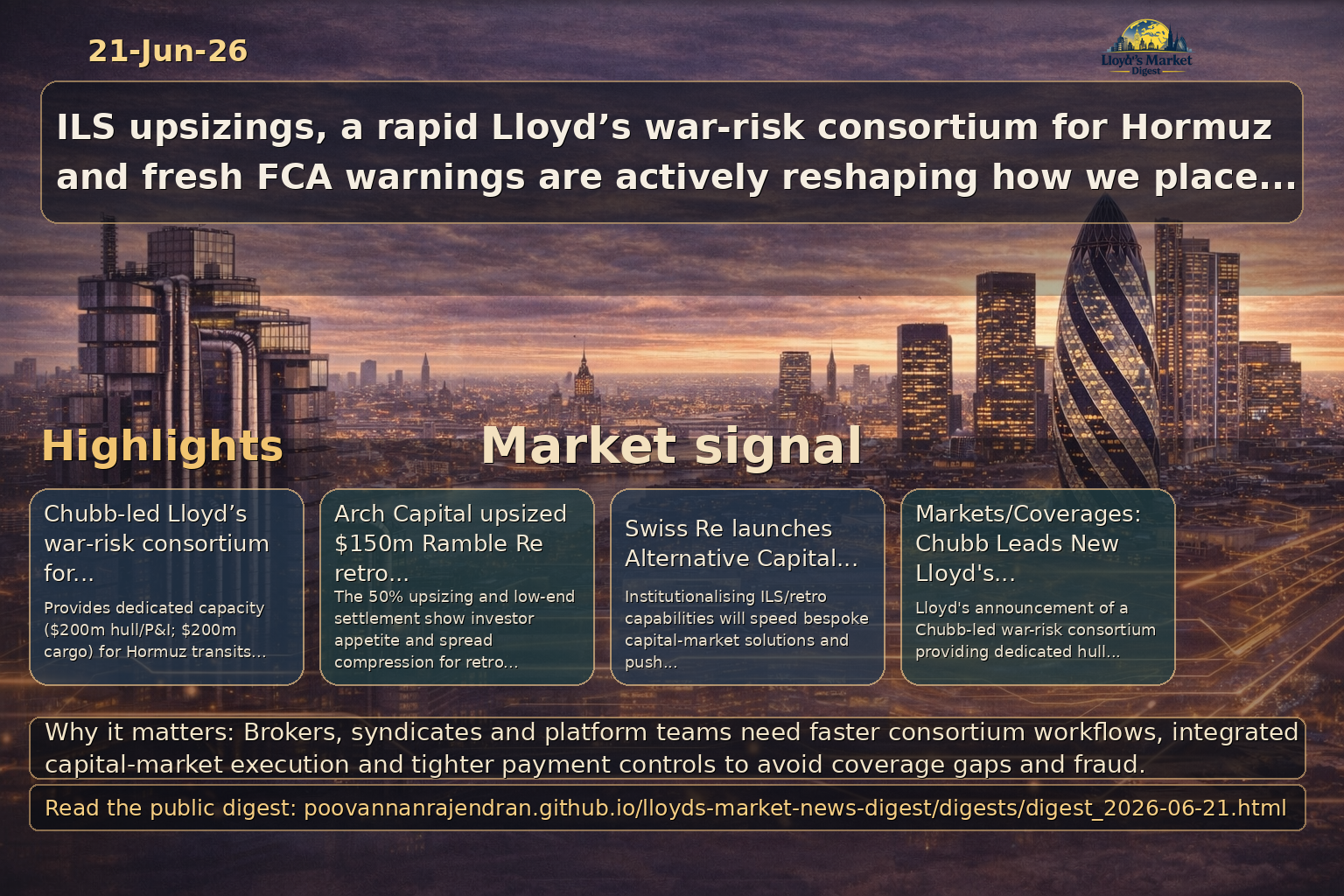
Why it matters: Lloyd's announcement of a Chubb-led war-risk consortium providing dedicated hull, P&I and cargo capacity is a direct market response enabling brokers and clients to place immediate cover for Hormuz transits — a template for rapid consortium mobilisation.
- Capacity signalling: the dedicated $200m hull/P&I and $200m cargo capacity demonstrates Lloyd's ability to aggregate sizable, targeted limits for acute geopolitical exposures.
- Operationalisation: brokers should pre-position submissions and standardised wordings to access the consortium quickly; syndicates must finalise treaty/reinsurance and claims protocols.
- Market precedent: this consortium model can be replicated for other concentrated geopolitical hotspots; placement platforms should support multi-carrier slip placement and streamlined documentation.
Source: reinsurancene.ws
Why it matters: Lloyd's-led Chubb facility providing up to $200m hull/P&I and $200m cargo capacity for Strait of Hormuz transits is a market-level response to acute geopolitical risk — a template for coordinated capacity offerings via syndicates and placement platforms.
- Marine brokers gain a time-sensitive capacity instrument for clients transiting high-risk waters, reducing placement friction and time to bind.
- Syndicates and investors should evaluate participation terms and the reputational/technical underwriting standards required to join such Lloyd's consortia.
- Placement platforms must incorporate the facility's terms, eligibility and binding authorities into their marine war-risk modules to expedite shopper and submission processes.
Source: businessinsurance.com
Why it matters: Regulatory takeover of African Alliance underscores the governance, solvency and compliance risks when placing through local carriers — a key consideration for Lloyd’s syndicates and brokers operating in Africa.
- Syndicates: increase counterparty monitoring and consider contingency reinsurance or alternative fronting arrangements for affected territories.
- Brokers: reassess placement structures, verify local regulator engagement and update client disclosures on jurisdictional risk.
- Placement platforms: enforce jurisdictional KYC/AML and regulatory-alerting rules to prevent automated placements with impacted carriers.
Source: fca.org.uk
Why it matters: Forexobot is an FCA-listed warning for an unauthorised entity operating in FX/financial services. For Lloyd’s and specialty brokers this raises specific exposures around off-platform payment instructions, premium routing in foreign currencies, and potential entry points for fraudsters into placement chains and delegated authorities.
- Immediate: Block onboarding or new transactions involving the entity; instruct front-line teams and placement-platforms to decline interaction until independent authorisation is verified.
- Control: Review and temporarily suspend any direct-to-client or third-party FX payment routing used for premium collection; require bank-confirmed beneficiary details for all cross-border premium flows.
- Remedial: Conduct a targeted review of recent placements where non-authorised FX intermediaries were used; escalate instances to compliance, notify relevant syndicates and consider client notification where funds or PII may be exposed.
Source: fca.org.uk
Why it matters: capital-trustblank.online appears on the FCA warning list as an unauthorised firm. The name and context suggest impersonation of investment/capital services — a vector for fraudulent investment products, fake collateral arrangements or counterfeit reinsurance placements that can mislead brokers and syndicates in specialty lines.
- Immediate: Require written, verifiable proof of FCA authorisation for any counterparty claiming regulated status; do not accept screenshots or unverifiable documents as evidence.
- Control: Strengthen counterparty onboarding for investment-linked counterparties and conduct adverse-media and domain-history checks on web properties used to solicit business.
- Remedial: Trace recent counterparties and placement instructions referencing the domain; quarantine suspicious premium flows, inform Lloyd’s Market Services and the placement platform operators for blocking and watch-listing.
Source: fca.org.uk
Why it matters: PCP Refunds 4U Ltd is flagged by the FCA as unauthorised and appears to target consumer financial products (PCP vehicle finance refunds). For brokers, MGAs and syndicates that underwrite motor, GAP, or consumer-finance related covers, these scams can create downstream fraud, inflated claims activity, or abuse of payment channels used for refunds and premium returns.
- Immediate: Notify retail and distribution partners to reject refund-processing or claims-handling instructions originating from the entity and to validate any refund routing through existing client-authorised bank accounts.
- Control: Audit motor and consumer-product lines for recent claims or refund instructions that involve third-party refund agents; require dual-authorisation for any non-standard refund payments.
- Remedial: Update client-communication templates and compliance training to highlight refund-agent scams; coordinate with brokers, customer-facing teams and placement platforms to ensure suspicious activity is reported and blocked promptly.
Source: businessinsurance.com
Why it matters: Calls for clearer renewal pricing directly affect Lloyd’s syndicates and brokers by increasing regulatory and client expectations for transparent premium justifications, comparators and renewal documentation.
- Brokers: standardise renewal briefing packs that explain drivers (loss experience, exposure changes, model revisions) to preserve client retention.
- Syndicates: implement traceable pricing rationales and versioned rate-change summaries for audits and delegated authority oversight.
- Placement platforms: add renewal-comparison tools and audit trails to show rate movements and underwriting notes to buyers and brokers.
Source: businessinsurance.com
Why it matters: Sompo’s appointment of an international markets underwriting chief signals potential strategic shifts in capacity, appetite and partnership approaches that matter to specialty brokers and Lloyd’s market collaborators.
- Syndicates: review potential competitive and partnership implications; evaluate co-underwriting or quota-share opportunities where Sompo expands appetite.
- Brokers: proactively engage the new underwriting team to clarify product scope, lead limits and appetite for structured placements.
- Placement platforms: monitor changes in published terms and authority matrices; ensure workflow supports new lead-follow relationships.
Source: businessinsurance.com
Why it matters: Resolution of a transponder blackout tied to an Iran deal reduces immediate navigation uncertainty but creates precedent for rapid premium and routing volatility in marine war and political-risk covers.
- Underwriters: reassess war and political-risk exposure models and consider short-term readjustment of premiums and deductibles as activity normalises.
- Brokers: update clients on routing and war clause implications; revise notice and voyage-specific declarations where exposures change rapidly.
- Placement platforms: integrate real-time AIS and geopolitical feeds to flag affected voyages and trigger notification workflows for underwriters and brokers.
Source: businessinsurance.com
Why it matters: The BI Top 10 weekly distills market priorities and is a high-value signal for executives and markets teams to align pricing strategy, product focus and distribution activity across brokers and syndicates.
- C-suite: use the weekly digest to inform agenda items for pricing committees and board-level risk discussions.
- Underwriting teams: track recurring topics (cyber, pricing, geopolitics) to prioritise model updates and capacity allocation.
- Placement platforms: surface Top 10 themes into dashboards and alerting rules so brokers and underwriters receive curated intelligence in their workflow.
Source: insurancejournal.com
Why it matters: Space startups seeking insurance for orbital AI data centers signals a new class of high-value, low-frequency specialty risk that requires bespoke Lloyd's/syndicate capacity, novel wordings and multidisciplinary underwriting expertise.
- Underwriting architecture: develop end-to-end policy modules covering launch/transit, on-orbit hardware damage, debris collision, satellite operations failure and revenue interruption for hosted AI workloads.
- Placement strategy: brokers should assemble multi-syndicate tower capacity and propose parametric triggers or layered programmes to attract debt financing for start-ups.
- Market implications: syndicates and platforms must create standardised data requirements, valuation protocols and reinsurance structures to manage aggregation risk across multiple orbital assets.
Source: insurancejournal.com
Why it matters: Delay in US–Iran talks and escalating Lebanon clashes increase near-term political violence and war risk exposures for vessels, cargo and related supply chains — directly relevant to Lloyd's marine war-risk underwriters and brokers.
- Immediate demand surge: prepare for upticks in voyage-specific war-risk placements and tightened terms/exclusions for transits through Gulf choke points.
- Broker-syndicate coordination: urgent need to align capacity allocation and clause language (PV/K&R/war exclusions) to avoid gaps or inconsistent coverage across programmes.
- Operational controls: placement platforms should enable fast notification workflows, conditional endorsements for route deviations and dynamic premium adjustments tied to geopolitical triggers.
Source: insurancejournal.com
Why it matters: Thinning traffic through the Strait of Hormuz reflects owner caution and route disruption risk, which has direct implications for cargo delay exposures, voyage-based pricing and the structuring of marine war-risk offerings from Lloyd's syndicates.
- Claims profile shift: expect increased cargo delay and contingent business interruption notifications — underwriting teams should reassess transit warranties and delay-trigger definitions.
- Pricing & terms response: underwriters to apply voyage-specific premiums, increased deductibles and stricter casualty/route warranties for affected transits.
- Placement enhancements: platforms and brokers must integrate live AIS/voyage data into submissions and enable near-real-time quoting and endorsement issuance.
Source: insurancejournal.com
Why it matters: Analysis that the Strait of Hormuz will take months to normalise highlights a medium-term period of continued elevated marine risk and transitional market dynamics relevant to syndicate accumulation modelling and rate adequacy.
- Rate cycle management: syndicates should stress-test portfolios for prolonged elevated exposures and avoid premature rate softening while traffic normalises.
- Reinsurance & capital planning: cedents and Lloyd's participants need to recalibrate treaty terms and catastrophe accumulation assumptions for regional hotspot persistence.
- Product flexibility: brokers to propose staged coverage options (temporary premium loadings, voyage-by-voyage issuance, short-term extensions) to manage client liquidity and risk transfer needs.
Source: insurancetimes.co.uk
Why it matters: Verlingue’s apprenticeship push addresses the chronic skills pipeline shortfall affecting brokers, syndicates and platform teams — a strategic priority for sustaining specialty capability at Lloyd’s and in global wholesale distribution.
- Prioritise apprenticeship programmes tied to Lloyd’s technical rotations to accelerate underwriting literacy and broker technical skillsets
- Use apprenticeships as a cost-effective talent pipeline for placement platform operations, claims and delegated authority oversight
- Develop employer-branding and school outreach aligned to specialty career paths to reduce recruitment friction and protect institutional knowledge
Source: insurancetimes.co.uk
Why it matters: Senior appointments at MS Amlin and broker Konsileo signal shifts in risk governance and insurer-broker strategy — changes that will influence capacity appetite, technology investment and placement dynamics across syndicates and panels.
- Expect CIO and CRO hires to accelerate platform modernisation and data-led underwriting, affecting syndicate connectivity requirements
- Broker-side insurer strategy hires indicate consolidation of insurer frameworks and deeper strategic placement relationships
- Syndicates should proactively engage new leadership to reaffirm appetite and streamline submission and delegated-authority integration
Source: insurancetimes.co.uk
Why it matters: The weekly 'top stories' snapshot amplifies which people and commercial moves are driving market attention — useful for executive monitoring of competitor strategy, broker relationships and capacity flows.
- Use such market-tracking to identify emerging broker-insurer alignments and potential shifts in placement volumes
- Monitor appointments at key brokers to anticipate changes in panel priorities and market access for syndicates
- Sequence outreach and relationship reviews around newly appointed executives to secure or renegotiate placement terms
Source: insurancetimes.co.uk
Why it matters: Airmic’s message that risk managers must operate across traditional buckets impacts how underwriters and brokers design covers — encouraging outcome-focused products and multi-class placement strategies relevant to Lloyd’s specialty lines.
- Syndicates should revisit wording flexibility and cross-class capacity to support multi-risk solutions demanded by corporate risk managers
- Brokers must position placement strategies that aggregate and articulate cross-category exposures to underwriters
- Placement platforms should surface multi-peril data and scenario analysis to bridge underwriting gaps and speed decision-making
Source: insurancetimes.co.uk
Why it matters: The LMA’s call for clarity on the US–Iran peace deal directly affects marine, energy, trade-credit and war-exposure underwriting — a near-term trigger for rerating routes, embargo relaxation and re-opening of Gulf transits for Lloyd’s capacity.
- Immediate priority: syndicates and brokers must clarify coverage triggers, voyage terms and premium adjustments for transits through the Strait of Hormuz
- Legal and sanctions teams should validate the mechanics and timing for sanctions removal to avoid inadvertent exposures
- Underwriters and placement platforms should model exposure reallocation and communicate clear guidance to shipowners and brokers to restore transactional certainty
Source: reinsurancene.ws
Why it matters: Historical Reinsurance News archive content provides context on past cat events, underwriting cycles and market responses — useful for syndicate stress-testing, broker client narratives and placement-platform scenario planning.
- Use archived claim and cat-loss narratives to validate current accumulation and retro modelling assumptions for syndicates and reinsurers.
- Brokers should leverage historical precedent when advising clients on coverage limits, sub-limits and catastrophe layering decisions.
- Placement platforms can incorporate archival outcomes into product decision trees and client-facing loss-story materials to support pricing and capacity allocation.
Source: reinsurancene.ws
Why it matters: CRC Group's Insurisk Middle Market Property Program exemplifies platform-led productisation that unlocks significant capacity for non-cat commercial risks — a model Lloyd's syndicates and brokers can emulate or partner with.
- Syndicates should evaluate co-investment or quota-share participation to access scalable middle-market property flows without traditional retail friction.
- Brokers can route appropriate mid-market accounts through the programme to access efficient underwriting and A-rated capacity, improving placement speed and hit rates.
- Placement platforms must ensure systems and appetite rules align to support single-location and small-schedule accounts, enabling automated access to the stated up-to-$50m capacity.
Source: reinsurancene.ws
Why it matters: Triple-I's reported surge in lightning-related homeowners losses highlights a growing peril frequency/severity trend that will influence retail pricing, facultative placement decisions and treaty design across global specialty and Lloyd's portfolios.
- Syndicates need to reassess peril-level exposure modelling and consider tightening terms, sub-limits or endorsements where lightning risk concentration is material.
- Brokers should proactively present mitigation and claims-control narratives to clients and explore revised attachment points or facultative options for high-exposure books.
- Placement platforms and analytics teams must integrate updated lightning claim severity data into pricing engines and loss-cost assumptions.
Source: reinsurancene.ws
Why it matters: Conning's view that investment strategy may become a key differentiator underscores the need for syndicates and capital providers to align asset strategies with underwriting horizons as underwriting tailwinds moderate.
- Syndicate finance and board teams should reassess asset-liability alignment, liquidity buffers and yield optimisation as part of capital allocation frameworks.
- Brokers and MGAs should highlight carriers’ investment resilience and counterparty strength when placing long-tenor or loss-sensitive business.
- Placement platforms can add value by surfacing capacity partners with differentiated investment strategies to sophisticated buyers seeking total-capital stability.
Source: artemis.bm
Why it matters: Arch Capital’s $150m Ramble Re retro cat bond demonstrates large reinsurers are actively sourcing ILS for peak North American retrocession, with upsizing and low-end pricing pointing to favourable market conditions for cedants and pressure on traditional retro pricing and capacity providers.
- 50% upsizing to $150m highlights acute demand for peak-peril retrocession through capital markets.
- Settlement at the low end of guidance signals investor competition and compression of spreads for retro layers.
- Creates a template for brokers to package retro via cat bonds, and for syndicates to reassess appetite where ILS can supplant traditional retro capacity.
Source: artemis.bm
Why it matters: Swiss Re’s establishment of an Alternative Capital Solutions team formalises ILS and retro hedging within a large reinsurer, signalling more coordinated, faster execution of capital-market solutions that will affect broker workflows, platform demand, and the strategic responses of Lloyd’s syndicates.
- A centralised team led by an experienced executive indicates Swiss Re is institutionalising ILS and retro hedging capabilities.
- Expect more bespoke ILS and hedging products as execution and structuring expertise is consolidated.
- Brokers and platforms will need closer collaboration with reinsurers’ internal capital teams; Lloyd’s participants should consider reciprocal capability upgrades.
Source: artemis.bm
Why it matters: Achmea’s upsized Windmill III Re issuance signals demand from European insurers for collateralised windstorm capacity and confirms investor willingness to provide competitive pricing for regional peril coverage — a development brokers and Lloyd’s specialty teams must factor into capacity sourcing and portfolio optimisation.
- One-third upsizing to €100m indicates cedant confidence in accessing capital markets for European windstorm protection.
- Pricing below initial guidance reflects strong investor demand and yields compression for euro windstorm cover.
- Use of Windmill III Re DAC underscores the role of sponsored, collateralised vehicles — brokers should align placement strategies with such structures to optimise execution.
Source: artemis.bm
Why it matters: Mercury’s Luca Re 2026-1 seeing price guidance fall repeatedly indicates strong execution dynamics in wildfire and fire-following-earthquake coverage for California risk — a trend that reduces cost of capital for exposed insurers and affects placement timing for brokers and Lloyd’s specialty underwriters.
- Repeated downward guidance movements demonstrate robust investor demand for US wildfire and earthquake-linked securities.
- Improved pricing lowers hedging costs for primary insurers, potentially encouraging more frequent capital-market transactions.
- Brokers and syndicates should prioritise timing and structure to capture tightened terms, particularly for catastrophe-prone regional exposures.
Source: artemis.bm
Why it matters: Swiss Re targeting $275m via Matterhorn Re 2026-3 for broad North American retrocession reflects significant reinsurer appetite to diversify retro sources through ILS and to use multi-tranche structures to match investor risk preferences — a strategic signal for placement platforms and brokers.
- $275m target for broad NA peak-peril retro shows reinsurers are scaling ILS as a core retro tool.
- Multi-tranche format broadens investor base and improves pricing execution for cedants.
- Increases competitive pressure on traditional retro markets and creates opportunities for brokers to integrate ILS into retro programs.
Source: newsnow.co.uk
Why it matters: Al Jazeera coverage and the surrounding press‑freedom dispute creates direct and indirect exposures for media liability, political risk and reputational loss for insurers and their broker clients operating in contested regions.
- Underwriting: syndicates providing media, AV, and contingent business interruption need to reassess policy wordings (war/terrorism exclusions, editorial risk) and potential claims from coverage of conflict zones.
- Compliance & sanctions: brokers and carriers must validate client activities and correspondent relationships for sanction/authorization risk when underwriting Middle East exposures and Qatar‑based entities.
- Distribution & placement: placement platforms and MGAs should ensure enhanced due diligence and pricing models for media networks and adjust appetite or capacity where reputational contagion could transfer to other lines.
Source: newsnow.co.uk
Why it matters: A failed or empty search result highlights data integrity and signal‑to‑noise issues in news aggregators used for market intelligence and automated risk monitoring across broking and underwriting platforms.
- Operational risk: placement platforms and underwriting tools reliant on third‑party feeds must verify data completeness and fallback processes to avoid blind spots in surveillance of geopolitical and market events.
- Decisioning: brokers and syndicates should implement validation checks and human oversight for automated alerts that trigger capacity or pricing changes.
- Vendor management: procurement and compliance teams must include data quality KPIs in contracts with news and intelligence providers to support accurate exposure monitoring.
Source: newsnow.co.uk
Why it matters: Bolivia political instability and state of emergency reporting has important implications for political violence, supply‑chain disruption in mining (notably lithium) and sovereign/political‑risk exposures relevant to specialty insurers and reinsurers.
- Commodity exposure: syndicates with energy/mining portfolios should reassess BI, physical damage and political‑risk limits tied to lithium and mineral supply chains serving global EV markets.
- Political‑risk products: brokers should revisit term structure and pricing for PRI, war, and non‑honouring of sovereign obligations given heightened protest activity and state interventions.
- Aggregation: placement platforms must flag concentration of Latin America risk and enable syndicates to run correlated‑event stress tests across property, cargo and trade credit lines.
Source: newsnow.co.uk
Why it matters: Economic and political headlines on Bolivia’s economy signpost heightened sovereign and counterparty risks that affect trade credit, political risk and directors & officers exposures for firms operating in the country.
- Sovereign and trade credit: underwriters should reprice or restrict capacity where fiscal stress or emergency measures increase default or non‑payment risk for insureds.
- Corporate governance: D&O and management liability carriers need to monitor regulatory interventions and protest‑driven operational disruptions that could prompt claims against corporate officers.
- Portfolio stress‑testing: brokers and syndicates must incorporate emerging economic scenarios for Latin American portfolios into placement decisions and reinsurance buying.
Source: newsnow.co.uk
Why it matters: Newsflow on the Dominican Republic is a reminder of Caribbean exposures—catastrophe modelling, tourism sector BI and sovereign/regulatory shifts—that specialty markets and brokers continue to manage.
- CAT and parametric solutions: opportunity for Lloyd’s syndicates to expand parametric and micro‑insurance offerings for hurricane, flood and tourism disruption risks in the Caribbean.
- Tourism & BI exposures: brokers should advise hospitality and travel sector clients on broadened coverages and continuity planning given volatility in the region.
- Regional capacity: placement platforms must ensure transparent aggregation reporting to avoid hidden accumulations from multiple carriers across Caribbean exposures.